



Question: Strategic Human Resource Management Subject Topic Strategic Human Resource Management in Action -Developing Hr Strategies -Setting out the Strategy -Conducting a Strateggy Review Discuss How
Strategic Human Resource Management Subject
Topic Strategic Human Resource Management in Action -Developing Hr Strategies -Setting out the Strategy -Conducting a Strateggy Review
Discuss How hr strategies develop and setting out the strategy Illustrate how Strategic Review background is Conducted Explain how hr strategies is implement
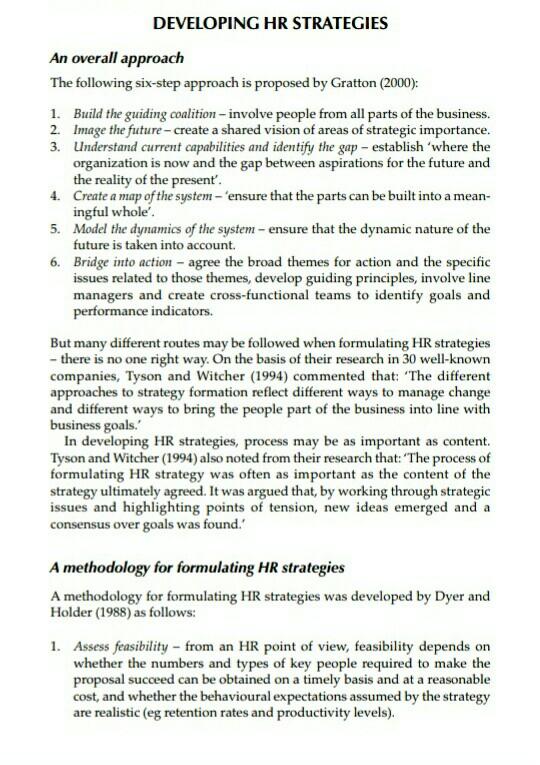
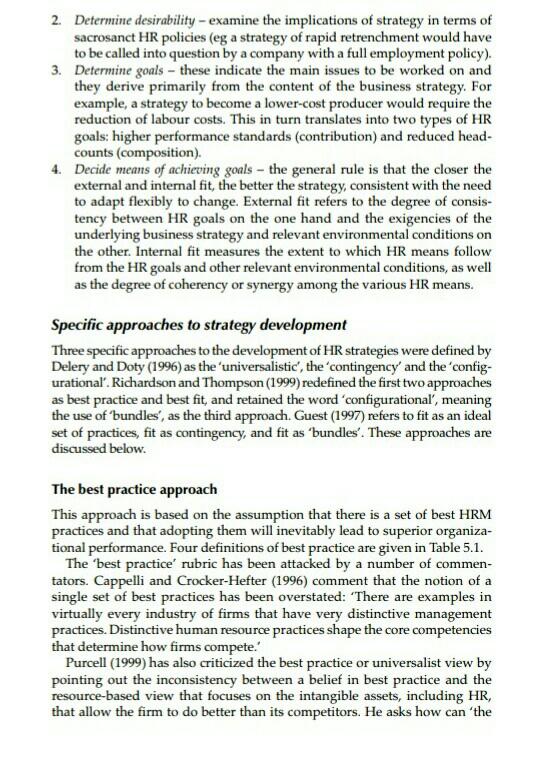
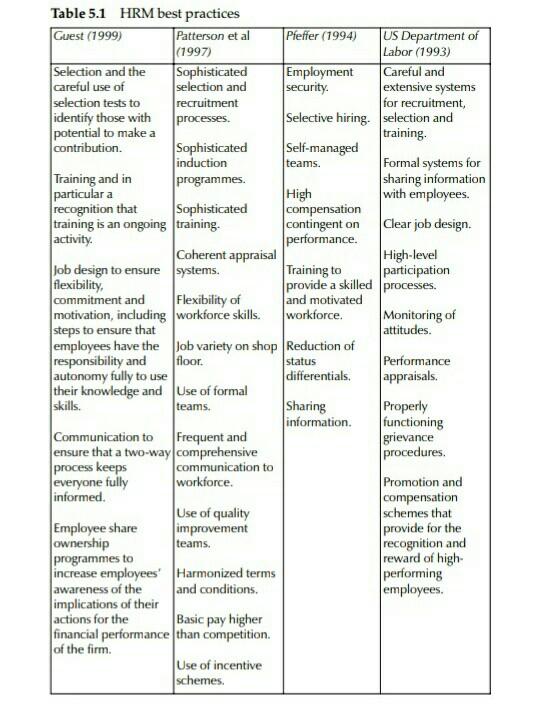
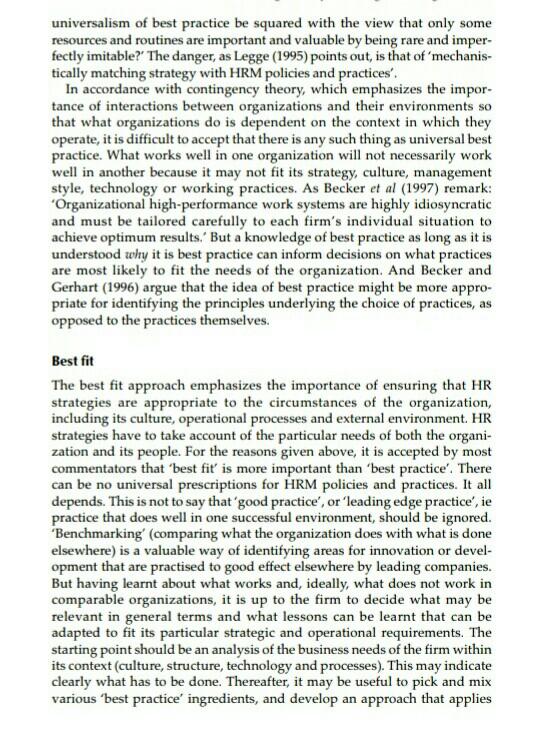
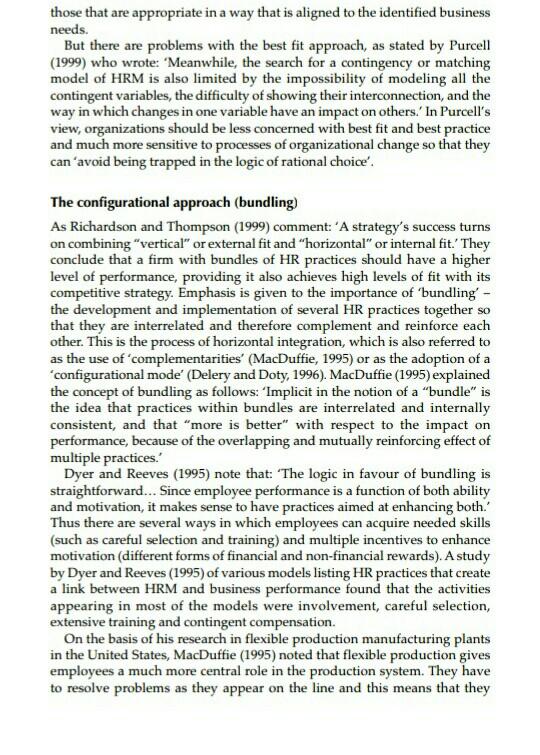
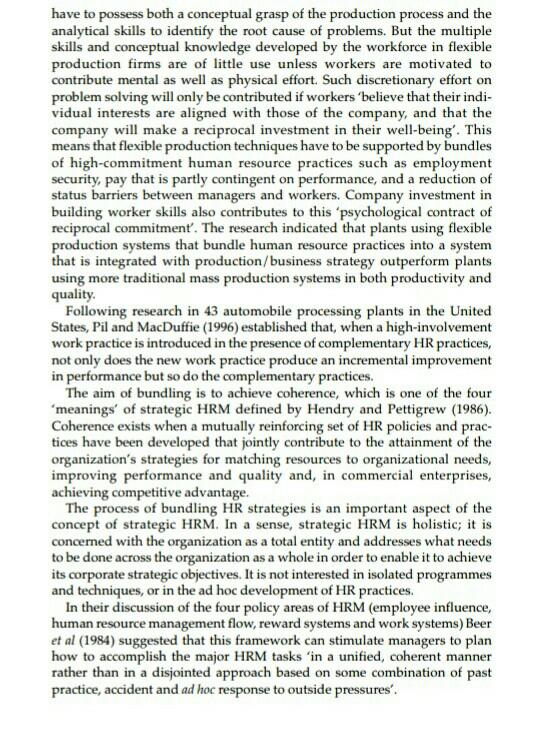
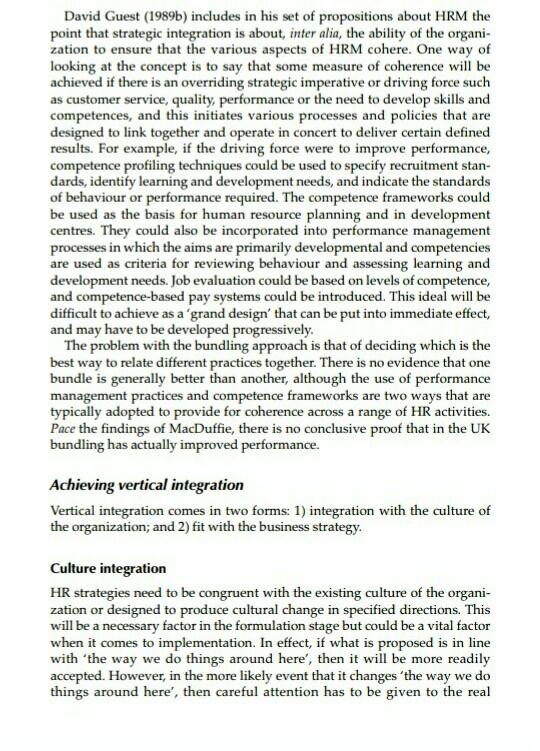
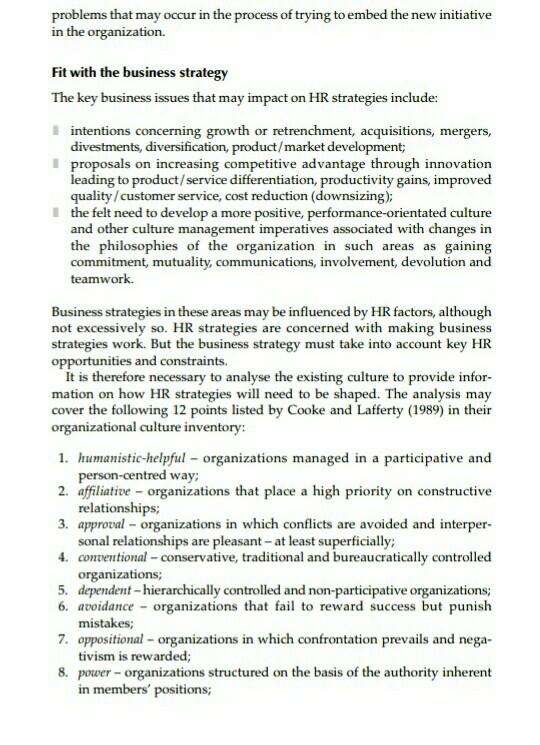
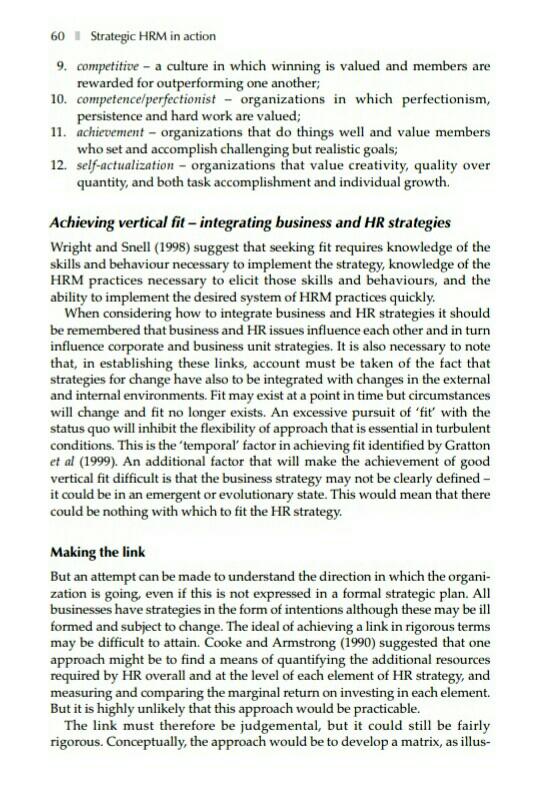
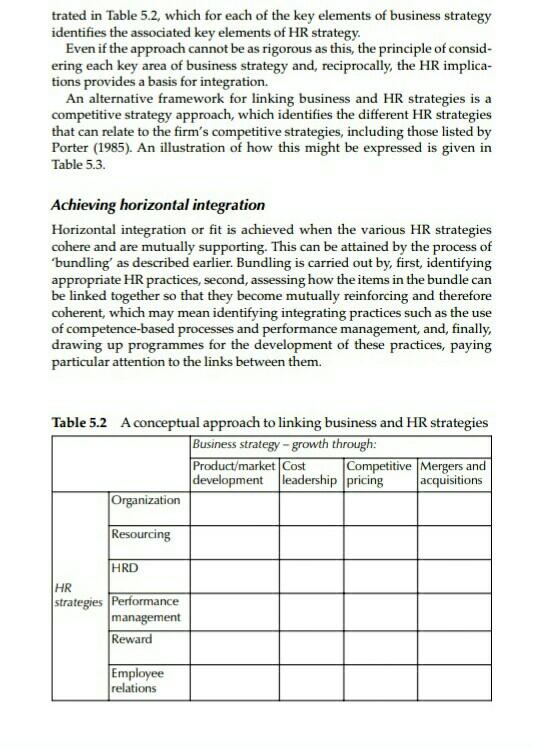
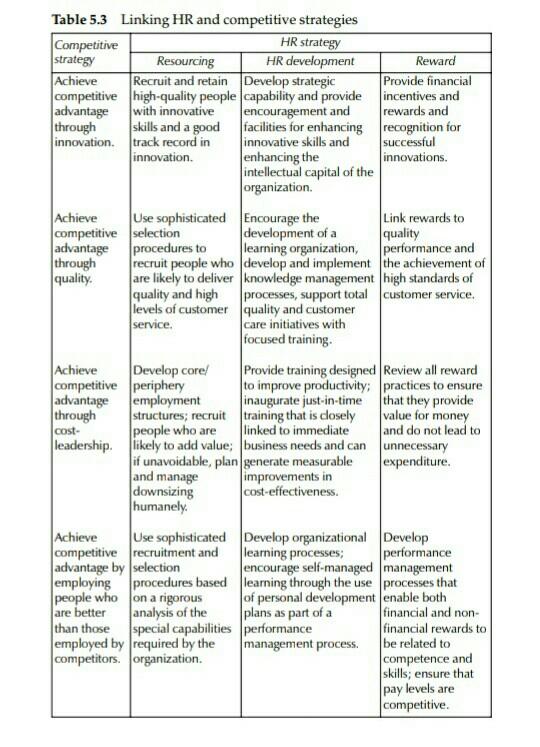
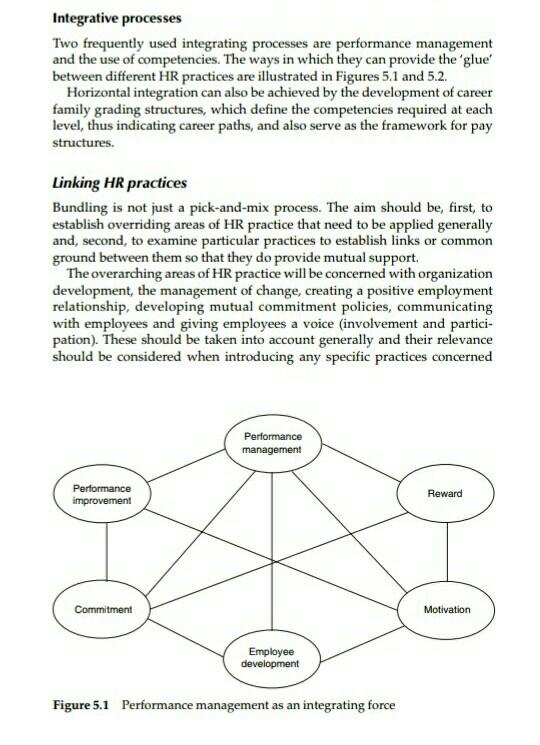
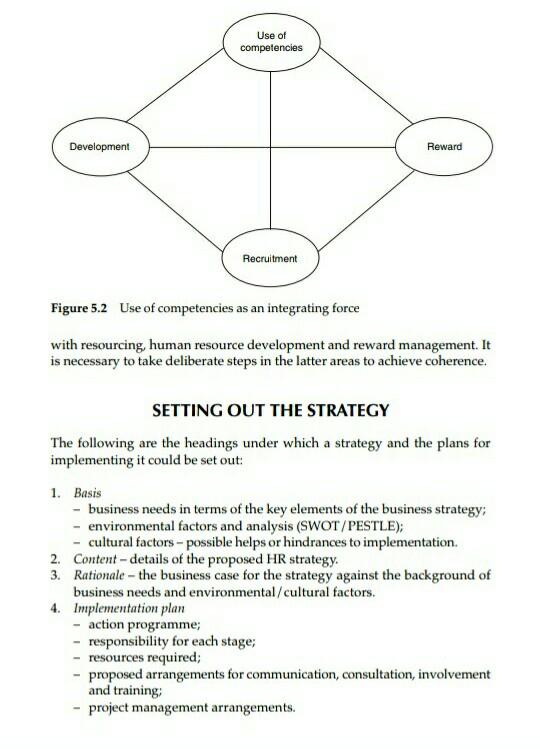
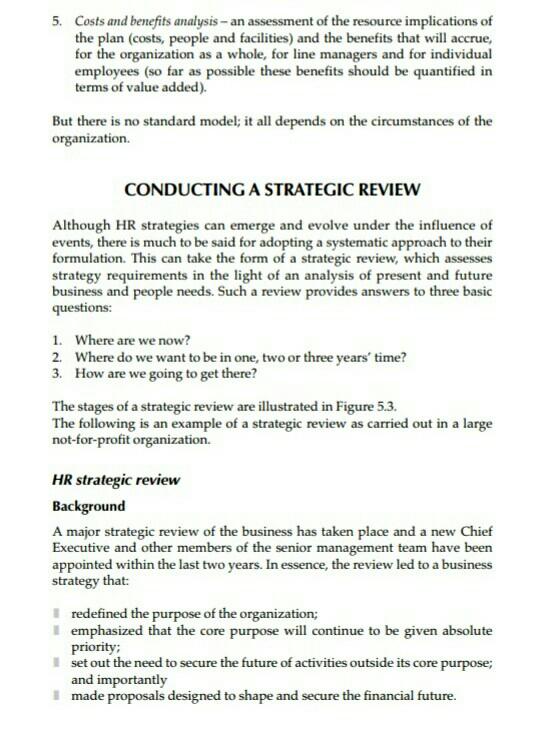
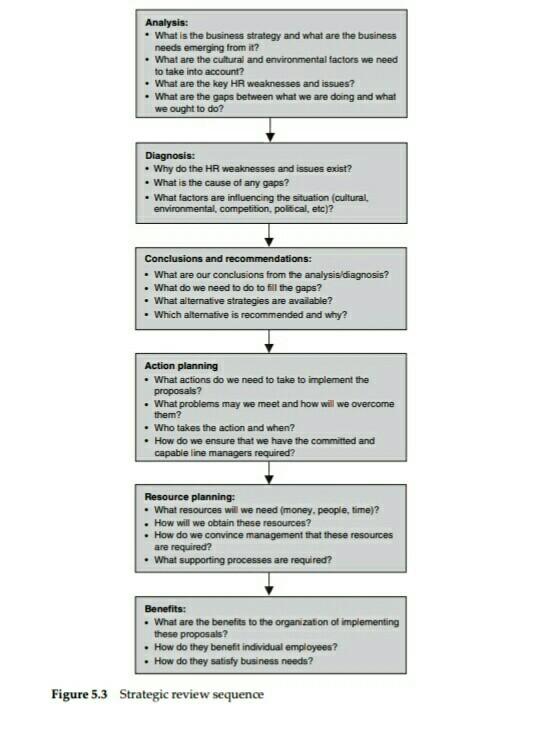
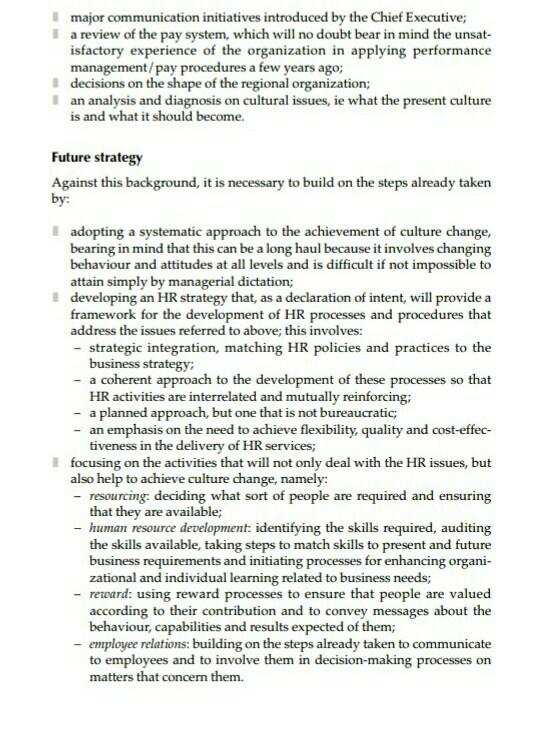
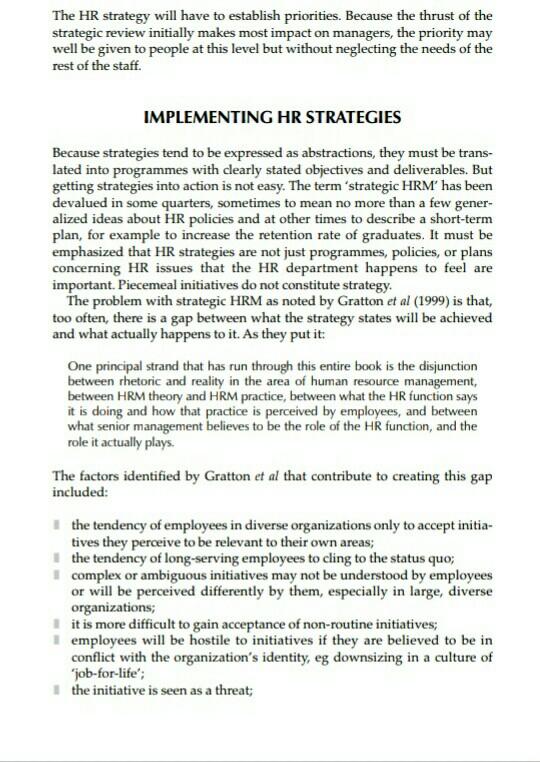
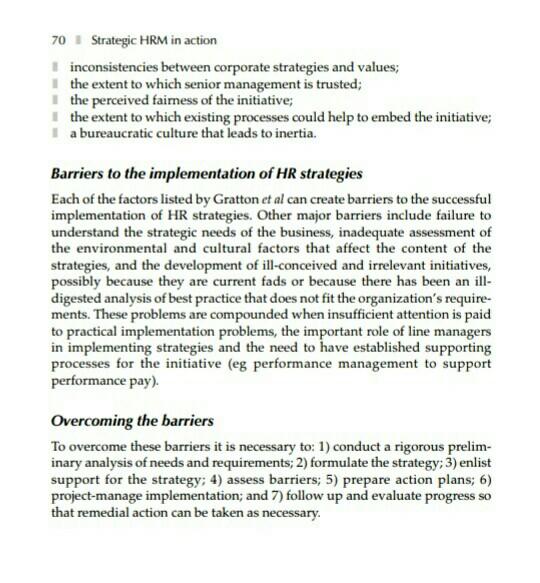
DEVELOPING HR STRATEGIES An overall approach The following six-step approach is proposed by Gratton (2000): 1. Build the guiding coalition - involve people from all parts of the business. 2. Image the future - create a shared vision of areas of strategic importance. 3. Understand current capabilities and identify the gap - establish 'where the organization is now and the gap between aspirations for the future and the reality of the present'. 4. Create a map of the system - ensure that the parts can be built into a mean- ingful whole'. 5. Model the dynamics of the system - ensure that the dynamic nature of the future is taken into account. 6. Bridge into action - agree the broad themes for action and the specific issues related to those themes, develop guiding principles, involve line managers and create cross-functional teams to identify goals and performance indicators. But many different routes may be followed when formulating HR strategies - there is no one right way. On the basis of their research in 30 well-known companies, Tyson and Witcher (1994) commented that: "The different approaches to strategy formation reflect different ways to manage change and different ways to bring the people part of the business into line with business goals.' In developing HR strategies, process may be as important as content. Tyson and Witcher (1994) also noted from their research that: "The process of formulating HR strategy was often as important as the content of the strategy ultimately agreed. It was argued that, by working through strategic issues and highlighting points of tension, new ideas emerged and a consensus over goals was found. A methodology for formulating HR strategies A methodology for formulating HR strategies was developed by Dyer and Holder (1988) as follows: 1. Assess feasibility - from an HR point of view, feasibility depends on whether the numbers and types of key people required to make the proposal succeed can be obtained on a timely basis and at a reasonable cost, and whether the behavioural expectations assumed by the strategy are realistic (eg retention rates and productivity levels). 2. Determine desirability - examine the implications of strategy in terms of sacrosanct HR policies (eg a strategy of rapid retrenchment would have to be called into question by a company with a full employment policy). 3. Determine goals - these indicate the main issues to be worked on and they derive primarily from the content of the business strategy. For example, a strategy to become a lower-cost producer would require the reduction of labour costs. This in turn translates into two types of HR goals: higher performance standards (contribution) and reduced head- counts (composition) 4. Decide means of achieving goals - the general rule is that the closer the external and internal fit, the better the strategy, consistent with the need to adapt flexibly to change. External fit refers to the degree of consis- tency between HR goals on the one hand and the exigencies of the underlying business strategy and relevant environmental conditions on the other. Internal fit measures the extent to which HR means follow from the HR goals and other relevant environmental conditions, as well as the degree of coherency or synergy among the various HR means. Specific approaches to strategy development Three specific approaches to the development of HR strategies were defined by Delery and Doty (1996) as the 'universalistic', the contingency' and the config- urational'. Richardson and Thompson (1999) redefined the first two approaches as best practice and best fit, and retained the word 'configurational', meaning the use of bundles', as the third approach. Guest (1997) refers to fit as an ideal set of practices, fit as contingency, and fit as 'bundles'. These approaches are discussed below. The best practice approach This approach is based on the assumption that there is a set of best HRM practices and that adopting them will inevitably lead to superior organiza- tional performance. Four definitions of best practice are given in Table 5.1. The 'best practice' rubric has been attacked by a number of commen- tators. Cappelli and Crocker-Hefter (1996) comment that the notion of a single set of best practices has been overstated: There are examples in virtually every industry of firms that have very distinctive management practices. Distinctive human resource practices shape the core competencies that determine how firms compete.' Purcell (1999) has also criticized the best practice or universalist view by pointing out the inconsistency between a belief in best practice and the resource-based view that focuses on the intangible assets, including HR, that allow the firm to do better than its competitors. He asks how can 'the Table 5.1 HRM best practices Guest (1999) Patterson et al Pfeffer (1994) US Department of (1997) Labor (1993) Selection and the Sophisticated Employment Careful and careful use of selection and security. extensive systems selection tests to recruitment for recruitment, identify those with processes. Selective hiring selection and potential to make a training contribution Sophisticated Self-managed induction teams. Formal systems for Training and in programmes. sharing information particulara High with employees. recognition that Sophisticated compensation training is an ongoing training. contingent on Clear job design. activity. performance. Coherent appraisal High-level Job design to ensure systems. Training to participation flexibility, provide a skilled processes. commitment and Flexibility of and motivated motivation, including workforce skills. workforce. Monitoring of steps to ensure that attitudes. employees have the Job variety on shop Reduction of responsibility and floor. status Performance autonomy fully to use differentials. appraisals. their knowledge and use of formal skills teams. Sharing Properly information. functioning Communication to Frequent and grievance ensure that a two-way comprehensive procedures. process keeps communication to everyone fully workforce. Promotion and informed. compensation Use of quality schemes that Employee share improvement provide for the ownership teams. recognition and programmes to reward of high increase employees' Harmonized terms performing awareness of the and conditions, employees implications of their actions for the Basic pay higher financial performance than competition. of the firm Use of incentive schemes. universalism of best practice be squared with the view that only some resources and routines are important and valuable by being rare and imper- fectly imitable?' The danger, as Legge (1995) points out, is that of 'mechanis- tically matching strategy with HRM policies and practices'. In accordance with contingency theory, which emphasizes the impor- tance of interactions between organizations and their environments so that what organizations do is dependent on the context in which they operate, it is difficult to accept that there is any such thing as universal best practice. What works well in one organization will not necessarily work well in another because it may not fit its strategy, culture, management style, technology or working practices. As Becker et al (1997) remark: "Organizational high-performance work systems are highly idiosyncratic and must be tailored carefully to each firm's individual situation to achieve optimum results.' But a knowledge of best practice as long as it is understood why it is best practice can inform decisions on what practices are most likely to fit the needs of the organization. And Becker and Gerhart (1996) argue that the idea of best practice might be more appro- priate for identifying the principles underlying the choice of practices, as opposed to the practices themselves. Best fit The best fit approach emphasizes the importance of ensuring that HR strategies are appropriate to the circumstances of the organization, including its culture, operational processes and external environment HR strategies have to take account of the particular needs of both the organi- zation and its people. For the reasons given above, it is accepted by most commentators that 'best fit' is more important than 'best practice'. There can be no universal prescriptions for HRM policies and practices. It all depends. This is not to say that'good practice', or 'leading edge practice', ie practice that does well in one successful environment, should be ignored. "Benchmarking' (comparing what the organization does with what is done elsewhere) is a valuable way of identifying areas for innovation or devel- opment that are practised to good effect elsewhere by leading companies. But having learnt about what works and, ideally, what does not work in comparable organizations, it is up to the firm to decide what may be relevant in general terms and what lessons can be learnt that can be adapted to fit its particular strategic and operational requirements. The starting point should be an analysis of the business needs of the firm within its context (culture, structure, technology and processes). This may indicate clearly what has to be done. Thereafter, it may be useful to pick and mix various 'best practice ingredients, and develop an approach that applies those that are appropriate in a way that is aligned to the identified business needs. But there are problems with the best fit approach, as stated by Purcell (1999) who wrote: 'Meanwhile, the search for a contingency or matching model of HRM is also limited by the impossibility of modeling all the contingent variables, the difficulty of showing their interconnection, and the way in which changes in one variable have an impact on others.' In Purcell's view, organizations should be less concerned with best fit and best practice and much more sensitive to processes of organizational change so that they can'avoid being trapped in the logic of rational choice'. The configurational approach (bundling) As Richardson and Thompson (1999) comment: 'A strategy's success turns on combining "vertical" or external fit and "horizontal" or internal fit. They conclude that a firm with bundles of HR practices should have a higher level of performance, providing it also achieves high levels of fit with its competitive strategy. Emphasis is given to the importance of 'bundling - the development and implementation of several HR practices together so that they are interrelated and therefore complement and reinforce each other. This is the process of horizontal integration, which is also referred to as the use of complementarities' (MacDuffie, 1995) or as the adoption of a configurational mode' (Delery and Doty, 1996). MacDuffie (1995) explained the concept of bundling as follows: 'Implicit in the notion of a "bundle" is the idea that practices within bundles are interrelated and internally consistent, and that "more is better" with respect to the impact on performance, because of the overlapping and mutually reinforcing effect of multiple practices.' Dyer and Reeves (1995) note that: 'The logic in favour of bundling is straightforward... Since employee performance is a function of both ability and motivation, it makes sense to have practices aimed at enhancing both. Thus there are several ways in which employees can acquire needed skills (such as careful selection and training) and multiple incentives to enhance motivation (different forms of financial and non-financial rewards). A study by Dyer and Reeves (1995) of various models listing HR practices that create a link between HRM and business performance found that the activities appearing in most of the models were involvement, careful selection, extensive training and contingent compensation. On the basis of his research in flexible production manufacturing plants in the United States, MacDuffie (1995) noted that flexible production gives employees a much more central role in the production system. They have to resolve problems as they appear on the line and this means that they have to possess both a conceptual grasp of the production process and the analytical skills to identify the root cause of problems. But the multiple skills and conceptual knowledge developed by the workforce in flexible production firms are of little use unless workers are motivated to contribute mental as well as physical effort. Such discretionary effort on problem solving will only be contributed if workers believe that their indi- vidual interests are aligned with those of the company, and that the company will make a reciprocal investment in their well-being. This means that flexible production techniques have to be supported by bundles of high-commitment human resource practices such as employment security, pay that is partly contingent on performance, and a reduction of status barriers between managers and workers. Company investment in building worker skills also contributes to this psychological contract of reciprocal commitment. The research indicated that plants using flexible production systems that bundle human resource practices into a system that is integrated with production/business strategy outperform plants using more traditional mass production systems in both productivity and quality. Following research in 43 automobile processing plants in the United States, Pil and MacDuffie (1996) established that, when a high-involvement work practice is introduced in the presence of complementary HR practices, not only does the new work practice produce an incremental improvement in performance but so do the complementary practices. The aim of bundling is to achieve coherence, which is one of the four 'meanings of strategic HRM defined by Hendry and Pettigrew (1986). Coherence exists when a mutually reinforcing set of HR policies and prac- tices have been developed that jointly contribute to the attainment of the organization's strategies for matching resources to organizational needs, improving performance and quality and, in commercial enterprises, achieving competitive advantage. The process of bundling HR strategies is an important aspect of the concept of strategic HRM. In a sense, strategic HRM is holistic; it is concerned with the organization as a total entity and addresses what needs to be done across the organization as a whole in order to enable it to achieve its corporate strategic objectives. It is not interested in isolated programmes and techniques, or in the ad hoc development of HR practices. In their discussion of the four policy areas of HRM (employee influence, human resource management flow, reward systems and work systems) Beer et al (1984) suggested that this framework can stimulate managers to plan how to accomplish the major HRM tasks 'in a unified, coherent manner rather than in a disjointed approach based on some combination of past practice, accident and ad hoc response to outside pressures'. David Guest (1989b) includes in his set of propositions about HRM the point that strategic integration is about, inter alia, the ability of the organi- zation to ensure that the various aspects of HRM cohere. One way of looking at the concept is to say that some measure of coherence will be achieved if there is an overriding strategic imperative or driving force such as customer service, quality, performance or the need to develop skills and competences, and this initiates various processes and policies that are designed to link together and operate in concert to deliver certain defined results. For example, if the driving force were to improve performance, competence profiling techniques could be used to specify recruitment stan- dards, identify learning and development needs, and indicate the standards of behaviour or performance required. The competence frameworks could be used as the basis for human resource planning and in development centres. They could also be incorporated into performance management processes in which the aims are primarily developmental and competencies are used as criteria for reviewing behaviour and assessing learning and development needs. Job evaluation could be based on levels of competence, and competence-based pay systems could be introduced. This ideal will be difficult to achieve as a 'grand design that can be put into immediate effect, and may have to be developed progressively. The problem with the bundling approach is that of deciding which is the best way to relate different practices together. There is no evidence that one bundle is generally better than another, although the use of performance management practices and competence frameworks are two ways that are typically adopted to provide for coherence across a range of HR activities. Pace the findings of MacDuffie, there is no conclusive proof that in the UK bundling has actually improved performance. Achieving vertical integration Vertical integration comes in two forms: 1) integration with the culture of the organization; and 2) fit with the business strategy. Culture integration HR strategies need to be congruent with the existing culture of the organi- zation or designed to produce cultural change in specified directions. This will be a necessary factor in the formulation stage but could be a vital factor when it comes to implementation. In effect, if what is proposed is in line with 'the way we do things around here', then it will be more readily accepted. However, in the more likely event that it changes the way we do things around here', then careful attention has to be given to the real problems that may occur in the process of trying to embed the new initiative in the organization. Fit with the business strategy The key business issues that may impact on HR strategies include: intentions concerning growth or retrenchment, acquisitions, mergers, divestments, diversification, product/market development; proposals on increasing competitive advantage through innovation leading to product/service differentiation, productivity gains, improved quality/customer service, cost reduction (downsizing); the felt need to develop a more positive, performance-orientated culture and other culture management imperatives associated with changes in the philosophies of the organization in such areas as gaining commitment, mutuality, communications, involvement, devolution and teamwork. Business strategies in these areas may be influenced by HR factors, although not excessively so. HR strategies are concerned with making business strategies work. But the business strategy must take into account key HR opportunities and constraints. It is therefore necessary to analyse the existing culture to provide infor- mation on how HR strategies will need to be shaped. The analysis may cover the following 12 points listed by Cooke and Lafferty (1989) in their organizational culture inventory: 1. humanistic-helpful - organizations managed in a participative and person-centred way; 2. affiliative - organizations that place a high priority on constructive relationships: 3. approval - organizations in which conflicts are avoided and interper- sonal relationships are pleasant - at least superficially; 4. contentional - conservative, traditional and bureaucratically controlled organizations; 5. dependent - hierarchically controlled and non-participative organizations; 6. avoidance - organizations that fail to reward success but punish mistakes; 7. oppositional - organizations in which confrontation prevails and nega- tivism is rewarded; 8. power - organizations structured on the basis of the authority inherent in members' positions; 60 Strategic HRM in action 9. competitive - a culture in which winning is valued and members are rewarded for outperforming one another; 10. competencel perfectionist - organizations in which perfectionism, persistence and hard work are valued; 11. achievement - organizations that do things well and value members who set and accomplish challenging but realistic goals; 12. self-actualization - organizations that value creativity, quality over quantity, and both task accomplishment and individual growth. Achieving vertical fit - integrating business and HR strategies Wright and Snell (1998) suggest that seeking fit requires knowledge of the skills and behaviour necessary to implement the strategy, knowledge of the HRM practices necessary to elicit those skills and behaviours, and the ability to implement the desired system of HRM practices quickly. When considering how to integrate business and HR strategies it should be remembered that business and HR issues influence each other and in turn influence corporate and business unit strategies. It is also necessary to note that, in establishing these links, account must be taken of the fact that strategies for change have also to be integrated with changes in the external and internal environments. Fit may exist at a point in time but circumstances will change and fit no longer exists. An excessive pursuit of 'fit' with the status quo will inhibit the flexibility of approach that is essential in turbulent conditions. This is the temporal factor in achieving fit identified by Gratton et al (1999). An additional factor that will make the achievement of good vertical fit difficult is that the business strategy may not be clearly defined - it could be in an emergent or evolutionary state. This would mean that there could be nothing with which to fit the HR strategy. Making the link But an attempt can be made to understand the direction in which the organi- zation is going, even if this is not expressed in a formal strategic plan. All businesses have strategies in the form of intentions although these may be ill formed and subject to change. The ideal of achieving a link in rigorous terms may be difficult to attain Cooke and Armstrong (1990) suggested that one approach might be to find a means of quantifying the additional resources required by HR overall and at the level of each element of HR strategy, and measuring and comparing the marginal return on investing in each element. But it is highly unlikely that this approach would be practicable. The link must therefore be judgemental, but it could still be fairly rigorous. Conceptually, the approach would be to develop a matrix, as illus- trated in Table 5.2, which for each of the key elements of business strategy identifies the associated key elements of HR strategy. Even if the approach cannot be as rigorous as this, the principle of consid- ering each key area of business strategy and, reciprocally, the HR implica- tions provides a basis for integration. An alternative framework for linking business and HR strategies is a competitive strategy approach, which identifies the different HR strategies that can relate to the firm's competitive strategies, including those listed by Porter (1985). An illustration of how this might be expressed is given in Table 5.3. Achieving horizontal integration Horizontal integration or fit is achieved when the various HR strategies cohere and are mutually supporting. This can be attained by the process of bundling' as described earlier. Bundling is carried out by, first, identifying appropriate HR practices, second, assessing how the items in the bundle can be linked together so that they become mutually reinforcing and therefore coherent, which may mean identifying integrating practices such as the use of competence-based processes and performance management, and finally, drawing up programmes for the development of these practices, paying particular attention to the links between them. Table 5.2 A conceptual approach to linking business and HR strategies Business strategy - growth through: Product/market Cost Competitive Mergers and development leadership pricing acquisitions Organization Resourcing HRD HR strategies Performance management Reward Employee relations Table 5.3 Linking HR and competitive strategies Competitive HR strategy strategy Resourcing HR development Reward Achieve Recruit and retain Develop strategic Provide financial competitive high-quality people capability and provide incentives and advantage with innovative encouragement and rewards and through skills and a good facilities for enhancing recognition for innovation. track record in innovative skills and successful innovation enhancing the innovations. intellectual capital of the organization. Achieve Use sophisticated Encourage the Link rewards to competitive selection development of a quality advantage procedures to learning organization performance and through recruit people who develop and implement the achievement of quality. are likely to deliver knowledge management high standards of quality and high processes, support total customer service. levels of customer quality and customer service. care initiatives with focused training Achieve Develop core/ Provide training designed Review all reward competitive periphery to improve productivity; practices to ensure advantage employment inaugurate just-in-time that they provide through structures; recruit training that is dosely value for money cost people who are linked to immediate and do not lead to leadership. likely to add value; business needs and can unnecessary if unavoidable, plan generate measurable expenditure. and manage improvements in downsizing cost-effectiveness. humanely. Achieve Use sophisticated Develop organizational Develop competitive recruitment and learning processes performance advantage by selection encourage self-managed management employing procedures based learning through the use processes that people who on a rigorous of personal development enable both are better analysis of the plans as part of a financial and non- than those special capabilities performance financial rewards to employed by required by the management process be related to competitors. organization. competence and skills; ensure that pay levels are competitive. Integrative processes Two frequently used integrating processes are performance management and the use of competencies. The ways in which they can provide the 'glue' between different HR practices are illustrated in Figures 5.1 and 5.2. Horizontal integration can also be achieved by the development of career family grading structures, which define the competencies required at each level, thus indicating career paths, and also serve as the framework for pay structures. Linking HR practices Bundling is not just a pick-and-mix process. The aim should be, first, to establish overriding areas of HR practice that need to be applied generally and, second, to examine particular practices to establish links or common ground between them so that they do provide mutual support The overarching areas of HR practice will be concerned with organization development, the management of change, creating a positive employment relationship, developing mutual commitment policies, communicating with employees and giving employees a voice (involvement and partici- pation). These should be taken into account generally and their relevance should be considered when introducing any specific practices concerned Performance management Performance improvement Reward Commitment Motivation Employee development Figure 5.1 Performance management as an integrating force Use of competencies Development Reward Reward Recruitment Figure 5.2 Use of competencies as an integrating force with resourcing, human resource development and reward management. It is necessary to take deliberate steps in the latter areas to achieve coherence. SETTING OUT THE STRATEGY The following are the headings under which a strategy and the plans for implementing it could be set out: 1. Basis - business needs in terms of the key elements of the business strategy; - environmental factors and analysis (SWOT/PESTLE); - cultural factors - possible helps or hindrances to implementation. 2. Content - details of the proposed HR strategy. 3. Rationale - the business case for the strategy against the background of business needs and environmental/cultural factors. 4. Implementation plan - action programme; - responsibility for each stage; resources required; proposed arrangements for communication, consultation, involvement and training: - project management arrangements. 5. Costs and benefits analysis - an assessment of the resource implications of the plan (costs, people and facilities) and the benefits that will accrue, for the organization as a whole, for line managers and for individual employees (so far as possible these benefits should be quantified in terms of value added) But there is no standard model; it all depends on the circumstances of the organization CONDUCTING A STRATEGIC REVIEW Although HR strategies can emerge and evolve under the influence of events, there is much to be said for adopting a systematic approach to their formulation. This can take the form of a strategic review, which assesses strategy requirements in the light of an analysis of present and future business and people needs. Such a review provides answers to three basic questions: 1. Where are we now? 2. Where do we want to be in one, two or three years' time? 3. How are we going to get there? The stages of a strategic review are illustrated in Figure 5.3. The following is an example of a strategic review as carried out in a large not-for-profit organization. HR strategic review Background A major strategic review of the business has taken place and a new Chief Executive and other members of the senior management team have been appointed within the last two years. In essence, the review led to a business strategy that: redefined the purpose of the organization; emphasized that the core purpose will continue to be given absolute priority; set out the need to secure the future of activities outside its core purpose; and importantly made proposals designed to shape and secure the financial future. Analysis: . What is the business strategy and what are the business needs emerging from it? What are the cultural and environmental factors we need to take into account? What are the key HR weaknesses and issues? What are the gaps between what we are doing and what we ought to do? Diagnosis: Why do the HR weaknesses and issues exist? What is the cause of any gaps? What factors are influencing the situation (Cultural environmental competition, political, etc)? Conclusions and recommendations: What are our conclusions from the analysis diagnosis? What do we need to do to fill the gaps? What alternative strategies are available? Which alternative is recommended and why? Action planning What actions do we need to take to implement the proposals? What problems may we meet and how will we overcome them? Who takes the action and when? How do we ensure that we have the committed and capabile fine managers required? Resource planning: What resources will we need (money, people, time)? How will we obtain these resources ? How do we convince management that these resources are required? What supporting processes are required? Benefits: these proposals? What are the benefits to the organization of implementing How do they benefit individual employees? How do they satisty business needs? Figure 5.3 Strategic review sequence HR issues emerging from the strategic review The key HR issues emerging from the strategic review are that: it will lead to the transformation of the organization; this involves major cultural changes, for example: - some change in the focus to activities other than the core activity: a move away from a paternalistic, command-and-control organization; - introducing processes that enable the organization to operate more flexibly; - clarifying expectations but simultaneously gaining commitment to managing and carrying out activities on the basis of increased self- regulation and decision making at an operational level rather than pressures or instructions from above; more emphasis on managerial as distinct from technical skills for managers; - greater concentration on the financial requirement to balance income and expenditure while continuing to develop and improve service delivery: a significant change in the regional organization and the roles of the management team and regional controllers/ managers is taking place; this means that new skills will have to be used that some existing managers may not possess; from a human resource planning viewpoint, decisions will have to be made on the capabilities required in the future at managerial and other levels, and these may involve establishing policies for recruiting new managerial talent from outside the organization rather than relying on promotion from within; difficult decisions may have to be made on retaining some existing managers in their posts who lack the required skills, and there may be a requirement to reduce staff numbers in the future; more positively, management development and career planning activ- ities will need to be introduced that reflect the changing culture and structure of the organization and the different roles managers and others will be expected to play. The provision of the core HR services such as recruitment and training is not an issue. Steps to address the issues Steps have already been taken to address these issues, for example: major communication initiatives introduced by the Chief Executive; a review of the pay system, which will no doubt bear in mind the unsat- isfactory experience of the organization in applying performance management/pay procedures a few years ago; decisions on the shape of the regional organization; an analysis and diagnosis on cultural issues, ie what the present culture is and what it should become. Future strategy Against this background, it is necessary to build on the steps already taken by: adopting a systematic approach to the achievement of culture change, bearing in mind that this can be a long haul because it involves changing behaviour and attitudes at all levels and is difficult if not impossible to attain simply by managerial dictation; developing an HR strategy that, as a declaration of intent, will provide a framework for the development of HR processes and procedures that address the issues referred to above; this involves: - strategic integration, matching HR policies and practices to the business strategy - a coherent approach to the development of these processes so that HR activities are interrelated and mutually reinforcing, - a planned approach, but one that is not bureaucratic, an emphasis on the need to achieve flexibility, quality and cost-effec- tiveness in the delivery of HR services; focusing on the activities that will not only deal with the HR issues, but also help to achieve culture change, namely: - resourcing: deciding what sort of people are required and ensuring that they are available; - human resource development identifying the skills required, auditing the skills available, taking steps to match skills to present and future business requirements and initiating processes for enhancing organi- zational and individual learning related to business needs; - reward: using reward processes to ensure that people are valued according to their contribution and to convey messages about the behaviour, capabilities and results expected of them; - employee relations: building on the steps already taken to communicate to employees and to involve them in decision-making processes on matters that concern them. The HR strategy will have to establish priorities. Because the thrust of the strategic review initially makes most impact on managers, the priority may well be given to people at this level but without neglecting the needs of the rest of the staff. IMPLEMENTING HR STRATEGIES Because strategies tend to be expressed as abstractions, they must be trans- lated into programmes with clearly stated objectives and deliverables. But getting strategies into action is not easy. The term 'strategic HRM' has been devalued in some quarters, sometimes to mean no more than a few gener- alized ideas about HR policies and at other times to describe a short-term plan, for example to increase the retention rate of graduates. It must be emphasized that HR strategies are not just programmes, policies, or plans concerning HR issues that the HR department happens to feel are important. Piecemeal initiatives do not constitute strategy. The problem with strategic HRM as noted by Gratton et al (1999) is that, too often, there is a gap between what the strategy states will be achieved and what actually happens to it. As they put it: One principal strand that has run through this entire book is the disjunction between rhetoric and reality in the area of human resource management, between HRM theory and HRM practice, between what the HR function says it is doing and how that practice is perceived by employees, and between what senior management believes to be the role of the HR function, and the role it actually plays The factors identified by Gratton et al that contribute to creating this gap included: the tendency of employees in diverse organizations only to accept initia- tives they perceive to be relevant to their own areas; the tendency of long-serving employees to cling to the status quo; complex or ambiguous initiatives may not be understood by employees or will be perceived differently by them, especially in large diverse organizations; it is more difficult to gain acceptance of non-routine initiatives; 1 employees will be hostile to initiatives if they are believed to be in conflict with the organization's identity, eg downsizing in a culture of job-for-life'; the initiative is seen as a threat; 70 Strategic HRM in action 1 inconsistencies between corporate strategies and values; the extent to which senior management is trusted; the perceived fairness of the initiative; the extent to which existing processes could help to embed the initiative; a bureaucratic culture that leads to inertia. Barriers to the implementation of HR strategies Each of the factors listed by Gratton et al can create barriers to the successful implementation of HR strategies. Other major barriers include failure to understand the strategic needs of the business, inadequate assessment of the environmental and cultural factors that affect the content of the strategies, and the development of ill-conceived and irrelevant initiatives, possibly because they are current fads or because there has been an ill- digested analysis of best practice that does not fit the organization's require- ments. These problems are compounded when insufficient attention is paid to practical implementation problems, the important role of line managers in implementing strategies and the need to have established supporting processes for the initiative (eg performance management to support performance pay). Overcoming the barriers To overcome these barriers it is necessary to: 1) conduct a rigorous prelim- inary analysis of needs and requirements; 2) formulate the strategy; 3) enlist support for the strategy; 4) assess barriers; 5) prepare action plans; 6) project-manage implementation; and 7) follow up and evaluate progress so that remedial action can be taken as necessary
Step by Step Solution
There are 3 Steps involved in it
1 Expert Approved Answer
Step: 1 Unlock

Question Has Been Solved by an Expert!
Get step-by-step solutions from verified subject matter experts
Step: 2 Unlock
Step: 3 Unlock