







Question: SUBJECT NAME : AIRPORT MANAGEMENT 30 MARKS LONG ANSWER CASE STUDY The core function of Airport Operations has been, and remains, to operate the airport

SUBJECT NAME : AIRPORT MANAGEMENT
30 MARKS LONG ANSWER
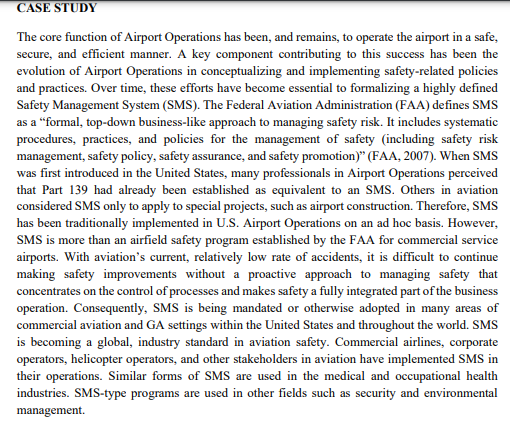
CASE STUDY The core function of Airport Operations has been, and remains, to operate the airport in a safe, secure, and efficient manner. A key component contributing to this success has been the evolution of Airport Operations in conceptualizing and implementing safety-related policies and practices. Over time, these efforts have become essential to formalizing a highly defined Safety Management System (SMS). The Federal Aviation Administration (FAA) defines SMS as a formal, top-down business-like approach to managing safety risk. It includes systematic procedures, practices, and policies for the management of safety (including safety risk management, safety policy, safety assurance, and safety promotion)" (FAA, 2007). When SMS was first introduced in the United States, many professionals in Airport Operations perceived that Part 139 had already been established as equivalent to an SMS. Others in aviation considered SMS only to apply to special projects, such as airport construction. Therefore, SMS has been traditionally implemented in U.S. Airport Operations on an ad hoc basis. However, SMS is more than an airfield safety program established by the FAA for commercial service airports. With aviation's current, relatively low rate of accidents, it is difficult to continue making safety improvements without a proactive approach to managing safety that concentrates on the control of processes and makes safety a fully integrated part of the business operation. Consequently, SMS is being mandated or otherwise adopted in many areas of commercial aviation and GA settings within the United States and throughout the world. SMS is becoming a global, industry standard in aviation safety. Commercial airlines, corporate operators, helicopter operators, and other stakeholders in aviation have implemented SMS in their operations. Similar forms of SMS are used in the medical and occupational health industries. SMS-type programs are used in other fields such as security and environmental management. Q2. Explain FIVE (5) benefits of Safety Management System (SMS) in order to implement the rules in the airports. (30 marks)Step by Step Solution
There are 3 Steps involved in it
1 Expert Approved Answer
Step: 1 Unlock

Question Has Been Solved by an Expert!
Get step-by-step solutions from verified subject matter experts
Step: 2 Unlock
Step: 3 Unlock
 Study Help