







Question: Thank you for your time and help! Please help me finish the table and please show work so I can understand! No rush! Thank you
Thank you for your time and help! Please help me finish the table and please show work so I can understand! No rush! Thank you again! I also posted all the references I have.
![[transmission] diffraction grating is a thin film of clear glass or plastic](https://dsd5zvtm8ll6.cloudfront.net/si.experts.images/questions/2024/09/66f6af68e0b41_79266f6af68c4f0c.jpg)
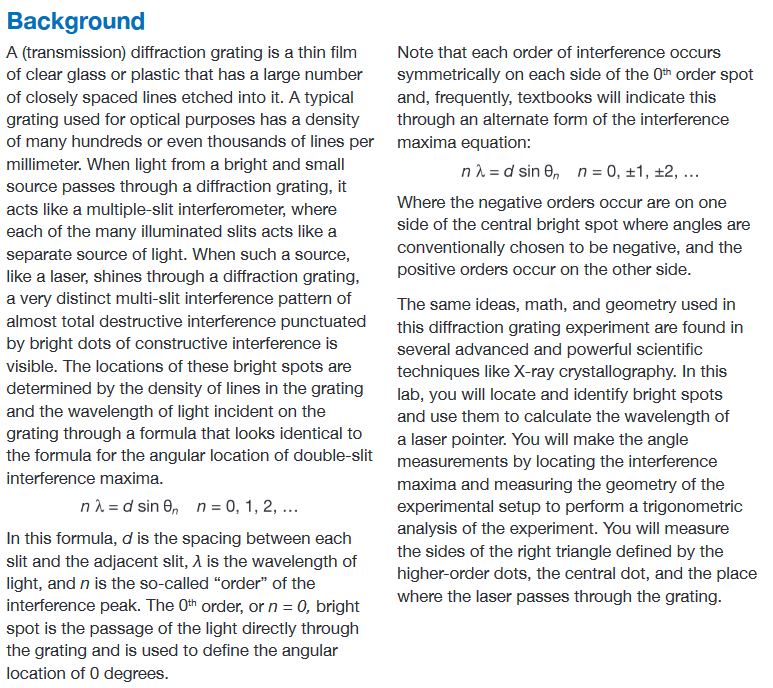
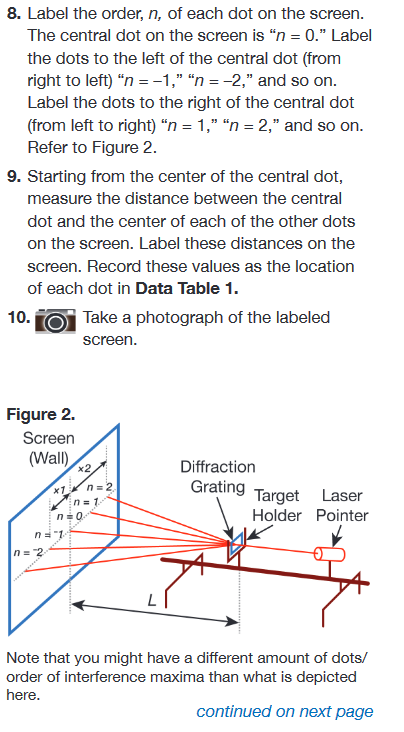
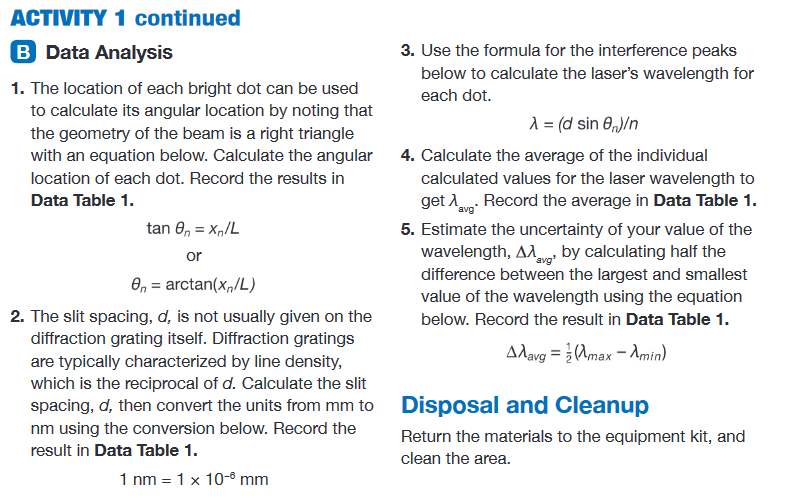
Background A [transmission] diffraction grating is a thin film of clear glass or plastic that has a large number of closely spaced lines etched into it. A typical grating used for optical purposes has a density of many hundreds or even thousands of lines per millimeter. 1When light from a bright and small source passes through a diffraction grating, it acts like a multipleslit interferometer, where each of the many illuminated slits acts like a separate source of light. When such a source, like a laser, shines through a diffraction grating, a very distinct multislit interference pattern of almost total desthctive interference punctuated by bright dots of constmctive interference is visible. The locations of these bright spots are determined by the density of lines in the grating and the wavelength of light incident on the grating through a formula that looks identical to the formula for the angular location of doubleslit interference maxima. l'ti1.=dsinf:ln n=i,1,2, In this fomtula, d is the spacing between each slit and the adjacent slit, A is the wavelength of light, and n is the socalled \"order" of the interference peak. The 0*\" order, or n = D, bright spot is the passage of the light directly through the grating and is used to define the angular location of D degrees. Note that each order of interference occurs symmetrically on each side of the ill\" order spot and, frequently, textbooks will indicate this through an alternate form of the interference maxima equation: nil.=dsinf:ln n=.:l:1,:|:2, Where the negative orders occur are on one side of the central bright spot where angles are conventionally chosen to be negative, and the positive orders occur on the other side. The same ideas, math, and geometry used in this diffraction grating experiment are found in several advanced and powerful scientific techniques like Xray crystallography. In this lab, you will locate and identifyr bright spots and use them to calculate the wavelength of a laser pointer. You will make the angle measurements by locating the interference maxima and measuring the geometry of the experimental setup to perform a trigonometric analysis of the experiment. You will measure the sides of the right triangle defined by the higherorder dots, the central dot, and the place where the laser passes through the grating. 8. Label the order, n, of each dot on the screen. The central dot on the screen is "n = 0." Label the dots to the left of the central dot (from right to left) "n = -1," "n = -2," and so on. Label the dots to the right of the central dot (from left to right) "n = 1," "n = 2," and so on. Refer to Figure 2. 9. Starting from the center of the central dot, measure the distance between the central dot and the center of each of the other dots on the screen. Label these distances on the screen. Record these values as the location of each dot in Data Table 1. 10. O Take a photograph of the labeled screen. Figure 2. Screen (Wall) *2 Diffraction n =2 Grating Target Laser Holder Pointer n = 2 Note that you might have a different amount of dots/ order of interference maxima than what is depicted here. continued on next pageACTIVITY 1 continued Data Analysis 3. Use the formula for the interference peaks below to calculate the laser's wavelength for 1. The location of each bright dot can be used each dot. to calculate its angular location by noting that the geometry of the beam is a right triangle A = (d sin 0,) with an equation below. Calculate the angular 4. Calculate the average of the individual location of each dot. Record the results in calculated values for the laser wavelength to Data Table 1. get 1 . Record the average in Data Table 1. tan On = Xn/L 5. Estimate the uncertainty of your value of the or wavelength, A1 , by calculating half the On = arctan(X,/L) difference between the largest and smallest value of the wavelength using the equation 2. The slit spacing, d, is not usually given on the below. Record the result in Data Table 1. diffraction grating itself. Diffraction gratings are typically characterized by line density, Alavg = (1max - Amin) which is the reciprocal of d. Calculate the slit spacing, d, then convert the units from mm to Disposal and Cleanup nm using the conversion below. Record the Return the materials to the equipment kit, and result in Data Table 1. clean the area. 1 nm = 1 x 10⁻⁵ mmActivity 1 Data Table 1 d (nm) = 1000000 nm L = 310 mm Order, n Location (mm) Angular location * (nm) (degrees) +2 250 mm + 1 120 mm 0 0.0 -1 134 mm 278 mm Alava
Step by Step Solution
There are 3 Steps involved in it

Get step-by-step solutions from verified subject matter experts
 Study Help