







Question: The truss should be 3 0 c m in length in length and no more than 2 0 c m in height. You are required
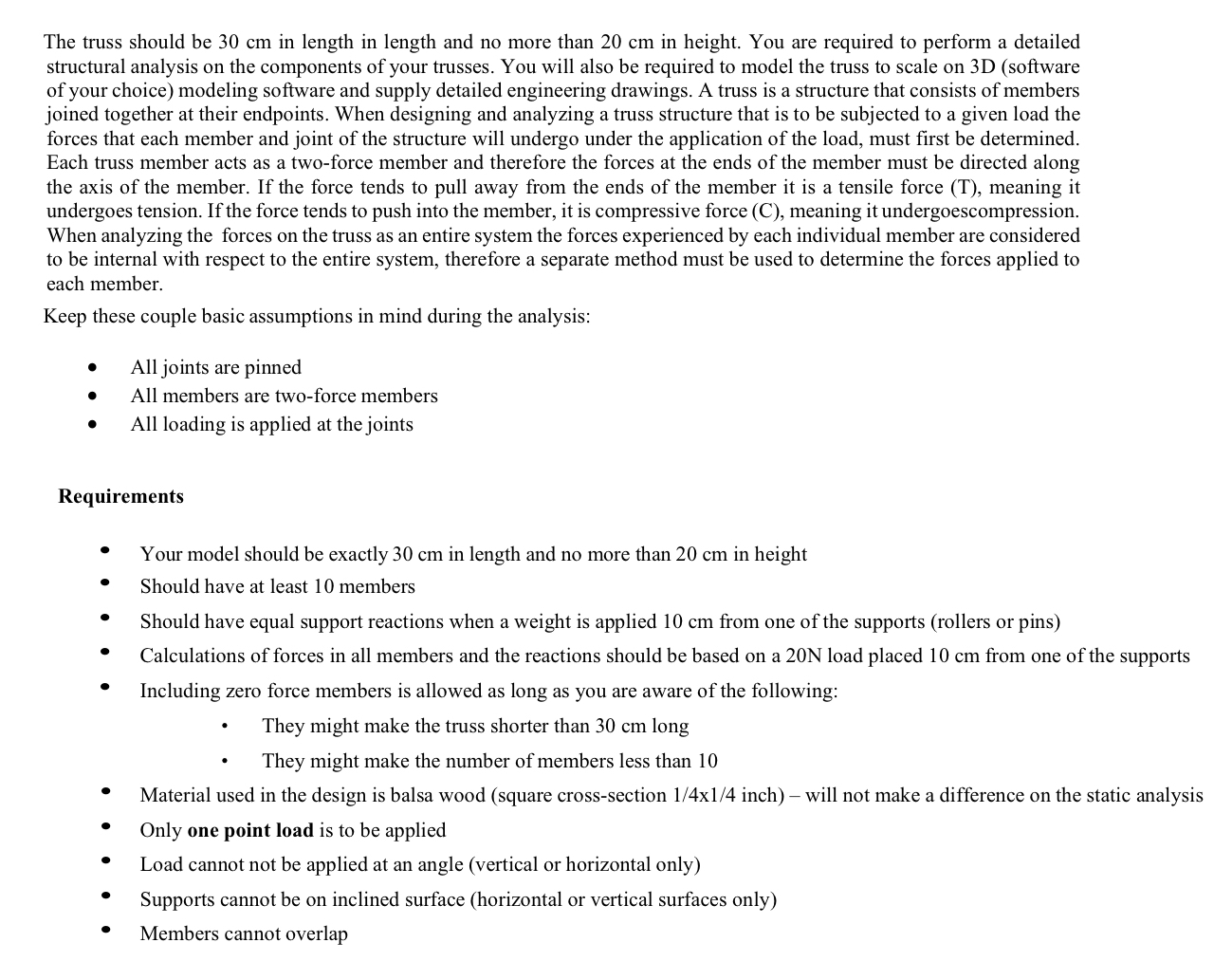
The truss should be in length in length and no more than in height. You are required to perform a detailed structural analysis on the components of your trusses. You will also be required to model the truss to scale on D software of your choice modeling software and supply detailed engineering drawings. A truss is a structure that consists of members joined together at their endpoints. When designing and analyzing a truss structure that is to be subjected to a given load the forces that each member and joint of the structure will undergo under the application of the load, must first be determined. Each truss member acts as a twoforce member and therefore the forces at the ends of the member must be directed along the axis of the member. If the force tends to pull away from the ends of the member it is a tensile force T meaning it undergoes tension. If the force tends to push into the member, it is compressive force meaning it undergoescompression. When analyzing the forces on the truss as an entire system the forces experienced by each individual member are considered to be internal with respect to the entire system, therefore a separate method must be used to determine the forces applied to each member.
Keep these couple basic assumptions in mind during the analysis:
All joints are pinned
All members are twoforce members
All loading is applied at the joints
Requirements
Your model should be exactly in length and no more than in height
Should have at least members
Should have equal support reactions when a weight is applied from one of the supports rollers or pins
Calculations of forces in all members and the reactions should be based on a load placed from one of the supports
Including zero force members is allowed as long as you are aware of the following:
They might make the truss shorter than long
They might make the number of members less than
Material used in the design is balsa wood square crosssection inch will not make a difference on the static analysis
Only one point load is to be applied
Load cannot not be applied at an angle vertical or horizontal only
Supports cannot be on inclined surface horizontal or vertical surfaces only
Members cannot overlap
Step by Step Solution
There are 3 Steps involved in it
1 Expert Approved Answer
Step: 1 Unlock

Question Has Been Solved by an Expert!
Get step-by-step solutions from verified subject matter experts
Step: 2 Unlock
Step: 3 Unlock
 Study Help