







Question: There is hardly anyone who does not know about Cricket. While it's a great fun to watch cricket, technological advancements have augmented the passion.
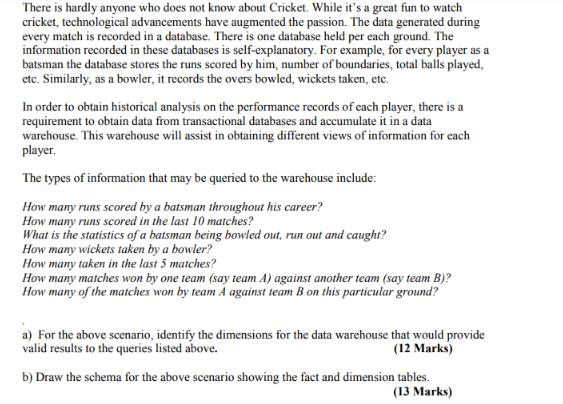
There is hardly anyone who does not know about Cricket. While it's a great fun to watch cricket, technological advancements have augmented the passion. The data generated during every match is recorded in a database. There is one database held per each ground. The information recorded in these databases is self-explanatory. For example, for every player as a batsman the database stores the runs scored by him, number of boundaries, total balls played, etc. Similarly, as a bowler, it records the overs bowled, wickets taken, etc. In order to obtain historical analysis on the performance records of each player, there is a requirement to obtain data from transactional databases and accumulate it in a data warehouse. This warehouse will assist in obtaining different views of information for each player. The types of information that may be queried to the warehouse include: How many runs scored by a batsman throughout his career? How many runs scored in the last 10 matches? What is the statistics of a batsman being bowled out, run out and caught? How many wickets taken by a bowler? How many taken in the last 5 matches? How many matches won by one team (say team A) against another team (say team B)? How many of the matches won by team A against team B on this particular ground? a) For the above scenario, identify the dimensions for the data warehouse that would provide valid results to the queries listed above. (12 Marks) b) Draw the schema for the above scenario showing the fact and dimension tables. (13 Marks)
Step by Step Solution
There are 3 Steps involved in it

Get step-by-step solutions from verified subject matter experts
 Study Help