







Question: Thermochemistry - Show all work/steps please! Thermochemistry - Show all steps 1. A 0.692 g sample of glucose, CoH12Oo is oxidized (burned) in a calorimeter.
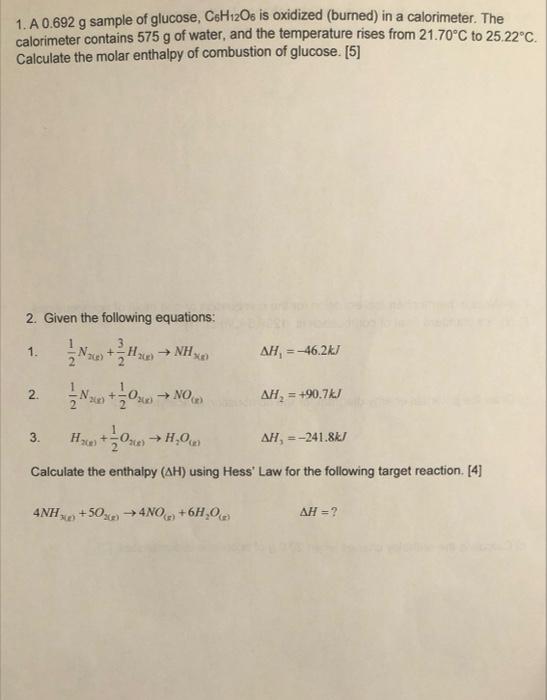
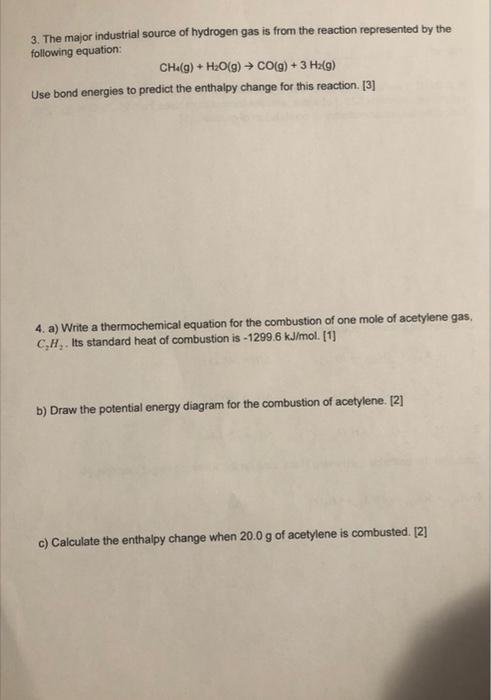
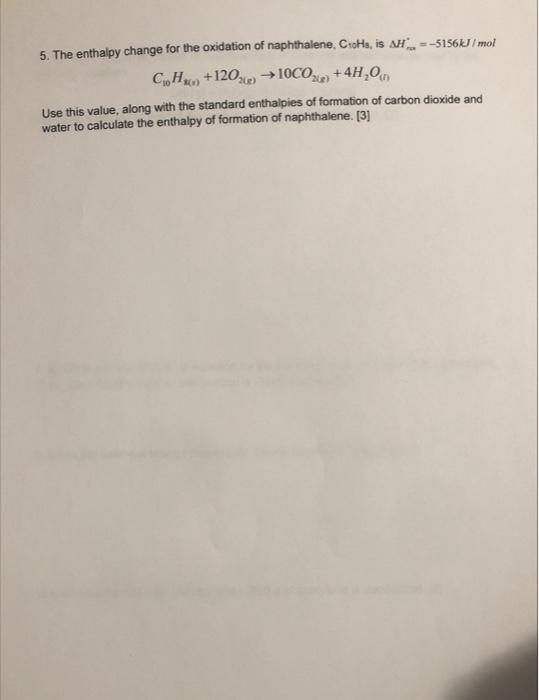
1. A 0.692 g sample of glucose, CoH12Oo is oxidized (burned) in a calorimeter. The calorimeter contains 575 g of water, and the temperature rises from 21.70C to 25.22C. Calculate the molar enthalpy of combustion of glucose. [5] 2. Given the following equations: 1. 3. Nova - NHxe + AH, = -46.2k 2. NO AH, = +90.7) 3. + How+0. HOW AH, =-241.8k) Calculate the enthalpy (AH) using Hess' Law for the following target reaction. [4] 4NH3 +503 4N0 +6H.0 AH = ? 3. The major industrial source of hydrogen gas is from the reaction represented by the following equation: CH_(g) + H2O(g) CO(g) + 3 H2(g) Use bond energies to predict the enthalpy change for this reaction. [3] 4. a) Write a thermochemical equation for the combustion of one mole of acetylene gas, C.H. Its standard heat of combustion is -1299.6 kJ/mol. [1] b) Draw the potential energy diagram for the combustion of acetylene. [2] c) Calculate the enthalpy change when 20.0 g of acetylene is combusted. [2] ) 5. The enthalpy change for the oxidation of naphthalene. C oHs, is --5156kJ/mol C,,H..) +12000 10CO2 + 4H,00 Use this value, along with the standard enthalpies of formation of carbon dioxide and water to calculate the enthalpy of formation of naphthalene. [3]
Step by Step Solution
There are 3 Steps involved in it

Get step-by-step solutions from verified subject matter experts
 Study Help