



Question: This question is based on The Energy (Bernoulli) Equation of Fluid Mechanics/Dynamics. Q1. Flow either side of a t-piece is shown in Figure 1. All
This question is based on The Energy (Bernoulli) Equation of Fluid Mechanics/Dynamics.
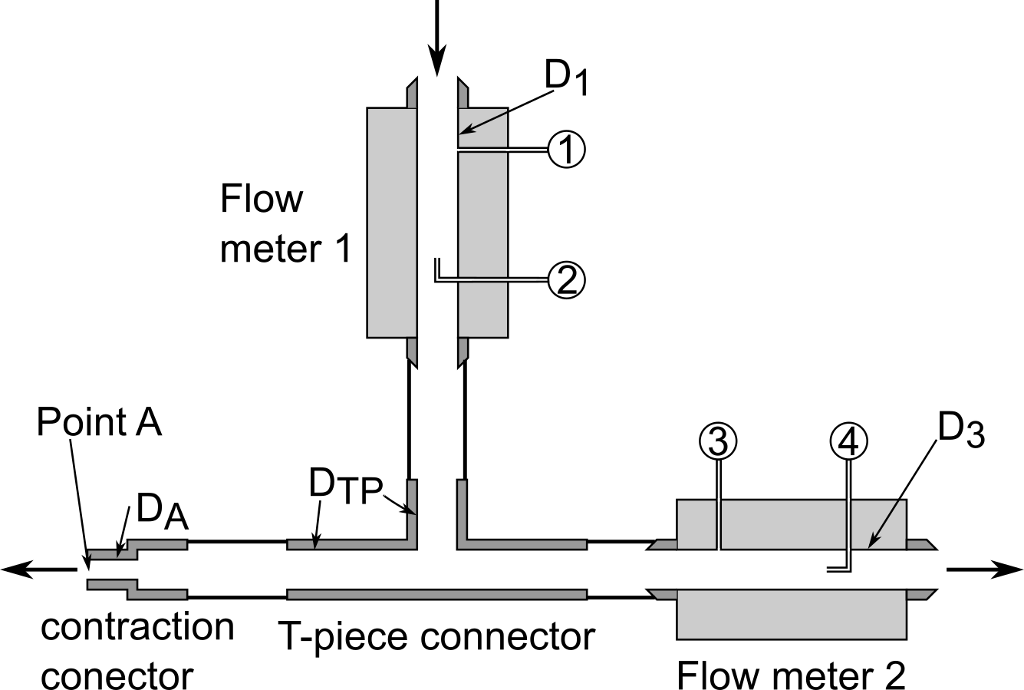
Q1. Flow either side of a t-piece is shown in Figure 1. All flows are in the horizontal plane. Pitot tube flow meters with pressure measurements are fitted to two of the branches (top and RHS) while the other branch (LHS) has a sudden flow contraction. Pressures are measured at 4 points (labelled 1-4). The loss coefficient of the contraction connector K L,cc is known but the loss coefficient of the T-piece K L,TP is not. The known values are given in Table 2. In your calculations use 1000 kg/m 3 as the density of water.
| P 1 | 9180 Pa | D 1 , D 3 , D TP | 16 mm | |
| P 2 | 10820 Pa | K L,CC * | 0.4 | |
| P 3 | 7840 Pa | D A | 11 mm | |
| P 4 | 8470 Pa | r (water) | 1000 kg/m 3 | |
| g | 9.81 m/s 2 | m (water) | 1.2 x 10 -3 Nsm -2 |
* Loss coefficient in contraction is based on the higher velocity
Table 2 Data for question 1
Calculate the following (you may assume major losses are negligible):
a) The velocities in the flow meters V 1 and V 3
b) The velocity after the contraction V A
c) The loss coefficient of the T-piece K L,TP (hint consider the flow between p 1 and p 3 ) where K L,TP is based on the outlet velocity
d) The pressure after the contraction p A
Point A DA Flow meter 1 DTP D1 2 contraction T-piece connector conector 14 Flow meter 2 D3
Step by Step Solution
3.33 Rating (159 Votes )
There are 3 Steps involved in it
To solve this problem well use Bernoullis equation the continuity equation and the given data a Velocities in the flow meters V1 and V3 Step 1 Calcula... View full answer

Get step-by-step solutions from verified subject matter experts