







Question: TRUE/FALSE (2 PTS EACH) 1. The SELECT clause in a query is optional. 2. In sorting, if DESC A C (descending) or ASC (ascending) is
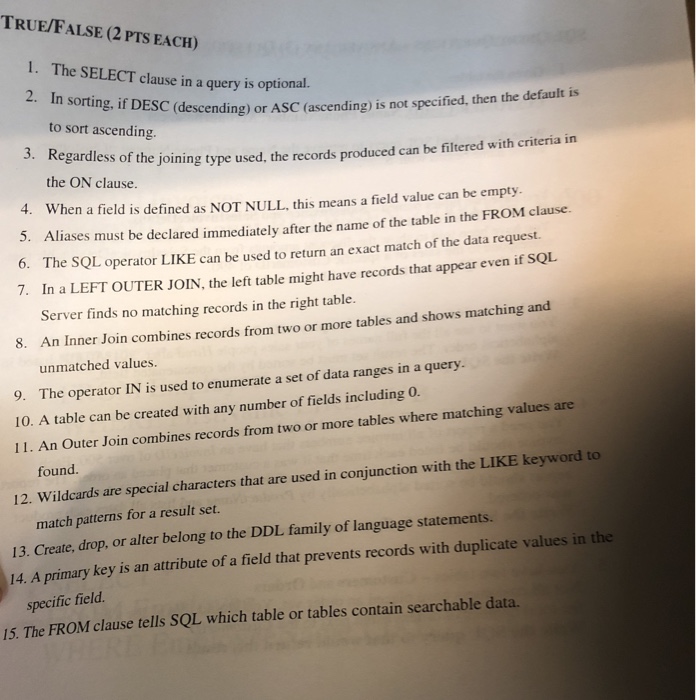
TRUE/FALSE (2 PTS EACH) 1. The SELECT clause in a query is optional. 2. In sorting, if DESC A C (descending) or ASC (ascending) is not specified, then the default is to sort ascending. egardless of the joining type used, the records produced can be fitered with criteria in the ON clause. When a field is defined as NOT NULL, this means a field value can be empty. 5. Aliases must be declared immediately after the name of the table in the FROM clause. 6. The SQL operator LIKE can be used to return an exact match of the data request 7. In a LEFT OUTER JOIN, the left table might have records that appear even i 4. f SQL Server finds no matching records in the right table. 8. An Inner Join combines records from two or more tables and shows matching and unmatched values. 9. The operator IN is used to enumerate a set of data ranges in a query. 10. A table can be created with any number of fields including O. II. An Outer Join combines records from two or more tables where matching values are found. 12. Wildcards are special characters that are used in conjunction with the LIKE keyword to match patterns for a result set. 13. Create, drop, or alter belong to the DDL family of language statements. 14. A primary key is an attribute of a field that prevents records with duplicate values in the specific field 15. The FROM clause tells SQL which table or tables contain searchable data
Step by Step Solution
There are 3 Steps involved in it

Get step-by-step solutions from verified subject matter experts
 Study Help