Question: Use the list below as a checklist while you draft and revise essays for this course. This paragraph structure will help you fully develop your
Use the list below as a checklist while you draft and revise essays for this course. This paragraph structure will help you fully develop your essay's argument.
STEP 1:Topic Sentence
STEP 2:Transition ? that continue to set up the paragraph's argument
STEP 3:Set up the evidence by providing context
STEP 4:Signal Phrase + MLA
STEP 5:Quote/Evidence
STEP 6:Analysis/Explanation
STEP 7:Transition ? Transition & Connection to 2nd piece of evidence
STEP 8:Set up the evidence by providing context
STEP 9:Signal Phrase + MLA
STEP 10:Quote/Evidence
STEP 11:Analysis/Explanation
STEP 12:Paragraph Close
Things to Keep in Mind
1. It is evident that the text was written without AI.
2. Includes a clear thesis that responds well to the prompt
3. Includes relevant textual evidence that sufficiently supports the thesis
4. Uses sources effectively: an effective amount from sources (10-20%), introduces sources, and analyzes evidence from sources 5. Is clear and organized enough for the reader to understand
6. Includes a works cited page that matches the sources used and follows MLA
Determine the author's argument.
Analyze how the author accomplished this through their craft (i.e., writing style, characters, metaphors, similes, etc).
Research information regarding the social/historical context of the text, past and present.
Support your argument with an academic article that addresses this theme or concept.
Here is the Outline as an example to help you write an essay
The "Phantom Tongue" by Steven Sanchez explores a truly deep concern with the subject of belonging to a place, or rather identity, at the Mexico-U.S. border. "Approaching El Arco / Reloj Monumental San Ysidro, California," the poem strikes this ache conjunction of cultural and physical boundaries and reflects the struggle of those who traverse them. The essay is best suited for readers with an interest in contemporary poetry and social justice. Sanchez uses vivid imagery and personal reflections to unveil the emotional turmoil associated with border crossings and how to chase through identity in a divided world. Sanchez uses striking imagery to describe the physical and emotional barriers built by the border. The line "the arch is visible everywhere in Tijuana, a sign just south of the border whose metal shines like a northern star for lost Americans seeking home" (Sanchez 31) portrays how the arch is a symbol of hope but at the same time displacement. The line "the border bisects their bodies" (Sanchez 32) provokes how the border carves the people and their identities. Sanchez also writes that, "Like a parrot, I repeat his question, each barbed syllable twisting from my throat" (Sanchez 32), highlighting this very point of the inability to say and therefore connect across the divide. Through such powerful imagery, Sanchez depicts the impossibility of identity constructed by the border as one of desire to connect and actual disengagement. It is through the border patrol agent encounters that the dehumanizing nature of immigration enforcement is exposed. "You can't stand on his side of the fence" is an order the author represents in relation to the strict barriers the authorities create (Sanchez 32). The order to "Show me identification" (Sanchez 32) symbolizes how the border does not only control but interrogates anyone who attempts to cross. Vila states, "The border's presence needles into every facet of the lives it touches, creating an unseen yet palpable tension" (Vila 75). Through these, Sanchez is developing how immigration policies humanize, making other aliens who do not possess their identities but being treated as subjects to be controlled. Sanchez juxtaposes the harsh realities of border life with moments of hope and personal memory. The line, "I try to convince myself, even though I know what happens if I do nothing" (Sanchez 32), reveals the internal conflict between inaction and the consequences of despair. The memory, "I can hear my grandmother's voice in my throat, sana sana colita de rana" (Sanchez 32), reveals cultural memories that soothe and belong. Vila suggests that "cultural memories play a crucial role in forming identities across borders" (Vila 75), pointing out the importance of heritage regarding identity issues. This paragraph indicates how Sanchez uses memory and such natural imagery to give hope, thus proving how the human spirit bounces back in a hostile world. In this regard, one has to summarize that Sanchez's poem with its interpretation by Vila proves that the border is a true crossroad where personal as well as collective identities cannot be taken for granted. Through critical readings of the poem, we see clear indications of the deeper implications of the issues and thus call for a more empathetic attitude toward those who are forced to face such situations.
Here, in the Book Phantom Tongue by Steven Sanchez, one poem
Approaching El Arco / Reoj Monumental San Ysidro, California, They say the arch is visible everywhere in Tijuana, a sign just south of the border whose metal shines like a northern star for lost Americans seeking home. Even here north of the border, I can see it bend into a halo, into the pink and purple buildings, rising like a silver sun over the border wall--- that lean shadow stretching across this beach where children pass through cold iron bars-first their hands, then arms and shoulders, each daring the next to go one limb farther. The bravest keep one foot on this side, one on the other, and the border bisects their bodies-- it almost seems to vanish from chipped paint that reveals a blue undercoat, pieces of sky to hold between their fingers. Quieres en elote? A man asks from the other side. I say no, gracias. He says something else I don't quite understand. A border (p.31) patrol officer points at me, flexes his finger, and warns you can't stand on his side of the fence. This is American property. Why are you here? Show me identification. Like a parrot, I repeat his question, each barbed syllable twisting from my throat. A gull walks in circles a few feet away, his left-wing broken, upside down; his white Remax makes a path in wet sand that three offspring follow. I could hold the gull, stroke his sleek back, and make a purple sling from my shirt. But I wouldn't know what I'm doing, how to reset or mend his bones. I would just break another one. I try to convince myself, even though I know what happens if I do nothing. I imagine my grandmother's voice filling my throat, sana sana colita de rana... but I can't remember the rest of it, the incantation that could heal anything. Where were you born? Who do you know on the other side? I articulate two words (p.32): California. Nobody. I can barely even speak Spanish. Turn around and raise your arms. The children observe me, and my silhouette hangs from the wall's barred shadows. He presses his hands against my body, pats my calves, searches my thighs, cups my crotch, and pauses. You can leave. Walking across the beach, my feet sink. I try to step inside the footprints of others and notice another gull, this one dead, tire treads marking his body, his body, his neck snapped into a parabola, Tijuana's arc crossing his flattened chest. (p.33)
This is an Academic article here. Work cite as well
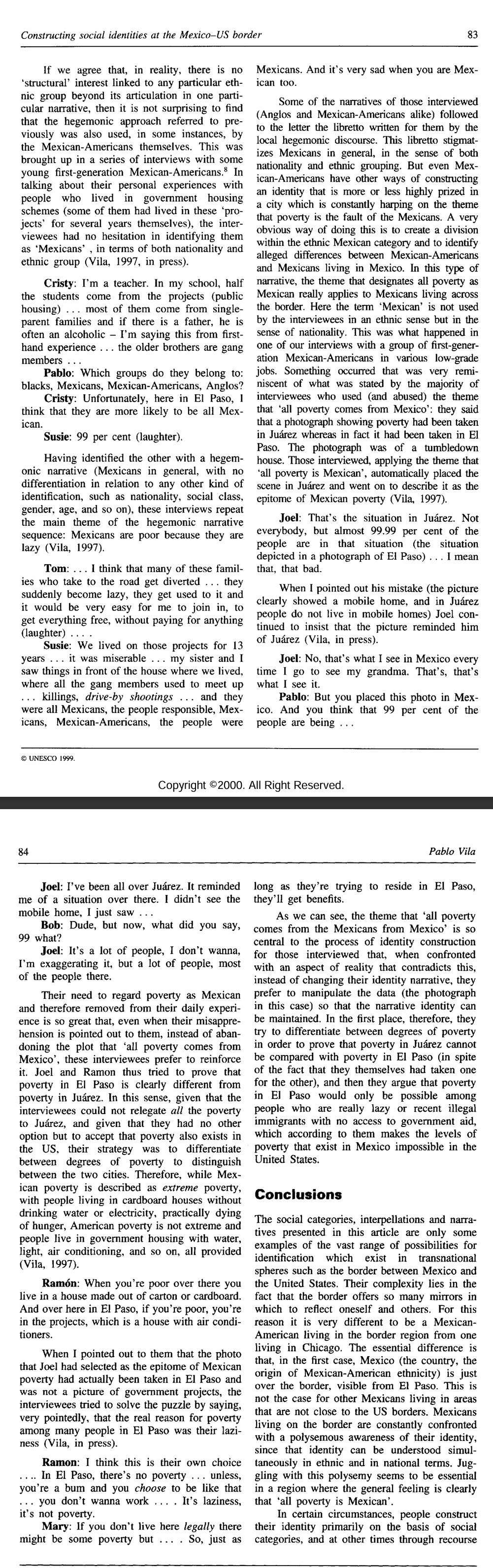
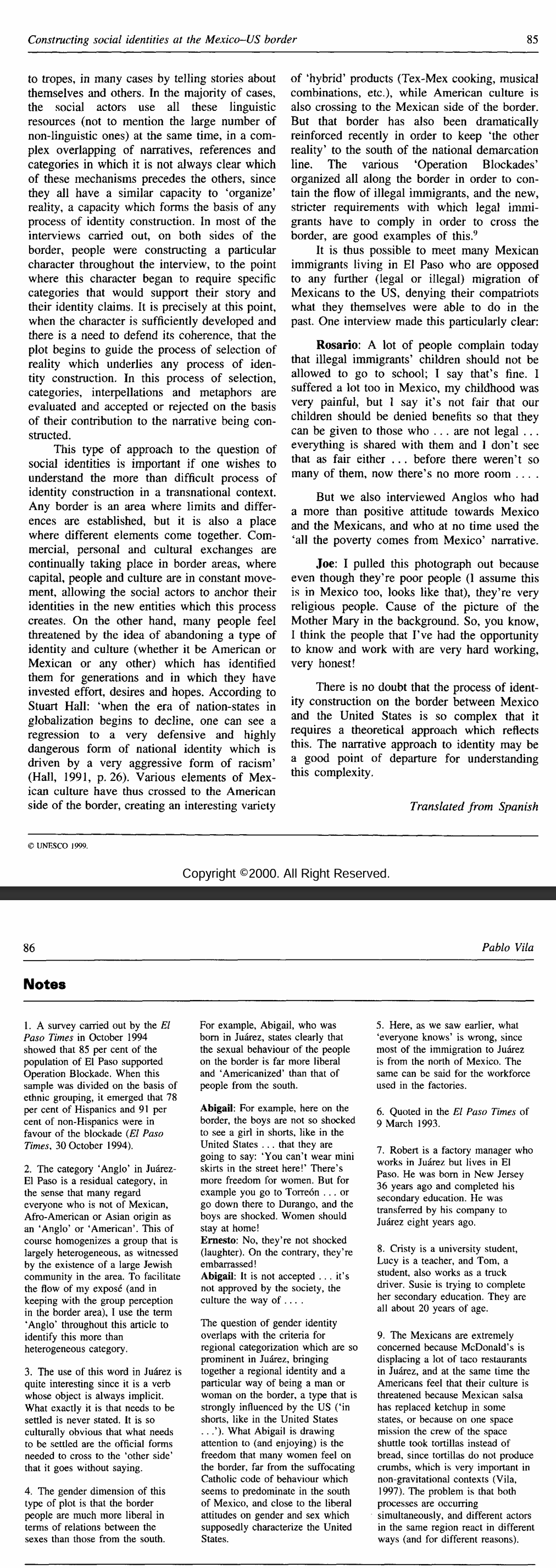
Vila, Pablo. "Constructing Social Identities in Transnational Contexts: The Case of the Mexico-US Border." International Social Science Journal, vol. 51, no. 159, Mar. 1999, p. 75. EBSCOhost, https://doi.org/10.1111/1468-2451.00178.
Constructing social identities in transnational contexts: the case of the Mexico-US border Pablo Vila In September 1993, just before the signing of Blockade) to stand for the Democratic Party in the Free Trade Agreement with the United the congressional elections. Reyes based his States, the border patrol in El Paso (under the entire campaign on his image as the city's hero, command of Silvestre Reyes, who was born and as he was the person who put an end to the brought up in the area) began to apply new flood of illegal Mexican immigrants. In the Fed- strategies to stem the flow of illegal immigrants. eral elections of 5 November he defeated his This new approach, known as Operation Block- Republican opponent, Rick Ledesma, winning ade, won the almost unanimous support of both 70 per cent of the votes cast, 15 per cent more the Anglo-Saxon and Mexican communities of than Clinton in the presidential elections (Vila, El Paso. In fact, several studies showed that in press). between 80 to 90 per cent of The operation was an enor- the town's inhabitants sup- Pablo Vila is Assistant Professor, mous success in the town, ported the measure (it must Division of Social and Policy Sciences, but brought to the surface a be borne in mind that 70 per University of Texas at San Antonio, 6900 deep resentment between cent of the town's popu- North Loop 1604 West, San Antonio, TX Mexicans and Mexican- lation is of Mexican extrac- 78249, USA, email: pvila'lonestar. utsa.edu He has done research in Americans; remarkably, tion, most of them having Argentina, Mexico and the United States many Mexican-Americans crossed the border within and has published various articles on cul- held Mexicans responsible the last 20 years).' ture and identity. The title of his next for practically all the social The overwhelming book is Crossing Borders-Reinforcing problems plaguing El Paso, support expressed for the Borders. such as crime, drugs, unem- border patrol on this ployment, fraudulent use of occasion does not seem to the social security system, be an isolated phenomenon and so on. This reaction A survey carried out by the caused great astonishment El Paso Times on 2 April in the academic community 1995 revealed that 62 per cent of the population who studied border problems of the US, as of El Paso would support anti-immigration mea- these researchers regarded the 'border-crosser' sures similar to Proposal 187 in California as the epitome of the social agent in border (Vila, in press), and at a time when most cities areas (Anzaldua, 1987; Rosaldo, 1989; Calderon in the United States with a large Mexican com- and Saldivar, 1991; Martinez, 1994; Velez- munity were organizing a series of rallies in Ibanez, 1996) and did not attach great impor- protest against the beating of two illegal immi tance to the attitudes and behaviour of El Paso grants in Riverside, not only was there no pro- border enforcers. However, despite the astonish- test action in El Paso, but that very week, the ment caused in the academic community at population elected Silvestre Reyes (head of the large, the opinions expressed by the people of Border Patrol and inventor of Operation El Paso, both on Operation Blockade and in ISSJ 159/1999 @ UNESCO 1999. Published by Blackwell Publishers, 108 Cowley Road, Oxford OX4 IJF, UK and 350 Main Street, Malden, MA 02148, USA. Copyright 2000. All Right Reserved. 76 Pablo Vila the context of the elections referred to above, were separated by the Treaty of Guadalupe Hid- only confirmed the main conclusion of my algo after the war between Mexico and the research on this subject since 1991; perception United States, it was not so easy to sever the of the 'other' is fundamental in identifying one- social and economic relations between the two self, and many Mexican-Americans construct cities. This was due partly to the fact that their their own identity by reference not only to the geographical isolation (the nearest large town 'Anglos', but to the Mexicans living across the was more than 500 km away) made integration border in Mexico. The support expressed for in these areas imperative. The close relationship the border patrol may therefore be attributed to between the two cities intensified during the the fact that the agency had begun to do physi- first decades of this century, and the period of cally what many Mexican-Americans were prohibition in the US not only encouraged a already doing symbolically, that is to say, separ- flourishing tourist industry in Juarez but also ating themselves from Mexican nationals in made possible the creation of a new upper class order to construct a different identity for them- which expanded due to its relationship with 'the selves as Mexicans living in the United States. other side'. Alcohol smuggled from factories Meanwhile, on the Mexican side of the border, established across the border provided wealth Operation Blockade (and its support by Mex- for some Mexicans, who went on to become ican-Americans) only confirmed what the politicians or prominent figures in the develop- majority of the population of Juarez already ment of the area (Lau, 1986, p. 1 1). thought of Mexican-Americans (aptly summed This new bourgeoisie established strong up in the expression 'pocho'): Mexican-Amer- economic ties with the US in general and with icans are betraying their own 'race' and El Paso in particular; in fact, the entire city is, rejecting their cultural heritage in order to in one way or another, linked to 'the other side' become a part of American society (Vila, in in that a large portion of the private income of press). the people of Juarez (50 per cent according to This article seeks to follow the intricate some estimates) is generated, directly or process of constructing a social identity at a indirectly, by the US economy. very specific point on the US-Mexico border, The centre of the region's economic Juarez-El Paso. It is a complex process in which activity is undoubtedly the city of El Paso with the cultures involved are neither unitary nor its 515,342 inhabitants (Lorey, 1993, p. 49), homogeneous, and the identities being con- whose economy represents more than half the structed are multifaceted ifaceted and contradictory. This total budget for the region (US$8.6 billion). The article focuses particularly on the identity con- economy of El Paso depends to an extent on struction process by Mexicans on both sides of the assembly plants in the north of Mexico, and the border, given that in the American border functions as a service centre for the whole area. literature they are regarded as epitomizeng the Given the close relationship between El Paso border-crossing' phenomenon. The process and Juarez, it is not surprising that the retail whereby the Anglos (or Americans, as they are trade is one of the most important activities in referred to in the border area) construct their El Paso, with nearly 40 per cent of economic identity will be covered in more general terms. transactions attributable to visiting Mexican cus- obviously, it would be very interesting (in tomers. another article) to study in more detail the vari- For its part, Ciudad Juarez, a city of ous ways in which the different 'Americans' 789,522 inhabitants according to the 1990 cen- (Anglo-Saxons, Germans, Irish, Jews, etc.) in sus, is a very special case on the border. The the border region build up a construct of their first reason for this is that its population is far respective 'others'. more homogeneous than the population of other large border towns on the Mexican side. On the one hand, its migrant population is quite Historical and social context different from that of other big towns on the border. Whereas in Tijuana more than 58 per Until 1848 Juarez and El Paso formed a single cent of the population was born outside the city, called El Paso del Norte. Although they State of Baja California, in Ciudad Juarez onlyConstructing social identities at the Mexico-US border M 34 per cent of the population was born outside the State of Chihuahua (Lorey, 1993, p.51). Furthermore, the majority of those who are not from Chihuahua but who decide to move to Judrez are from north Mexican states bordering Chihuahua Durango, Zacatecas and Coahuila. Ciudad Judrez is an unusual border town in other respects. For example, the situation of Mexicans who commute daily to work in the US from Juarez is completely different from those of Tijuana-San Diego. First, the number of American citizens living in Judrez and work- ing in El Paso is much higher than in Tijuana- San Diego (Alegria Olazdbal, 1992, p. 132). This is due to the fact that many of the town's inhabitants make sure their children are born in El Paso in order to give them American cit- izenship. More important, however, is the fact that the flow from Judrez to El Paso (both legal and illegal) is primarily local, that is, to work in El Paso or neighbouring communities in western Texas or southern New Mexico. The fact that many Mexicans commute to El Paso to work does not mean that the city pays extremely high wages: quite the contrary. While it is true that incomes are much higher there than in Judrez, it is also one of the poorest cities in the US. At the beginning of the 1990s, the per capita income in El Paso was only $10,778, far lower than the average per capita income for the state of Texas, which was $16,702 (Stoddard and Hedderson, 1989). Whereas this is the general picture for the whole city, in the poor neighbourhoods of El Paso the situation is even worse. It is important to note that there are many Mexican immigrants in most of these neighbourhoods. The level of poverty is such that many of the inhabitants of these neighbourhoods depend largely on govern- ment aid. Unemployment is another indication of problems in the El Paso economy (Stoddard and Hedderson, 1989). At the beginning of the 1990s, unemployment stood at 11 per cent. Brief theoretical framework The concept of identity has, over the last few years, been the object of one of the most pro- ductive challenges in the social sciences. Sev- eral disciplines, ranging from philosophy to feminism, have been very critical of the concept of integral, original, unified identity. Instead, the concepts of identity and identification have been described as follows: a process of articulation, a suturing, an over-determi- nation not a subsumption ... Like all signifying prac- tices, it is subject to the 'play', of difference. It obeys the logic of more than one. And since as a process it operates across difference, it entails discursive work, the binding and marking of symbolic boundarics, the production of 'frontier-effects'. It requires what is left outside, its constitutive outside, to consolidate the pro- cess. (Hall, 1996, p. 3) This way of understanding identity differs from those theories that view identity as some- thing that an individual possesses once and for all. The approach is rather to see this concept as a construction over time, which is constantly negotiated in relation to others in a process in which its outlines are constantly being defined and redefined. Although, on the one hand, identity is not an 'essential internal state', neither is it, on the other hand, the exclusive result of powerful external discourse, as in Althusser or Foucault. Identities are formed partially through a com- plex intertwining over time of categories and identity narratives about ourselves and others. Social action becomes intelligible only when we recognize that these behaviour patterns are determined by the type of social relationship in which these actors participate. People also attribute meaning to these social relationships through the narratives, classification systems and metaphors they use in their daily lives. How does this idea of identity affect the various ways of understanding the processes of identity construction in transnational contexts? On the one hand, we need to talk about 'identit- ies' rather than 'identity', since this new theoreti- cal perspective implies that conceptualization of any type of unified or centred identity must be avoided. It also means paying a lot of attention to the various 'others' involved in any process of identity construction. In this context, the others may be considered as 'supplementary', that is, as being outside the range of subjectivity, as merely in excess; or they may be considered as 'negativity': others located in the realm of subjectivity but playing the role of the constitu- tive outside (Grossberg, 1996, p. 90). In order to spell out the complex process of identity construction that underlies the way UNESCO 1999. Copyright 2000. All Right Reserved. 78 Pablo Vila in which Mexicans, Mexican-Americans, Afro- Americans and Anglos perceive each other in the multicultural environment of the El Paso- Judrez area, the use of categories and narratives in the process of identity construction must be analysed. This analysis is based on an extensive series of interviews with small groups formed on the basis of class, gender, age, nationality, ethnic origin, religion and time of migration; this fieldwork was carried out between Sep- tember 1991 and June 1996 involving 254 group interviews with 932 individuals on both sides of the border. Each interview focused on discussing a set of photographs of the border region which had been divided into subject groups. Analysis of these interviews permitted identification of the cultural frameworks used by the various border actors to identify 'others' and hence to define their own identities. Social categories, references and the complex construction of identities in transnational spheres It is not easy to live on the border between Mexico and the United States. While there is a clear 'fronterizo identity' on the Mexican side, on the American side there is no equivalent category with which people can identify them- selves. This self-identification is possible in Jud- rez for two reasons. First, since the people in that city use their proximity to the United States to give a certain 'status' to their social identity, they emphasize the advantages of being neigh- bours with the most powerful country in the world, given all the opportunities for work and the tremendous availability of goods. Secondly, the people of Judrez can also construct a strong border identity because Mexicans generally use a system of classification based on region to explain behaviour patterns and attitudes. This regional system allows them to label their ident- ity by reference to a specific geographical area, like the border region. This combination of fac- tors explains why the 'border identity' is popu- lar on the northern frontier of Mexico but is not very often invoked on the border with Guat- emala, for example (Vila, in press). On the American side of the border, how- ever, there is no kudos to be gained from emphasizing one's proximity to a Third World country as part of one's El Paso or Tijuana identity. Americans tend to base their identity on a system of classification referring primarily to ethnic origin and race rather than to region. People in El Paso would therefore never be heard saying 'I am a frontiersman (or a bor- derman or a borderite)' (Vila, in press); the presence or absence of a 'border identity' obvi- ously points to a type of discourse that is central to the process of identity construction in a trans- national context (i.e. social categories and references). Both Mexicans and Americans belong to societies which, although they have similar classification systems relating to a vast number of positions in society, differ significantly in respect of other classification and narrative sys- tems which significantly affect everyday behav- iour patterns. In the border region, these simi- larities and differences give rise to group perceptions that are unusually complex in that people are forced to switch from one system of classification to another, sometimes on a daily basis. Not only do they move from one system to another, but the proliferation of classification systems in which people may find themselves makes possible a constant mingling of different classification systems in order to give an account of the 'other' (Vila, in press). Thus, if someone of African descent from Veracruz meets a native of Judrez, the factor that will allow the person from Judrez to establish con- tact and to take that person's attitudes and behaviour into account is the fact that that per- son is from Veracruz. But for someone from El Paso, the most important factor when estab- lishing initial contact with a black American from New York is the fact that the person from New York is black. Switching from one country to another entails a change of classification systems, and the people concerned have a guaranteed place in both taxonomies. Let us take the imaginary case of a resident of Jurez born and raised in Mexico City. In the Mexican regional classi- fication system, this person would be labelled a 'Chilango', with the connotation for that cate- gory and the narratives and metaphors which many people in Judrez bring in with reference to Chilangos (depicting them as enterprising, pushy, always trying to take advantage of other Constructing social identities at the Mexico-US border 79 people). However, once he crosses the border and settles in the US, our hypothetical Chilango enters a system of racial and ethnic categoriz- ation, and becomes for many Americans (for whom the regional categorization Chilango has no meaning) simply a Mexican or a Mexican- American (if he lives in the southwest) or a Hispanic (if he lives in any other part of the United States). The Chilango is lumped together not only with Mexican citizens from all over the country including the 'border people' who not so many years ago put stickers on their cars saying: 'Serve the motherland, kill a Chilan- g0' but also with Cubans, Puerto Ricans, South Americans, and so on. Our Chilango not only acquires a new label, but with it a new identity in the eyes of others because the label comes with a series of assumptions as to who he is and how he can be expected to behave which, given popular cultural conceptions in the US, represent the ex-Chilango, now a Hispanic or Mexican-American, as the opposite of what he was considered to be in Mexico. He is no longer seen as enterprising or pushy, but as lazy and lacking in ambition, given that these are the stereotypical views of the Hispanic repeatedly formulated in the common-sense narratives of many Americans. The problem is that our Chil- ango is obliged, in one way or another, to respond to the image that is reflected to him by others, and thus to reconstruct his individual and social identity (Vila, 1997). Switching from one side of the border to the other presents Mexicans with a different set of mirrors which reflect a different identity back to them, while the proximity of Mexico keeps the mirror that initially reflected their identity still before them. Living on the border thus offers a multitude of mirrors generating images which can be used to categorize and compile narratives about others and about themselves. The self-definition of a Mexican-American liv- ing in Chicago is thus very different from the self-definition of one who lives in El Paso. The essential difference is that Mexico (the country defining Mexican-American ethnicity) is still there, actually visible from El Paso. For Mexican-Americans living on the American side of the border, the origin of their difference is always present, serving as a constant reminder. This means that Mexicans living on the border are constantly grappling with awareness of their identity as an ethnic group and as part of a nation at one and the same time (Vila, 1997). Narrative identities, plots and the selective appropriation of reality People often develop their sense of identity by seeing themselves as protagonists in different stories (Polkinghorne, 1988; Novitz, 1989; Taylor, 1989; Kerby, 1991; Ricoeur, 1992; Rosenwald and Ochberg, 1992; Somers, 1992). These stories serve to form a narrative of the episodes of our lives in such a way as to make them intelligible to ourselves and to others. Nar- rating, therefore, is much more than describing events or actions. It also means relating events and actions, organizing them into sequences or plots and then attaching them to a character. It is thus the narrative that constructs the identity of the character by constructing the story. What creates the identity of the character is the ident- ity of the story and not the other way around (Ricoeur, 1992). This constant shifting between narratives and identities (between living and narrating) allows the actors to adjust their sto- ries to coincide with their identities. At the same time, the plot allows the actors to manipu- late reality to make it fit with their stories (Vila, 1997). Different actors in the border regions struc- ture their narratives by using very different themes. In doing so, they make selective use of categories, references and metaphors to sup- port and lend more credibility to the type of character that their narratives require. On the Mexican side of the frontier, a very popular theme is that 'all the poverty and social prob- lems are due to the immigrants from the south of Mexico'. This reference to 'southerners' could have two meanings. On the one hand, it could mean Mexicans who are not from the north, or to be more precise, who are not from Cuidad Judrez. On the other hand, it could mean the immigrants who arrive in Jurez from states in central and southern Mexico with a large indigenous population. In this type of narrative, \"from the south of Mexico' is a euphemism for a negative ethnic reference of a type that has been banned from use in public discourse, thanks to official rhetoric (from central Mexico) UNESCO 1999, Copyright 2000. All Right Reserved. 80 Pablo Vila 'Wedding party of Americans of Mexican origin in South Texas, USA. Abigail Heyman/Rapho which pays tribute to the indigenous roots (Aztec, Maya, etc.) of Mexican culture. This type of anti-indigenous discourse is thus re- introduced into the narratives of the border communities with a regional metaphor for 'what cannot be mentioned' (Vila, in press). The com- ments about people from the south made by some of those interviewed referred to them (explicitly or implicitly) as having clearly indigenous origins, and described them in more than negative terms as being culturally back- ward, with no spirit, much more interested in having an easy life than in working ('shrimps, niggers and assholes', according to one of those interviewed). It is important to remember here that a very prevalent attitude in the region holds that the north of Mexico was almost unaffected by the racial mixing which occurred in the centre and south of the country. Therefore, for many northerners, the population of the north is 'white', while that of the centre and the south of Mexico is 'indigenous' or 'mixed' (Alonso, 1995, p. 68). The view that 'all the social problems and poverty are due to immigration from the south', is very prevalent in Judrez, crossing all barriers of class, gender, age and religion. This was what happened when we spoke to a group of middle-class youngsters in a vocational training institute in Judrez. Abigail: We are different. I think that the border is different from the rest of the country. Ernesto: Border people are more dynamic, aren't they? Jorge: Yes, we are . ... We are more hard- working. Abigail and her friends are asserting that border people work harder than people from the south, and are also more dynamic. Moreover, they are less likely to be frivolous or spend- thrift. Recent immigrants from the south are portrayed as basically idle, lazy and/or drunkards, having only themselves to blame for their lack of resources. Jorge: The people who come here from outside, well, they have a really hard life! UNESCO 1999. Constructing social identities at the Mexico-US border 81 Ernesto: But these people have, well, no backbone! If you ask a bricklayer or a factory worker . .. they work from six in the morning to six in the evening to earn some overtime and many of them do take home good pay- cheques. But ask them what they do on a Fri- day. The answer is always the same ... Ramiro: Dancing ... . Jorge: Dancing and drinking! Ernesto: Drinking. Why? If during the week they have to beg for their bus fare ... . Many of those interviewed seem quite con- vinced that all the people who were born in Judrez and are still living there are very well off, while the others have already 'settled', that is, they are already living and working in the United States. The only people in Judrez living in poverty are thus immigrants from other parts of Mexico, and the explanation for their poverty lies in certain cultural deficiencies brought from the 'south'.* Ernesto: Ask a bricklayer how much he earns and you get the answer 'If I work a full week, if I go in on Monday' . .. and that refer- ence to Monday is typical. 'If I do a full week including Monday, then I take home five or six hundred thousand pesos!\" But ask him where he goes on Saturdays and remember he works half day on Saturday! Ask him what he does on Saturday ... and Sunday! He gets home the next day completely sozzled and all his pesos have disappeared. Why? Because these are people who have no backbone. Jorge: These are people who do not really want to get on in life! Abigail: But, poverty does not mean ... if a person is clean ... he will continue to be clean. Ernesto: Poverty ... to be poor is not the same as to be dirty. Ramiro: Poverty is one thing, laziness is another ... The root of poverty is thus not low wages, but cultural background, a particular attitude to life. The word 'laziness' puts the finishing touch to this more than negative image of the 'people from the south'. The identity of the borderite or inhabitant of Juirez would serve as a symbolic dividing-line, distinguishing the unworthy poor from the others. By describing the 'others' recent immigrants who work in factories and on building-sites and who allegedly come from the south as undeserving, interviewees who identify themselves as 'Juarenses' or borderites are protecting themselves, almost by definition, from the extreme poverty which they identify with 'others'. Sometimes the need to establish this type of differentiation with respect to others, in this case the people from the south, is so strong that a symbolic dividing-line is not enough. Some of the people born in Ciudad Judrez whom we interviewed said that they often thought that a good way of stopping 'undesir- able' immigration from the south of Mexico would be to establish the same type of border control which the Americans have set up on their borders. This is what happened in one of our interviews with a trade union group. Felipe, a union leader who is 29 years old and who had attended secondary education in Judrez, made the following statement: Felipe: It enrages me ... and I keep ... I don't know if everyone who lives here, who was born here thinks 'If 1 were the Governor, I would stop the people from down south flood- ing in here ... or at least regulate the flow ... create a sort of border like with the United States'. I don't think that way any more, but for a long time I put the blame on all those people who flood in here because ... I can't bear to see so many homeless people; I hate to see so much garbage in my city, in my home, and I blamed it on the people who come from outside and said to myself, 'if they had not come here, I would not be seeing all this dirt Clearly, the view that all the poverty and social problems in Juirez come from the south is very widespread in the city, and it is reflected in categories, metaphors and narratives that are constantly seeking to establish that over-popu- lation, squalor, crime, delinquency, unemploy- ment and other evils are not to be associated with the people of Juirez themselves, but with immigrants from the south. If this is one of the commonest narratives in Juarez, in El Paso the equivalent is certainly that all the poverty and social problems are due to the Mexicans (Vila, 1997). This narrative is so widespread that it has already taken root in innumerable common- sense perceptions voiced in El Paso, sometimes UNESCO 1999, Copyright 2000. All Right Reserved. 82 Pablo Vila giving rise to very odd practices. I should like to cite as an example of this an extract from a bilingual invoice for medical services at the El Paso public hospital. The English text reads 'Courtesy reminder. Please remit full payment today. Contact the business office regarding your account.\" This is followed by a text in Spanish reading 'If you cannot pay your bills for medical services, you may qualify for fin- ancial assistance. Please call 534-5908 or 534 5918.' The English version assumes that English speakers who use the hospital can pay immediately; the Spanish version, on the other hand, implicitly assumes that the Mexican or Mexican-American patients are the only ones requiring this type of assistance (Vila, 1997). In addition to discriminating against poor English speakers who do not understand Spanish, and so would not realize that they could receive assistance, the hospital bill reinforces a view which is already commonly accepted in the city: everything to do with the Spanish language and with Mexico as a country or ethnic grouping is synonymous with poverty in El Paso (Vila, in press). This is precisely the background against which many of the inhabitants of El Paso con- struct their social identities. Needless to say, in this context upgrading one's identity is much easier for middle-class Anglos than it is for Mexican-Americans, whatever their social class. The former (and all those of different ethnic origins including Mexican-Americans who share with the Anglos this particular perception of identity), using a system of ethnic categoriz- ation, tend to place Mexicans and Mexican- Americans in the same category since both belong to the same ethnic group. Many Mex- ican-Americans, on the other hand, are con- stantly mixing different classification systems in order to present themselves and 'others'. They would thus use the concept of nationality to differentiate between themselves and Mexican citizens, whereas ethnic categorization would be used to differentiate them from Anglos. Mex- ican immigrants, in turn, have to deal with the fact that they 'are' Mexicans in both senses of the word, as a nationality and as an ethnic group (Vila, in press). If people of Anglo-Saxon origin decided to synchronize the hegemonic approach that equates poverty with being Mexican, they would have a vast arsenal of highly structured and well-established arguments to support their identity claims. When we interviewed an Anglo manager in a factory in Judrez, he described the shock experienced by many Anglos when they come to the border for the first time from the interior of the US as follows: Robert:\" I used to take my family to Mex- ico, I used to like to take them to Zaragoza or up through there. It's a different world altogeth- er. For Robert, referring to Judrez as another city or another country is not enough to express adequately the enormous gap that he feels separ- ates the two cities. To express the feeling of 'otherness' Robert refers to another planet. The depth of otherness that Robert feels in relation to the people across the border is such that it destroys any possibility of recognizing differ- ences within that group of 'others'. Robert, like many other Anglos interviewed, never referred to the people of Judrez as 'juarenses' (which is what they prefer to be called), or even 'juar- efios' (the insulting way in which many Mex- ican-Americans refer to the people of Judrez), but constantly referred to them simply as 'Mex- icans'. In this type of discourse, the others are not the people of Judrez in particular, but Mex- icans in general. The laboriously constructed identity of the people of Judrez, who see them- selves as a 'different type of Mexican', as we have seen, is demolished at a stroke. Although geography is a very useful way of establishing one's difference from Mexicans, time can also play a role in this process. Many of the interviewees gradually painted a picture of Mexicans not only as belonging to another world, but as living in another time-frame, a different phase of history. Robert: I'm coming from New Jersey so I'm coming from a lot different environment. 1 had culture shock for like the first three or four months and . .. Even talking to the people that come down from over there ... we had an engineer here that was from the middle of the state and where I'm from it's like we're mostly farmers, you know, we're country people. He says: 'Judrez is just like what Smithville, New Jersey, was like 40 or 50 years ago. Its a whole different world ...". UNESCO 1999, Constructing social identities at the Mexico-US border 83 If we agree that, in reality, there is no 'structural' interest linked to any particular eth- nic group beyond its articulation in one parti- cular narrative, then it is not surprising to find that the hegemonic approach referred to pre- viously was also used, in some instances, by the Mexican-Americans themselves. This was brought up in a series of interviews with some young first-generation Mexican-Americans. In talking about their personal experiences with people who lived in government housing schemes (some of them had lived in these 'pro- jects' for several years themselves), the inter- viewees had no hesitation in identifying them as 'Mexicans' , in terms of both nationality and ethnic group (Vila, 1997, in press). Cristy: I'm a teacher. In my school, half the students come from the projects (public housing) ... most of them come from single- parent families and if there is a father, he is often an alcoholic I'm saying this from first- hand experience . .. the older brothers are gang members . . . Pablo: Which groups do they belong to: blacks, Mexicans, Mexican-Americans, Anglos? Cristy: Unfortunately, here in El Paso, 1 think that they are more likely to be all Mex- ican. Susie: 99 per cent (laughter). Having identified the other with a hegem- onic narrative (Mexicans in general, with no differentiation in relation to any other kind of identification, such as nationality, social class, gender, age, and so on), these interviews repeat the main theme of the hegemonic narrative sequence: Mexicans are poor because they are lazy (Vila, 1997). Tom: ... I think that many of these famil- ies who take to the road get diverted ... they suddenly become lazy, they get used to it and it would be very easy for me to join in, to get everything free, without paying for anything (laughter) ... . Susie: We lived on those projects for 13 years ... it was miserable ... my sister and I saw things in front of the house where we lived, where all the gang members used to meet up ... killings, drive-by shootings ... and they were all Mexicans, the people responsible, Mex- icans, Mexican-Americans, the people were Mexicans. And it's very sad when you are Mex- ican too. Some of the narratives of those interviewed (Anglos and Mexican-Americans alike) followed to the letter the libretto written for them by the local hegemonic discourse. This libretto stigmat- izes Mexicans in general, in the sense of both nationality and ethnic grouping. But even Mex- ican-Americans have other ways of constructing an identity that is more or less highly prized in a city which is constantly harping on the theme that poverty is the fault of the Mexicans, A very obvious way of doing this is to create a division within the ethnic Mexican category and to identify alleged differences between Mexican-Americans and Mexicans living in Mexico. In this type of narrative, the theme that designates all poverty as Mexican really applies to Mexicans living across the border. Here the term 'Mexican' is not used by the interviewees in an ethnic sense but in the sense of nationality. This was what happened in one of our interviews with a group of first-gener- ation Mexican-Americans in various low-grade jobs. Something occurred that was very remi- niscent of what was stated by the majority of interviewees who used (and abused) the theme that 'all poverty comes from Mexico': they said that a photograph showing poverty had been taken in Judrez whereas in fact it had been taken in El Paso. The photograph was of a tumbledown house. Those interviewed, applying the theme that 'all poverty is Mexican', automatically placed the scene in Judrez and went on to describe it as the epitome of Mexican poverty (Vila, 1997). Joel: That's the situation in Judrez. Not everybody, but almost 99.99 per cent of the people are in that situation (the situation depicted in a photograph of El Paso) . .. I mean that, that bad. When [ pointed out his mistake (the picture clearly showed a mobile home, and in Jurez people do not live in mobile homes) Joel con- tinued to insist that the picture reminded him of Judrez (Vila, in press). Joel: No, that's what I see in Mexico every time I go to see my grandma. That's, that's what I see it. Pablo: But you placed this photo in Mex- ico. And you think that 99 per cent of the people are being ... UNESCO 1999, Copyright 2000. All Right Reserved. 84 Pablo Vila Joel: I've been all over Judrez. It reminded me of a situation over there. I didn't see the mobile home, I just saw ... Bob: Dude, but now, what did you say, 99 what? Joel: It's a lot of people, I don't wanna, I'm exaggerating it, but a lot of people, most of the people there. Their need to regard poverty as Mexican and therefore removed from their daily experi- ence is so great that, even when their misappre- hension is pointed out to them, instead of aban- doning the plot that 'all poverty comes from Mexico', these interviewees prefer to reinforce it. Joel and Ramon thus tried to prove that poverty in EI Paso is clearly different from poverty in Judrez. In this sense, given that the interviewees could not relegate all the poverty to Judrez, and given that they had no other option but to accept that poverty also exists in the US, their strategy was to differentiate between degrees of poverty to distinguish between the two cities. Therefore, while Mex- ican poverty is described as extreme poverty, with people living in cardboard houses without drinking water or electricity, practically dying of hunger, American poverty is not extreme and people live in government housing with water, light, air conditioning, and so on, all provided (Vila, 1997). Ramn: When you're poor over there you live in a house made out of carton or cardboard. And over here in El Paso, if you're poor, you're in the projects, which is a house with air condi- tioners. When I pointed out to them that the photo that Joel had selected as the epitome of Mexican poverty had actually been taken in El Paso and was not a picture of government projects, the interviewees tried to solve the puzzle by saying, very pointedly, that the real reason for poverty among many people in El Paso was their lazi- ness (Vila, in press). Ramon: I think this is their own choice .... In El Paso, there's no poverty ... unless, you're a bum and you choose to be like that ... you don't wanna work ... . It's laziness, it's not poverty. Mary: If you don't live here legally there might be some poverty but ... . So, just as long as they're trying to reside in El Paso, they'll get benefits. As we can see, the theme that 'all poverty comes from the Mexicans from Mexico' is so central to the process of identity construction for those interviewed that, when confronted with an aspect of reality that contradicts this, instead of changing their identity narrative, they prefer to manipulate the data (the photograph in this case) so that the narrative identity can be maintained. In the first place, therefore, they try to differentiate between degrees of poverty in order to prove that poverty in Judrez cannot be compared with poverty in El Paso (in spite of the fact that they themselves had taken one for the other), and then they argue that poverty in El Paso would only be possible among people who are really lazy or recent illegal immigrants with no access to government aid, which according to them makes the levels of poverty that exist in Mexico impossible in the United States. Conclusions The social categories, interpellations and narra- tives presented in this article are only some examples of the vast range of possibilities for identification which exist in transnational spheres such as the border between Mexico and the United States. Their complexity lies in the fact that the border offers so many mirrors in which to reflect oneself and others. For this reason it is very different to be a Mexican- American living in the border region from one living in Chicago. The essential difference is that, in the first case, Mexico (the country, the origin of Mexican-American ethnicity) is just over the border, visible from El Paso. This is not the case for other Mexicans living in areas that are not close to the US borders. Mexicans living on the border are constantly confronted with a polysemous awareness of their identity, since that identity can be understood simul- taneously in ethnic and in national terms. Jug- gling with this polysemy seems to be essential in a region where the general feeling is clearly that 'all poverty is Mexican', In certain circumstances, people construct their identity primarily on the basis of social categories, and at other times through recourse Constructing social identities at the Mexico-US border 85 to tropes, in many cases by telling stories about themselves and others. In the majority of cases, the social actors use all these linguistic resources (not to mention the large number of non-linguistic ones) at the same time, in a com- plex overlapping of narratives, references and categories in which it is not always clear which of these mechanisms precedes the others, since they all have a similar capacity to 'organize' reality, a capacity which forms the basis of any process of identity construction. In most of the interviews carried out, on both sides of the border, people were constructing a particular character throughout the interview, to the point where this character began to require specific categories that would support their story and their identity claims. It is precisely at this point, when the character is sufficiently developed and there is a need to defend its coherence, that the plot begins to guide the process of selection of reality which underlies any process of iden- tity construction. In this process of selection, categories, interpellations and metaphors are evaluated and accepted or rejected on the basis of their contribution to the narrative being con- structed. This type of approach to the question of social identities is important if one wishes to understand the more than difficult process of identity construction in a transnational context. Any border is an area where limits and differ- ences are established, but it is also a place where different elements come together. Com- mercial, personal and cultural exchanges are continually taking place in border areas, where capital, people and culture are in constant move- ment, allowing the social actors to anchor their identities in the new entities which this process creates. On the other hand, many people feel threatened by the idea of abandoning a type of identity and culture (whether it be American or Mexican or any other) which has identified them for generations and in which they have invested effort, desires and hopes. According to Stuart Hall: 'when the era of nation-states in globalization begins to decline, one can see a regression to a very defensive and highly dangerous form of national identity which is driven by a very aggressive form of racism' (Hall, 1991, p. 26). Various elements of Mex- ican culture have thus crossed to the American side of the border, creating an interesting variety of 'hybrid' products (Tex-Mex cooking, musical combinations, etc.), while American culture is also crossing to the Mexican side of the border. But that border has also been dramatically reinforced recently in order to keep 'the other reality' to the south of the national demarcation line. The various 'Operation Blockades' organized all along the border in order to con- tain the flow of illegal immigrants, and the new, stricter requirements with which legal immi- grants have to comply in order to cross the border, are good examples of this.\" It is thus possible to meet many Mexican immigrants living in El Paso who are opposed to any further (legal or illegal) migration of Mexicans to the US, denying their compatriots what they themselves were able to do in the past. One interview made this particularly clear: Rosario: A lot of people complain today that illegal immigrants' children should not be allowed to go to school; 1 say that's fine. 1 suffered a lot too in Mexico, my childhood was very painful, but 1 say it's not fair that our children should be denied benefits so that they can be given to those who ... are not legal ... everything is shared with them and 1 don't see that as fair either ... before there weren't so many of them, now there's no more room ... . But we also interviewed Anglos who had a more than positive attitude towards Mexico and the Mexicans, and who at no time used the 'all the poverty comes from Mexico' narrative. Joe: I pulled this photograph out because even though they're poor people (I assume this is in Mexico too, looks like that), they're very religious people. Cause of the picture of the Mother Mary in the background. So, you know, I think the people that I've had the opportunity to know and work with are very hard working, very honest! There is no doubt that the process of ident- ity construction on the border between Mexico and the United States is so complex that it requires a theoretical approach which reflects this. The narrative approach to identity may be a good point of departure for understanding this complexity. Translated from Spanish UNESCO 1999. Copyright 2000. All Right Reserved. 86 Pablo Vila Notes 1. A survey carried out by the Ef Paso Times in October 1994 showed that 85 per cent of the population of El Paso supported Operation Blockade. When this sample was divided on the basis of cthnic grouping, it emerged that 78 per cent of Hispanics and 91 per cent of non-Hispanics were in favour of the blockade (EI Paso Times. 30 October 1994). 2. The category 'Anglo' in Judrez- El Paso is a residual category, in the sense that many regard everyone who is not of Mexican, Afro-American or Asian origin as an 'Anglo' or 'American'. This of course homogenizes a group that is largely heterogeneous, as witnessed by the existence of a large Jewish community in the area. To facilitate the flow of my expos (and in keeping with the group perception in the border area), 1 use the term \"Anglo\" throughout this article to identify this more than heterogeneous category. 3. The use of this word in Judrez is quite interesting since it is a verb whose object is always implicit. 'What cxactly it is that needs to be settled is never stated. It is so culturally obvious that what needs to be settled are the official forms needed to cross to the 'other side' that it goes without saying. 4. The gender dimension of this type of plot is that the border people are much more liberal in terms of relations between the sexes than those from the south. For example, Abigail, who was born in Judrez, states clearly that the sexual behaviour of the people on the border is far more liberal and 'Americanized' than that of people from the south. Abigail: For example, here on the border, the boys are not so shocked to see a girl in shorts, like in the United States . . . that they are going to say: 'You can't wear mini skirts in the street here!\" There's more freedom for women. But for example you go to Torren . .. or go down there to Durango, and the boys are shocked. Women should stay at home! Ernesto: No, they're not shocked (laughter). On the contrary, they're embarrassed! Abigail: It is not accepted ... it's not approved by the society, the culture the way of ... . The question of gender identity overlaps with the criteria for regional categorization which are so prominent in Judrez, bringing together a regional identity and a particular way of being a man or woman on the border, a type that is strongly influenced by the US ('in shorts, like in the United States ..."). What Abigail is drawing attention to (and enjoying) is the freedom that many women feel on the border, far from the suffocating Catholic code of behaviour which seems to predominate in the south of Mexico, and close to the liberal attitudes on gender and sex which supposedly characterize the United States. 5. Here, as we saw earlier, what 'everyone knows' is wrong, since most of the immigration to Judrez is from the north of Mexico. The same can be said for the workforce used in the factories. 6. Quoted in the El Paso Times of 9 March 1993. 7. Robert is a factory manager who works in Judrez but lives in EI Paso. He was born in New Jersey 36 years ago and completed his secondary education. He was transferred by his company to Judrez eight years ago. 8. Cristy is a university student, Lucy is a teacher, and Tom, a student, also works as a truck driver. Susie is trying to complete her secondary education. They are all about 20 years of age. 9. The Mexicans are extremely concerned because McDonald's is displacing a lot of taco restaurants in Judrez, and at the same time the Americans feel that their culture is threatened because Mexican salsa has replaced ketchup in some states, or because on one space mission the crew of the space shuttle took tortillas instead of bread, since tortillas do not produce crumbs, which is very important in non-gravitational contexts (Vila, 1997). The problem is that both processes are occurring simultaneously, and different actors in the same region react in different ways (and for different reasons)
Step by Step Solution
There are 3 Steps involved in it
1 Expert Approved Answer
Step: 1 Unlock
Question Has Been Solved by an Expert!
Get step-by-step solutions from verified subject matter experts
Step: 2 Unlock
Step: 3 Unlock
Students Have Also Explored These Related Business Writing Questions!









 Study Help