Question: Using Exhibit 7.5(attached), identify the type of study described in each of the Snapshots featured in this question(attached) part The Design of Business Research the
Using Exhibit 7.5(attached), identify the type of study described in each of the Snapshots featured in this question(attached)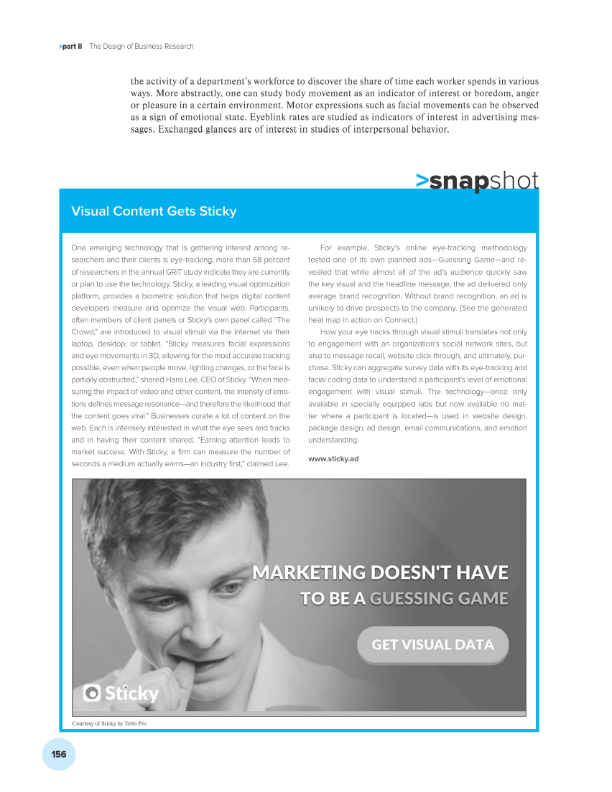
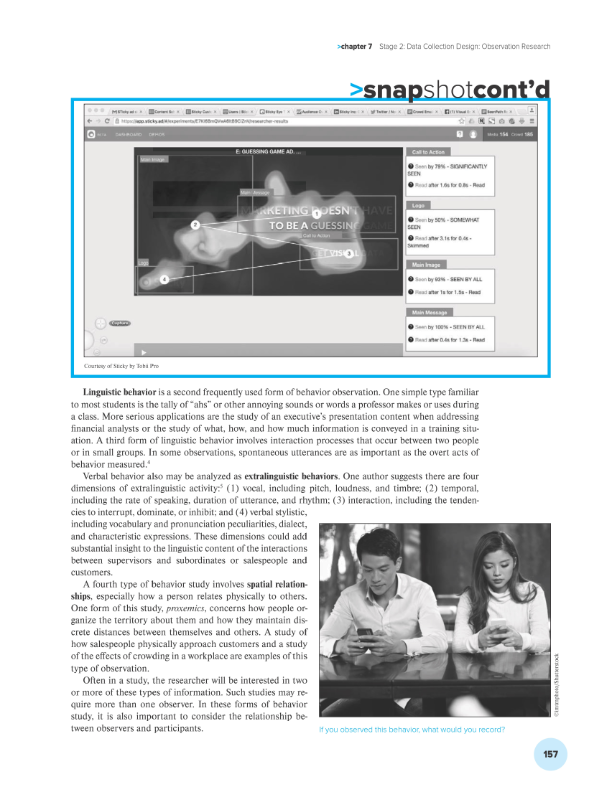
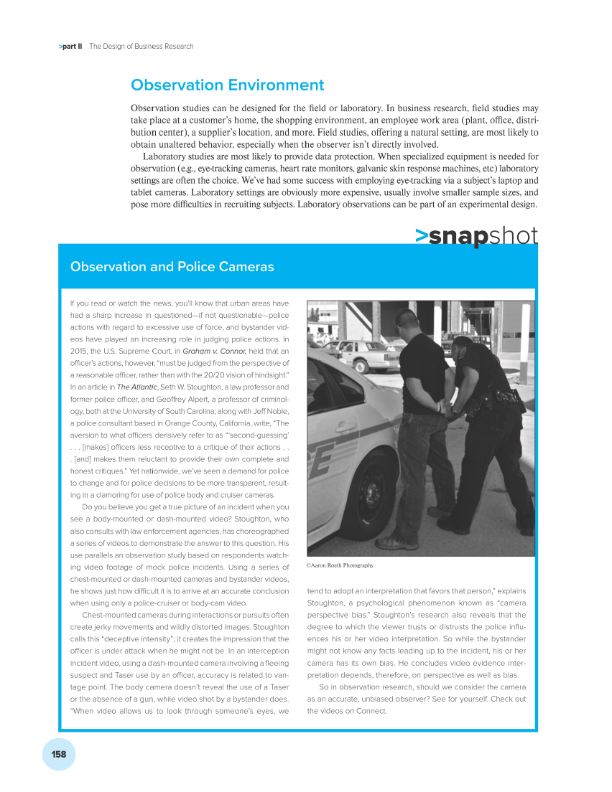
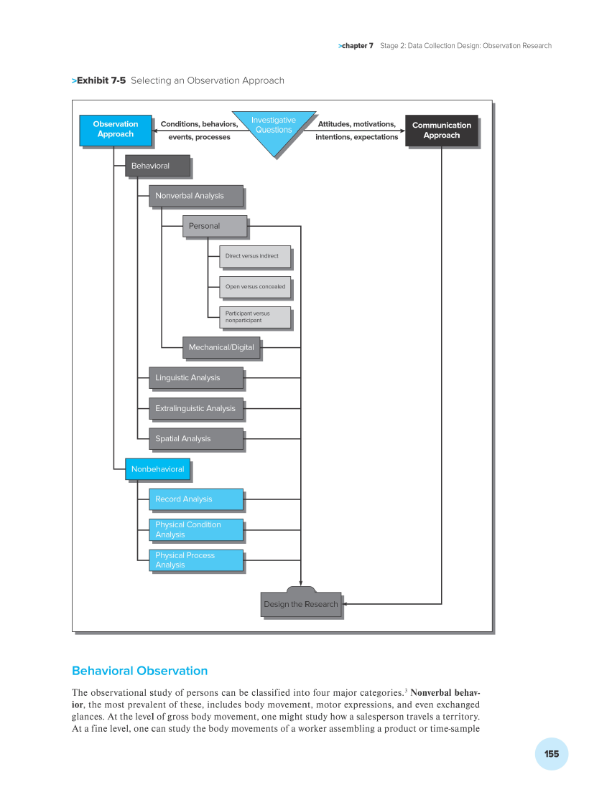
part The Design of Business Research the activity of a department's workforce to discover the share of time each worker spends in various ways. More abstractly, one can study body movement as an indicator of interest or boredom, anger or pleasure in a certain environment. Motor expressions such as facial movements can be observed as a sign of emotional state. Eyeblink rates are studied as indicators of interest in advertising mes- sages. Exchanged glances are of interest in studies of interpersonal behavior. >snapshot Visual Content Gets Sticky One emerging technology that is gathering interest among re- searchers and their clients is eye tracking more than 58 percent of researchers in the annual GRIT study indicate they are currently or plan to use the technology Sticky, a leading visual optimization platform, provides a biometric solution that helps digital content developers measure and optimize the visual web. Participants, often members of client panels or Sucky's own panel called "The Crowd are introduced to visual stimuli via the Internet via their laptop desktop or tablet "Sticky measures facial expressions and eye movements in 3D, allowing for the most accurate tracking possible, even when people move, lighting changes, or the face is partially obstructed."shared Hans Lee, CEO of Sticky "When mes suring the impact of video and other content, the intensity of emo tions defines message resonance and therefore the likelihood that the content goes viral Businesses curate a lot of content on the web Each is intensely interested in what the eye sees and tracks and in having their content shared "Earning attention leads to market success. With Sticky, a firm can measure the number of seconds a medium actually ears an industry first claimed Lee For example. Sticky's online eye tracking methodology tested one of its own planned ads-Guessing Game andre vealed that while almost al of the ad's audience quickly saw the key visual and the headline message, the ad deivered only average brand recognition. Without brand recognition, an ad is unlikely to drive prospects to the company. (See the generated heatmap in action on Connect) How your eye tracks through visual stimuli translates not only to engagement with an organization's social network sites, but also to message recall website click through and ultimately, pur chase. Sticky can aggregate survey data with its eye tracking and facial coding data to understand a participant's level of emotional engagement with visual stimull The technology once only available in specially equipped labs but now avalable no mat- ter where a participant is located is used in website design package design ad design, email communications, and emotion understanding www.sticky ad MARKETING DOESN'T HAVE TO BE A GUESSING GAME GET VISUAL DATA O Sticky Caunesy of Sikky by TP 156 chapter 7 Stage 2: Data Collection Design: Observation Research >snapshotcont'd chuhe QUEBING GAME AD 79-SON CAVITY RKETING OESN'T HAVE TO BE A GUESSINE by BMW SEEN ETVISNO by-SENSYALL CouTuy Sticky by The Pro Linguistic behavior is a second frequently used form of behavior observation. One simple type familiar to most students is the tally of ahs" or other annoying sounds or words a professor makes or uses during a class. More serious applications are the study of an executive's presentation content when addressing financial analysts or the study of what, how, and how much information is conveyed in a training situ- ation. A third form of linguistic behavior involves interaction processes that occur between two people or in small groups. In some observations, spontaneous utterances are as important as the overt acts of behavior measured Verbal behavior also may be analyzed as extralinguistic behaviors. One author suggests there are four dimensions of extralinguistic activity: (1) vocal, including pitch, loudness, and timbre (2) temporal, including the rate of speaking, duration of utterance and rhythm: (3) interaction, including the tenden cies to interrupt, dominate, or inhibit; and (4) verbal stylistic, including vocabulary and pronunciation peculiarities, dialect, and characteristic expressions. These dimensions could add substantial insight to the linguistic content of the interactions between supervisors and subordinates or salespeople and customers. A fourth type of behavior study involves spatial relation- ships, especially how a person relates physically to others. One form of this study, proxemics, concerns how people or ganize the territory about them and how they maintain dis- crete distances between themselves and others. A study of how salespeople physically approach customers and a study of the effects of crowding in a workplace are examples of this type of observation Often in a study, the researcher will be interested in two or more of these types of information. Such studies may re- quire more than one observer. In these forms of behavior study, it is also important to consider the relationship be tween observers and participants, if you observed this behavior, what would you record? 157 part I The Design of Business Research Observation Environment Observation studies can be designed for the field or laboratory. In business research, field studies may take place at a customer's home, the shopping environment, an employee work area (plant, office, distri bution center), a supplier's location, and more. Field studies, offering a natural setting, are most likely to obtain unaltered behavior, especially when the observer isn't directly involved. Laboratory studies are most likely to provide data protection. When specialized equipment is needed for observation (eg, eye tracking cameras, heart rate monitors, galvanic skin response machines, etc) laboratory settings are often the choice. We've had some success with employing eye tracking via a subject's laptop and tablet cameras. Laboratory settings are obviously more expensive, usually involve smaller sample sizes, and pose more difficulties in recruiting subjects. Laboratory observations can be part of an experimental design. >snapshot Observation and Police Cameras you read or watch the news, you'll know that urban areas have had a sharp increase in questioned if not questionable police actions with regard to excessive use of force, and bystander vid eos have played an increasing role in judging police actions in 2015, the U.S. Supreme Court, in Graham . Connor, held that en oficer's actions, however, "must be judged from the perspective of a reasonable officer, rather than with the 2020 vision of hindsight." In an article in the Atlantic, Seth W. Stoughton, a lew professor and former police officer, and Geoffrey Alpert, a professor of criminal ogy, both at the University of South Carolina, along with Jeff Noble, a police consultant based in Orange County, California, write, The aversion to what officers dersively refer to assecond guessing ... [makes] omers less receptive to a critique of their actions.. and makes them reluctant to provide their own complete and honest critiques et nationwide, we've seen a demand for police to change and for police decisions to be more transparent, result ing in a clamoring for use of police body and cruiser cameras Do you believe you get a true picture of an incident when you see a body mounted or dash-mounted video? Stoughton, who also consults with law enforcement agencies, has choreographed a series of videos to demonstrate the answer to this question. His use parallels en observation study based on respondents watch- ing video footage of mock police incidents Using a series of chest mounted or dash-mounted cameras and bystander videos, he shows just how difficult it is to arrive at an accurate conclusion when using only a police-cruiser or body-com video Chest-mounted cameras during interactions or pursuit often create jerky movements and wildly distorted images. Stoughton calls this deceptive intensity"It creates the impression that the officer is under attack when he might not be. In an interception incident video, using adesh-mounted camera involving a fleeing suspect and Taser use by an officer, accuracy is related to van tage point. The body camere doesnt reveal the use of a Taser or the absence of a gun, while video shot by a bystander does. When video allows us to look through someone's eyes, we Caron Roth tend to adopt an interpretation that favors that person explains Stoughton, a psychological phenomenon known as "camera perspective blas." Stoughton's research also reveals that the degree to which the viewer trusts or distrust the police influ ences his or her video interpretation. So while the bystander might not know any facts leading up to the incident, his or her camera has its own bias. He concludes video evidence inter pretation depends, therefore, on perspective as well as bias. So in observation research, should we consider the camera as an accurate, unbiased observer? See for yourself Check out the videos on Connect 158 chapter 7 Stage 2: Data Collection Design: Observation Research >Exhibit 7-5 Selecting an Observation Approach Observation Approach Conditions, behaviors. events, processes Investigative Questions Attitudes, motivations intentions, expectations Communication Approach Behavioral Nonverbal Analysis Personal Drala Open vas concealed Portress ramparainars Mechanical Digital Linguistic Analysis Extralinguistic Analysis Spatial Analysis . Nonbehevioral Record Analysis Physical Condition Analysis Physical Process Analysis Design the Research Behavioral Observation The observational study of persons can be classified into four major categories. Nonverbal behav- ior, the most prevalent of these includes body movement, motor expressions, and even exchanged glances. At the level of gross body movement, one might study how a salesperson travels a territory. At a fine level, one can study the body movements of a worker assembling a product or time-sample 155)









 Study Help