





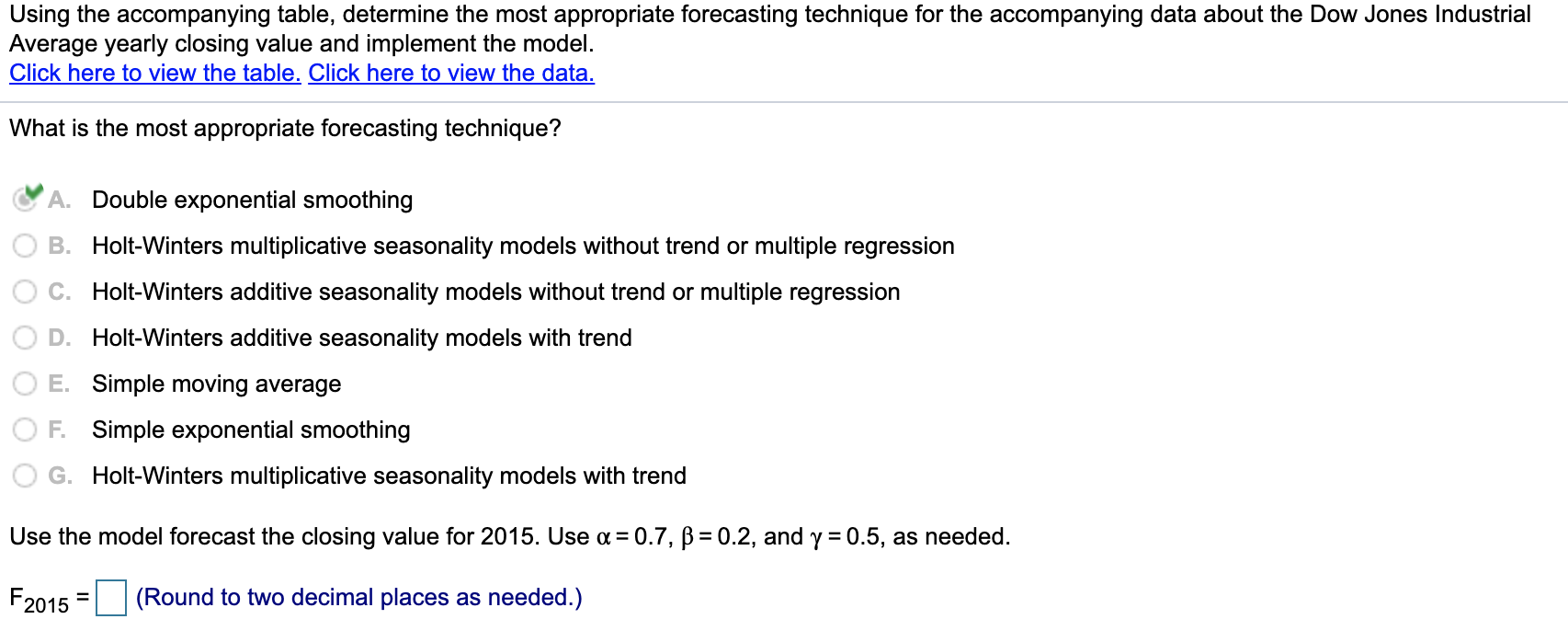
Question: Using the accompanying table, determine the most appropriate forecasting technique for the accompanying data about the Dow Jones Industrial Average yearly closing value and implement
Using the accompanying table, determine the mostUsing the accompanying table, determine the mostUsing the accompanying table, determine the most

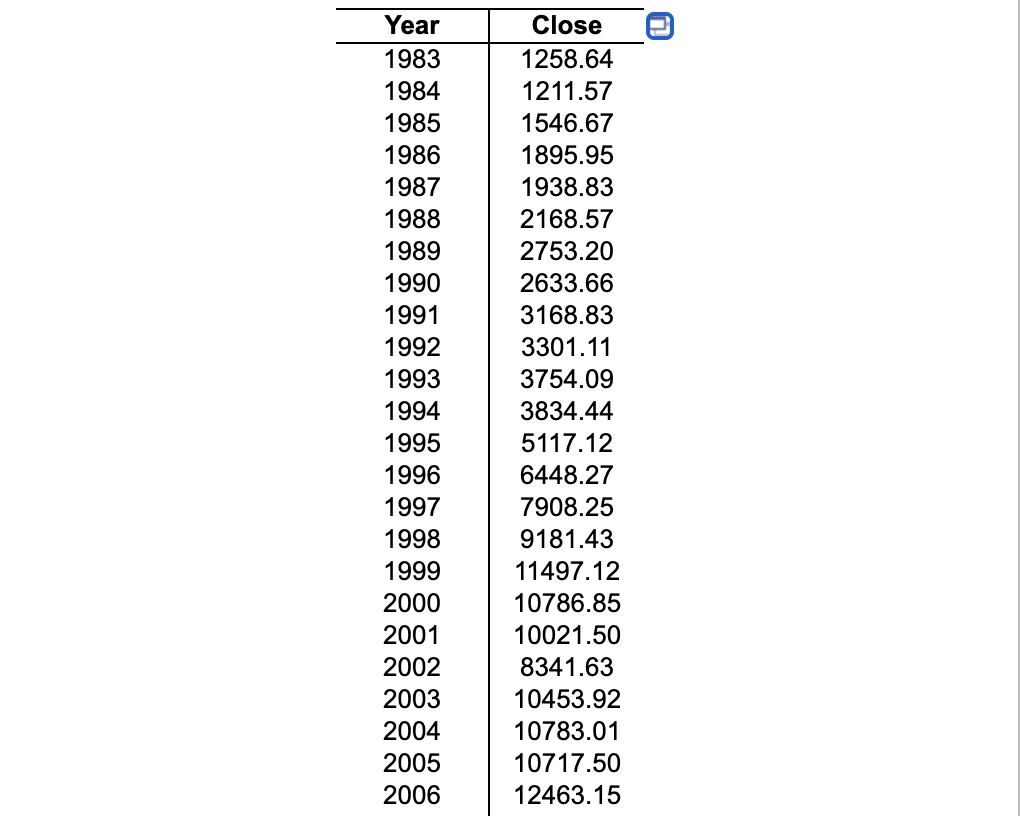
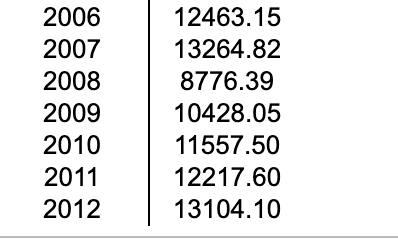
Using the accompanying table, determine the most appropriate forecasting technique for the accompanying data about the Dow Jones Industrial Average yearly closing value and implement the model. Click here to view the table. Click here to view the data. What is the most appropriate forecasting technique? A. Double exponential smoothing B. Holt-Winters multiplicative seasonality models without trend or multiple regression C. Holt-Winters additive seasonality models without trend or multiple regression D. Holt-Winters additive seasonality models with trend E. Simple moving average F. Simple exponential smoothing Holt-Winters multiplicative seasonality models with trend Use the model forecast the closing value for 2015. Use a = = 0.7, p = 0.2, and y=0.5, as needed. F2015 = (Round to two decimal places as needed.) Year 1983 1984 1985 1986 1987 1988 1989 1990 1991 1992 1993 1994 1995 1996 1997 1998 1999 2000 2001 2002 2003 2004 2005 2006 Close 1258.64 1211.57 1546.67 1895.95 1938.83 2168.57 2753.20 2633.66 3168.83 3301.11 3754.09 3834.44 5117.12 6448.27 7908.25 9181.43 11497.12 10786.85 10021.50 8341.63 10453.92 10783.01 10717.50 12463.15 2006 2007 2008 2009 2010 2011 2012 12463.15 13264.82 8776.39 10428.05 11557.50 12217.60 13104.10 Using the accompanying table, determine the most appropriate forecasting technique for the accompanying data about the Dow Jones Industrial Average yearly closing value and implement the model. Click here to view the table. Click here to view the data. What is the most appropriate forecasting technique? A. Double exponential smoothing B. Holt-Winters multiplicative seasonality models without trend or multiple regression C. Holt-Winters additive seasonality models without trend or multiple regression D. Holt-Winters additive seasonality models with trend E. Simple moving average F. Simple exponential smoothing Holt-Winters multiplicative seasonality models with trend Use the model forecast the closing value for 2015. Use a = = 0.7, p = 0.2, and y=0.5, as needed. F2015 = (Round to two decimal places as needed.) Year 1983 1984 1985 1986 1987 1988 1989 1990 1991 1992 1993 1994 1995 1996 1997 1998 1999 2000 2001 2002 2003 2004 2005 2006 Close 1258.64 1211.57 1546.67 1895.95 1938.83 2168.57 2753.20 2633.66 3168.83 3301.11 3754.09 3834.44 5117.12 6448.27 7908.25 9181.43 11497.12 10786.85 10021.50 8341.63 10453.92 10783.01 10717.50 12463.15 2006 2007 2008 2009 2010 2011 2012 12463.15 13264.82 8776.39 10428.05 11557.50 12217.60 13104.10
Step by Step Solution

There are 3 Steps involved in it

1 Expert Approved Answer
Step: 1 Unlock blur-text-image

Question Has Been Solved by an Expert!

Get step-by-step solutions from verified subject matter experts

Step: 2 Unlock
Step: 3 Unlock

Students Have Also Explored These Related General Management Questions!