







Question: Using the given table to calculate the product of unsigned 4-bit integers 9 and 5 based on the hardware described in Figure 3.5 (attached below).
Using the given table to calculate the product of unsigned 4-bit integers 9 and 5 based on the hardware described in Figure 3.5 (attached below). You should show the contents of Multiplicand and Product/multiplier on each step.
The multiplicand register is 4 bits wide, and the product register is 8 bits wide. There is no separate register for Multiplier. The multiplier, 4 bits wide, is placed in the right half of the product register.
You can refer the steps in Figure 3.6 (attached below) to fill the table. Please note the registers in Figure 3.6 are different from those in the table. However, the steps are similar. 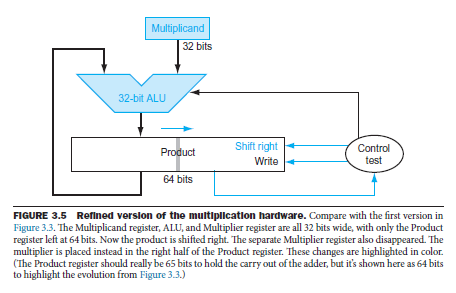
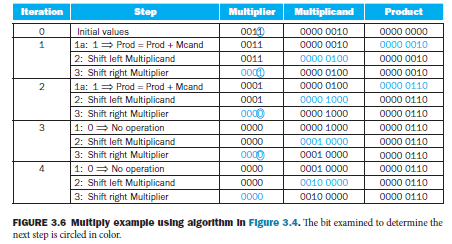
Multiplicand 32 bits 32-bit ALU Shift right Contro test 44 bi FIGURE 3.5 Refined verslon of the multipllcation hardware. Compare with the first version in Figure 3.3. The Multiplicand register, ALU, and Multiplier register are all 32 bits wide, with only the Product register left at 64 bits. Now the product is shifted right. The separate Multiplier register also disappeared. The multiplier is placed instead in the right half of the Product register. These changes are highlighted in color. (The Product register should really be 65 bits to hold the carry out of the adder, but it's shown here as 64 bits to highlight the evolution from Figure 3.3.)
Step by Step Solution
There are 3 Steps involved in it

Get step-by-step solutions from verified subject matter experts
 Study Help