







Question: What is the instructional sequence for lesson 1 Lesson 1: Unit Topic: Algebra - Solving Linear Equations Standards: MA 11.2.2.d Perform operations on rational expressions
What is the instructional sequence for lesson 1
Lesson 1:
Unit Topic: Algebra - Solving Linear Equations
Standards:MA 11.2.2.d Perform operations on rational expressions (add, subtract, multiply, divide, and simplify)
This sequence of three lessons is designed to help students understand how to solve linear equations, addressing both basic and more advanced concepts as the lessons progress.
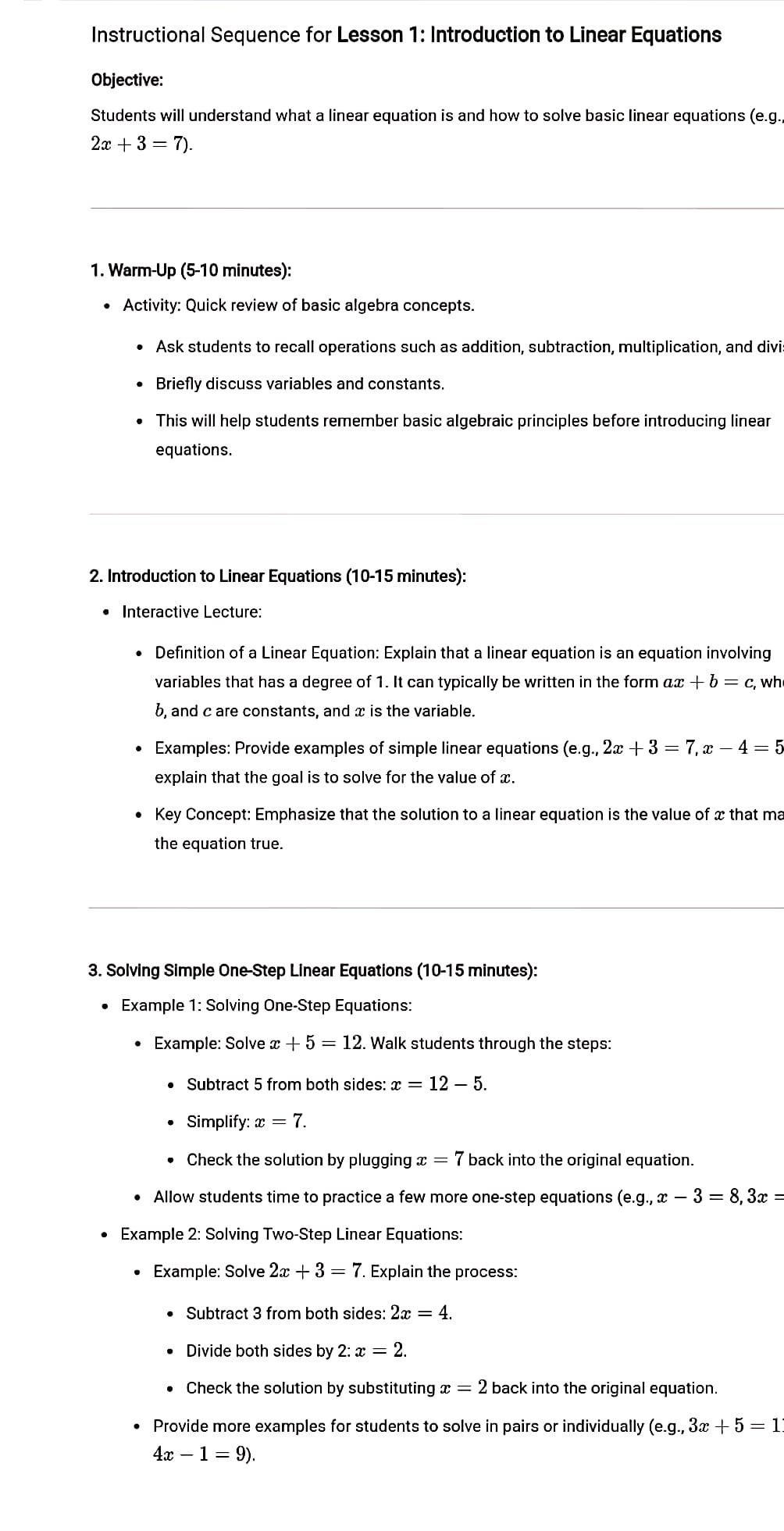
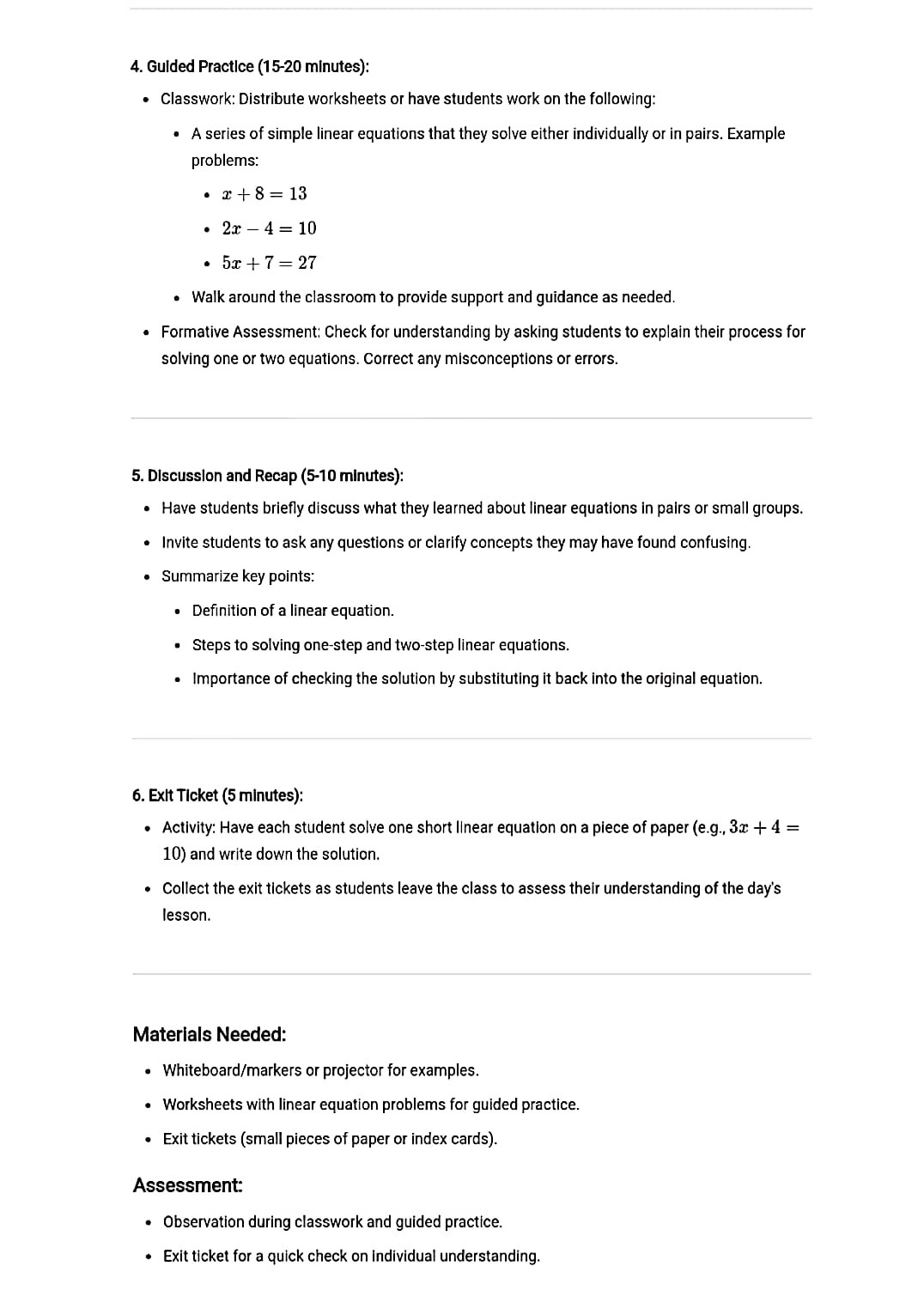
Lesson 1: Introduction to Linear Equations
- Objective: Students will understand what a linear equation is and how to solve basic linear equations (e.g., 2x+3=72x + 3 = 72x+3=7).
- Activities:
- Interactive lecture on the definition of a linear equation.
- Examples of solving simple one-step and two-step linear equations.
- Classwork: Solving equations individually and in pairs.
Instructional Sequence for Lesson 2 and 3:
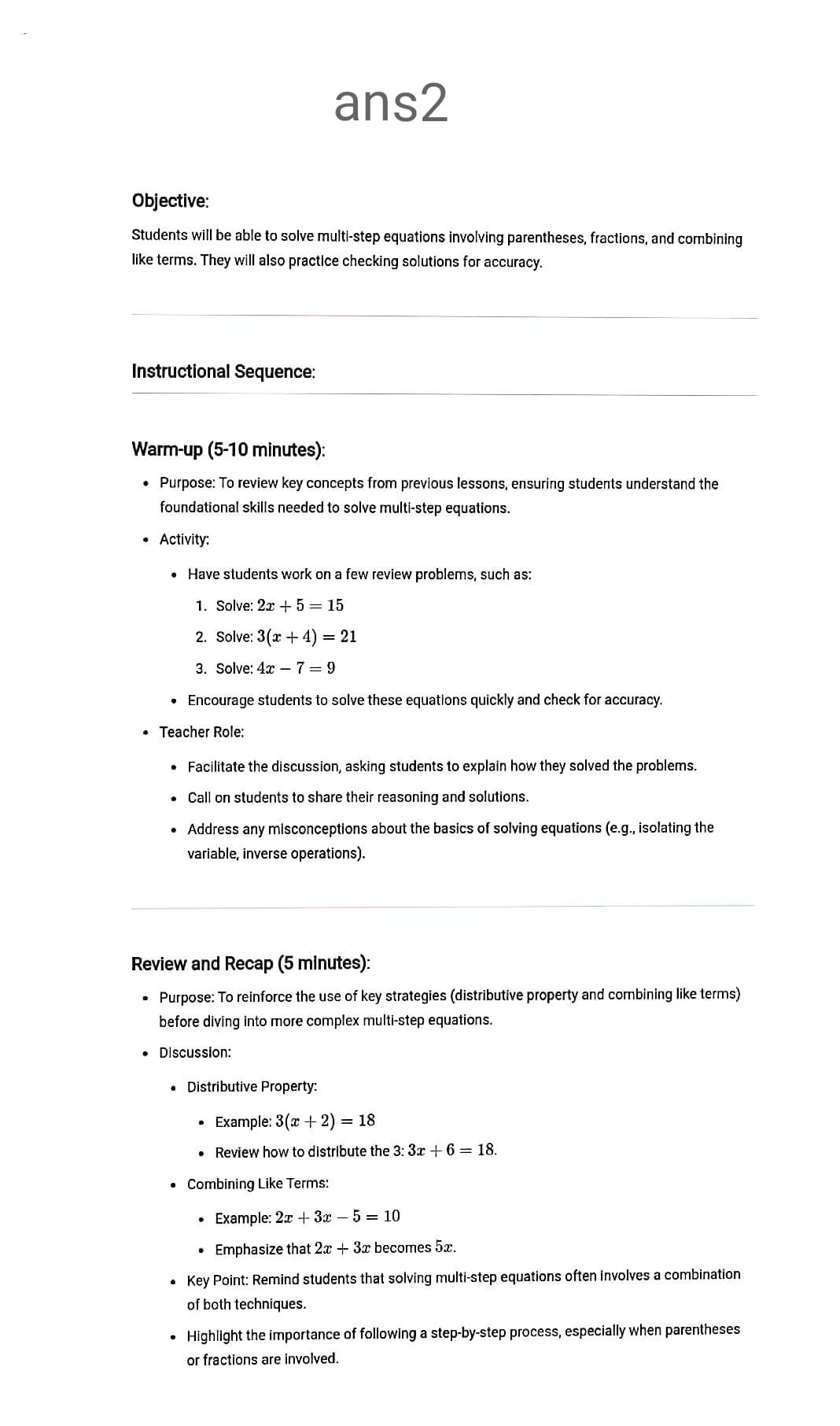
Lesson 2: Solving Multi-Step Equations
Instructional Sequence:
- Warm-up (5-10 minutes):
- Students will work on warm-up questions that focus on reviewing key concepts from previous lessons, like solving basic multi-step equations.
- Teacher facilitates discussion, calling on students to explain their reasoning and solutions.
- Review and Recap (5 minutes):
- Review the distributive property and combining like terms, explaining their relevance to solving multi-step equations.
- Discuss key points from the previous lesson and emphasize the step-by-step process.
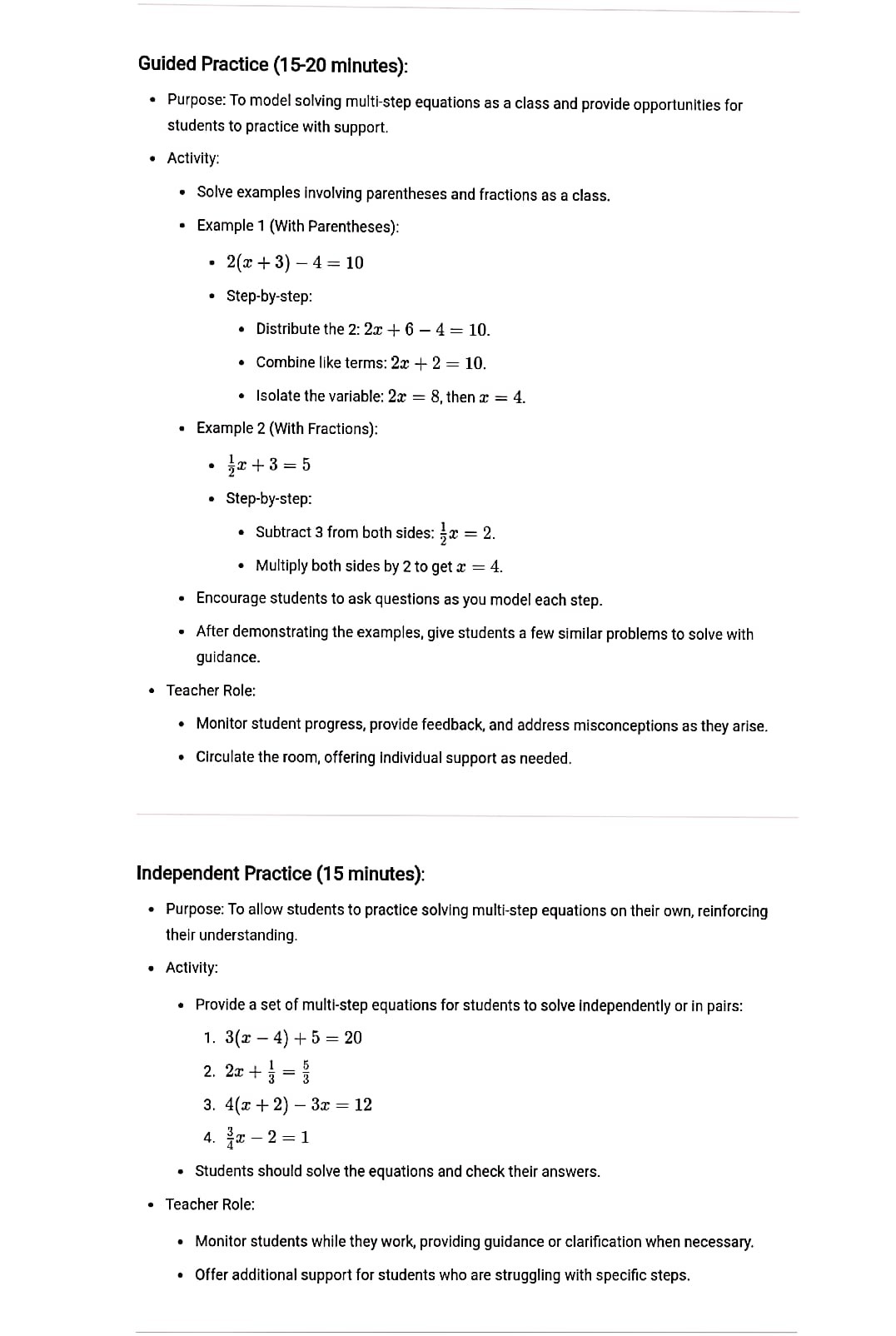
- Guided Practice (15-20 minutes):
- Solve multi-step equations involving parentheses and fractions as a class, with teacher modeling the steps and explaining each one.
- Students work through examples while the teacher checks for understanding and addresses misconceptions.
- Independent Practice (15 minutes):
- Students solve a set of multi-step equations individually or in pairs.
- Teacher monitors progress and assists as needed.
- Class Discussion (10 minutes):
- Focus on the importance of checking solutions by substituting the values back into the equations to verify accuracy.
- Encourage students to discuss common errors and how to avoid them.
- Closure (5 minutes):
- Recap the key steps in solving multi-step equations, ensuring students understand the process.
Lesson 3: Solving Word Problems Using Linear Equations
Instructional Sequence:
- Warm-up (5-10 minutes):
- Review previous concepts related to solving multi-step equations.
- Ask students to think of examples where math could help in everyday decision-making (e.g., budgeting).
- Introduction to Word Problems (10 minutes):
- Teacher introduces how to model word problems with linear equations.
- Discuss keywords that indicate the need for linear equations (e.g., "total," "sum," "difference").
- Use real-life examples, such as calculating the total cost of items including tax.
- Guided Practice (15-20 minutes):
- Work through a few word problems as a class, modeling how to set up and solve linear equations based on the problem's context.
- Emphasize identifying variables, setting up equations, and solving for unknowns.
- Group Activity (15 minutes):
- Students work in small groups to solve additional word problems using linear equations.
- Encourage collaboration and discussion within the groups, and monitor progress by circulating the room.
- Exit Ticket (5 minutes):
- Students individually solve a real-world word problem using a linear equation and submit it as an exit ticket.
- Review one or two exit ticket problems with the class if time permits.
This sequence provides a smooth transition from solving equations in abstract forms (Lesson 2) to applying those skills in real-world contexts (Lesson 3).
Explanation:
Instructional Sequence for Lesson 2 and 3:
Lesson 2: Solving Multi-Step Equations
Unit Topic: Solving Multi-Step Equations
Standards: MA 11.2.2.h Analyze and solve systems of two linear equations and inequalities in two variables algebraically and graphically.
Objective:
- Students will learn to solve multi-step equations involving parentheses and fractions.
Engagement Hook:
- Welcome students by asking about their day.
- Have two or three warm-up questions on the board related to multi-step equations for students to work on.
Instructional Sequence:
- Warm-up (5-10 minutes):
- Students will work on warm-up questions that focus on reviewing key concepts from previous lessons, like solving basic multi-step equations.
- Teacher facilitates discussion, calling on students to explain their reasoning and solutions.
- Review and Recap (5 minutes):
- Review the distributive property and combining like terms, explaining their relevance to solving multi-step equations.
- Discuss key points from the previous lesson and emphasize the step-by-step process.
- Guided Practice (15-20 minutes):
- Solve multi-step equations involving parentheses and fractions as a class, with teacher modeling the steps and explaining each one.
- Students work through examples while the teacher checks for understanding and addresses misconceptions.
- Independent Practice (15 minutes):
- Students solve a set of multi-step equations individually or in pairs.
- Teacher monitors progress and assists as needed.
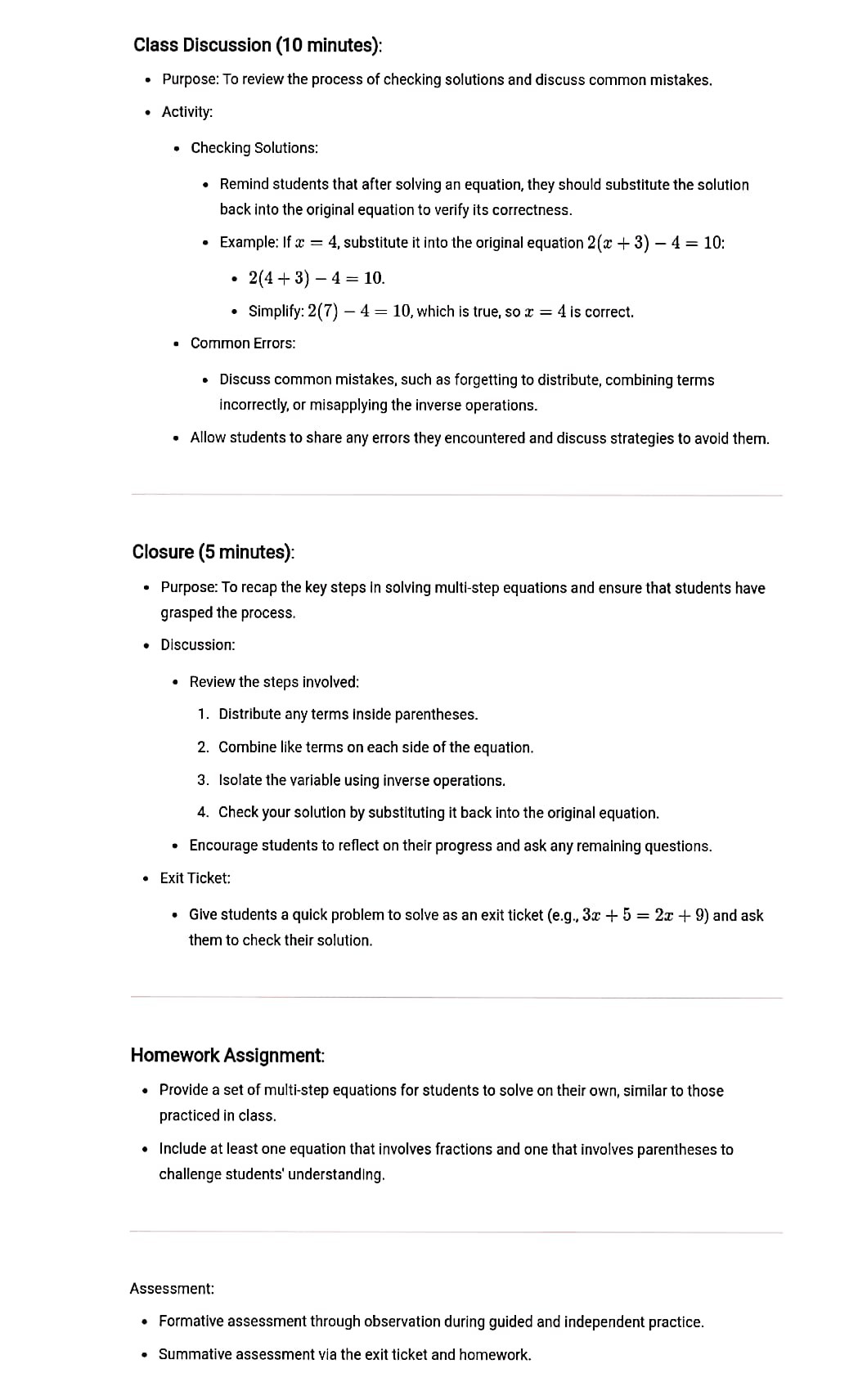
- Class Discussion (10 minutes):
- Focus on the importance of checking solutions by substituting the values back into the equations to verify accuracy.
- Encourage students to discuss common errors and how to avoid them.
- Closure (5 minutes):
- Recap the key steps in solving multi-step equations, ensuring students understand the process.
Lesson 3: Solving Word Problems Using Linear Equations
Unit Topic: Solving Word Problems Using Linear Equations
Standards: MA 11.2.1 All Standards within Algebraic Relationships: Students will demonstrate, represent, and show relationships with functions.
Objective:
- Students will apply their knowledge of linear equations to solve word problems.
Instructional Sequence:
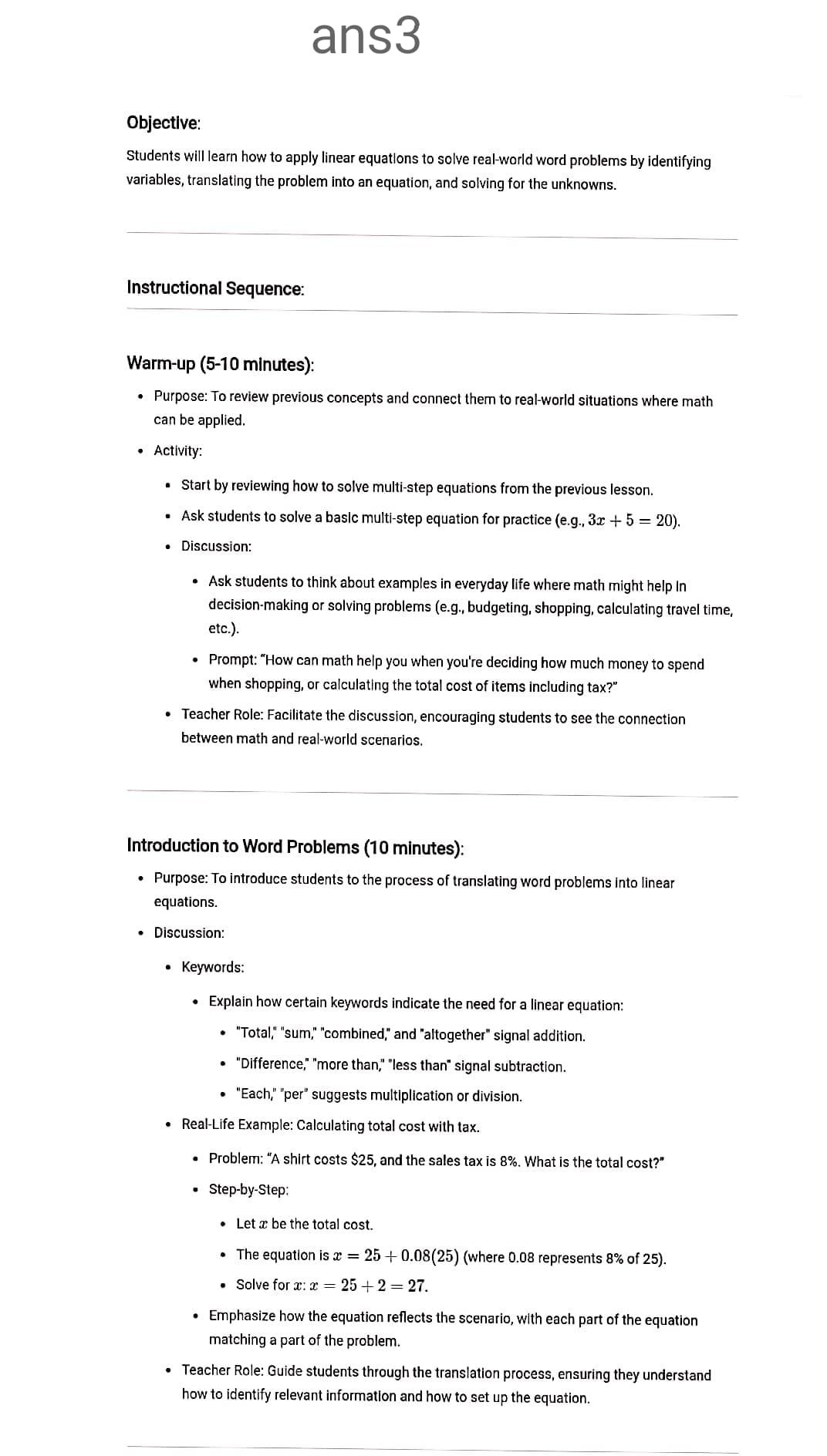
- Warm-up (5-10 minutes):
- Review previous concepts related to solving multi-step equations.
- Ask students to think of examples where math could help in everyday decision-making (e.g., budgeting).
- Introduction to Word Problems (10 minutes):
- Teacher introduces how to model word problems with linear equations.
- Discuss keywords that indicate the need for linear equations (e.g., "total," "sum," "difference").
- Use real-life examples, such as calculating the total cost of items including tax.
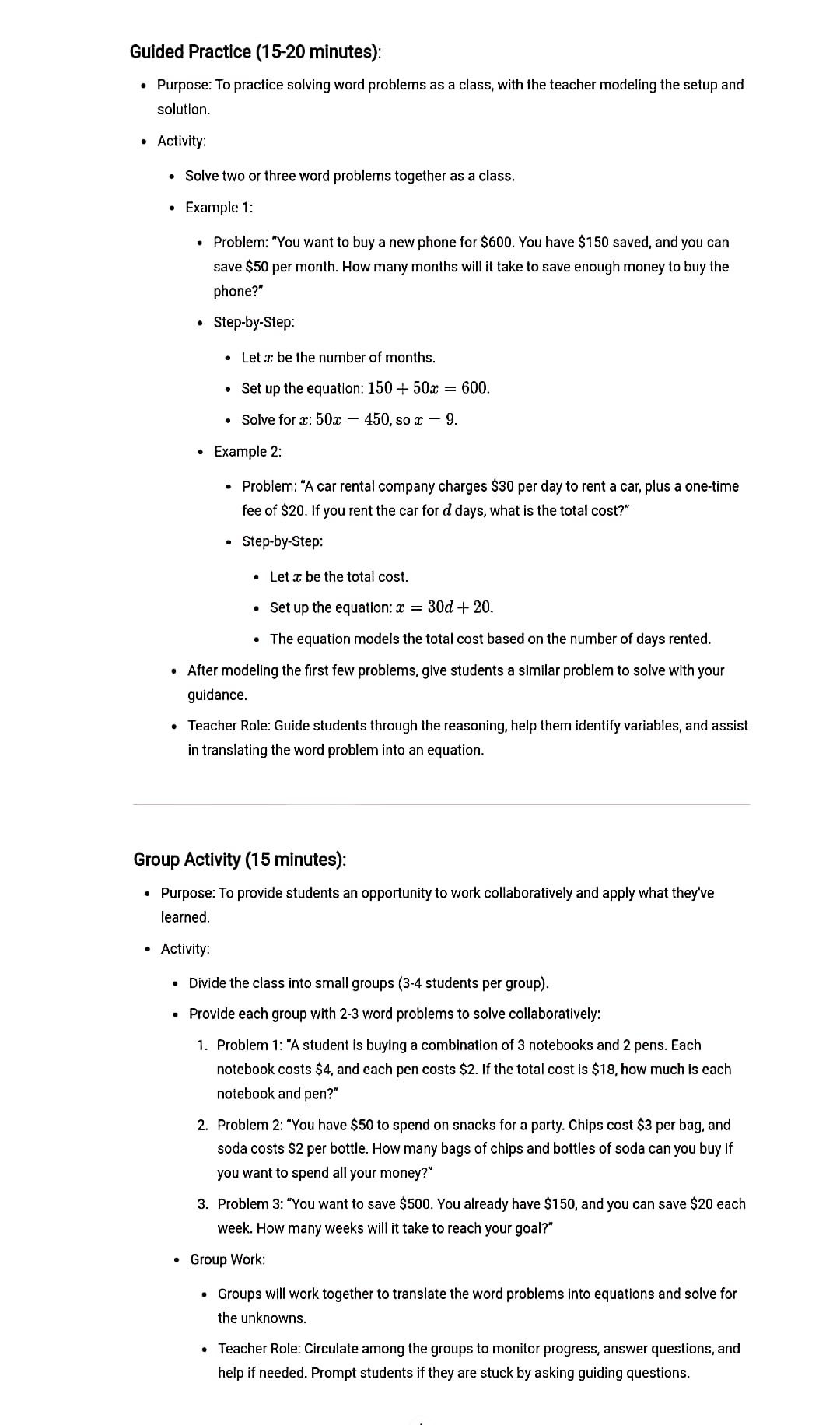
- Guided Practice (15-20 minutes):
- Work through a few word problems as a class, modeling how to set up and solve linear equations based on the problem's context.
- Emphasize identifying variables, setting up equations, and solving for unknowns.
- Group Activity (15 minutes):
- Students work in small groups to solve additional word problems using linear equations.
- Encourage collaboration and discussion within the groups, and monitor progress by circulating the room.
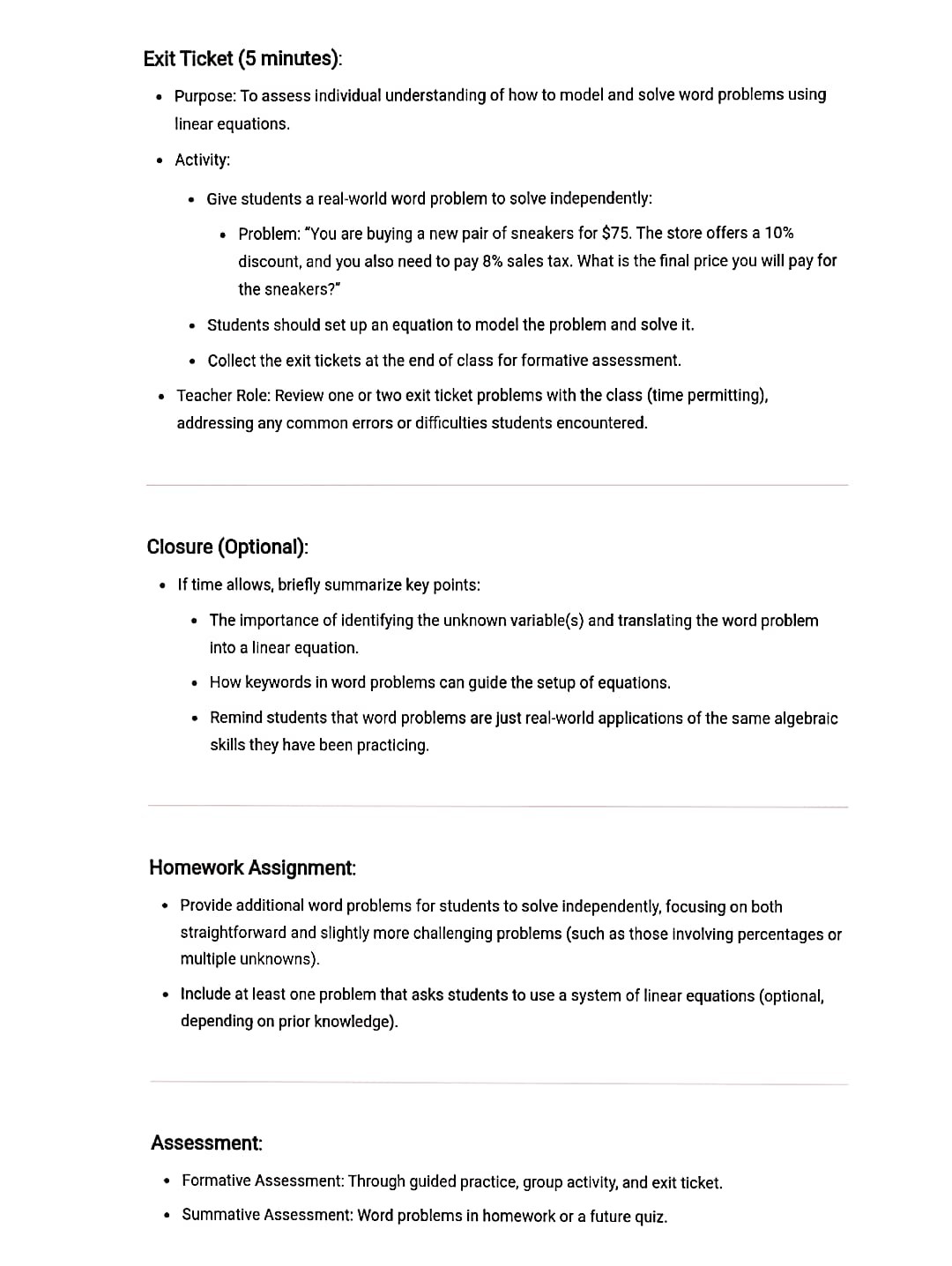
- Exit Ticket (5 minutes):
- Students individually solve a real-world word problem using a linear equation and submit it as an exit ticket.
- Review one or two exit ticket problems with the class if time permits.
This sequence provides a smooth transition from solving equations in abstract forms (Lesson 2) to applying those skills in real-world contexts (Lesson 3).
Instructional Sequence for Lesson 1: Introduction to Linear Equations Objective: Students will understand what a linear equation is and how to solve basic linear equations (e.g., 2043=T1). 1. Warm-Up (5-10 minutes): Activity: Quick review of basic algebra concepts. + Ask students to recall operations such as addition, subtraction, multiplication, and divi: Briefly discuss variables and constants. * This will help students remember basic algebraic principles before introducing linear equations. 2. Introduction to Linear Equations (10-15 minutes): = Interactive Lecture: Definition of a Linear Equation: Explain that a linear equation is an equation involving variables that has a degree of 1. It can typically be written in the form az + b = , whi b, and are constants, and z is the variable. Examples: Provide examples of simple linear equations (e.g., 2z +3 =7,z 4=295 explain that the goal is to solve for the value of z. Key Concept: Emphasize that the solution to a linear equation is the value of z that ma the equation true. 3. Solving Simple One-Step Linear Equations (10-15 minutes): Example 1: Solving One-Step Equations: Example: Solve + 5 = 12. Walk students through the steps: s Subtract 5 from both sides: z = 12 5. s Simplify:z = T. Check the solution by plugging = = 7 back into the original equation. Allow students time to practice a few more one-step equations (e.g.,. 2z 3 = 8,3z = + Example 2: Solving Two-Step Linear Equations: Example: Solve 2z + 3 = 7. Explain the process: Subtract 3 from both sides: 2z = 4. = Divide both sidesby 2: z = 2. = Check the solution by substituting = = 2 back into the original equation. Provide more examples for students to solve in pairs or individually (e.g, 3z +5 = 1. 4x1=9). 4. Gulded Practice (15-20 minutes): Classwork: Distribute worksheets or have students work on the following: A series of simple linear equations that they solve either individually or in pairs. Example problems: 4+8=13 2r4=10 o Sx4T7=27 Walk around the classroom to provide support and guidance as needed. Formative Assessment: Check for understanding by asking students to explain their process for solving one or two equations. Correct any misconceptions or errors. 5. Discusslon and Recap (5-10 minutes): = Have students briefly discuss what they learned about linear equations in palrs or small groups. Invite students to ask any questions or clarify concepts they may have found confusing. e Summarize key points: Definition of a linear equation. = Steps to solving one-step and two-step linear equations. = Importance of checking the solution by substituting it back into the original equation. 6. Exlt Ticket (5 minutes): Activity: Have each student solve one short linear equation on a piece of paper (e.g., 3z + 4 = 10) and write down the solution. Collect the exit tickets as students leave the class to assess their understanding of the day's lesson. Materials Needed: Whiteboard/markers or projector for examples. Worksheets with linear equation problems for guided practice. Exit tickets (small pieces of paper or index cards). Assessment: Observation during classwork and guided practice. Exit ticket for a quick check on Individual understanding. ans? Objective: Students will be able to solve multi-step equations involving parentheses, fractions, and combining like terms. They will also practice checking solutions for accuracy. Instructional Sequence: Warm-up (5-10 minutes): + Purpose: To review key cancepts from previous lessons, ensuring students understand the foundational skills needed 1o solve multi-step equations. = Activity: Have students work on a few review problems, such as: 1. Solve:2x +5=15 2. Solve:3(x +4) =21 3. Solve:dz T=9 Encourage students to solve these equations quickly and check for accuracy. Teacher Role: Facilitate the discussion, asking students to explain how they solved the problems. Call on students to share their reasoning and solutions. Address any misconceptions about the basics of solving equations (e.g., isolating the variable, inverse operations). Review and Recap (5 minutes): = Purpose: To reinforce the use of key strategies (distributive property and combining like terms) before diving into more complex multi-step equations. = Discussion: Distributive Property: Example: 3(z 4 2) = 18 Review how to distribute the 3: 3z + 6 = 18. Combining Like Terms: o Example: 2z + 3z 5 =10 + Emphasize that 2 + 3z becomes 5. Key Point: Remind students that solving multi-step equations often involves a combination of both techniques. Highlight the impartance of following a step-by-step process, especially when parentheses or fractions are involved. Guided Practice (15-20 minutes): * Purpose: To model solving multi-step equations as a class and provide opportunities for students to practice with support, * Activity: Solve examples involving parentheses and fractions as a class. = Example 1 (With Parentheses): 2(z+3)-4=10 * Step-by-step: + Distribute the 2: 2z + 6 4 = 10. s Combine like terms: 22 + 2 = 10. |solate the variable; 2z = 8,thenz = 4. Example 2 (With Fractions): . %:r +3=5 Step-by-step: = Subtract 3 from both sides: %x = 2. Multiply both sides by 2to get x = 4. = Encourage students to ask questions as you model each step. = After demonstrating the examples, give students a few similar problems to solve with guidance. Teacher Role: Monitor student progress, provide feedback, and address misconceptions as they arise. Circulate the room, offering Individual support as needed. Independent Practice (15 minutes): = Purpose: To allow students to practice solving multi-step equations on their own, reinforcing their understanding. Activity: Provide a set of multi-step equations for students to solve independently or in pairs: 1. 3(z4)+5=20 2 2r+1=1 3 4(z+2)-3z=12 3 _ = Students should solve the equations and check their answers. Teacher Role; Monitor students while they work, providing guidance or clarification when necessary. Offer additional support for students who are struggling with specific steps. Class Discussion (10 minutes): = Purpose: To review the process of checking solutions and discuss common mistakes. Activity: Checking Solutions: Remind students that after solving an equation, they should substitute the solution back into the original equation to verify its correctness. = Example: If & = 4, substitute it into the original equation 2(z + 3) 4 = 10 e 2(4+3)4=10. Simplify: 2(7) 4 = 10, which is true, so z = 4 is correct. = Common Errors: = Discuss common mistakes, such as forgetting to distribute, combining terms incorrectly, or misapplying the inverse operations. Allow students to share any errors they encountered and discuss strategies to avoid them. Closure (5 minutes): Purpose: To recap the key steps In solving multi-step equations and ensure that students have grasped the process, Discussion: Review the steps involved: 1. Distribute any terms inside parentheses. 2. Combine like terms on each side of the equation. 3. Isolate the variable using inverse operations. 4. Check your solution by substituting it back into the original equation. = Encourage students to reflect on their progress and ask any remaining questions. = Exit Ticket: + Give students a quick problem to solve as an exit ticket (e.q,, 3 + b = 2z + 9) and ask them to check their solution. Homework Assignment: Provide a set of multi-step equations for students to solve on their own, similar to those practiced in class. Include at least one equation that involves fractions and one that involves parentheses to challenge students' understanding. Assessment: + Formative assessment through observation during guided and independent practice. = Summative assessment via the exit ticket and homework. ans3 Objective: Students will learn how to apply linear equations to solve real-world word problems by identifying variables, translating the problem into an equation, and solving for the unknowns. Instructional Sequence: Warm-up (5-10 minutes): . Purpose: To review previous concepts and connect them to real-world situations where math can be applied. . Activity: . Start by reviewing how to solve multi-step equations from the previous lesson. . Ask students to solve a basic multi-step equation for practice (e.g., 3x + 5 = 20). . Discussion: . Ask students to think about examples in everyday life where math might help In decision-making or solving problems (e.g., budgeting, shopping, calculating travel time, etc.) . Prompt: "How can math help you when you're deciding how much money to spend when shopping, or calculating the total cost of items including tax?" . Teacher Role: Facilitate the discussion, encouraging students to see the connection between math and real-world scenarios. Introduction to Word Problems (10 minutes): . Purpose: To introduce students to the process of translating word problems into linear equations. . Discussion: . Keywords: . Explain how certain keywords indicate the need for a linear equation: . "Total," "sum," "combined," and "altogether" signal addition. . "Difference," "more than," "less than" signal subtraction. . "Each," "per" suggests multiplication or division. . Real-Life Example: Calculating total cost with tax. . Problem: "A shirt costs $25, and the sales tax is 8%. What is the total cost?" . Step-by-Step: . Let a be the total cost. The equation is a = 25 + 0.08(25) (where 0.08 represents 8% of 25). . Solve for x: 2 = 25 + 2 = 27. Emphasize how the equation reflects the scenario, with each part of the equation matching a part of the problem. . Teacher Role: Guide students through the translation process, ensuring they understand how to identify relevant information and how to set up the equation.Guided Practice (1520 minutes): Purpose: To practice solving word problems as a class, with the teacher modeling the setup and solutlion. s Activity: = Solve two or three word problems together as a class. + Example 1: Problem: \"You want to buy a new phone for $600. You have 150 saved, and you can save $50 per month. How many months will it take to save enough money to buy the phone?* Step-by-Step: Letx be the number of months. + Set up the equation: 150 + 50z = 600. Solve for z: 50z = 450,50z = 9. + Example 2: Problem: "A car rental company charges $30 per day to rent a car, plus a one-time fee of $20. If you rent the car for d days, what is the total cost?\" Step-by-Step: + Let z be the total cost. Setup the equation: z = 30d + 20. The equation models the total cost based on the number of days rented. After modeling the first few problems, give students a similar problem to solve with your guidance. Teacher Role: Guide students through the reasoning, help them identify variables, and assist in translating the word problem into an equation. Group Activity (15 minutes): Purpose: To provide students an opportunity to work collabaoratively and apply what they've learned. = Activity: Divide the class into small groups (3-4 students per group). Provide each group with 2-3 word problems to solve collaboratively: 1. Problem 1: "A student is buying a combination of 3 notebooks and 2 pens. Each notebook costs $4, and each pen costs $2. If the total cost is $18, how much is each notebook and pen?\" 2. Problem 2: \"You have $50 to spend on snacks for a party. Chips cost $3 per bag, and soda costs $2 per bottle. How many bags of chips and bottles of soda can you buy If you want to spend all your money?\" 3. Problem 3: "You want to save $500. You already have $150, and you can save $20 each week. How many weeks will it take to reach your goal?\" Group Work: Groups will work together to translate the word problems Into equations and solve for the unknowns. Teacher Role: Circulate among the groups to monitor progress, answer questions, and help if needed. Prompt students if they are stuck by asking guiding questions. Exit Ticket (5 minutes): Purpose: To assess individual understanding of how to model and solve word problems using linear equations. o Activity: = Give students a real-world word problem to solve independently: Problem: \"You are buying a new pair of sneakers for $75. The store offers a 10% discount, and you also need to pay 8% sales tax. What is the final price you will pay for the sneakers?\" = Students should set up an equation to model the problem and solve it. Collect the exit tickets at the end of class for formative assessment. Teacher Role: Review one or two exit ticket problems with the class (time permitting), addressing any common errors or difficulties students encountered. Closure (Optional): [f time allows, briefly summarize key points: The importance of identifying the unknown variable(s) and translating the word problem into a linear equation. + How keywords in word problems can guide the setup of equations. = Remind students that word problems are Just real-world applications of the same algebraic skills they have been practicing. Homework Assignment: Provide additional word problems for students to solve independently, focusing on both straightforward and slightly more challenging problems (such as those involving percentages or multiple unknowns). * Include at least one problem that asks students to use a system of linear equations (opticnal, depending on prior knowledge). Assessment: + Formative Assessment: Through guided practice, group actlvity, and exit ticket. Summative Assessment: Word problems in homework or a future quiz
Step by Step Solution
There are 3 Steps involved in it

Get step-by-step solutions from verified subject matter experts
 Study Help