







Question: Explain why the 2-bromo-4-methoxy-phenoxy benzyl ether product of this lab was prepared by first by electrophilic bromination followed by etherification, rather than the reverse
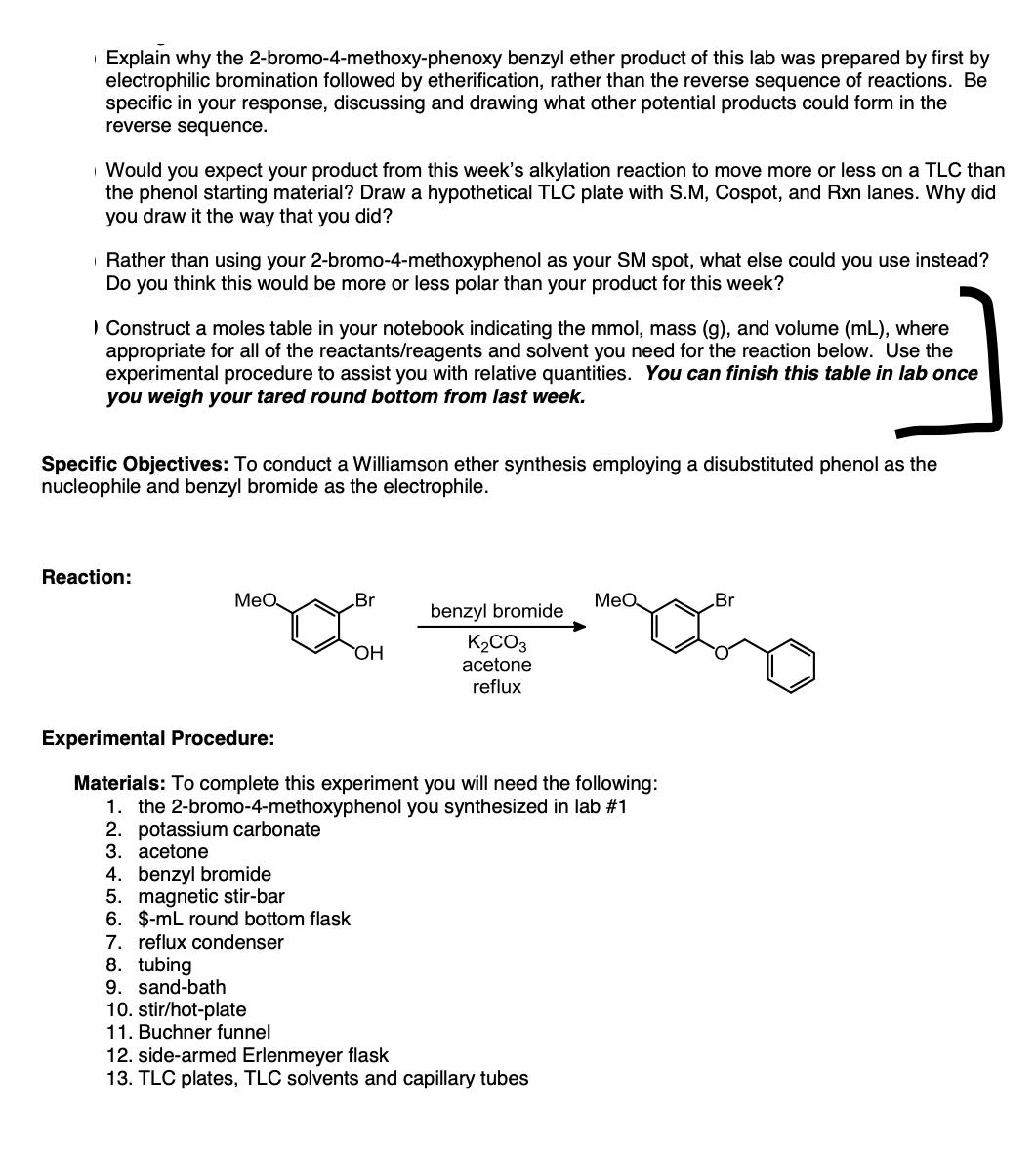
Explain why the 2-bromo-4-methoxy-phenoxy benzyl ether product of this lab was prepared by first by electrophilic bromination followed by etherification, rather than the reverse sequence of reactions. Be specific in your response, discussing and drawing what other potential products could form in the reverse sequence. Would you expect your product from this week's alkylation reaction to move more or less on a TLC than the phenol starting material? Draw a hypothetical TLC plate with S.M, Cospot, and Rxn lanes. Why did you draw it the way that you did? Rather than using your 2-bromo-4-methoxyphenol as your SM spot, what else could you use instead? Do you think this would be more or less polar than your product for this week? > Construct a moles table in your notebook indicating the mmol, mass (g), and volume (mL), where appropriate for all of the reactants/reagents and solvent you need for the reaction below. Use the experimental procedure to assist you with relative quantities. You can finish this table in lab once you weigh your tared round bottom from last week. Specific Objectives: To conduct a Williamson ether synthesis employing a disubstituted phenol as the nucleophile and benzyl bromide as the electrophile. Reaction: MeO Br OH benzyl bromide K2CO3 acetone MeO Br reflux Experimental Procedure: Materials: To complete this experiment you will need the following: 1. the 2-bromo-4-methoxyphenol you synthesized in lab #1 2. potassium carbonate 3. acetone 4. benzyl bromide 5. magnetic stir-bar 6. $-mL round bottom flask 7. reflux condenser 8. tubing 9. sand-bath 10. stir/hot-plate 11. Buchner funnel 12. side-armed Erlenmeyer flask 13. TLC plates, TLC solvents and capillary tubes Safety Considerations: Benzyl bromide is a lachrymator, i.e. a tear gas or a chemical that causes severe eye, respiratory and skin irritation. Your instructor will transfer the benzyl bromide into your reaction mixture once you have prepared the solution of reagents. Gloves must be worn at all times during this experiment. If you spill any benzyl bromide on yourself wash the affected area with copious amounts of soap and water and alert your instructor. Reaction Setup: To an appropriately sized round bottom flask add 2-bromo-4-methoxyphenol (1.0 equiv.), potassium carbonate (2.0 equiv.), a magnetic stir-bar, and acetone [1M] with respect to the 2-bromo-4- methoxyphenol. Once you have prepared the heterogeneous solution alert your instructor and they will provide you with benzyl bromide (0.9 equiv., note: you will need to calculate your specific volume of benzyl bromide required since each student will have a different amount of starting material). Submerge your flask into a sand filled heating mantle and place a reflux condenser with the tubing properly attached on top of the flask. Turn on the stirring function of the stir plate. Since the reaction mixture is heterogeneous you want the reaction to stir vigorously. Set the stir rate to 800 rpm. Submerge the temperature probe into the sand-bath and dial the set-point temperature to 100 C on the probe, and set the heating dial on the base to 200 C. Reaction Monitoring: Every 20 minutes conduct a Thin-Layer Chromatography (TLC) analysis of your reaction mixture by carefully lifting the reflux condenser from the flask and quickly removing a TLC sample with a capillary tube. Let the reaction reflux for a maximum of 2 hours but stop before if it appears to be complete. Reaction Workup: Once all of the starting material has reacted (as determined by TLC) power off the stirring and heating functions and carefully lift your flask from the sand-bath. CAUTION: the sand will be hot as will your flask. Allow 5 minutes for your flask to cool before proceeding. Once the flask has cooled filter the mixture through a Buchner funnel equipped with filter paper. Record the tare weight of an appropriately sized round bottom flask in you notebook and transfer the filtrate into the flask. Label the flask with your initials using a Sharpie and hand it to your instructor/TA who will remove the solvent on the rotary evaporator. Reaction Analysis: Once the flask has been returned record the mass of your crude product and calculate your percent yield. Prepare an NMR sample in CDCl3.
Step by Step Solution
There are 3 Steps involved in it

Get step-by-step solutions from verified subject matter experts
 Study Help