







Question: would you please please help me with all the questions thanks alot Question 1 (3 points) In the case of both one-to-one and one-to-many relationships,
would you please please help me with all the questions thanks alot
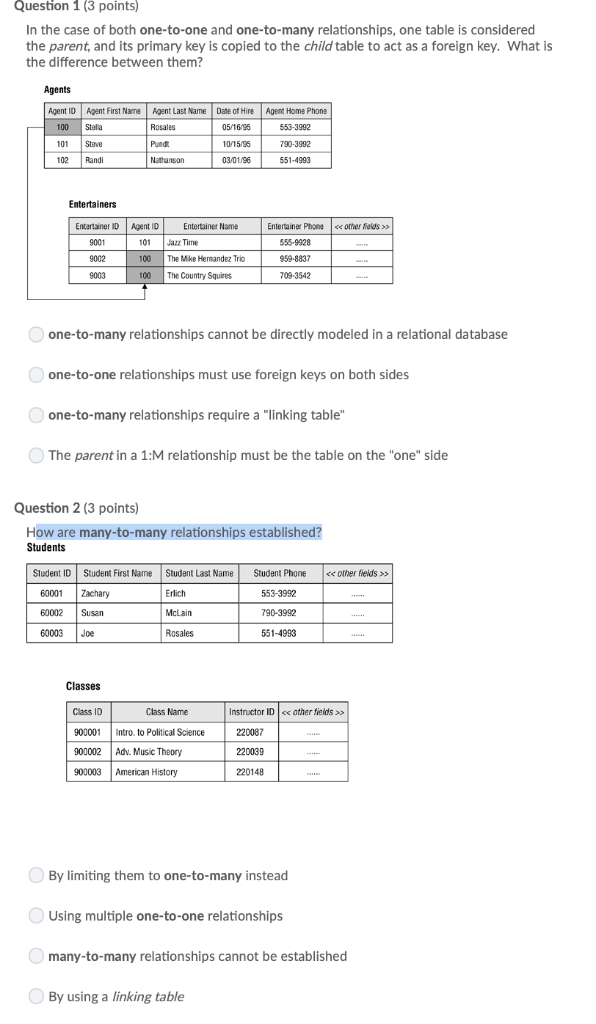
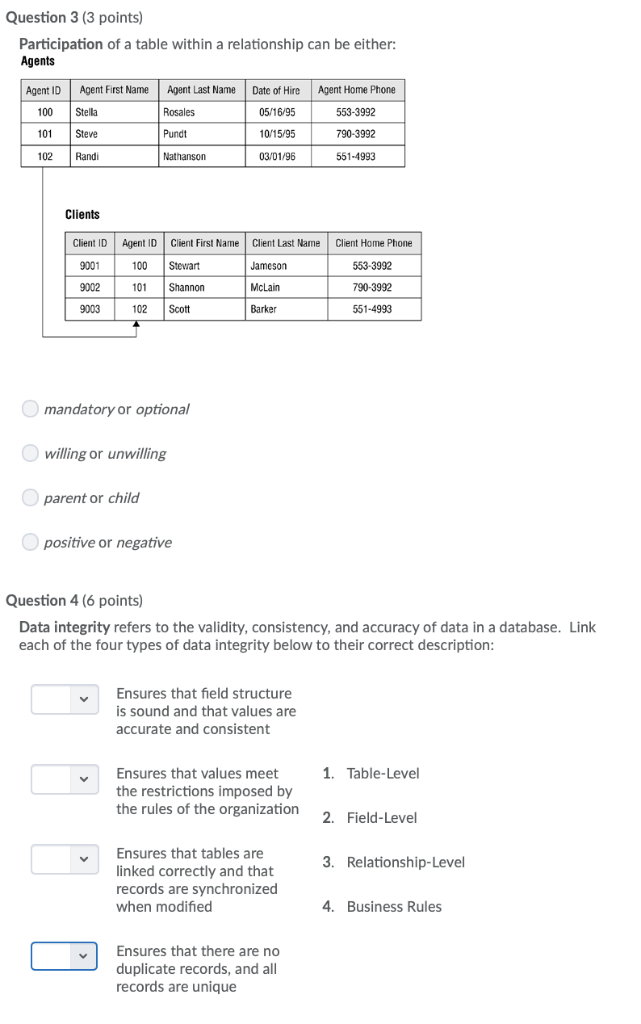
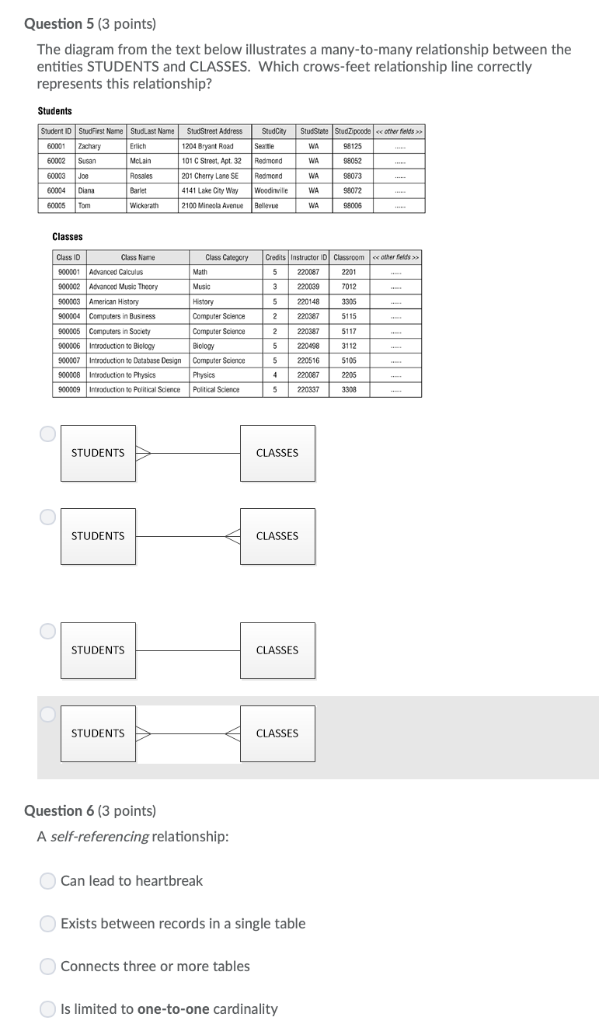
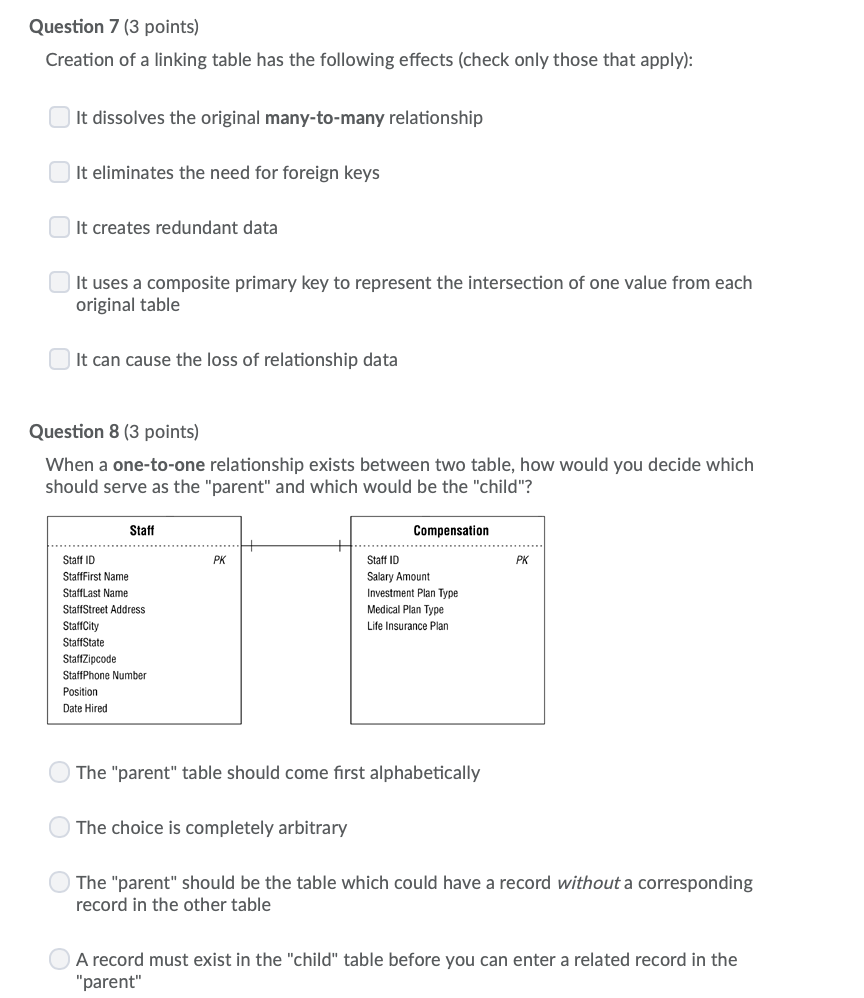
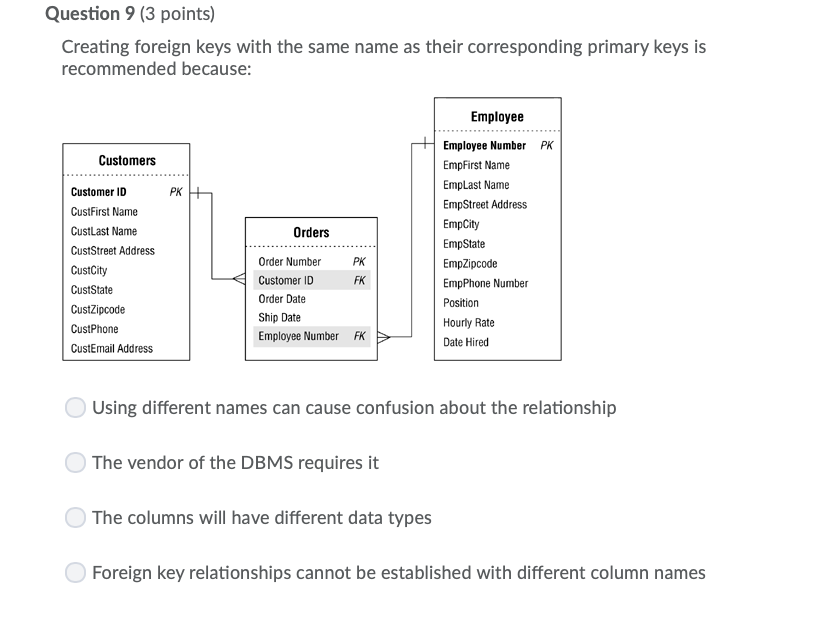
Question 1 (3 points) In the case of both one-to-one and one-to-many relationships, one table is considered the parent, and its primary key is copied to the child table to act as a foreign key. What is the difference between them? Agents Agent ID Agent First Name Agent Last Name Date of Hire Agent Home Phone 100 Stella 101 Steve 102 Randi Rosales 05/16/96 10 15/96 03/01/96 553-3992 790-3992 551-4993 Entertainers Entertainer ID Agent ID Entertainer Name Entertainer Phone oer Maus> 9001 101 Jazz Time 100 The Mke Hermandez Trio 100 The Country Squires 9003 709-3542 one-to-many relationships cannot be directly modeled in a relational database one-to-one relationships must use foreign keys on both sides one-to-many relationships require a "linking table" The parent in a 1:M relationship must be the table on the "one" side Question 2 (3 points) How are many-to-many relationships established? Students Student ID | Student First Name | Student Last Name l Student Phone 553-3992 790-3992 551-4993 | > 220087 220039 220148 By limiting them to one-to-many instead Using multiple one-to-one relationships many-to-many relationships cannot be established By using a linking table Question 3 (3 points) Participation of a table within a relationship can be either: Agents Agent ID Agent First Name 100 Stella 101 Stev 102 Randi Agent Last Name Date of Hire Agent Home Phone 05/16/95 10/15/95 03/01/96 Rosales Pundt Nathanson 553-3992 790-3992 551-4993 Clients Client ID Agent ID Client First Name Client Last Name Client Home Phone 9001 9002 003102 100 Stevart 101 Shannon Scott ameson McLain Barker 553-3992 790-3992 551-4993 mandatory or optional willing or unwilling parent or child positive or negative Question 4 (6 points) Data integrity refers to the validity, consistency, and accuracy of data in a database. Link each of the four types of data integrity below to their correct description Ensures that field structure is sound and that values are accurate and consistent 1. Table-Level Ensures that values meet the restrictions imposed by the rules of the organization 2. Field-Level Ensures that tables are linked correctly and that records are synchronized when modified 3. Relationship-Level 4. Business Rules Ensures that there are no duplicate records, and all records are unique Question 5 (3 points) The diagram from the text below illustrates a many-to-many relationship between the entities STUDENTS and CLASSES. Which crows-feet relationship line correctly represents this relationship? Students Student ID StudFirst Name Studast Name StudStreet Address StuCty StudState Studeotherels 60001 Zachary 60002 Susan 60003 Jos 0004 Diana 0005 Tom 204 Bryant Road S 01 C Street, Apt 32 Radmoed 201 Charry Lane SERedmeed 141 Lake Cty WayWoodinvile 2100 Minecla Avenue Belevue 98125 Mclain 96073 5072 88006 Barlet A Wickerath WA Classes Class ID Class Nane Class Category Credits Instructor ID Classroom ather felds> 5 220087 00001 Advanced Ca culus 00002 dvanood Musig Theory 00003 American History 900004 Computers in Bus ness 00005 Computers in Society 000006 Introduction o Bislogy 900007 Introduction to Dutabase Design Computer Science 900008 Introduction to Physics 00009 Inteoduction to Political Science Political Science 220039 012 220148 2 220387 Computer Science Computer Science Biology 5115 2220387 5 220408 3112 S 220516 5105 4 220087 5 220337 Physics STUDENTS CLASSES STUDENTS CLASSES STUDENTS CLASSES STUDENTS CLASSES Question 6 (3 points) A self-referencing relationship Can lead to heartbreak Exists between records in a single table Connects three or more tables Is limited to one-to-one cardinality Question 7 (3 points) Creation of a linking table has the following effects (check only those that apply): It dissolves the original many-to-many relationship It eliminates the need for foreign key:s It creates redundant data It uses a composite primary key to represent the intersection of one value from each original table It can cause the loss of relationship data Question 8 (3 points) When a one-to-one relationship exists between two table, how would you decide which should serve as the "parent" and which would be the "child"? Staff Compensation Staff ID Salary Amount Investment Plan Type Medical Plan Type Life Insurance Plan Staff ID StaffFirst Name StaffLast Name StaffStreet Address StaffCity StaffState StaffZipcode StafPhone Number Position Date Hired PK PK The "parent" table should come first alphabetically The choice is completely arbitrary The "parent" should be the table which could have a record without a corresponding record in the other table A record must exist in the "child" table before you can enter a related record in the parent" Question 9 (3 points) Creating foreign keys with the same name as their corresponding primary keys is recommended because: Employee Employee Number EmpFirst Name EmpLast Name EmpStreet Address EmpCity EmpState EmpZipcode EmpPhone Number Position Hourly Rate Date Hired PK Customers PK Customer ID CustFirst Name CustLast Name CustStreet Address CustCity CustState Custzipcode CustPhone CustEmail Address Orders Order Number Customer ID Order Date Ship Date Employee Number PK FK FK Using different names can cause confusion about the relationship The vendor of the DBMS requires it The columns will have different data types Foreign key relationships cannot be established with different column names
Step by Step Solution
There are 3 Steps involved in it

Get step-by-step solutions from verified subject matter experts
 Study Help