Question: write me reflections of this topic you have learned and how it will help you to think and apply the topics in daily life. *
write me reflections of this topic you have learned and how it will help you to think and apply the topics in daily life.
* just one pages is enough and no plagiarism *
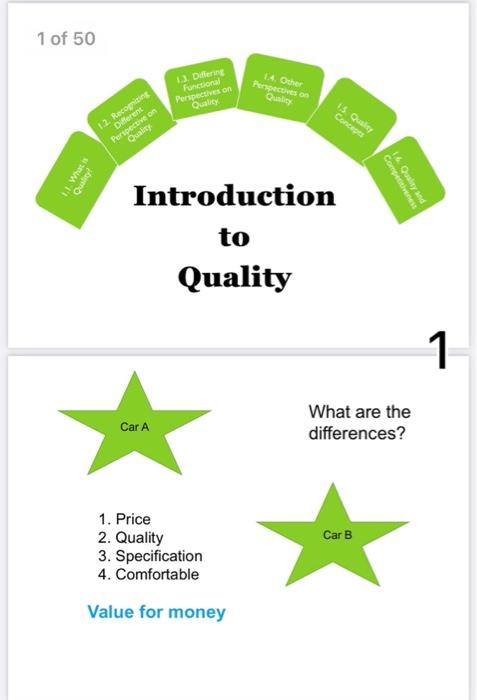
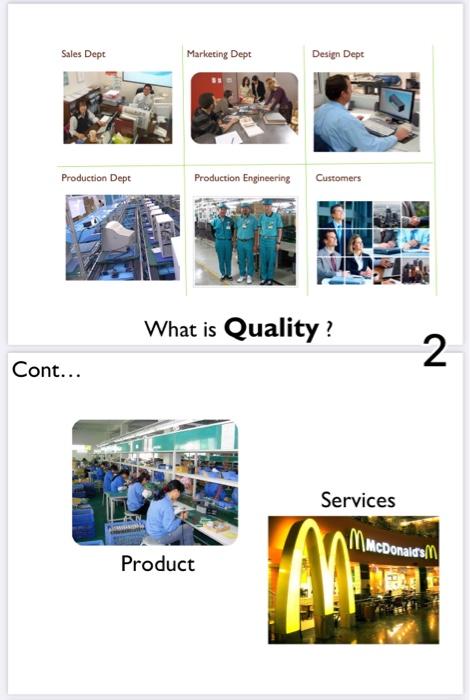
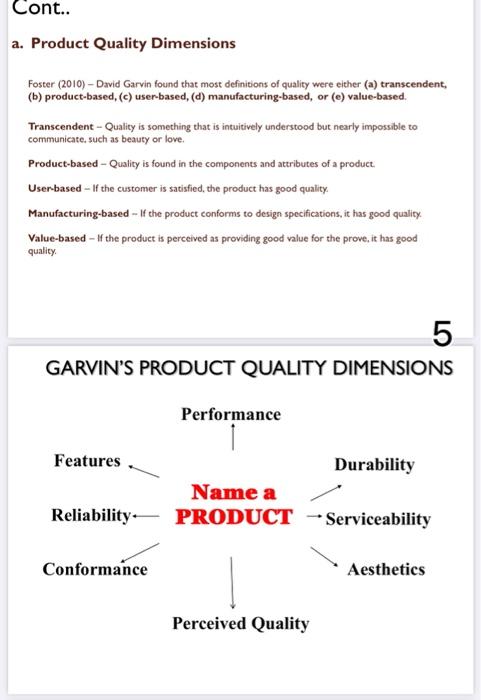
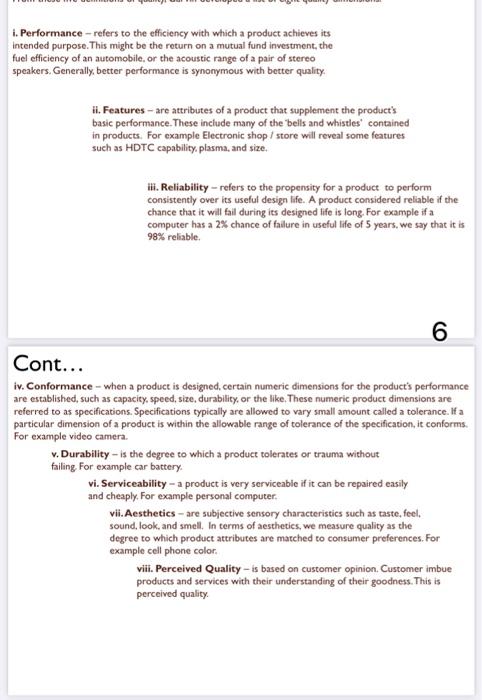
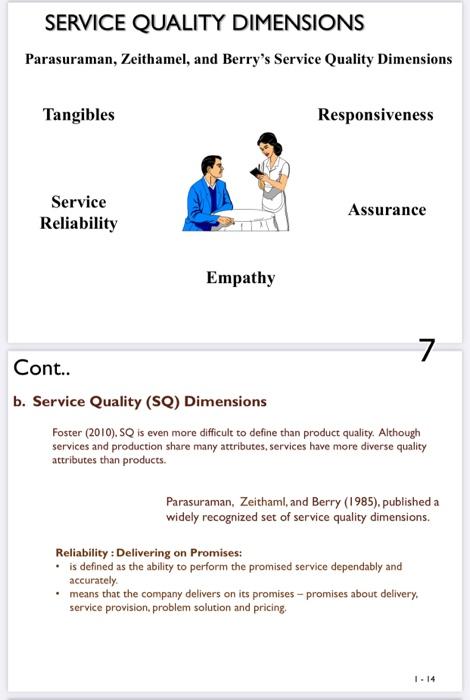
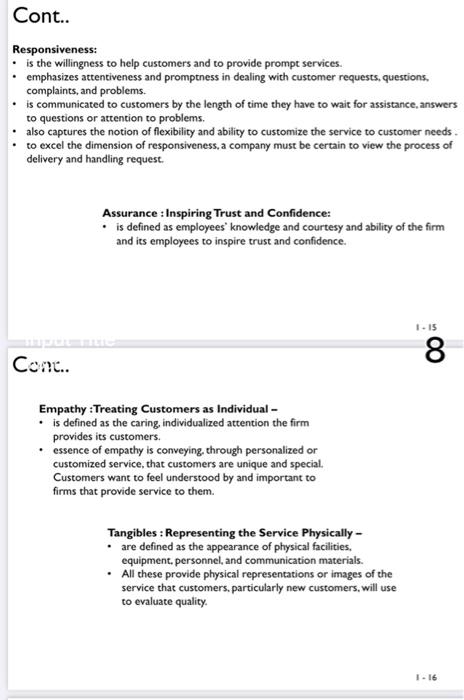
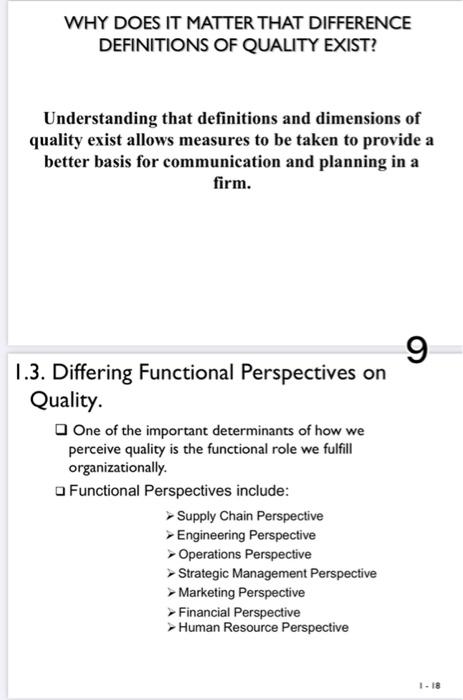
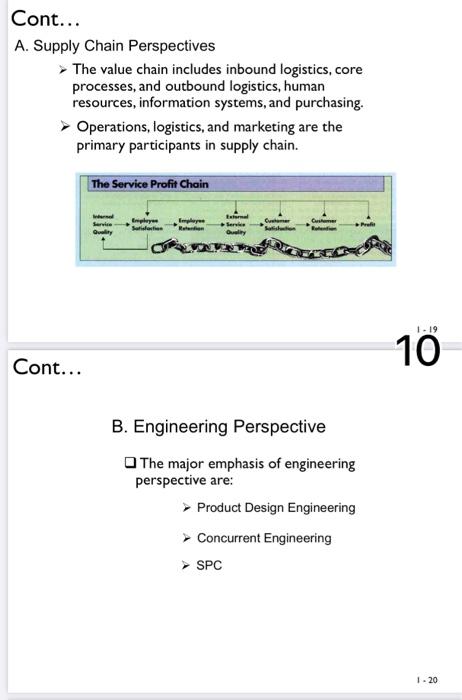
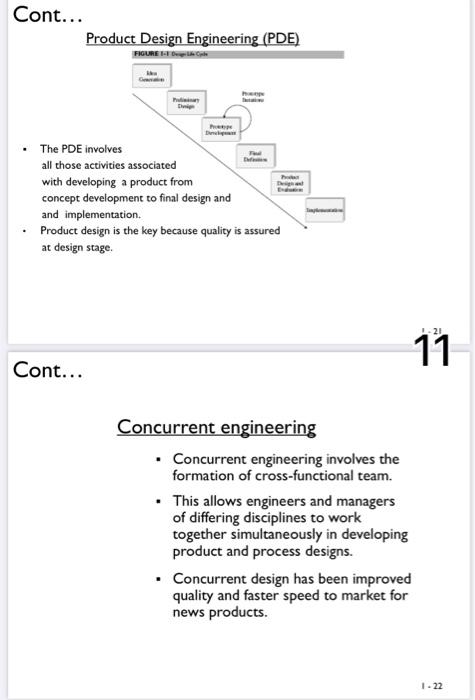
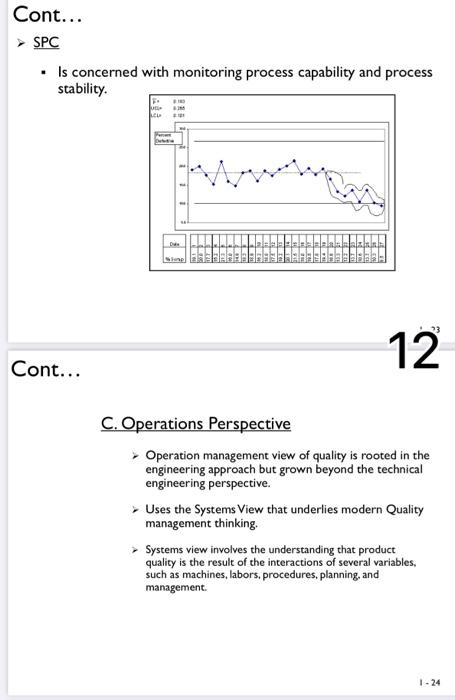
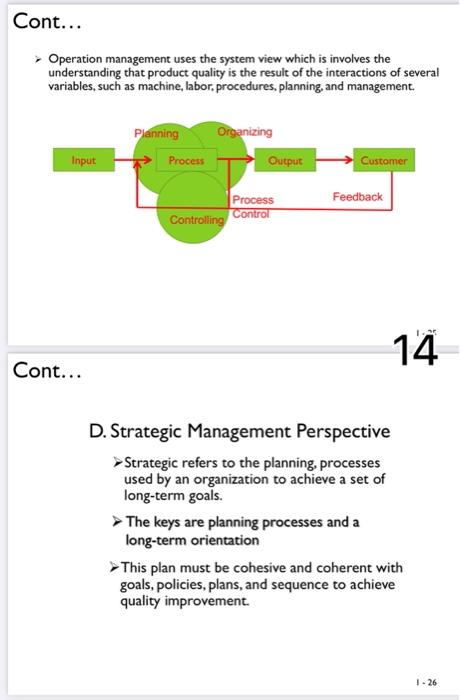
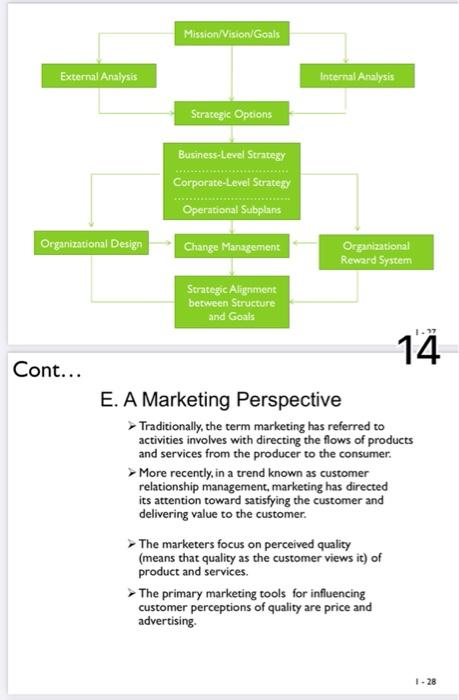
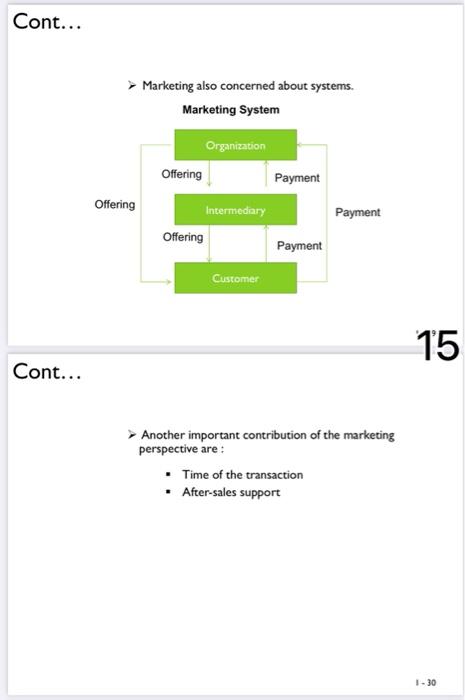
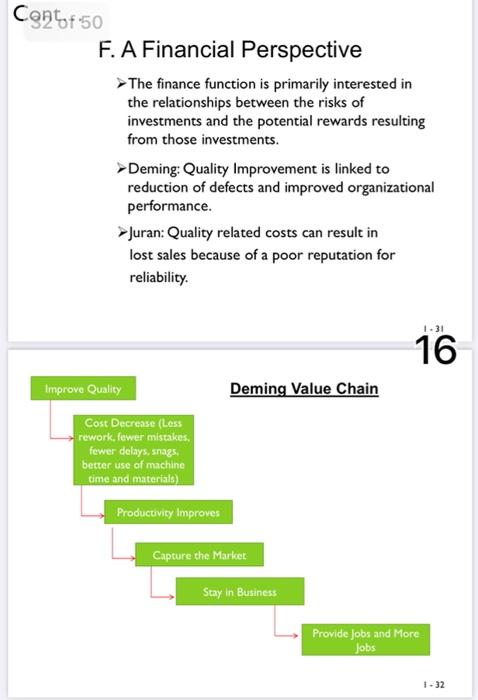
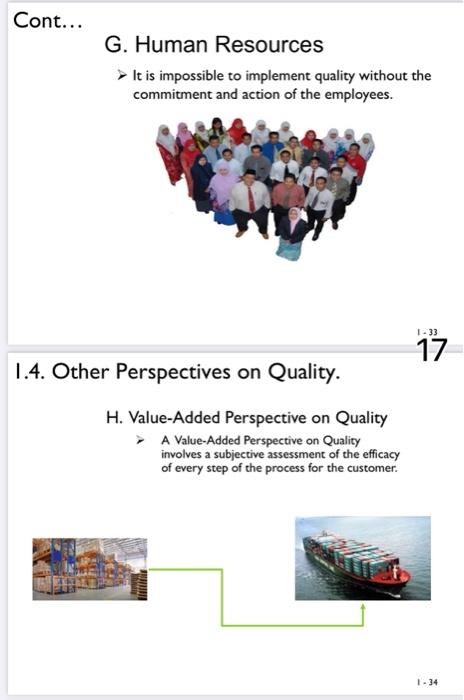
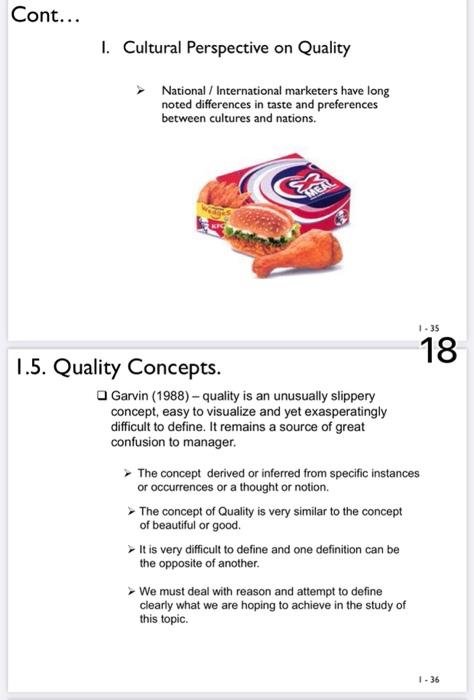
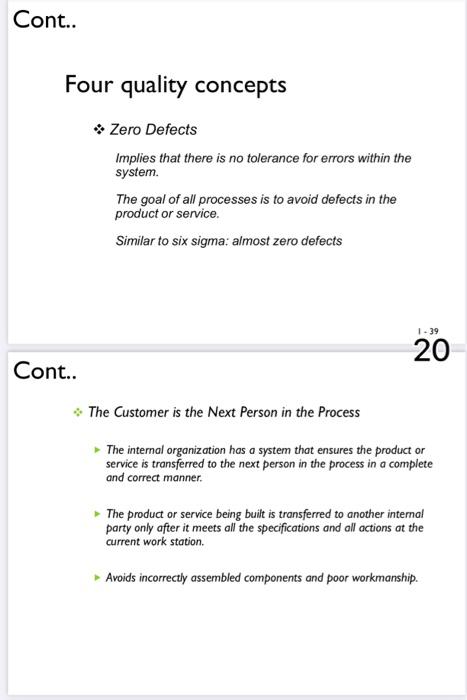
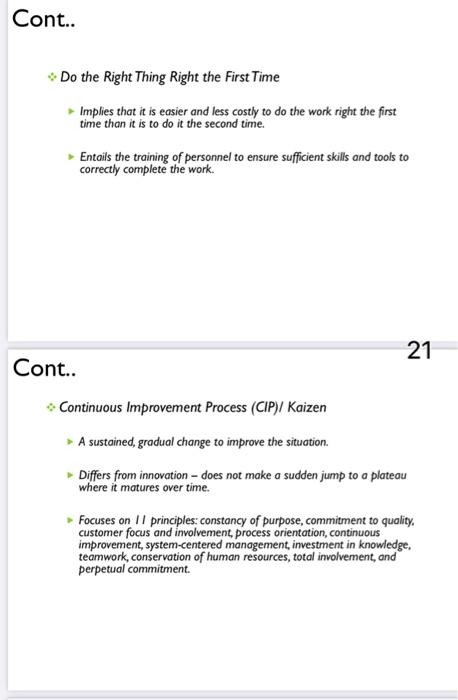
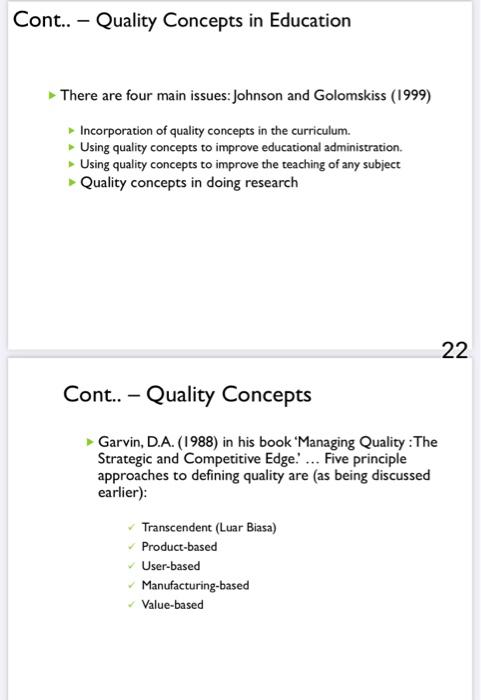
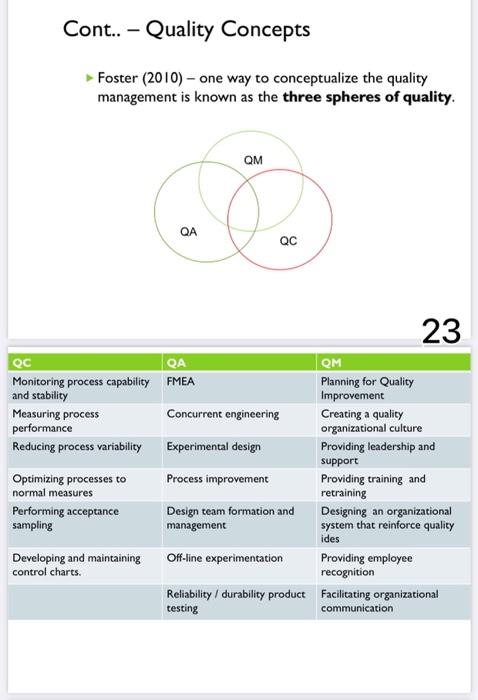
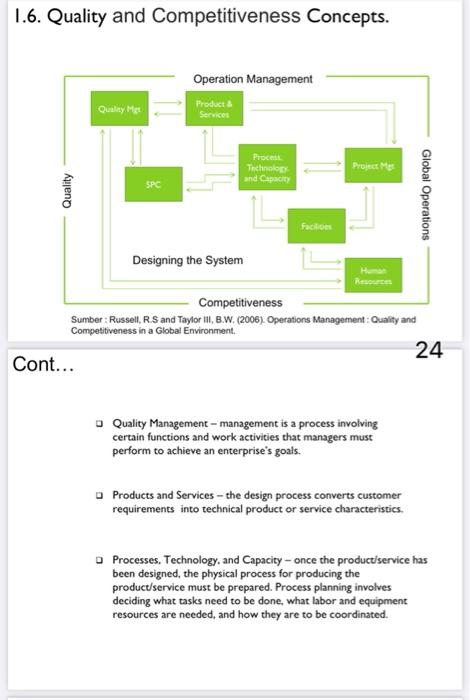
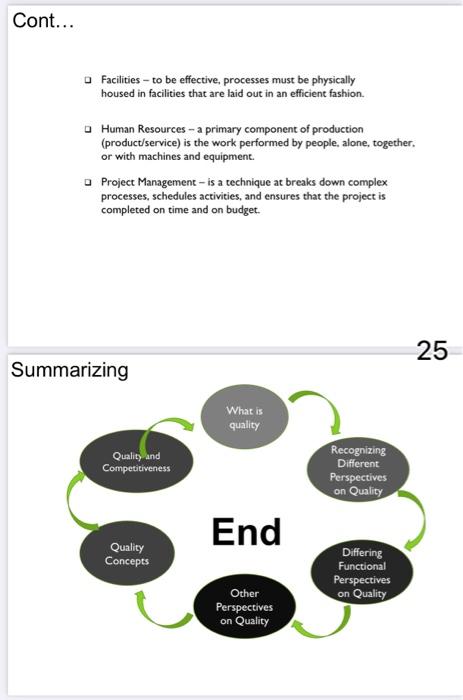
1 of 50 14. Other Perspectives of 1.3 Differne Functional Perspectives on Quality 15 Quality Conceptes 1.2. Recogniting Different Perspective on Quality What is Qui! Com Introduction put lajar to Quality 1 Car A What are the differences? Car B 1. Price 2. Quality 3. Specification 4. Comfortable Value for money Sales Dept Marketing Dept Design Dept Production Dept Production Engineering Customers What is Quality ? 2 Cont... Services M. McDonaldson Product Cont... If You Ask 10 People to Define Quality, You Probably Will Get 10 Definitions - Foster (2010) - Pg 29 According to Summers, Donna C.S.: The American Society for Quality defines quality as a subjective term for which each person had his or her own definition. In technical usage, quality can have two meanings : (a) the characteristics of a product or service that bear on its ability to satisfy stated or implied needs; (b) a product or service free of deficiencies Dr.W.Edwards Deming describes quality as 'nonfaulty systems are error free systems that have ability to provide the consumer with a product or service as specified Dr. Joseph M. Juran describes quality as fitness for use Philip Crosby describes quality as conformance to requirements. (nonquality as nonconformance) 3 Cont... Summers, Donna C. S. (2010) concluded that the above definitions stated three types of quality: Quality of Design - means that the product has been designed to successfully filla consumer need, real or perceived. Quality of Conformance - means conformance to requirements, refers to the manufacture of the product or the provision of the service that meets the specific requirements say by consumer. Quality of Performance - means that the product or service performs its intended function as identified by the consumer. Summers, Donna C.S.(2010) stressed -- that clearly communicating the needs, requirements, and expectations of the consumer requires a more complete definition of quality Cont... But ... Summers, Donna C.S. (2010) believes that perhaps most complete definition of quality is as defined by Armand Feigenbaum: Quality is a customer determination which is based on the customer's actual experience with the product or service, measured against his or her requirements - stated or unstated, conscious or merely sensed, technically operational or entirely subjective and always representing a moving target in a competitive market. Some key words stand out from this definition are: a Customer Determination - only a customer can decide if and how well a product or service meets his or her needs, requirements, and expectations. b. Actual Experience - the customer will judge the quality of a product or service not only at the time of purchase but throughout usage of the product or service Requirements - necessary aspects of a product or service called for or demanded by the customer may be stated or unstated. conscious or merely sensed d. Technically Operational - aspects of a product or service may be clearly identified in words by the e Entirely Subjective - aspects of a product or service may only be conjured in a consumer's personal feelings consumer 4 Recognizing Different Perspectives on Quality. a. Product Quality Dimensions b. Service Quality (SQ) Dimensions Cont.. a. Product Quality Dimensions Foster (2010) - David Garvin found that most definitions of quality were either (a) transcendent, (b) product-based, (c) user-based, (d) manufacturing-based, or (e) value-based. Transcendent - Quality is something that is intuitively understood but nearly impossible to communicate, such as beauty or love Product-based - Quality is found in the components and attributes of a product. User based - If the customer is satisfied, the product has good quality Manufacturing-based - If the product conforms to design specifications, it has good quality Value-based - If the product is perceived as providing good value for the prove, it has good quality 5 GARVIN'S PRODUCT QUALITY DIMENSIONS Performance Features Durability Name a Reliability PRODUCT - Serviceability Conformance Aesthetics Perceived Quality i. Performance - refers to the efficiency with which a product achieves its intended purpose. This might be the return on a mutual fund investment, the fuel efficiency of an automobile, or the acoustic range of a pair of stereo speakers. Generally, better performance is synonymous with better quality ii. Features - are attributes of a product that supplement the product's basic performance. These include many of the bells and whistles' contained in products . For example Electronic shop / store will reveal some features such as HDTC capability. plasma, and size, 1. Reliability - refers to the propensity for a product to perform consistently over its useful design life. A product considered reliable if the chance that it will fail during its designed life is long. For example if a computer has a 2% chance of failure in useful life of 5 years, we say that it is 98% reliable. 6 Cont... iv. Conformance - when a product is designed, certain numeric dimensions for the product's performance are established, such as capacity. speed, size, durability, or the like. These numeric product dimensions are referred to as specifications. Specifications typically are allowed to vary small amount called a tolerance. If a particular dimension of a product is within the allowable range of tolerance of the specification, it conforms For example video camera. v.Durability - is the degree to which a product tolerates or trauma without failing For example car battery vi. Serviceability - a product is very serviceable if it can be repaired easily and cheaply. For example personal computer. vii. Aesthetics - are subjective sensory characteristics such as taste, feel. sound, look, and smell. In terms of aesthetics, we measure quality as the degree to which product attributes are matched to consumer preferences. For example cell phone calor viii. Perceived Quality - is based on customer opinion. Customer imbue products and services with their understanding of their goodness. This is perceived quality SERVICE QUALITY DIMENSIONS Parasuraman, Zeithamel, and Berry's Service Quality Dimensions Tangibles Responsiveness Service Reliability Assurance Empathy 7 Cont.. b. Service Quality (SQ) Dimensions Foster (2010). SQ is even more difficult to define than product quality. Although services and production share many attributes, services have more diverse quality attributes than products. Parasuraman, Zeithaml, and Berry (1985).published a widely recognized set of service quality dimensions. Reliability: Delivering on Promises: is defined as the ability to perform the promised service dependably and accurately means that the company delivers on its promises - promises about delivery. service provision problem solution and pricing 1.14 Cont.. Responsiveness: is the willingness to help customers and to provide prompt services. emphasizes attentiveness and promptness in dealing with customer requests, questions, complaints, and problems. is communicated to customers by the length of time they have to wait for assistance, answers to questions or attention to problems also captures the notion of flexibility and ability to customize the service to customer needs to excel the dimension of responsiveness, a company must be certain to view the process of delivery and handling request. Assurance : Inspiring Trust and Confidence: . is defined as employees' knowledge and courtesy and ability of the firm and its employees to inspire trust and confidence. 1-15 8 Conc.. Empathy :Treating Customers as Individual - is defined as the caring individualized attention the firm provides its customers essence of empathy is conveying, through personalized or customized service, that customers are unique and special. Customers want to feel understood by and important to firms that provide service to them. Tangibles : Representing the Service Physically- are defined as the appearance of physical facilities, equipment, personneland communication materials. . All these provide physical representations or images of the service that customers, particularly new customers, will use to evaluate quality 1 - 16 WHY DOES IT MATTER THAT DIFFERENCE DEFINITIONS OF QUALITY EXIST? Understanding that definitions and dimensions of quality exist allows measures to be taken to provide a better basis for communication and planning in a firm. 9 1.3. Differing Functional Perspectives on Quality One of the important determinants of how we perceive quality is the functional role we fulfill organizationally Functional Perspectives include: Supply Chain Perspective > Engineering Perspective Operations Perspective Strategic Management Perspective > Marketing Perspective Financial Perspective Human Resource Perspective 1 - 18 Cont... A. Supply Chain Perspectives The value chain includes inbound logistics, core processes, and outbound logistics, human resources, information systems, and purchasing. Operations, logistics, and marketing are the primary participants in supply chain. The Service Profit Chain Enly my Q Quality 1 - 19 10 Cont... B. Engineering Perspective The major emphasis of engineering perspective are: Product Design Engineering Concurrent Engineering SPC 1. 20 Cont... Product Design Engineering (PDE) FIGURE DO D The PDE involves all those activities associated with developing a product from concept development to final design and and implementation Product design is the key because quality is assured at design stage. 21 11 Cont... Concurrent engineering . Concurrent engineering involves the formation of cross-functional team. . This allows engineers and managers of differing disciplines to work together simultaneously in developing product and process designs. . Concurrent design has been improved quality and faster speed to market for news products. 1.22 Cont... SPC Is concerned with monitoring process capability and process stability. D Blan Spl alala 1838 12 Cont... C. Operations Perspective Operation management view of quality is rooted in the engineering approach but grown beyond the technical engineering perspective. Uses the Systems View that underlies modern Quality management thinking, Systems view involves the understanding that product quality is the result of the interactions of several variables, such as machines, labors, procedures, planning, and management. 1-24 Cont... > Operation management uses the system view which is involves the understanding that product quality is the result of the interactions of several variables, such as machine, labor. procedures, planning, and management Planning Organizing Input Process Output Customer Feedback Process Control Controlling 14 Cont... D. Strategic Management Perspective > Strategic refers to the planning, processes used by an organization to achieve a set of long-term goals. The keys are planning processes and a long-term orientation This plan must be cohesive and coherent with goals, policies, plans, and sequence to achieve quality improvement 1-26 Mission Vision/Goals External Analysis H Internal Analysis Strategic Options Business-Level Strategy Corporate-Level Strategy Operational Subplans Organizational Design Change Management Organizational Reward System Strategic Alignment between Structure and Goals 14 Cont... E. A Marketing Perspective Traditionally, the term marketing has referred to activities involves with directing the flows of products and services from the producer to the consumer. More recently, in a trend known as customer relationship management, marketing has directed its attention toward satisfying the customer and delivering value to the customer. The marketers focus on perceived quality (means that quality as the customer views it) of product and services > The primary marketing tools for influencing customer perceptions of quality are price and advertising 1-28 Cont... Marketing also concerned about systems. Marketing System Organization Offering Payment Offering Intermediary Payment Offering Payment Customer 15 Cont... Another important contribution of the marketing perspective are : Time of the transaction After-sales support 1 - 30 Contot 50 F. A Financial Perspective The finance function is primarily interested in the relationships between the risks of investments and the potential rewards resulting from those investments. Deming: Quality Improvement is linked to reduction of defects and improved organizational performance. >Juran: Quality related costs can result in lost sales because of a poor reputation for reliability. 1-31 16 Improve Quality Deming Value Chain Cost Decrease (Less rework, fewer mistakes. fewer delays, snags. better use of machine time and materials Productivity Improves Capture the Market Stay in Business Provide Jobs and More Jobs 1-32 Cont... G. Human Resources It is impossible to implement quality without the commitment and action of the employees. 1-33 17 1.4. Other Perspectives on Quality. H. Value Added Perspective on Quality A Value Added Perspective on Quality involves a subjective assessment of the efficacy of every step of the process for the customer. 1 - 34 Cont... 1. Cultural Perspective on Quality National / International marketers have long noted differences in taste and preferences between cultures and nations. 1.35 18 1.5. Quality Concepts. Garvin (1988)-quality is an unusually slippery concept, easy to visualize and yet exasperatingly difficult to define. It remains a source of great confusion to manager. The concept derived or inferred from specific instances or occurrences or a thought or notion The concept of Quality is very similar to the concept of beautiful or good. It is very difficult to define and one definition can be the opposite of another. We must deal with reason and attempt to define clearly what we are hoping to achieve in the study of this topic. 1 - 36 Cont.. Sinha and Willborn (1985) --- an abstract explanation of quality concept as follows: Quality is what people think it is, perceive it to be, or experience it to be Quality perceived as high, low, or negative, describes its value in utility and useful. Quality is not always what the consumer buys and expects as fair and adequate. Quality is also understood as 'excellence,' which is better than a minimum standard. 1:37 19 Cont.. Quality means not just fitness for use but, in more specific terms, reliability, safety, maintainability, status etcetera. Quality in business is expressed as specified standards against which actual performance and conformance can be measured. Quality, understood as product and service characteristics that are specified, standardized, and contracted, has a relationship to quantity, time, and space.. Quality also is an expression of the people who contribute to produce. Attaining quality is thus everybody's responsibility Quality is totality of all attributes and characteristics of a product or service as specified, required, and expected. 1 - 38 Cont.. Sinha and Willborn (1985) --- an abstract explanation of quality concept as follows: Quality is what people think it is, perceive it to be, or experience it to be Quality perceived as high, low, or negative, describes its value in utility and useful. Quality is not always what the consumer buys and expects as fair and adequate. Quality is also understood as 'excellence,' which is better than a minimum standard. 1:37 19 Cont.. Quality means not just fitness for use but, in more specific terms, reliability, safety, maintainability, status etcetera. Quality in business is expressed as specified standards against which actual performance and conformance can be measured. Quality, understood as product and service characteristics that are specified, standardized, and contracted, has a relationship to quantity, time, and space.. Quality also is an expression of the people who contribute to produce. Attaining quality is thus everybody's responsibility Quality is totality of all attributes and characteristics of a product or service as specified, required, and expected. 1 - 38 Cont.. Four quality concepts Zero Defects Implies that there is no tolerance for errors within the system. The goal of all processes is to avoid defects in the product or service. Similar to six sigma: almost zero defects 1 - 39 20 Cont.. The Customer is the Next Person in the Process The internal organization has a system that ensures the product or service is transferred to the next person in the process in a complete and correct manner. The product or service being built is transferred to another internal party only after it meets all the specifications and all actions at the current work station. Avoids incorrectly assembled components and poor workmanship. Cont.. Do the Right Thing Right the First Time Implies that it is easier and less costly to do the work right the first time than it is to do it the second time. Entails the training of personnel to ensure sufficient skills and tools to correctly complete the work. 21 Cont.. Continuous Improvement Process (CIP)/ Kaizen A sustained gradual change to improve the situation. Differs from innovation - does not make a sudden jump to a plateau where it matures over time. Focuses on 11 principles: constancy of purpose, commitment to quality. customer focus and involvement, process orientation, continuous improvement, system-centered management, investment in knowledge. teamwork, conservation of human resources, total involvement and perpetual commitment. Cont.. - Quality Concepts in Education There are four main issues: Johnson and Golomskiss (1999) Incorporation of quality concepts in the curriculum. Using quality concepts to improve educational administration. Using quality concepts to improve the teaching of any subject Quality concepts in doing research 22 Cont.. - Quality Concepts Garvin, D.A. (1988) in his book 'Managing Quality :The Strategic and Competitive Edge!... Five principle approaches to defining quality are as being discussed earlier): Transcendent (Luar Biasa) Product-based User-based Manufacturing-based Value-based Cont.. - Quality Concepts Foster (2010) - one way to conceptualize the quality management is known as the three spheres of quality. QM w QA QC 23 QC QA Monitoring process capability FMEA and stability Measuring process Concurrent engineering performance Reducing process variability Experimental design QM Planning for Quality Improvement Creating a quality organizational culture Providing leadership and support Providing training and retraining Designing an organizational system that reinforce quality ides Optimizing processes to normal measures Process improvement Performing acceptance sampling Design team formation and management Developing and maintaining control charts. Off-line experimentation Providing employee recognition Reliability / durability product Facilitating organizational testing communication 1.6. Quality and Competitiveness Concepts. Operation Management Qualny Met Products Services Process Technolo and Capacity Project Me SPC Quality Global Operations facilis Designing the System Route Competitiveness Sumber : Russell, R.S and Taylor ill, B.W. (2006). Operations Management: Quality and Competitiveness in a Global Environment 24 Cont... Quality Management - management is a process involving certain functions and work activities that managers must perform to achieve an enterprise's goals. Products and Services - the design process converts customer requirements into technical product or service characteristics Processes. Technology and Capacity - once the productiservice has been designed, the physical process for producing the product/service must be prepared. Process planning involves deciding what tasks need to be done, what labor and equipment resources are needed, and how they are to be coordinated Cont... Facilities - to be effective, processes must be physically housed in facilities that are laid out in an efficient fashion. Human Resources - a primary component of production (product/service) is the work performed by people, alone, together. or with machines and equipment Project Management - is a technique at breaks down complex processes, schedules activities, and ensures that the project is completed on time and on budget. 25 5 Summarizing What is quality Quality and Competitiveness Recognizing Different Perspectives on n Quality End Quality Concepts Differing Functional Perspectives on Quality Other Perspectives on Quality









 Study Help