







Question: An aqueous solution, buffered to a pH of 3.4 by sodium citrate and containing 20 mol/m 3 each of glutamic acid, glycine, and valine, is
An aqueous solution, buffered to a pH of 3.4 by sodium citrate and containing 20 mol/m3 each of glutamic acid, glycine, and valine, is separated in a chromatographic column packed with Dowex 50W-X8 in the sodium form to a depth of 470 mm. The resin is 0.07 mm in diameter and packs to a bed void fraction of 0.374. Equilibrium data follow a linear law, as in Example 15.15, with the following dimensionless constants determined by Takahashi and Goto [J. Chem. Eng. Japan, 24, 121–123 (1991)]:
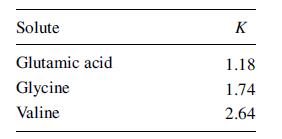
The superficial solution velocity is 0.025 cm/s. Using equilibrium theory, what pulse duration achieves complete separation? What is the time interval between elution and the second pulse?
Example 15.15
An aqueous solution of 3 g/cm3 each of glucose (G), sucrose (S), and fructose (F) is to be separated in a chromatographic column packed with an ion-exchange resin of the calcium form. For the expected solute concentrations, sorption isotherms are independent with qi = Kici, where qi is in grams sorbent per 100 cm3 resin and ci is in grams solute per 100 cm3 solution. From experiment:
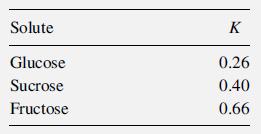
The superficial solution velocity, μs = ϵbu, is 0.031 cm/s and bed void fraction is 0.39. If a 500-second feed pulse, tP, is followed by elution with pure water, what length of column packing is needed to separate the three solutes if sorption equilibrium is assumed? How soon after the first pulse begins can a second 500-second pulse begin?
Solute Glutamic acid Glycine Valine K 1.18 1.74 2.64
Step by Step Solution
3.30 Rating (156 Votes )
There are 3 Steps involved in it
The first step is to calculate the pulse duration need... View full answer

Get step-by-step solutions from verified subject matter experts
 Study Help