







Question: Liquids A and B, which have nearly identical boiling points, are to be separated by liquidliquid extraction with solvent C. The following data represent the
Liquids A and B, which have nearly identical boiling points, are to be separated by liquid–liquid extraction with solvent C. The following data represent the phase equilibrium at 95οC.
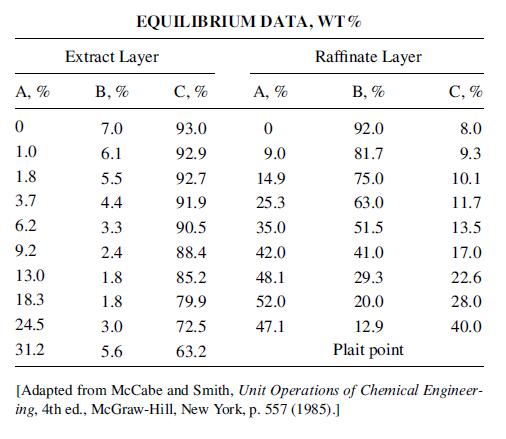
Determine the minimum reflux returned from the extract product to produce an extract containing 83% A and 17% B (compositions in this exercise are on a solvent-free basis) and a raffinate product of 10% A and 90% B. The feed contains 35% A and 65% B and is a saturated raffinate. The raffinate is the heavy liquid. Determine the number of theoretical stages on both sides of the feed to produce the same end products from the same feed when the reflux ratio of the extract (pounds of extract reflux per pound of extract product including solvent) is twice the minimum. Calculate the stream masses per 1,000 lb of feed. Use equilateral-triangle coordinates, right-triangle coordinates, and solvent-free coordinates. Which method is best for this exercise?
A, % 0 1.0 1.8 3.7 6.2 9.2 13.0 18.3 24.5 31.2 EQUILIBRIUM DATA, WT% Extract Layer B, % 7.0 6.1 5.5 4.4 3.3 2.4 1.8 1.8 3.0 5.6 C, % 93.0 92.9 92.7 91.9 90.5 88.4 85.2 79.9 72.5 63.2 A, % 0 9.0 14.9 25.3 35.0 42.0 48.1 52.0 47.1 Raffinate Layer B, % 92.0 81.7 75.0 63.0 51.5 41.0 29.3 20.0 12.9 Plait point C, % 8.0 9.3 10.1 11.7 13.5 17.0 22.6 28.0 40.0 [Adapted from McCabe and Smith, Unit Operations of Chemical Engineer- ing, 4th ed., McGraw-Hill, New York, p. 557 (1985).]
Step by Step Solution
3.46 Rating (169 Votes )
There are 3 Steps involved in it
To solve this problem we will use the McCabeThiele method which is a graphical method for analyzing distillation and liquidliquid extraction processes ... View full answer

Get step-by-step solutions from verified subject matter experts
 Study Help