







Question: At a certain genetic locus on a chromosome, each individual has one of three different DNA sequences (alleles). The three alleles are denoted A, B,
At a certain genetic locus on a chromosome, each individual has one of three different DNA sequences (alleles). The three alleles are denoted A, B, C. At another genetic locus on the same chromosome, each organism has one of three alleles, denoted 1, 2, 3. Each individual therefore has one of nine possible allele pairs: A1, A2, A3, B1, B2, B3, C1, C2, or C3. These allele pairs are called haplotypes. The loci are said to be in linkage equilibrium if the two alleles in an individual€™s haplotype are independent. Haplotypes were determined for 316 individuals. The following MINITAB output presents the results of a chi-square test for independence.
Chi-Square Test: A, B, C Expected counts are printed below observed counts Chi-Square contributions are printed below expected counts
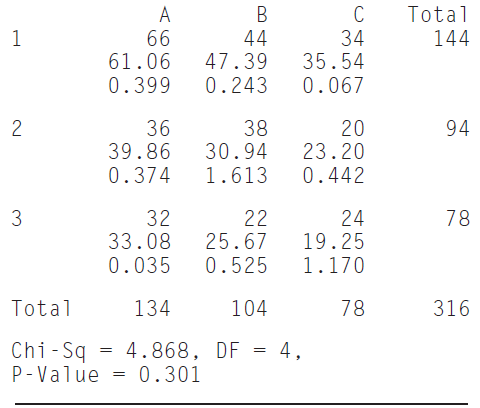
a. How many individuals were observed to have the haplotype B3?
b. What is the expected number of individuals with the haplotype A2?
c. Which of the nine haplotypes was least frequently observed?
d. Which of the nine haplotypes has the smallest expected count?
e. Can you conclude that the loci are not in linkage equilibrium (i.e., not independent)? Explain.
f. Can you conclude that the loci are in linkage equilibrium (i.e., independent)? Explain.
Total 144 66 61.06 0.399 44 47.39 0.243 34 35.54 0.067 36 39.86 0.374 38 30.94 1.613 20 23.20 0.442 94 3 32 33.08 0.035 22 25.67 0.525 24 19.25 1.170 78 Total 134 104 78 316 Chi-Sq = P- Value = 0.301 4.868, DF = 4,
Step by Step Solution
3.44 Rating (170 Votes )
There are 3 Steps involved in it
a 22 b 3986 c C2 d C3 e No The P... View full answer

Get step-by-step solutions from verified subject matter experts
 Study Help