







Question: Consider a general branching process. Let g(s) denote the generator function for the branching probabilities and let g Z n (s) denote the generator function
Consider a general branching process. Let g(s) denote the generator function for the branching probabilities and let gZn (s) denote the generator function for the size Zn of the nth generation. Furthermore, let xn = Prob{extinction by generation number n}.
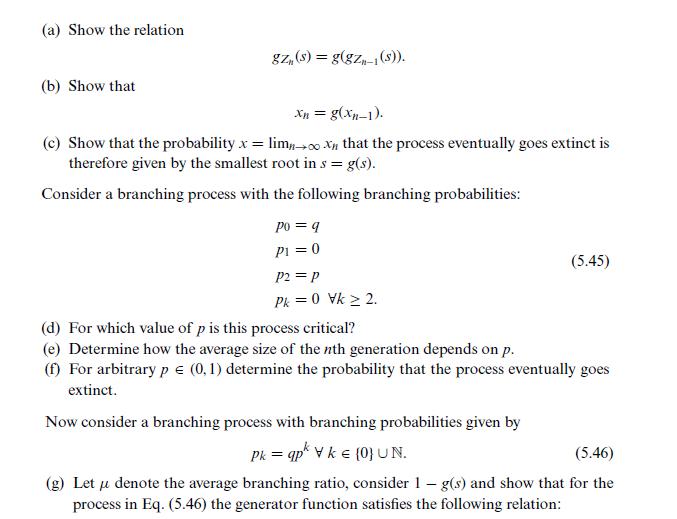
Equation (5.46)
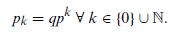
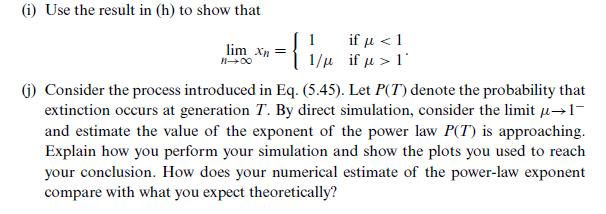
(a) Show the relation gz(s) = g(gz-($)). -1 (b) Show that (c) Show that the probability x = lim xn = g(xn1). xn that the process eventually goes extinct is therefore given by the smallest root in s = g(s). Consider a branching process with the following branching probabilities: Po= q P = 0 P2P Pk = 0 k 2. (d) For which value of p is this process critical? (e) Determine how the average size of the nth generation depends on p. (5.45) (f) For arbitrary p = (0,1) determine the probability that the process eventually goes extinct. Now consider a branching process with branching probabilities given by Pk=qpkk = {0} UN. (5.46) (g) Let denote the average branching ratio, consider 1 - g(s) and show that for the process in Eq. (5.46) the generator function satisfies the following relation:
Step by Step Solution
3.44 Rating (147 Votes )
There are 3 Steps involved in it

Get step-by-step solutions from verified subject matter experts
 Study Help