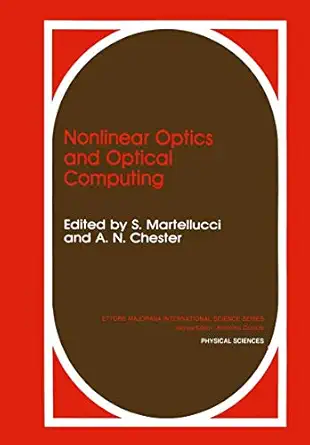
Nonlinear Optics And Optical Computing(1st Edition)
Authors:
S Martellucci ,A N Chester

In Stock: 2 Left
Shipment time
Expected shipping within 2 - 3 DaysPopular items with books
Total Price:
$0
Solution Manual Includes
Price:
$9.99
Book details
ISBN: 1461279003, 978-1461279006
Book publisher: Springer
Book Price $0 : The Conference "Nonlinear Optics And Optical Computing" Was Held May 11-19, 1988 In Erice, Sicily. This Was The 13th Conference Organized By The International School Of Quantum Electronics, Under The Auspices Of The "Ettore Majorana" Center For Scientific Culture. This Volume Contains Both The Invited And Contributed Papers Presented At The Conference, Providing Tutorial Background, The Latest Research Results, And Future Directions For The Devices, Structures And Architectures Of Optical Computing. The Invention Of The Transistor And The Integrated Circuit Were Followed By An Explosion Of Application As Ever Faster And More Complex Microelectronics Chips Became Available. The Information Revolution Occa Sioned By Digital Computers And Optical Communications Is Now Reaching The Limits Of Silicon Semiconductor Technology, But The Demand For Faster Com Putation Is Still Accelerating. The Fundamental Limitations Of Information Processing Today Derive From The Performance And Cost Of Three Technical Factors: Speed, Density, And Software. Optical Computation Offers The Potential For Improvements In All Three Of These Critical Areas: Speed Is Provided By The Transmission Of Impulses At Optical Veloc Ities, Without The Delays Caused By Parasitic Capacitance In The Case Of Conventional Electrical Interconnects. Speed Can Also Be Achieved Through The Massive Parallelism Characteristic Of Many Optical Computing Architec Tures; Density Can Be Provided In Optical Computers In Two Ways: By High Spatial Resolution, On The Order Of Wavelengths Of Light, And By Computa Tion Or Interconnection In Three Dimensions.
Popular Among Students (9)

Progress In Microemulsions - 1st Edition
S Martellucci
ISBN: 1489908110, 978-1489908117
$106.4 $152.00
Laser Applications For Mechanical Industry - 1st Edition
S Martellucci
ISBN: 9401048797, 978-9401048798
$193 $275.72
Inorganic Radicals Radical Ions And Radicals In Metal Complexes / Anorganische Radikale Radikalionen Und Radikale In Metallkomplexen In Science And Technology New Series 17a - 1st Edition
C Daul
ISBN: 3540166807, 978-3540166801
$1029 $1470.00
Infrared Thermal Imaging Fundamentals Research And Applications - 1st Edition
Michael Vollmer
ISBN: 3527407170, 978-3527407170
$82.08 $117.25

Pareto Optimality Game Theory And Equilibria - 1st Edition
Panos M Pardalos
ISBN: 0387772464, 978-0387772462
$118.99 $169.99

Supramolecular Chemistry From Biological Inspiration To Biomedical Applications - 1st Edition
Peter J Cragg
ISBN: 9048125812, 978-9048125814
$0 $74.97

Pottery Analysis A Sourcebook - 2nd Edition
Prudence M Rice
ISBN: 0226923215, 978-0226923215
$0 $19.43Recommended For You (12)

Savage Sudoku 140 Puzzles To Test Your Skills - 1st Edition
Terry Stickels
ISBN: 0486802892, 978-0486802893
$0 $8.95
Medical Illuminations Using Evidence Visualization And Statistical Thinking To Improve Healthcare - 1st Edition
Howard Wainer
ISBN: 0199668795, 978-0199668793
$0 $11.45

Optoelectronics For Environmental Science Proceedings Of The 14th Course Of The International School Of Quantum Electronics On Optoelectronics For Majorana International Science Series - 1st Edition
S Martellucci
ISBN: 1468458973, 978-1468458978
$0 $41.21
Biomedical Optical Instrumentation And Laser Assisted Biotechnology - 1st Edition
A M Verga Scheggi
ISBN: 0792341724, 978-0792341727
$175.04 $250.05
Biomedical Optical Instrumentation And Laser Assisted Biotechnology - 1st Edition
A M Verga Scheggi
ISBN: 9401072825, 978-9401072823
$181.14 $258.77

Nonlinear Optics And Optical Physics Lecture Notes From Capri Spring School -
Khoo
ISBN: 9810209673, 9789810209674
$0 $19.00
A First Guide To Computational Modelling In Physics - 1st Edition
Pawel Scharoch
ISBN: 1009413120, 978-1009413121
$0 $71.50

Catalan Numbers With Applications - 1st Edition
Thomas Koshy
ISBN: 019533454X, 978-0195334548
$0 $76.09
Statistical Reasoning For Surgeons - 1st Edition
Mitchell G Maltenfort
ISBN: 1138091790, 978-1138091795
$112.24 $160.34