New Semester
Started
Get
50% OFF
Study Help!
--h --m --s
Claim Now
Question Answers
Textbooks
Find textbooks, questions and answers
Oops, something went wrong!
Change your search query and then try again
S
Books
FREE
Study Help
Expert Questions
Accounting
General Management
Mathematics
Finance
Organizational Behaviour
Law
Physics
Operating System
Management Leadership
Sociology
Programming
Marketing
Database
Computer Network
Economics
Textbooks Solutions
Accounting
Managerial Accounting
Management Leadership
Cost Accounting
Statistics
Business Law
Corporate Finance
Finance
Economics
Auditing
Tutors
Online Tutors
Find a Tutor
Hire a Tutor
Become a Tutor
AI Tutor
AI Study Planner
NEW
Sell Books
Search
Search
Sign In
Register
study help
computer sciences
databases
Modern Database Management 12th edition Jeff Hoffer, Ramesh Venkataraman, Heikki Topi - Solutions
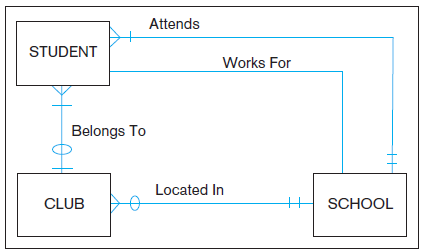
Figure 2-27 represents a situation of students who attend and work in schools and who also belong to certain clubs that are located in different schools. Study this diagram carefully to try to discern what business rules are represented.a. You will notice that cardinalities are not included on the
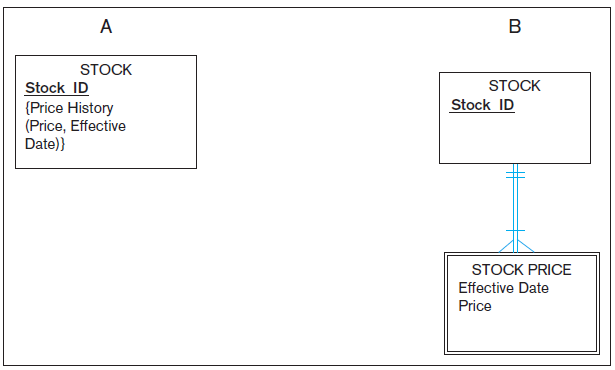
Figure 2-28 shows two diagrams (A and B), both of which are legitimate ways to represent that a stock has a history of many prices. Which of the two diagrams do you consider a better way to model this situation and why?
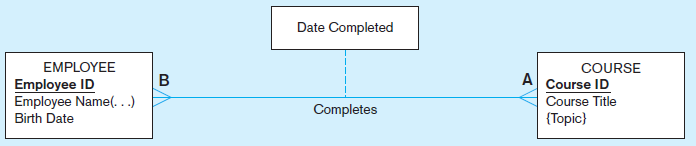
Modify Figure 2-11a to model the following additional information requirements: The training director decides for each employee who completes each class who (what employees) should be notified of the course completion. The training director needs to keep track of which employees are notified about
Review Figure 2-8 and Figure 2-22.Figure 2-8 Figure 2-22a. Identify any attributes in Figure 2-22 that might be composite attributes but are not shown that way. Justify your suggestions. Redraw the ERD to reflect any changes you suggest.b. Identify any attributes in Figure 2-22 that might be
Draw an ERD for each of the following situations. (If you believe that you need to make additional assumptions, clearly state them for each situation.) Draw the same situation using the tool you have been told to use in the course.a. A company has a number of employees. The attributes of EMPLOYEE
Give four reasons why many system designers believe that data modeling is important and arguably the most important part of the systems development process.
Assume that at Pine Valley Furniture, each product (described by product number, description, and cost) is composed of three components (described by component number, description, and unit of measure), and components are used to make one or many products. In addition, assume that components are
Emerging Electric wishes to create a database with the following entities and attributes:• Customer, with attributes Customer ID, Name, Address (Street, City, State, Zip Code), and Telephone• Location, with attributes Location ID, Address (Street, City, State, Zip Code), and Type (values of
Each semester, each student must be assigned an adviser who counsels students about degree requirements and helps students register for classes. Each student must register for classes with the help of an adviser, but if the student's assigned adviser is not available, the student may register with
In the chapter, when describing Figure 2-4a, it was argued that the Received and Summarizes relationships and TREASURER entity were not necessary. Within the context of this explanation, this is true. Now, consider a slightly different situation. Suppose it is necessary, for compliance purposes
Virtual Campus (VC) is a social media firm that specializes in creating virtual meeting places for students, faculty, staff, and others associated with different college campuses. VC was started as a student project in a database class at Cyber University, an online polytechnic college, with
After completing a course in database management, you are asked to develop a preliminary ERD for a symphony orchestra. You discover the entity types that should be included as shown in Table 2-3.During further discussions you discover the following:• A concert season schedules one or more
Draw an ERD to represent what you have discovered. Identify a business rule in this description and explain how this business rule is modeled on the E-R diagram. Also draw a data model for this situation using the tool you have been told to use in your course. 2-46. Obtain several common user views
Draw an ERD for the following situation (Batra et al., 1988). Also, develop the list of words for qualifiers and classes that you use to form attribute names. Explain why you chose the words on your list. Also, draw a data model for this situation using the tool you have been told to use in your
Draw an ERD for the following situation. (State any assumptions you believe you have to make in order to develop a complete diagram.) Also, draw a data model for this situation using the tool you have been told to use in your course: Stillwater Antiques buys and sells one-of-a-kind antiques of all
Draw an ERD for the following situation. (State any assumptions you believe you have to make in order to develop a complete diagram.) Also, draw a data model for this situation using the tool you have been told to use in your course: The A. M. Honka School of Business operates international
Give four reasons why a business rules approach is advocated as a new paradigm for specifying information systems requirements.
Wally Los Gatos, owner of Wally's Wonderful World of Wallcoverings, Etc., has hired you as a consultant to design a database management system for his new online marketplace for wallpaper, draperies, and home decorating accessories. He would like to track sales, prospective sales, and customers.
Doctors Information Technology (DocIT) is an IT services company supporting medical practices with a variety of computer technologies to make medical offices more efficient and less costly to run. Medical offices are rapidly becoming automated with electronic medical records, automated insurance
Review your answer to Problem and Exercise 2-49; if necessary, change the names of the entities, attributes, and relationships to conform to the naming guidelines presented in this chapter. Then, using the definition guidelines, write a definition for each entity, attribute, and relationship. If
Redo the enterprise data model you created in Chapter 1 to accommodate the information gleaned from Alex Martin, Dale Dylan, and Sandy Wallis' e-mails.
Explain where you can find business rules in an organization.
Create an E-R diagram for FAME based on the enterprise data model you developed in 1-52. Clearly state any assumptions you made in developing the diagram.
Use the narratives in Chapter 1 and above to identify the typical outputs (reports and displays) the various stakeholders might want to retrieve from your database. Now, revisit the E-R diagram you created in 2-60 to ensure that your model has captured the information necessary to generate the
State six general guidelines for naming data objects in a data model.
State four criteria for selecting identifiers for entities.
Why must some identifiers be composite rather than simple?
Define each of the following terms:a. Supertypeb. Subtypec. Specializationd. Entity clustere. Completeness constraintf. Enhanced entity-relationship (EER) modelg. Subtype discriminatorh. Total specialization rulei. Generalizationj. Disjoint rulek. Overlap rulel. Partial specialization rulem.
When would a packaged data model be useful?
In what ways is starting a data modeling project with a packaged data model different from starting a data modeling project with a clean sheet of paper?
How can data profiling be used during a data modeling project, especially one using a packaged data model?
Does a data modeling project using a packaged data model require less or greater skill than a project not using a packaged data model? Why or why not?
What do you purchase when you acquire a packaged data model?
When might a supertype/subtype hierarchy be useful?
Add a subtype discriminator for each of the supertypes shown in Figure 3-10. Show the discriminator values that assign instances to each subtype. Use the following subtype discriminator names and values: a. PERSON: Person Type (Employee? Alumnus? Student?) b. EMPLOYEE: Employee Type (Faculty,
Match the following terms and definitions: _________ Supertype…………………………. a. subset of supertype _________ Entity cluster……………………… b. entity belongs to two subtypes _________ Subtype……………………………. c. subtype gets supertype
For simplicity, subtype discriminators were left off many figures in this chapter. Add subtype discriminator notation in each figure listed below. If necessary, create a new attribute for the discriminator. a. Figure 3-2 b. Figure 3-3 c. Figure 3-4b d. Figure 3-7a e. Figure 3-7b
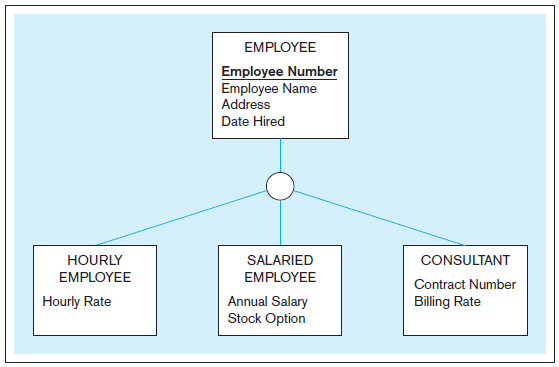
Refer to the employee EER diagram in Figure 3-2. Make any assumptions that you believe are necessary. Develop a sample definition for each entity type, attribute, and relationship in the diagram.
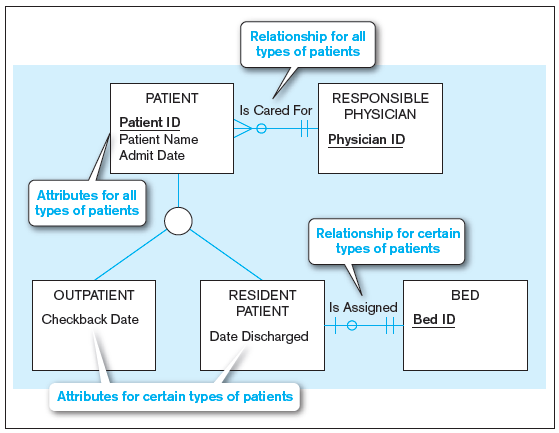
Refer to the EER diagram for patients in Figure 3-3. Make any assumptions you believe are necessary. Develop sample definitions for each entity type, attribute, and relationship in the diagram.
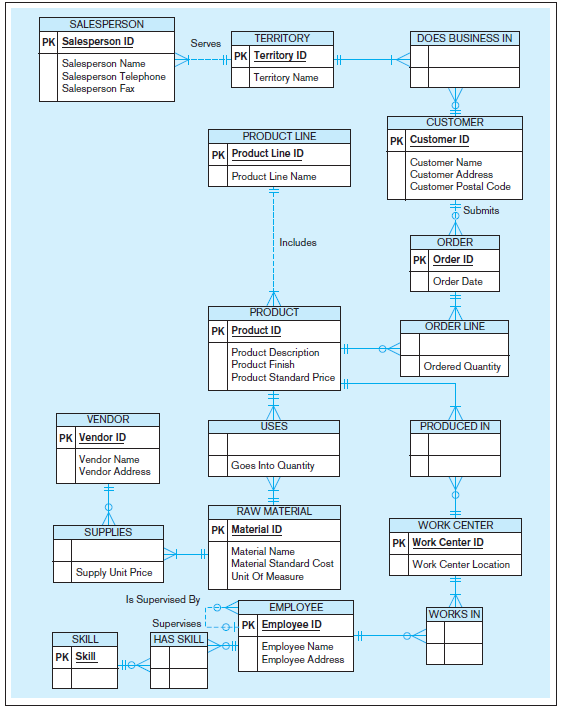
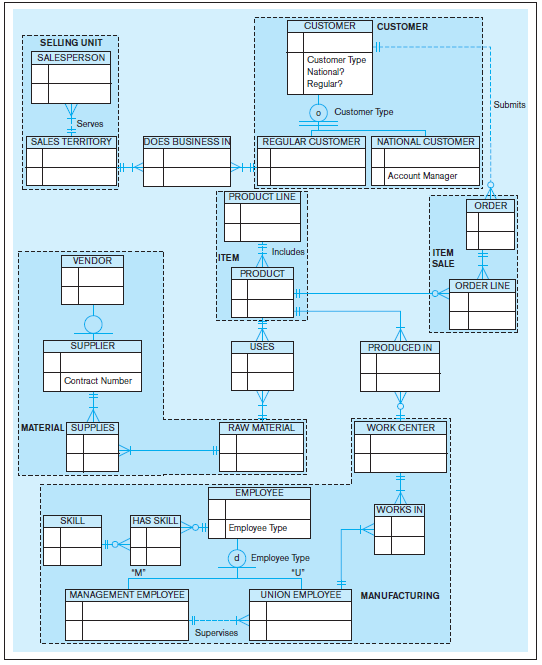
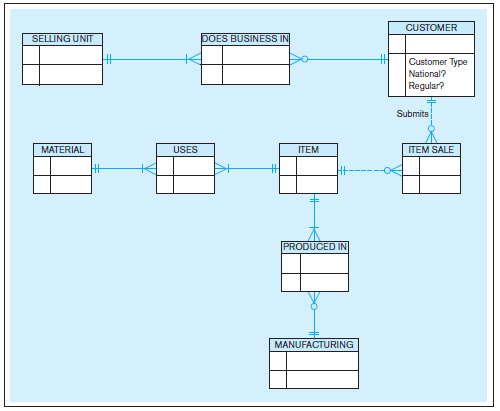
Figure 3-13 shows the development of entity clusters for the Pine Valley Furniture E-R diagram. In Figure 3-13b, explain the following:a. Why is the minimum cardinality next to the DOES BUSINESS IN associative entity coming from CUSTOMER zero?b. What would be the attributes of ITEM (refer to Figure
Refer to Problem and Exercise 2-44 in Chapter 2, Part f. Redraw the ERD for your answer to this exercise using appropriate supertypes and subtypes. In Exercise 2-44 Part f You may see various additional capabilities for the VC database. However, in the final phase you will consider in this
For a library, the entity type HOLDING has four subtypes: BOOK, AUDIO BOOK, DVD, and SOFTWARE. Draw a separate EER diagram segment for each of the following situations:a. At a given time, a holding must be exactly one of these subtypes.b. A holding may or may not be one of these subtypes. However,
A bank has three types of accounts: checking, savings, and loan. Following are the attributes for each type of account:CHECKING: Acct No, Date Opened, Balance, Service ChargeSAVINGS: Acct No, Date Opened, Balance, Interest RateLOAN: Acct No, Date Opened, Balance, Interest Rate, PaymentAssume that
Refer to your answer to Problem and Exercise 2-44 in Chapter 2. Develop entity clusters for this E-R diagram and redraw the diagram using the entity clusters. Explain why you chose the entity clusters you used.
Refer to your answer to Problem and Exercise 3-24. Develop entity clusters for this E-R diagram and redraw the diagram using the entity clusters. Explain why you chose the entity clusters you used.
Draw an EER diagram for the following problem using this text's EER notation, the Visio notation, or the subtypes inside supertypes notation, as specified by your instructor.A nonprofit organization depends on a number of different types of persons for its successful operation. The organization is
Contrast the following terms:a. Supertype; subtypeb. Generalization; specializationc. Disjoint rule; overlap ruled. Total specialization rule; partial specialization rulee. PARTY; PARTY ROLEf. Entity; entity cluster
Add a subtype discriminator (named Person Type) to the diagram you created in Problem and Exercise 2-29.
Develop an EER model for the following situation, using the traditional EER notation, the Visio notation, or the subtypes inside supertypes notation, as specified by your instructor:A technology company provides offerings to its customers. Offerings are of two separate types: products and services.
Draw an EER diagram for the following description of a law firm: Each case handled by the firm has a unique case number; a date opened, date closed, and judgment description are also kept on each case. A case is brought by one or more plaintiffs, and the same plaintiff may be involved in many
Develop an EER model for the following situation using the traditional EER notation, the Visio notation, or the subtypes inside supertypes notation, as specified by your instructor: An international school of technology has hired you to create a database management system to assist in scheduling
Develop an EER model for the following situation using the traditional EER notation, the Visio notation, or the subtypes inside supertypes notation, as specified by your instructor:Wally Los Gatos and his partner Henry Chordate have formed a new limited partnership, Fin and Finicky Security
Based on the EER diagram constructed for Problem and Exercise 3-34, develop a sample definition for each entity type, attribute, and relationship in the diagram. Consultant There are two types of consultants: business consultants and technical consultants. Business consultants are contacted by a
Refer to your answer to Problem and Exercise 2-51 in Chapter 2. The description for DocIT explained that there were to be data in the database about people who are not patients but are related to patients. Also, it is possible for some staff members to be patients or to be related to patients. And,
Draw an EER diagram for the following situation: TomKat Entertainment is a chain of theaters owned by former husband and wife actors/entertainers who, for some reason, can't get a job performing anymore. The owners want a database to track what is playing or has played on each screen in each
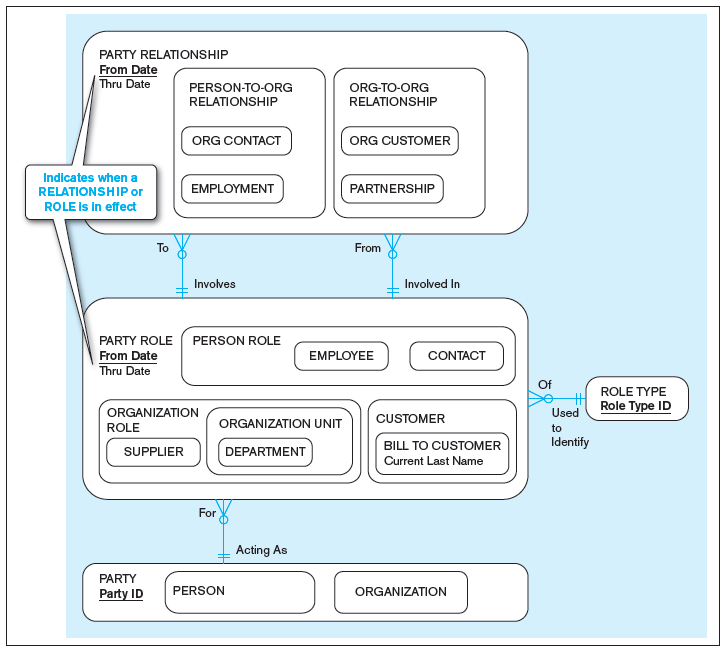
Add the following to Figure 3-16: An EMPLOYMENT party relationship is further explained by the positions and assignments to positions during the time a person is employed. A position is defined by an organization unit, and a unit may define many positions over time. Over time, positions are
State two conditions that indicate when a database designer should consider using supertype/subtype relationships.
Ask a database administrator or database or system analyst in a local company to show you an EER (or E-R) diagram for one of the organization's primary databases. Does this organization model have supertype/subtype relationships? If so, what notation is used, and does the CASE tool the company uses
Create an EER diagram for FAME that extends the E-R diagram you developed in Chapter 2, 2-60, but accommodates the information gleaned from the e-mails from Pat Smith and Shannon Howard.
Document your thought process around what changes you made to the model developed in Chapter 2, 2-60, to accommodate the new information. Pay particular attention to what changes you had to make to the original model to accommodate the need for supertype/subtype relationships that emerged from the
State the reasons for entity clustering.
Give an example (other than those discussed in the chapter) of a supertype/subtype relationship.
What is attribute inheritance? Why is it important?
Define each of the following terms: a. Determinant b. Functional dependency c. Transitive dependency d. Recursive foreign key e. Normalization f. Composite key g. Relation h. Normal form i. Partial functional dependency j. Enterprise key k. Surrogate primary key
What is a well-structured relation? Why are well-structured relations important in logical database design?
Describe the most common way in which relationships in an E-R diagram are expressed in a corresponding relational data model.
Describe how the following components of an E-R diagram are transformed into relations:a. Regular entity typeb. Relationship (1:M)c. Relationship (M:N)d. Relationship (supertype/subtype)e. Multivalued attributef. Weak entityg. Composite attribute
Why is normalization useful, given that EER conversion will typically lead to a normalized set of relations?
Briefly describe four typical problems that often arise in merging relations and common techniques for addressing those problems.
List three conditions that you can apply to determine whether a relation that is in first normal form is also in second normal form.
Explain how each of the following types of integrity constraints is enforced in the SQL CREATE TABLE commands:a. Entity integrityb. Referential integrity
What are the benefits of enforcing the integrity constraints as part of the database design and implementation process (instead of doing it in application design)?
Match the following terms to the appropriate definitions:
Explain three conditions that suggest a surrogate key should be created for the primary key of a relation.
What are the benefits of the use of a surrogate key?
For each of the following E-R diagrams from Chapter 2:I. Transform the diagram to a relational schema that shows referential integrity constraints (see Figure 4-5 for an example of such a schema):II. For each relation, diagram the functional dependencies (see Figure 4-23 for an example).III. If any
For each of the following EER diagrams from Chapter 3:I. Transform the diagram into a relational schema that shows referential integrity constraints (see Figure 4-5 for an example of such a schema).II. For each relation, diagram the functional dependencies (see Figure 4-23 for an example).III. If
Contrast the following terms:a. Normal form; normalizationb. Candidate key; primary keyc. Partial dependency; transitive dependencyd. Composite key; recursive foreign keye. Determinant; candidate keyf. Foreign key; primary keyg. Enterprise key; surrogate key
For each of the following relations, indicate the normal form for that relation. If the relation is not in third normal form, decompose it into 3NF relations. Functional dependencies (other than those implied by the primary key) are shown where appropriate. a. CLASSfCourseNo, SectionNo) b.
For your answers to the following Problems and Exercises from prior chapters, transform the EER diagrams into a set of relational schemas, diagram the functional dependencies, and convert all the relations to third normal form: a. Chapter 2, Problem and Exercise 2-37b b. Chapter 2, Problem and
Figure 4-32 shows a class list for Millennium College. Convert this user view to a set of 3NF relations using an enterprise key. Assume the following:€¢ An instructor has a unique location.€¢ A student has a unique major.€¢ A course has a unique title.Figure 4-32
Figure 4-33 (page 196) shows an EER diagram for a simplified credit card environment. There are two types of card accounts: debit cards and credit cards. Credit card accounts accumulate charges with merchants. Each charge is identified by the date and time of the charge as well as the primary keys
Table 4-3 contains sample data for parts and for vendors who supply those parts. In discussing these data with users, we find that part numbers (but not descriptions) uniquely identify parts and that vendor names uniquely identify vendors.a. Convert this table to a relation (named PART SUPPLIER) in
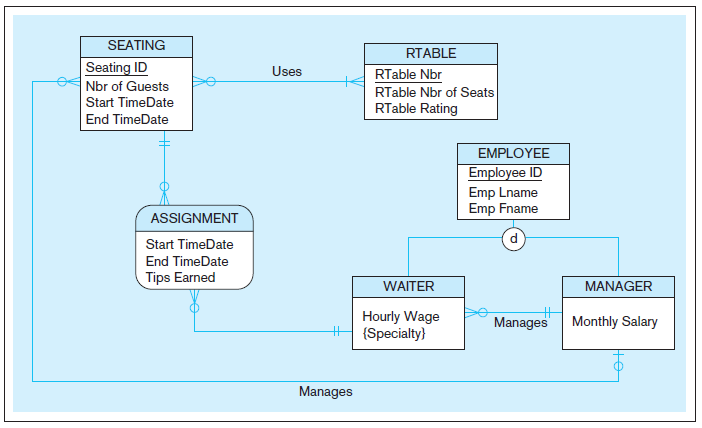
Figure 4-34 shows an EER diagram for a restaurant, its tables, and the waiters and waiting staff managers who work at the restaurant. Your assignment is to:a. Develop a relational schema.b. Show the functional dependencies.c. Develop a set of 3NF relations using an enterprise key.
Table 4-4 shows a relation called GRADE REPORT for a university. Your assignment is as follows:a. Draw a relational schema and diagram the functional dependencies in the relation.b. In what normal form is this relation?c. Decompose GRADE REPORT into a set of 3NF relations.d. Draw a relational
Table 4-5 shows a shipping manifest. Your assignment is as follows:a. Draw a relational schema and diagram the functional dependencies in the relation.b. In what normal form is this relation?c. Decompose MANIFEST into a set of 3NF relations.d. Draw a relational schema for your 3NF relations and
Transform the relational schema developed in Problem and Exercise 4-37 into an EER diagram. State any assumptions that you have made.
For your answers to the following Problems and Exercises from prior chapters, transform the EER diagrams into a set of relational schemas, diagram the functional dependencies, and convert all the relations to third normal form. a. Chapter 3, Problem and Exercise 3-32 b. Chapter 3, Problem and
Describe the primary differences between the conceptual and logical data models.
Transform Figure 2-15a, attribute version, to 3NF relations. Transform Figure 2-15b, relationship version, to 3NF relations. Compare these two sets of 3NF relations with those in Figure 4-10. What observations and conclusions do you reach by comparing these different sets of 3NF relations?
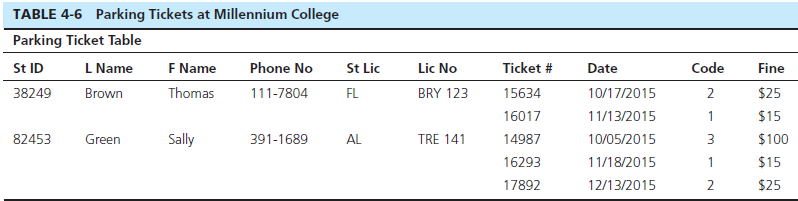
The Public Safety office at Millennium College maintains a list of parking tickets issued to vehicles parked illegally on the campus. Table 4-6 shows a portion of this list for the fall semester. (Attribute names are abbreviated to conserve space.)a. Convert this table to a relation in first normal
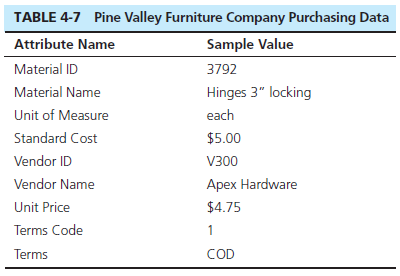
The materials manager at Pine Valley Furniture Company maintains a list of suppliers for each of the material items purchased by the company from outside vendors. Table 4-7 shows the essential data required for this application.a. Draw a dependency diagram for this data. You may assume the
Table 4-8 shows a portion of a shipment table for a large manufacturing company. Each shipment (identified by Shipment*) uniquely identifies the shipment Origin, Destination, and Distance. The shipment Origin and Destination pair also uniquely identifies the Distance.a. Develop a diagram that shows
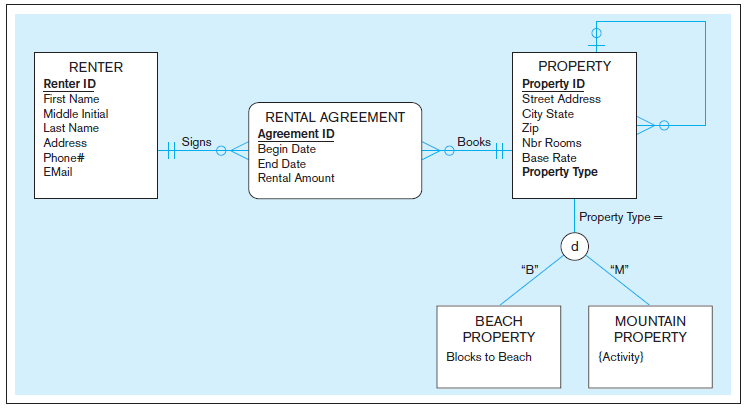
Figure 4-35 shows an EER diagram for Vacation Property Rentals. This organization rents preferred properties in several states. As shown in the figure, there are two basic types of properties: beach properties and mountain properties.a. Transform the EER diagram to a set of relations and develop a
For your answers to Problem and Exercise 3-33 from Chapter 3, transform the EER diagrams into a set of relational schemas, diagram the functional dependencies, and convert all the relations to third normal form.
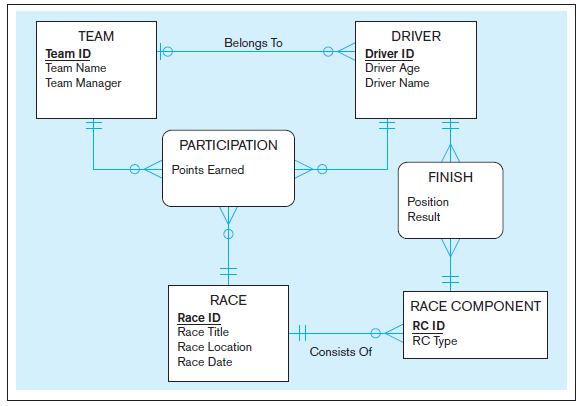
Figure 4-36 includes an EER diagram describing a car racing league. Transform the diagram into a relational schema that shows referential integrity constraints (see Figure 4-5 for an example of such a schema). In addition, verify that the resulting relations are in 3NF.Figure 4-36
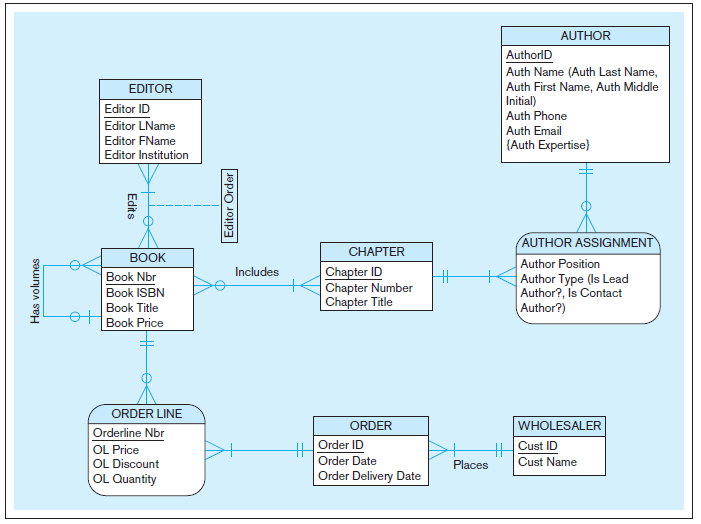
Figure 4-37 includes an EER diagram describing a publisher specializing in large edited works. Transform the diagram into a relational schema that shows referential integrity constraints (see Figure 4-5 for an example of such a schema). In addition, verify that the resulting relations are in 3NF.
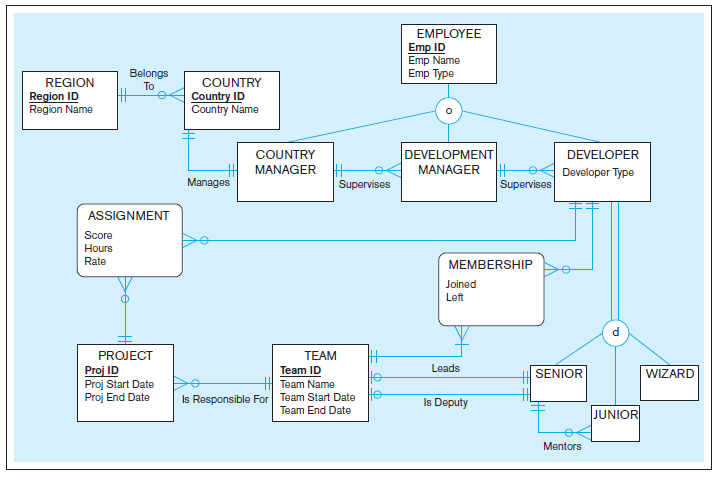
Figure 4-38 includes an EER diagram for a medium-size software vendor. Transform the diagram into a relational schema that shows referential integrity constraints (see Figure 4-5 for an example of such a schema). In addition, verify that the resulting relations are in 3NF.
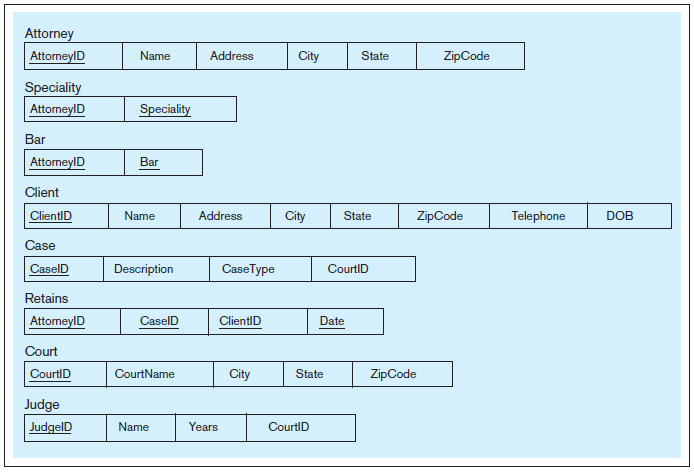
Examine the set of relations in Figure 4-39. What normal form are these in? How do you know this? If they are in 3NF, convert the relations into an EER diagram. What assumptions did you have to make to answer these questions?
Summarize six important properties of relations.
Showing 1600 - 1700
of 3228
First
10
11
12
13
14
15
16
17
18
19
20
21
22
23
24
Last
Step by Step Answers

 Get 50% OFF
Claim Now
Get 50% OFF
Claim Now


![EMPLOYEE Employee ID Employee Name(. . .) Payroll Address(...) Date Employed {Skill} [Years Employed] Multivalued Derive](https://dsd5zvtm8ll6.cloudfront.net/si.question.images/images/question_images/1552/4/7/7/8385c88ee8ec5d3b1552477839165.jpg)
.png)
.png)
.png)
.png)
.png)
.png)