New Semester
Started
Get
50% OFF
Study Help!
--h --m --s
Claim Now
Question Answers
Textbooks
Find textbooks, questions and answers
Oops, something went wrong!
Change your search query and then try again
S
Books
FREE
Study Help
Expert Questions
Accounting
General Management
Mathematics
Finance
Organizational Behaviour
Law
Physics
Operating System
Management Leadership
Sociology
Programming
Marketing
Database
Computer Network
Economics
Textbooks Solutions
Accounting
Managerial Accounting
Management Leadership
Cost Accounting
Statistics
Business Law
Corporate Finance
Finance
Economics
Auditing
Tutors
Online Tutors
Find a Tutor
Hire a Tutor
Become a Tutor
AI Tutor
AI Study Planner
NEW
Sell Books
Search
Search
Sign In
Register
study help
engineering
civil engineering
Engineering Mechanics Statics 12th Edition R. C. Hibbeler - Solutions
Determine the normal reactions at A and B in Prob. 5–1.
Determine the tension in the cord and the horizontal and vertical components of reaction at support A of the beam in Prob. 5–4.
Determine the horizontal and vertical components of reaction at C and the tension in the cable AB for the truss in Prob. 5–5.
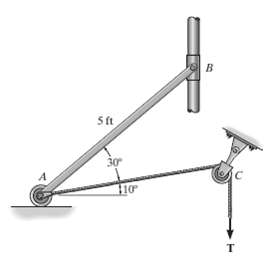
Determine the horizontal and vertical components of reaction at A and the tension in cable BC on the boom in Prob. 5–6.
Determine the horizontal and vertical components of reaction at A and the normal reaction at B on the spanner wrench in Prob. 5–7.
Determine the normal reactions at A and B and the force in link CD acting on the member in Prob. 5–8.
Determine the normal reactions at the points of contact at A, B, and C of the bar in Prob. 5–9.
Determine the horizontal and vertical components of reaction at pin C and the force in the pawl of the winch in Prob. 5–10.
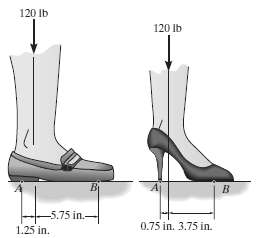
Compare the force exerted on the toe and heel of a 120-lb woman when she is wearing regular shoes and stiletto heels. Assume all her weight is placed on one foot and the reactions occur at points A and B asshown.
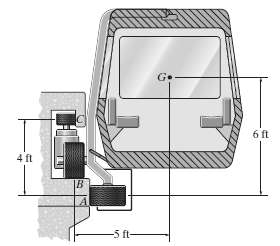
The train car has a weight of 24,000 lb and a center of gravity at G. It is suspended from its front and rear on the track by six tires located at A, B, and C. Determine the normal reactions on these tires if the track is assumed to be a smooth surface and an equal portion of the load is supported
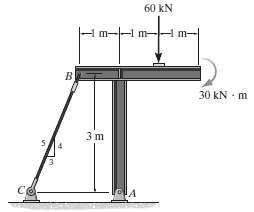
Determine the horizontal and vertical components of reaction at the pin A and the tension developed in cable BC used to support the steelframe.
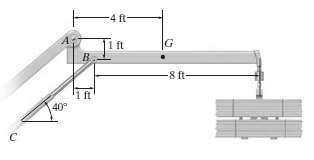
The articulated crane boom has a weight of 125 lb and center of gravity at G. If it supports a load of 600 lb, determine the force acting at the pin A and the force in the hydraulic cylinder BC when the boom is in the positionshown.
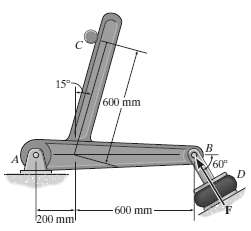
The airstroke actuator at D is used to apply a force of F = 200 N on the member at B. Determine the horizontal and vertical components of reaction at the pin A and the force of the smooth shaft at C on themember.
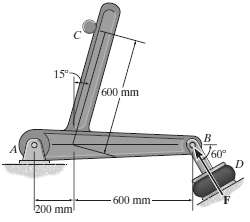
The airstroke actuator at D is used to apply a force of F on the member at B. The normal reaction of the smooth shaft at C on the member is 300 N. Determine the magnitude of F and the horizontal and vertical components of reaction at pinA.
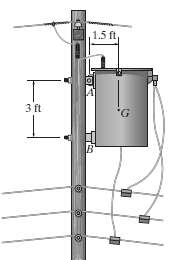
The 300-lb electrical transformer with center of gravity at G is supported by a pin at A and a smooth pad at B. Determine the horizontal and vertical components of reaction at the pin A and the reaction of the pad B on thetransformer.
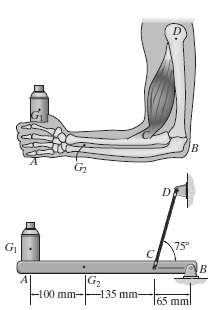
A skeletal diagram of a hand holding a load is shown in the upper figure. If the load and the forearm have masses of 2 kg and 1.2 kg, respectively, and their centers of mass are located at G1 and G2, determine the force developed in the biceps CD and the horizontal and vertical components of
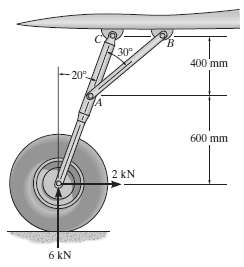
As an airplane?s brakes are applied, the nose wheel exerts two forces on the end of the landing gear as shown. Determine the horizontal and vertical components of reaction at the pin C and the force in strut AB.
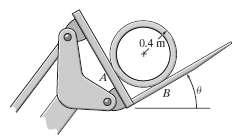
The 1.4-Mg drainpipe is held in the tines of the fork lift. Determine the normal forces at A and B as functions of the blade angle ? and plot the results of force (vertical axis) versus ? (horizontal axis) for 0 ? ? ? 90?.
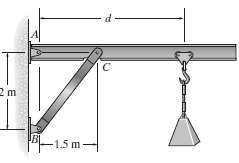
The mass of 700 kg is suspended from a trolley which moves along the crane rail from d = 1.7 m to d = 3.5 m. Determine the force along the pin-connected knee strut BC (short link) and the magnitude of force at pin A as a function of position d. Plot these results of FBC and FA (vertical axis)
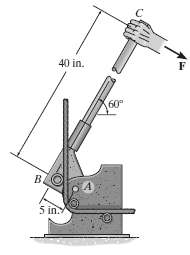
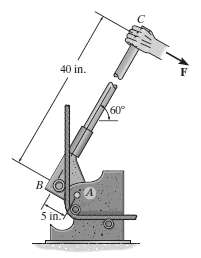
If the force of F = 100 lb is applied to the handle of the bar bender, determine the horizontal and vertical components of reaction at pin A and the reaction of the roller B on the smoothbar.
If the force of the smooth roller at B on the bar bender is required to be 1.5 kip, determine the horizontal and vertical components of reaction at pin A and the required magnitude of force F applied to thehandle.
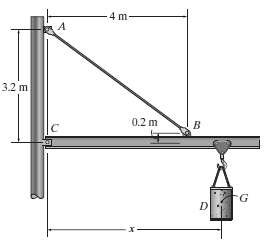
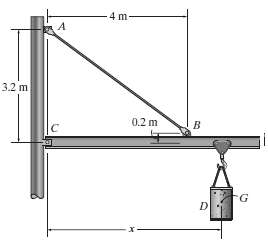
The jib crane is supported by a pin at C and rod AB. If the load has a mass of 2 Mg with its center of mass located at G, determine the horizontal and vertical components of reaction at the pin C and the force developed in rod AB on the crane when x = 5m.
The jib crane is supported by a pin at C and rod AB. The rod can withstand a maximum tension of 40 kN. If the load has a mass of 2 Mg, with its center of mass located at G, determine its maximum allowable distance x and the corresponding horizontal and vertical components of reaction atC.
Determine the horizontal and vertical components of reaction at the pin A and the normal force at the smooth peg B on themember.
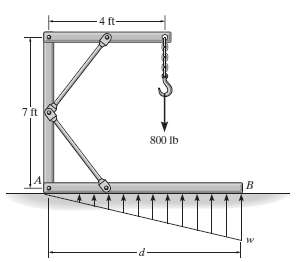
The framework is supported by the member AB which rests on the smooth floor. When loaded, the pressure distribution on AB is linear as shown. Determine the length d of member AB and the intensity w for thiscase.
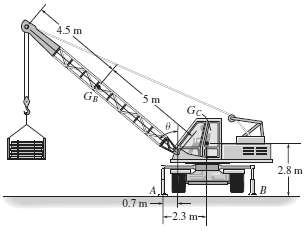
Outriggers A and B are used to stabilize the crane from overturning when lifting large loads. If the load to be lifted is 3 Mg, determine the maximum boom angle ? so that the crane does not overturn. The crane has a mass of 5 Mg and center of mass at GC, whereas the boom has a mass of 0.6 Mg and
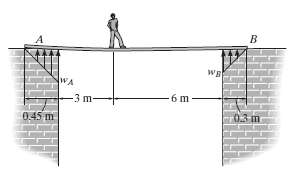
The wooden plank resting between the buildings deflects slightly when it supports the 50-kg boy. This deflection causes a triangular distribution of load at its ends, having maximum intensities of WA and WB. Determine WA and WB, each measured in N/m, when the boy is standing 3 m from one end as
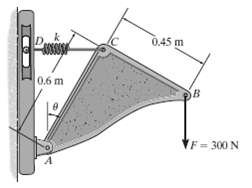
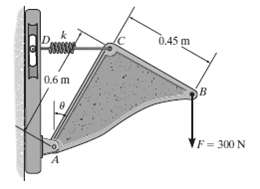
Spring CD remains in the horizontal position at all times due to the roller at D. If the spring is unstretched when ? = 0o and the bracket achieves its equilibrium position when ? = 30o, determine the stiffness k of the spring and the horizontal and vertical components of reaction at pin A.
Spring CD remains in the horizontal position at all times due to the roller at D. If the spring is unstretched when ? = 0o?and the stiffness is k = 1.5kN/m, determine the smallest angle ? for equilibrium and the horizontal and vertical components of reaction at pin A.
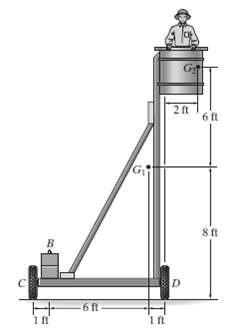
The platform assembly has a weight of 250 lb and center of gravity at G1 If it is intended to support a maximum load of 400 lb placed at point G2 determine the smallest counterweight W that should be placed at B in order to prevent the platform from tippingover.
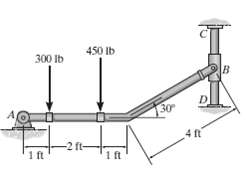
Determine the horizontal and vertical components of reaction at the pin A and the reaction of the smooth collar B on therod.
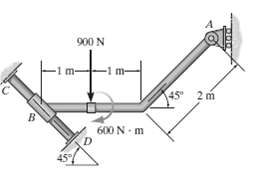
Determine the support reactions of roller A and the smooth collar B on the rod. The collar is fixed to the rod AB, but is allowed to slide along rodCD.
The uniform rod AB has a weight of 15 lb. Determine the force in the cable when the rod is in the positionshown.
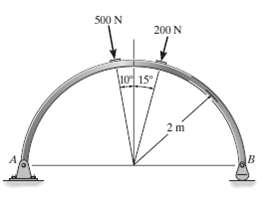
Determine the horizontal and vertical components of force at the pin A and the reaction at the rocker B of the curvedbeam.
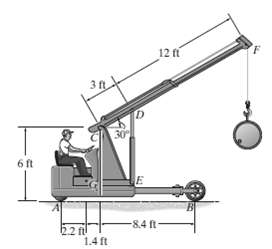
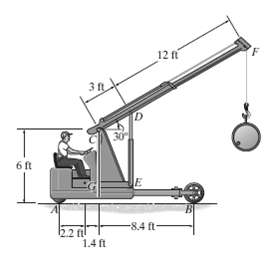
The floor crane and the driver have a total weight of 2500 lb with a center of gravity at G. If the crane is required to lift the 500-lb drum, determine the normal reaction on both the wheels at A and both the wheels at B when the boom is in the positionshown.
The floor crane and the driver have a total weight of 2500 lb with a center of gravity at G. Determine the largest weight of the drum that can be lifted without causing the crane to overturn when its boom is in the positionshown.
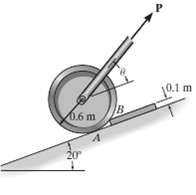
Determine the magnitude and direction ? of the minimum force P needed to pull the 50-kg roller over the smooth step.
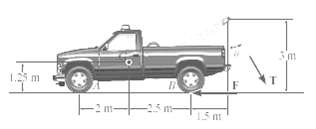
The winch cable on a tow truck is subjected to a force of T = 6 kN when the cable is directed at ? = 60o. Determine the magnitudes of the total brake frictional force F for the rear set of wheels B and the total normal forces at both front wheels A and both rear wheels B for equilibrium. The truck
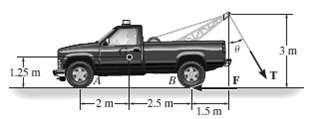
Determine the minimum cable force T and critical angle ? which will cause the tow truck to start tipping, i.e., for the normal reaction at A to be zero. Assume that the truck is braked and will not slip at B. The truck has a total mass of 4 Mg and mass center at G.x
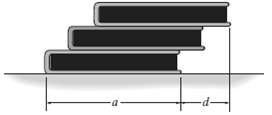
Three uniform books, each having a weight W and length a, are stacked as shown. Determine the maximum distance d that the top book can extend out from the bottom one so the stack does not toppleover.
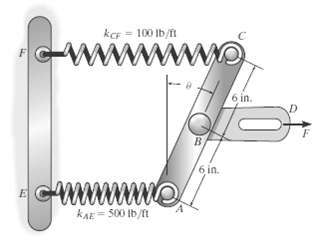
Determine the angle ? at which the link ABC is held in equilibrium if member BD moves 2 in. to the right. The springs are originally unstretched when ? = 0o. Each spring has the stiffness shown. The springs remain horizontal since they are attached to roller guides.
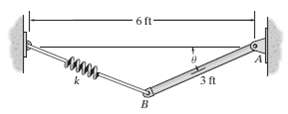
The uniform rod AB has a weight of 15 lb and the spring is unstretched when ?= 0o. If ? = 30o, determine the stiffness k of the spring.
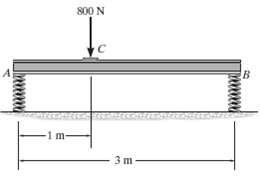
The horizontal beam is supported by springs at its ends. If the stiffness of the spring at A is kA = 5kN/m, determine the required stiffness of the spring at B so that if the beam is loaded with the 800 N it remains in the horizontal position. The springs are originally constructed so that the beam
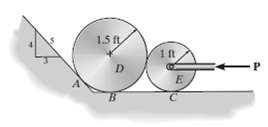
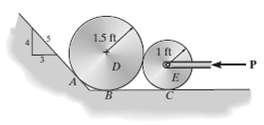
The smooth disks D and E have a weight of 200 lb and 100 lb, respectively. If a horizontal force of is applied to the center of disk E, determine the normal reactions at the points of contact with the ground at A, B, andC.
The smooth disks D and E have a weight of 200 lb and 100 lb, respectively. Determine the largest horizontal force P that can be applied to the center of disk E without causing the disk D to move up theincline.
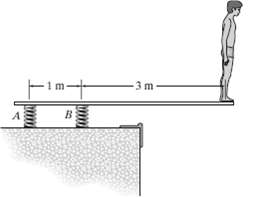
A man stands out at the end of the diving board, which is supported by two springs A and B, each having a stiffness of k = 15 kN/m. In the position shown the board is horizontal. If the man has a mass of 40 kg, determine the angle of tilt which the board makes with the horizontal after he jumps
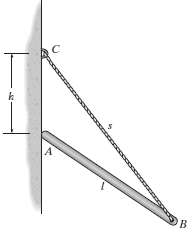
The uniform rod has a length l and weight W. It is supported at one end A by a smooth wall and the other end by a cord of length s which is attached to the wall as shown. Show that for equilibrium it is required that h = [(s2 -l2)/3]1/2.
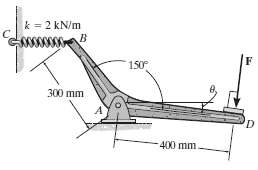
If spring BC is unstretched with ? = 0o and the bell crank achieves its equilibrium position when ? = 15o, determine the force F applied perpendicular to segment AD and the horizontal and vertical components of reaction at pin A. Spring BC remains in the horizontal position at all times due to the
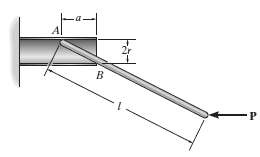
The thin rod of length l is supported by the smooth tube. Determine the distance a needed for equilibrium if the applied load isP.
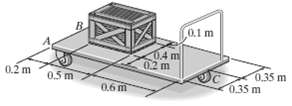
The cart supports the uniform crate having a mass of 85 kg. Determine the vertical reactions on the three casters at A, B, and C. The caster at B is not shown. Neglect the mass of thecart.
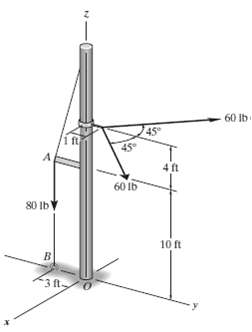
The pole for a power line is subjected to the two cable forces of 60 lb, each force lying in a plane parallel to the x ? y plane. If the tension in the guy wire AB is 80 lb, determine the x, y, z components of reaction at the fixed base of the pole, O.
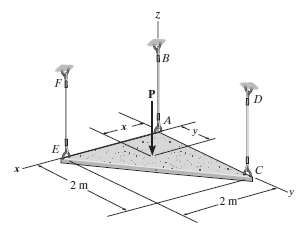
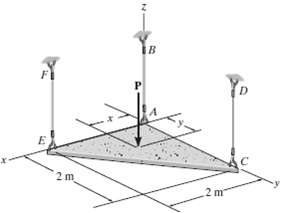
If P = 6 kN, x = 0.75 m and y = 1 m, determine the tension developed in cables AB, CD, and EF. Neglect the weight of theplate.
Determine the location x and y of the point of application of force P so that the tension developed in cables AB, CD, and EF is the same. Neglect the weight of theplate.
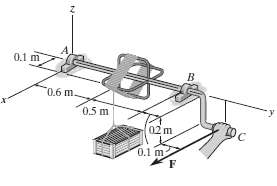
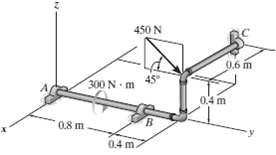
Determine the magnitude of force F that must be exerted on the handle at C to hold the 75-kg crate in the position shown. Also, determine the components of reaction at the thrust bearing A and smooth journal bearingB.
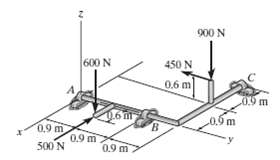
The shaft is supported by three smooth journal bearings at A, B, and C. Determine the components of reaction at thesebearings.
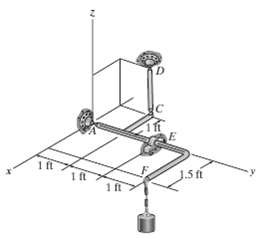
The rod assembly is used to support the 250-lb cylinder. Determine the components of reaction at the ball-and socket joint A, the smooth journal bearing E, and the force developed along rod CD. The connections at C and D are ball-and-socketjoints.
Determine the components of reaction acting at the smooth journal bearings A, B, andC.
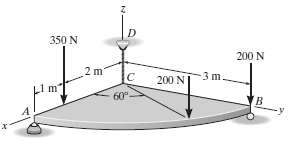
Determine the force components acting on the ball-and- socket at A, the reaction at the roller B and the tension on the cord CD needed for equilibrium of the quarter circularplate.
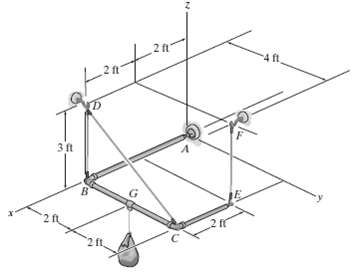
If the load has a weight of 200 lb, determine the x, y, z components of reaction at the ball-and-socket joint A and the tension in each of thewires.
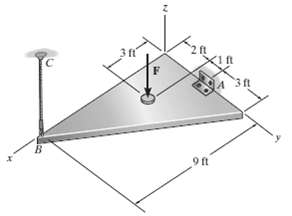
If the cable can be subjected to a maximum tension of 300 lb, determine the maximum force F which may be applied to the plate. Compute the x, y, z components of reaction at the hinge A for thisloading.
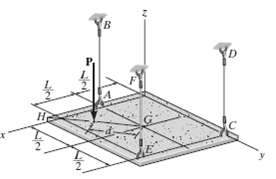
The plate has a weight of W with center of gravity at G. Determine the distance d along line GH where the vertical force P = 0.75Wwill cause the tension in wire CD to becomezero.
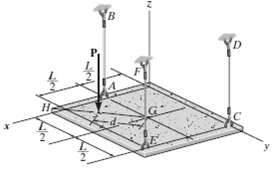
The plate has a weight of W with center of gravity at G. Determine the tension developed in wires AB, CD, and EF if the force P = 0.75W is applied at d =L/2.
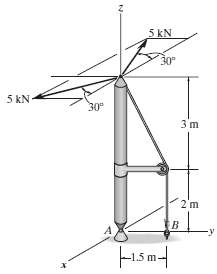
The boom is supported by a ball-and-socket joint at A and a guy wire at B. If the 5-kN loads lie in a plane which is parallel to the x?y plane, determine the x, y, z components of reaction at A and the tension in the cable at B.
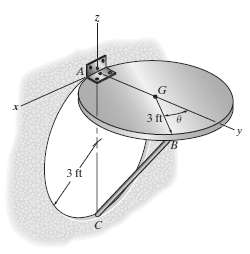
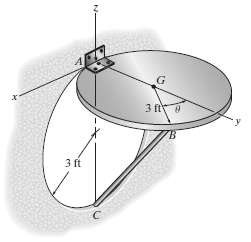
The circular door has a weight of 55 lb and a center of gravity at G. Determine the x, y, z components of reaction at the hinge A and the force acting along strut CB needed to hold the door in equilibrium. Set ? = 45?.
The circular door has a weight of 55 lb and a center of gravity at G. Determine the x, y, z components of reaction at the hinge A and the force acting along strut CB needed to hold the door in equilibrium. Set ? = 90?.
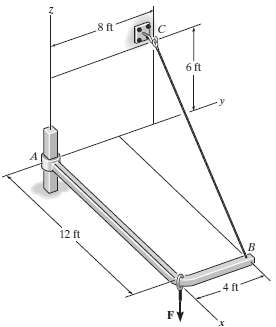
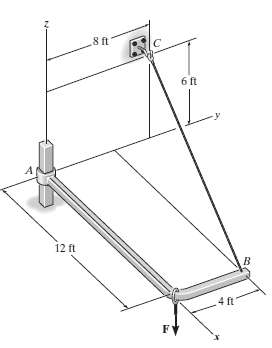
Member AB is supported at B by a cable and at A by a smooth fixed square rod which fits loosely through the square hole of the collar. If F = {20i ? 40j ? 75k}, determine the x, y, z components of reaction at A and the tension in the cable.
Member AB is supported at B by a cable and at A by a smooth fixed square rod which fits loosely through the square hole of the collar. Determine the tension in cable BC if the force F = {-45k}lb.
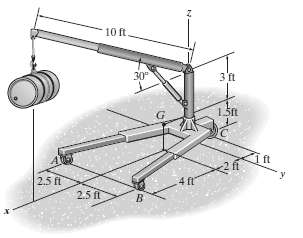
Determine the largest weight of the oil drum that the floor crane can support without overturning. Also, what are the vertical reactions at the smooth wheels A, B, and C for this case. The floor crane has a weight of 300 lb, with its center of gravity located atG.
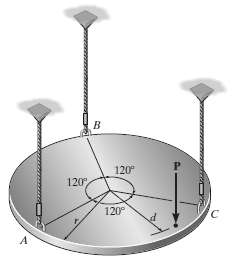
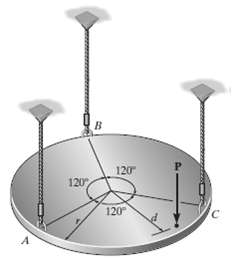
The circular plate has a weight W and center of gravity at its center. If it is supported by three vertical cords tied to its edge, determine the largest distance d from the center to where any vertical force P can be applied so as not to cause the force in any one of the cables to becomezero.
Solve Prob. 5?85 if the plate?s weight W is neglected.
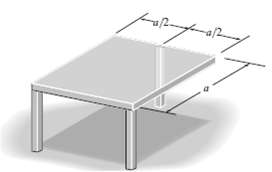
A uniform square table having a weight W and sides a is supported by three vertical legs. Determine the smallest vertical force P that can be applied to its top that will cause it to tipover.
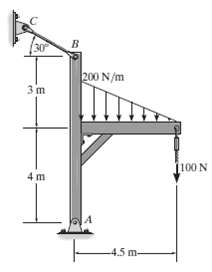
Determine the horizontal and vertical components of reaction at the pin A and the force in the cable BC. Neglect the thickness of themembers.
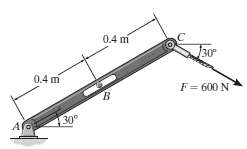
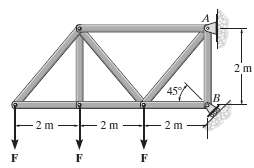
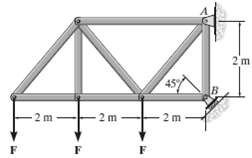
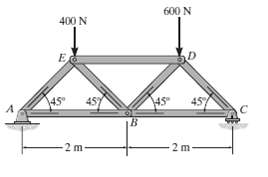
Determine the horizontal and vertical components of reaction at the pin A and the reaction at the roller B required to support the truss. Set F = 600N.
If the roller at B can sustain a maximum load of 3 kN, determine the largest magnitude of each of the three forces F that can be supported by thetruss.
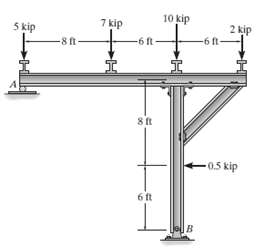
Determine the reactions at the supports A and B of theframe.
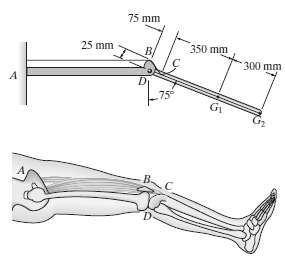
A skeletal diagram of the lower leg is shown in the lower figure. Here it can be noted that this portion of the leg is lifted by the quadriceps muscle attached to the hip at A and to the patella bone at B. This bone slides freely over cartilage at the knee joint. The quadriceps is further extended
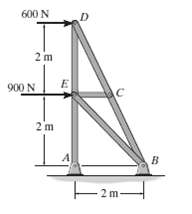
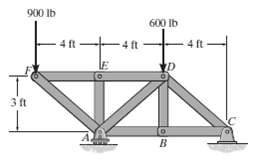
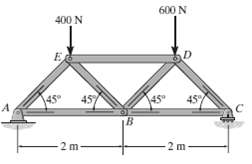
Determine the force in each member of the truss, and state if the members are in tension orcompression.
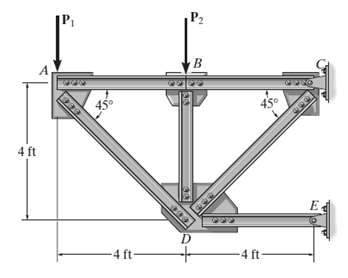
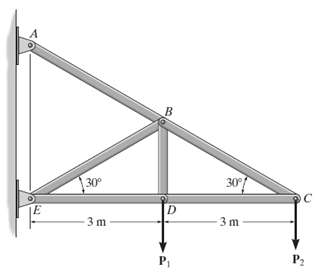
The truss, used to support a balcony, is subjected to the loading shown. Approximate each joint as a pin and determine the force in each member. State whether the members are in tension or compression. Set P1 = 800lb, P2 =0.
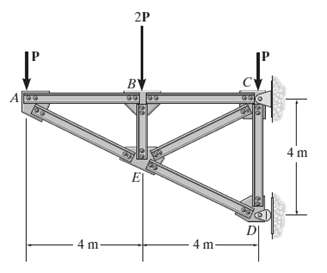
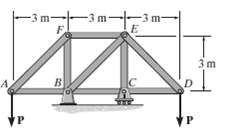
Determine the force in each member of the truss and state if the members are in tension or compression. Assume each joint as a pin. Set P = 4kN.
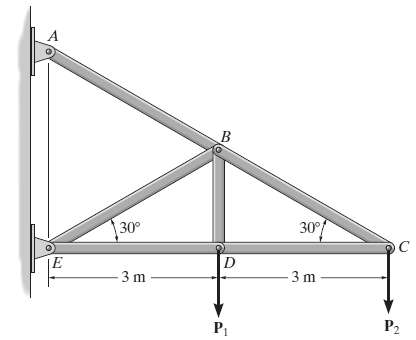
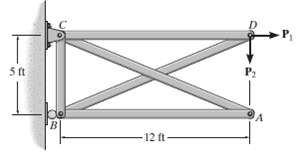
Determine the force in each member of the truss and state if the members are in tension or compression. Set P1 = 2 kN and P2 = 1.5kN.
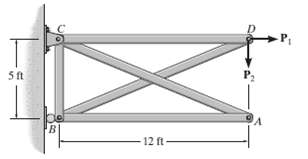
Determine the force in each member of the truss and state if the members are in tension or compression. Set P1 = P2 = 4kN.
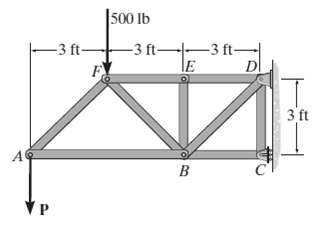
Determine the force in each member of the truss, and state if the members are in tension or compression. Set P = 800lb.
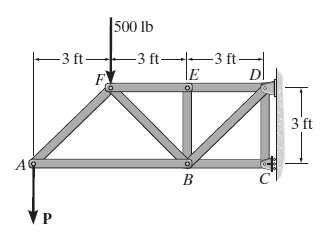
Remove the 500-lb force and then determine the greatest force P that can be applied to the truss so that none of the members are subjected to a force exceeding either 800 lb in tension or 600 lb incompression.
Determine the force in each member of the truss and state if the members are in tension or compression. Set P1 = 800 lb, P2 =0.
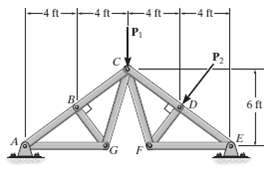
Determine the force in each member of the truss and state if the members are in tension or compression. Set P1 = 600 lb, P2 = 400lb.
Determine the force in each member of the truss and state if the members are in tension or compression. Set P1 = 240 lb, P2 = 100lb.
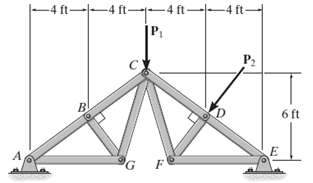
Determine the largest load P2 that can be applied to the truss so that the force in any member does not exceed 500 lb (T) or 350 lb (C). Take P1 =0.
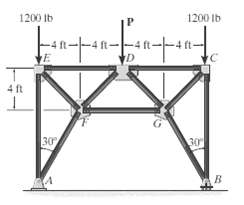
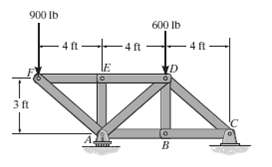
Determine the force in each member of the truss, and state if the members are in tension or compression. Set P = 2500lb.
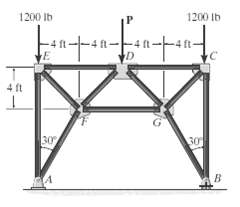
Remove the 1200-lb forces and determine the greatest force P that can be applied to the truss so that none of the members are subjected to a force exceeding either 2000 lb in tension or 1500 lb incompression.
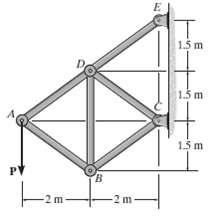
Determine the force in each member of the truss, and state if the members are in tension or compression. Set P = 5kN.
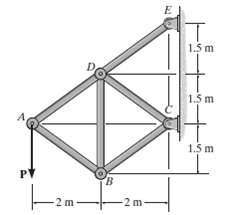
Determine the greatest force P that can be applied to the truss so that none of the members are subjected to a force exceeding either 2.5 kN in tension or 2 kN incompression.
Determine the force in each member of the truss and state if the members are in tension orcompression.
The truss is fabricated using members having a weight of 10 lb/ft. Remove the external forces from the truss, and determine the force in each member due to the weight of the members. State whether the members are in tension or compression. Assume that the total force acting on a joint is the sum of
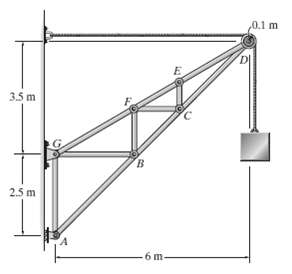
Determine the force in each member of the truss and state if the members are in tension or compression. The load has a mass of 40kg.
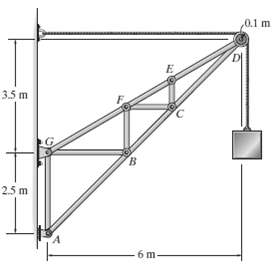
Determine the largest mass m of the suspended block so that the force in any member does not exceed 30 kN (T) or 25 kN(C).
Determine the force in each member of the truss, and state if the members are in tension orcompression.
The truss is fabricated using uniform members having a mass of 5kg/m. Remove the external forces from the truss, and determine the force in each member due to the weight of the truss. State whether the members are in tension or compression. Assume that the total force acting on a joint is the sum
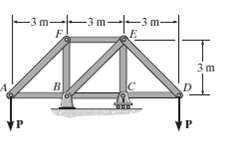
Determine the force in each member of the truss, and state if the members are in tension or compression. Set P = 4kN.
Determine the greatest force P that can be applied to the truss so that none of the members are subjected to a force exceeding either 1.5 kN in tension or 1 kN incompression.
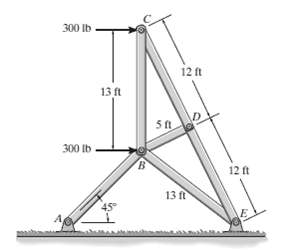
A sign is subjected to a wind loading that exerts horizontal forces of 300 lb on joints B and C of one of the side supporting trusses. Determine the force in each member of the truss and state if the members are in tension orcompression.
Showing 1800 - 1900
of 2574
First
12
13
14
15
16
17
18
19
20
21
22
23
24
25
26
Step by Step Answers

 Get 50% OFF
Claim Now
Get 50% OFF
Claim Now