







Question: Repeat Problem 7.31 with n-channel MOS transistors replacing all bipolar transistors. Assume W = 100 µm, L drwn = 2 µm, L d = 0.2
Repeat Problem 7.31 with n-channel MOS transistors replacing all bipolar transistors. Assume W = 100 µm, Ldrwn= 2 µm, Ld= 0.2 µm, Xd= 0, λ = 0, k€™n= 60 µA/V2, γ = 0, Vt= 1 V, Cox= 0.7 fF/µm2, Col= 0.15 fF/µm, Cj0= 0.4 fF/µm2, and Cjsw0= 0.4 fF/µm. Use (1.201) and (1.202) with ψ0= 0.6 V for the junctions. Use the information in Problem 7.17 to calculate Cdb0= Csb0. Skip part (d) in Problem 7.31.
Data from Prob. 7.31:
An amplifier stage is shown in Fig. 7.44.
(a) Calculate the low-frequency, small-signal voltage gain Ï…o/Ï…i.
(b) Apply the zero-value time-constant method to the DM half-circuit to calculate the ˆ’3-dB frequency of the gain. Data: Ccs0 = 2 pF, Cμ0 = 0.5 pF, Cje = 4 pF (at the bias point), fT = 500 MHz (at IC = 2 mA), β = 200, rb = 0, and ro = ˆž. Assume n = 0.5 and ψ0 = 0.55 V for all junctions.
Fig. 7.44:
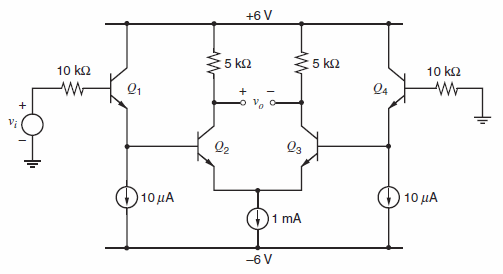
+6 V 5 k2 5 k2 10 k2 10 k2 Q4 Q3 Q2 10 10 1 mA -6 V W-
Step by Step Solution
3.46 Rating (166 Votes )
There are 3 Steps involved in it
Half circuit a M1 is a source follower with a perfect current source 0 ... View full answer

Get step-by-step solutions from verified subject matter experts
Document Format (2 attachments)

1528_605d88e1b9c2d_686941.pdf
180 KBs PDF File

1528_605d88e1b9c2d_686941.docx
120 KBs Word File
 Study Help