







Question: An article in the Journal of Applied Physiology [Humidity Does Not Affect Central Nervous System Oxygen Toxicity (2001, Vol. 91, pp. 13271333)] reported that central
An article in the Journal of Applied Physiology [€œHumidity Does Not Affect Central Nervous System Oxygen Toxicity€ (2001, Vol. 91, pp. 1327€“1333)] reported that central nervous system (CNS) oxygen toxicity can appear in humans on exposure to oxygen pressures >180 kPa. CNS oxygen toxicity can occur as convulsions (similar to epileptic seizures, grand mal) and loss of consciousness without any warning symptoms. CNS oxygen toxicity is a risk encountered in several fields of human activity, such as combat diving with closed-circuit breathing apparatus and diving with mixtures of nitrogen and oxygen (nitrox) or nitrogen, oxygen, and helium (trimix) in sport and professional diving to epths >30 μ. The risk of oxygen toxicity is always considered when deep diving is planned. The following data demonstrate shortened latencies in a dry atmosphere (<10% humidity) in 11 rats at O2of 507 kPa. The data collected are as follows:

(a) Given the following probability plot of the data, what is a logical assumption about the underlying distribution of the data?
(b) Explain why this check of the distribution underlying the sample data is important if you want to construct a confidence interval on the mean.
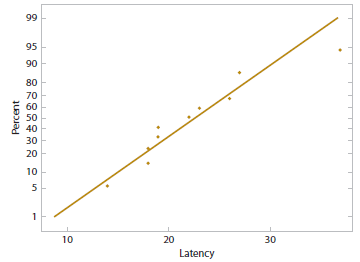
(c) Find the 95% confidence interval for the mean.
(d) Explain why this check of the distribution underlying the sample data is important if you want to construct a confidence interval on the variance.
(e) Find the 95% confidence interval for the variance.
22 37 18 27 19 26 19 27 18 23 14 99 95 90 80 70 60 * 50 40 30 20 10 10 20 30 Latency Percent
Step by Step Solution
3.45 Rating (177 Votes )
There are 3 Steps involved in it
a The data appear to follow a normal distribution based on the normal p... View full answer

Get step-by-step solutions from verified subject matter experts
 Study Help