







Question: 1 Figure 31 showed how a circle at the origin can be linearly separated by mapping from the features (21, 22) to the two dimensions
1 Figure 31 showed how a circle at the origin can be linearly separated by mapping
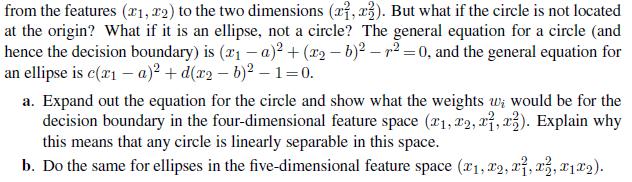
from the features (21, 22) to the two dimensions (2, 3). But what if the circle is not located at the origin? What if it is an ellipse, not a circle? The general equation for a circle (and hence the decision boundary) is (1 - a)2 + (2-6) - r2=0, and the general equation for an ellipse is c(x1a)2+d(x2 - b)2-1=0. a. Expand out the equation for the circle and show what the weights we would be for the decision boundary in the four-dimensional feature space (21, 22, 22, 2). Explain why this means that any circle is linearly separable in this space. b. Do the same for ellipses in the five-dimensional feature space (x1, x2, x, x, x1 x2).
Step by Step Solution
There are 3 Steps involved in it

Get step-by-step solutions from verified subject matter experts
 Study Help