







Question: For the toxicity study of Table 12.9, collapsing to a binary response, consider linear logit models for the probability a fetus is normal. a. Does
For the toxicity study of Table 12.9, collapsing to a binary response, consider linear logit models for the probability a fetus is normal.
a. Does the ordinary binomial model show evidence of overdispersion?
b. Fit the linear logit model using the quasi-likelihood approach with inflated binomial variance. How do the standard errors change?
c. Fit the linear logit model using quasi-likelihood with beta-binomial variance. Interpret and compare with previous results.
d. Fit the linear logit model using a GEE approach with exchangeable working correlation among fetuses in the same litter. Interpret and compare with previous results, including comparing the estimated GEE correlation with the estimate ?? from part (c).
e. Fit the linear logit GLMM after adding a litter-specific normal random effect. Interpret and compare with previous results.
Table 12.9:
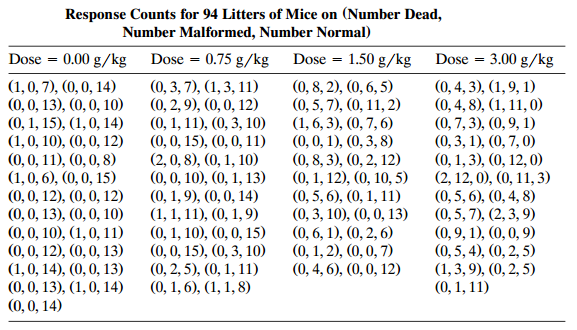
Response Counts for 94 Litters of Mice on (Number Dead, Number Malformed, Number Normal) Dose = 0.00 g/kg Dose = 3.00 g/kg Dose = 0.75 g/kg Dose = 1.50 g/kg (0, 3, 7), (1,3, 11) (0, 2, 9), (0,0, 12) (0, 1, 11), (0, 3, 10) (0, 0, 15), (0, 0, 11) (2, 0, 8), (0, 1, 10) (0, 0, 10), (0, 1, 13) (0, 1, 9), (0,0, 14) (1, 1, 11), (0, 1,9) (0, 1, 10), (0, 0, 15) (0, 0, 15), (0, 3, 10) (0, 2, 5), (0, 1, 11) (0, 1, 6), (1, 1, 8) (0, 8, 2), (0, 6, 5) (0, 5, 7), (0, 11, 2) (1, 6, 3), (0, 7, 6) (0, 0, 1), (0, 3, 8) (0, 8, 3), (0, 2, 12) (0, 1, 12), (0, 10, 5) (0, 5, 6), (0, 1, 11) (0, 3, 10), (0, 0, 13) (0, 6, 1), (0, 2, 6) (0, 1, 2), (0,0, 7) (0, 4, 6), (0, 0, 12) (1,0, 7), (0, 0, 14) (0, 0, 13), (0, 0, 10) (0, 1, 15), (1,0, 14) (1,0, 10), (0, 0, 12) (0, 0, 11), (0, 0, 8) (1,0, 6), (0, 0, 15) (0, 0, 12), (0, 0, 12) (0, 0, 13), (0, 0, 10) (0, 0, 10), (1,0, 11) (0, 0, 12), (0, 0, 13) (1,0, 14), (0,0, 13) (0, 0, 13), (1,0, 14) (0, 0, 14) (0, 4, 3), (1,9, 1) (0, 4, 8), (1, 11, 0) (0, 7, 3), (0, 9, 1) (0, 3, 1), (0, 7, 0) (0, 1, 3), (0, 12, 0) (2, 12, 0), (0, 11, 3) (0, 5, 6), (0, 4, 8) (0, 5, 7), (2, 3, 9) (0, 9, 1), (0, 0, 9) (0, 5, 4), (0, 2, 5) (1,3, 9), (0, 2, 5) (0, 1, 11)
Step by Step Solution
3.39 Rating (168 Votes )
There are 3 Steps involved in it
a Yes the ordinary bin omial model shows evidence of over dis p ersion b The standard errors change ... View full answer

Get step-by-step solutions from verified subject matter experts
 Study Help