







Question: Verify the average latency rate cited in the disk specification of Figure 7.15. Why is the calculation divided by 2? Figure 7.15. CONFIGURATION: Formatted capacity,
Verify the average latency rate cited in the disk specification of Figure 7.15. Why is the calculation divided by 2?
Figure 7.15.
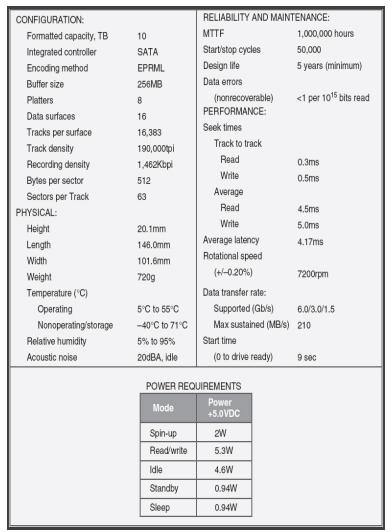
CONFIGURATION: Formatted capacity, TB Integrated controller Encoding method Buffer size Platters Data surfaces Tracks per surface Track density Recording density Bytes per sector Sectors per Track PHYSICAL: Height Length Width Weight Temperature (C) Operating Nonoperating/storage Relative humidity Acoustic noise 10 SATA EPAML 256MB 8 16 16,383 190,000 pl 1,462Kbpl 512 63 20.1mm 146.0mm 101.6mm 720g 5C to 55C -40C to 71C 5% to 95% 20dBA, idle Spin-up Read/write RELIABILITY AND MAINTENANCE: MTTF Start/stop cycles Design lite Data errors Idle Standby Sleep (nonrecoverable) PERFORMANCE: Seek times Track to track Read Write Average Read Write Average latency Rotational speed (+/-0.20%) Data transfer rate: Start time POWER REQUIREMENTS Power Mode +5.0VDC 2W 5.3W 4.6W 0.94W 0.94W (0 to drive ready) 1,000,000 hours 50,000 5 years (minimum)
Step by Step Solution
3.46 Rating (156 Votes )
There are 3 Steps involved in it
The average latency rate or rotational latency in the disk specification of Figure 715 is given as 4... View full answer

Get step-by-step solutions from verified subject matter experts
 Study Help