







Question: The article referenced in Exercise 15.24 reported on a study involving the following four learning methods: (1) Visual contact and imagery, (2) Nonvisual contact and
The article referenced in Exercise 15.24 reported on a study involving the following four learning methods:
(1) Visual contact and imagery,
(2) Nonvisual contact and imagery,
(3) Visual contact,
(4) Control.
There were 20 subjects assigned to each method. Calculate the 99% T–K intervals, indicate which methods differ significantly from one another, and summarize the results by underscoring. How do the 99% T–K intervals compare to the 95% T–K intervals of Exercise 15.24?
Data from Exercises 24
The degree of success at mastering a skill often depends on the method used to learn the skill. The article “Effects of Occluded Vision and Imagery on Putting Golf Balls” (Perceptual and Motor Skills [1995]: 179–186) reported on a study involving the following four learning methods: (1) Visual contact and imagery, (2) Nonvisual contact and imagery, (3) Visual contact, (4) Control.
There were 20 subjects randomly assigned to each method. The following summary information on putting performance score was reported:
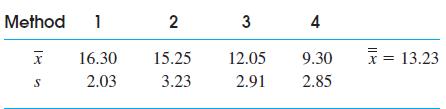
Method 1 X S 16.30 2.03 2 15.25 3.23 3 12.05 2.91 4 9.30 2.85 = 13.23
Step by Step Solution
3.32 Rating (164 Votes )
There are 3 Steps involved in it
To calculate the 99 TK intervals and determine which methods differ significantly from one another we need to perform a TukeyKramer test The TukeyKram... View full answer

Get step-by-step solutions from verified subject matter experts
 Study Help