







Question: 131 Time to solve a math programming problem. IEEE Transactions presented a hybrid algorithm for solving a polynomial zeroone mathematical programming problem. The algorithm incorporates
131 Time to solve a math programming problem. IEEE Transactions presented a hybrid algorithm for solving a polynomial zero–one mathematical programming problem.
The algorithm incorporates a mixture of pseudo-
Boolean concepts and time-proven implicit enumeration procedures. Fifty-two random problems were solved by the hybrid algorithm; the times to solution (CPU time in seconds) are listed in the accompanying table and saved in the MATHCPU file.
a. Estimate, with 95% confidence, the mean solution time for the hybrid algorithm. Interpret the result.
b. How many problems must be solved to estimate the mean m to within .25 second with 95% confidence?
*c. Form a 95% confidence interval for the true standard deviation of the solution times for the hybrid algorithm.
Interpret the result.
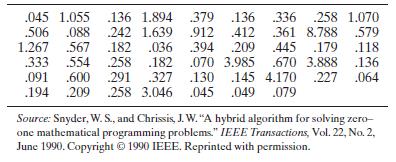
.045 1.055 136 1.894 .506 .088 .242 1.639 379 .136 336 .258 1.070 912 .412 .361 8.788 .579 .394 209 .445 .179 .118 1.267 567 .182 .036 .333 .554 .258 .182 .070 3.985 .670 3.888 .136 .091 .600 .291 .327 .291 .327 130 145 4.170 .227 .064 .194 209 .258 3.046 .045 .049 .079 Source: Snyder, W. S., and Chrissis, J. W. "A hybrid algorithm for solving zero- one mathematical programming problems." IEEE Transactions, Vol. 22, No. 2, June 1990. Copyright 1990 IEEE. Reprinted with permission.
Step by Step Solution
There are 3 Steps involved in it

Get step-by-step solutions from verified subject matter experts
 Study Help