



Question: Professor Diogenes has n supposedly identical integrated-circuit chips that in principle are capable of testing each other. The professor?s test jig accommodates two chips at
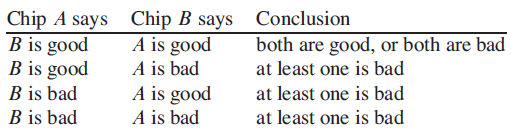
Professor Diogenes has n supposedly identical integrated-circuit chips that in principle are capable of testing each other. The professor?s test jig accommodates two chips at a time. When the jig is loaded, each chip tests the other and reports whether it is good or bad. A good chip always reports accurately whether the other chip is good or bad, but the professor cannot trust the answer of a bad chip. Thus, the four possible outcomes of a test are as follows:
a. Show that if more than n/2 chips are bad, the professor cannot necessarily determine which chips are good using any strategy based on this kind of pair wise test. Assume that the bad chips can conspire to fool the professor.
b.?Consider the problem of finding a single good chip from among?n?chips, assuming that more than?n/2?of the chips are good. Show that??n/2??pair wise tests are sufficient to reduce the problem to one of nearly half the size.
c. Show that the good chips can be identified with ?(n) pair wise tests, assuming that more than n/2 of the chips are good. Give and solve the recurrence that describes the number of tests.
Chip A says Chip B says Conclusion B is good B is good B is bad B is bad A is good A is bad A is good A is bad both are good, or both are bad at least one is bad at least one is bad at least one is bad
Step by Step Solution
3.31 Rating (151 Votes )
There are 3 Steps involved in it
Let g be the number f gd his nd ng be the number f bd his ls ssume ng g Frm this ssumtin we hve tht we n lwys find set G f gd his nd set B f bd his f equl size g Nw ssume tht the set B f bd his nsire ... View full answer

Get step-by-step solutions from verified subject matter experts
Document Format (2 attachments)

1778_61d57f25d5509_819370.pdf
180 KBs PDF File

1778_61d57f25d5509_819370.docx
120 KBs Word File