







Question: In deriving Equation 6.3 we assumed that our function had a Taylor series. The result holds more generally if we define the exponential of an
In deriving Equation 6.3 we assumed that our function had a Taylor series. The result holds more generally if we define the exponential of an operator by its spectral decomposition,

rather than its power series. Here I’ve given the operator in Dirac notation; acting on a position-space function (see the discussion on page 123) this means

where Φ(p) is the momentum space wave function corresponding to Ψ(x) and fp(x) is defined in Equation 3.32. Show that the operator T̂(a), as given by Equation 6.81, applied to the function
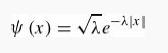
(whose first derivative is undefined at x = 0) gives the correct result.


(a) = [e- = [e-iap/h \p) (p\dp. (6.80)
Step by Step Solution
3.18 Rating (162 Votes )
There are 3 Steps involved in it
First we need to compute p Then we may use Equation 681 to compute Ta x ... View full answer

Get step-by-step solutions from verified subject matter experts
 Study Help