







Question: Consider the light propagating outward from the beam splitter, along the x arm of an interferometric gravitational-wave detector, as analyzed in TT gauge, so (suppressing
Consider the light propagating outward from the beam splitter, along the x arm of an interferometric gravitational-wave detector, as analyzed in TT gauge, so (suppressing the subscript “x arm” and superscript “out”) the electromagnetic vector potential is

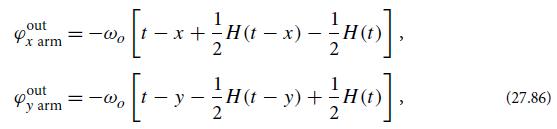
with Aα constant and with

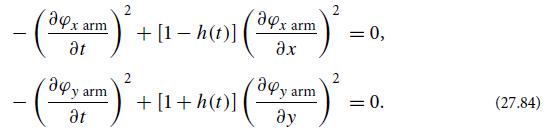
(a) Show that this φ satisfies the nullness equation (27.84), as claimed in the text—which implies that Aα = R(Aαeiφ(x, t)) satisfies Maxwell’s equations in the geometric-optics limit.
(b) Show that this φ satisfies the initial condition (27.85), as claimed in the text.
(c) Show that, because the gradient k(vector) = ∇(vector)φ of this φ satisfies k(vector) · k(vector) = 0, it also satisfies
Thus, the wave vector is the tangent vector to geometric-optics rays that are null geodesics in the gravitational-wave metric. Photons travel along these null geodesics and have 4-momenta p(vector) = ℏk(vector).
(d) Because the gravitational-wave metric (27.80) is independent of x, the px component of a photon’s 4-momentum must be conserved along its geodesic world line. Compute px = kx = ∂φ/∂x, and thereby verify this conservation law.
(e) Explain why the photon’s frequency, as measured by observers at rest in our TT coordinate system, is ω = −kt = −∂φ/∂t . Explain why the rate of change of this frequency, as computed moving with the photon, is dω/dt ≈ (∂/∂t + ∂/∂x)ω, and show that dω/dt ≈ −1/2ωodh/dt.
Equations.



A = R(Aeig(x,1)),
Step by Step Solution
3.46 Rating (162 Votes )
There are 3 Steps involved in it

Get step-by-step solutions from verified subject matter experts
 Study Help