



Question: Let (t_{2}=2 t_{1}) in Figure 17.3. (a) How does (R_{1}) compare with (R_{2}) ? (b) If the energy in the wave is (E) and there
Let \(t_{2}=2 t_{1}\) in Figure 17.3.
(a) How does \(R_{1}\) compare with \(R_{2}\) ?
(b) If the energy in the wave is \(E\) and there is no dissipation of energy, what is the energy per unit length along the circumference at \(R_{1}\) ? At \(R_{2}\) ?
(c) How does the energy per unit length along a wavefront vary with radial distance \(r\) ?
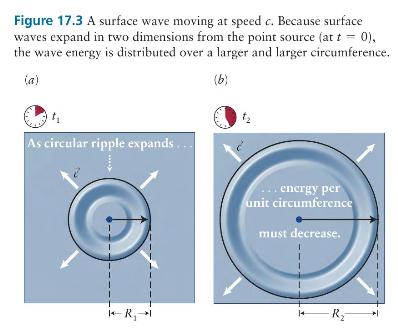
Figure 17.3 A surface wave moving at speed c. Because surface waves expand in two dimensions from the point source (at t = 0), the wave energy is distributed over a larger and larger circumference. (a) (b) As circular ripple expands. ... energy per unit circumference must decrease. R
Step by Step Solution
3.31 Rating (160 Votes )
There are 3 Steps involved in it

Get step-by-step solutions from verified subject matter experts