







Question: 1. Suppose that a router has N packets, numbered 1 to N, in its queue as shown below. pkt N pkt 3 pkt 2
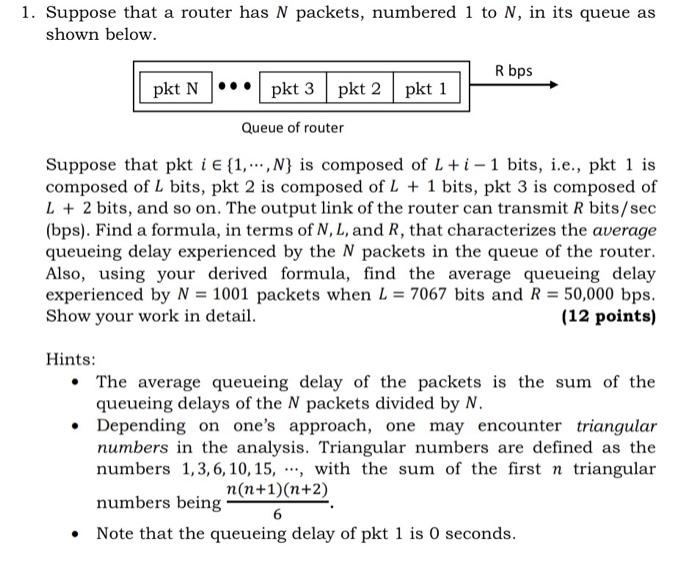
1. Suppose that a router has N packets, numbered 1 to N, in its queue as shown below. pkt N pkt 3 pkt 2 pkt 1 R bps Queue of router Suppose that pkt i E {1,...,N} is composed of L+i-1 bits, i.e., pkt 1 is composed of L bits, pkt 2 is composed of L + 1 bits, pkt 3 is composed of L + 2 bits, and so on. The output link of the router can transmit R bits/sec (bps). Find a formula, in terms of N, L, and R, that characterizes the average queueing delay experienced by the N packets in the queue of the router. Also, using your derived formula, find the average queueing delay experienced by N = 1001 packets when L = 7067 bits and R = 50,000 bps. Show your work in detail. (12 points) Hints: The average queueing delay of the packets is the sum of the queueing delays of the N packets divided by N. . Depending on one's approach, one may encounter triangular numbers in the analysis. Triangular numbers are defined as the numbers 1,3,6, 10, 15,, with the sum of the first n triangular n(n+1)(n+2) 6 numbers being Note that the queueing delay of pkt 1 is 0 seconds.
Step by Step Solution
There are 3 Steps involved in it
To find the average queueing delay we need to sum the queueing delay for each packet and divide by the total number of packets N Lets start by finding ... View full answer

Get step-by-step solutions from verified subject matter experts
 Study Help