







Question: 10. [I1 Points] DETAILS SERPSE10 25.3.P.012. MY NOTES | ASK YOUR TEACHER Consider the following figure. (D (a) Find the equivalent capacitance between points a
![10. [I1 Points] DETAILS SERPSE10 25.3.P.012. MY NOTES | ASK YOUR](https://dsd5zvtm8ll6.cloudfront.net/si.experts.images/questions/2024/09/66f69c4248389_89066f69c422627e.jpg)
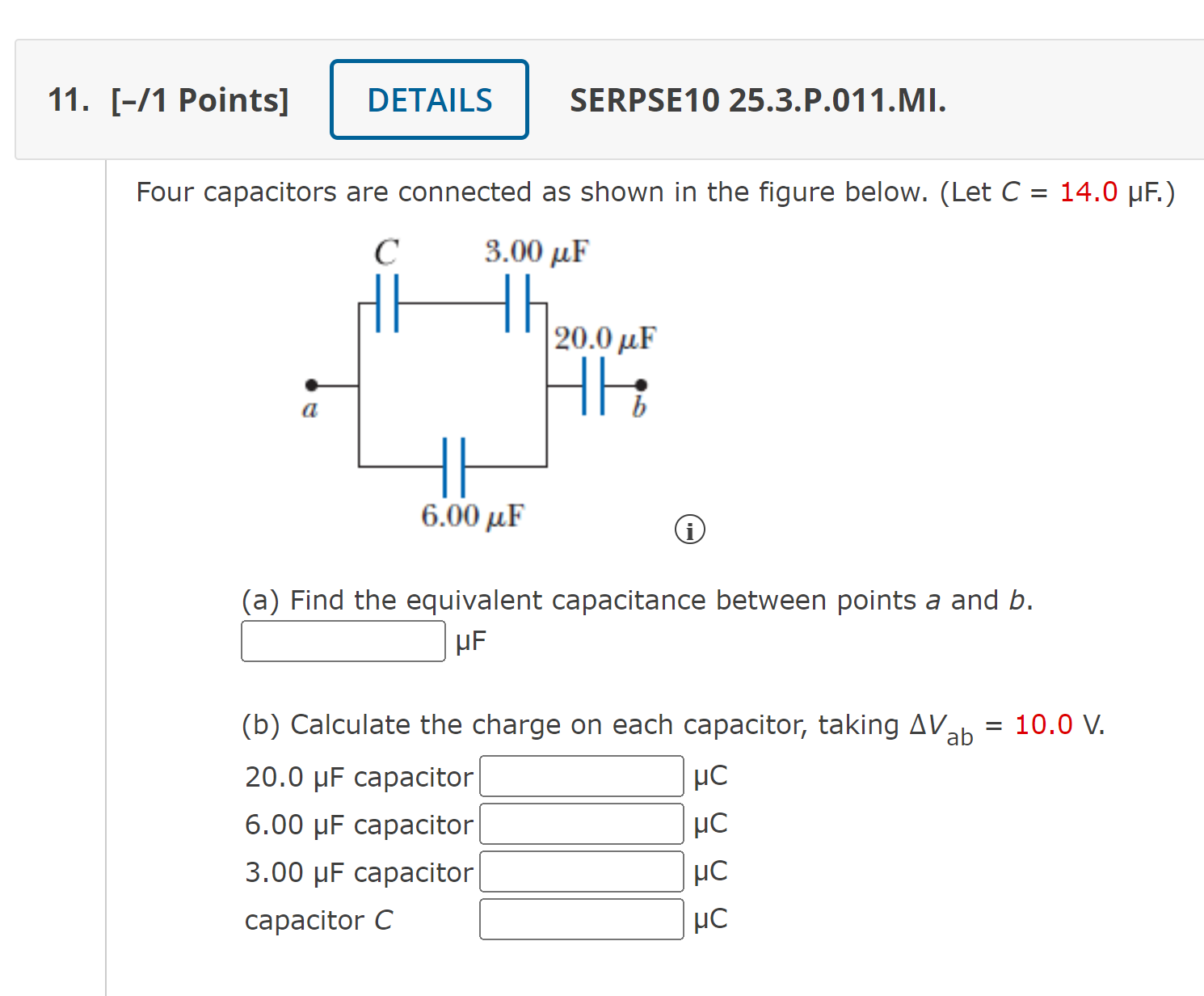
10. [I1 Points] DETAILS SERPSE10 25.3.P.012. MY NOTES | ASK YOUR TEACHER Consider the following figure. (D (a) Find the equivalent capacitance between points a and b for the group of capacitors connected as shown in the gure above. Take C1 = 3.00 pF, C2 = 15.0 HP, and C3 = 1.00 pF. E uF (b) What charge is stored on C3 if the potential difference between points a and b is 60.0 V? :uc 11. [-/1 Points] DETAILS SERPSE10 25.3.P.011.MI. Four capacitors are connected as shown in the figure below. (Let C = 14.0 JF.) C 3.00 UF 20.0 ULF a 6.00 uF i (a) Find the equivalent capacitance between points a and b. (b) Calculate the charge on each capacitor, taking AVab = 10.0 V. 20.0 HF capacitor HC 6.00 HF capacitor UC 3.00 HF capacitor UC capacitor C HC16. [-/1 Points] DETAILS SERPSE10 25.5.OP.017. MY NOTES ASK YOUR TEACHER (a) How much charge can be placed on a capacitor with air between the plates before it breaks down if the area of each plate is 7.00 cm? nc (b) Find the maximum charge if bakelite is used between the plates instead of air. nc Need Help? Read It Watch It 17. [-/1 Points] DETAILS SERPSE10 25.5.P.025. MY NOTES ASK YOUR TEACHER (a) Determine the capacitance of a Teflon-filled parallel-plate capacitor having a plate area of 1.65 cm and a plate separation of 0.020 0 mm. PF (b) Determine the maximum potential difference that can be applied to a Teflon-filled parallel-plate capacitor having a plate area of 1.65 cm and a plate separation of 0.020 0 mm. KV9. [-/1 Points] DETAILS SERPSE10 25.3.0P.008. Two capacitors (C1 = 6.00 pF and C2 = 14.0 pF) are now connected in series and to a 9.00-V battery. (a) Find the equivalent capacitance of the combination. :qu (b) Find the potential difference across each capacitor
Step by Step Solution
There are 3 Steps involved in it

Get step-by-step solutions from verified subject matter experts
 Study Help