



Question: 14) Which of the following compounds is optically active: a. trans-1-bromo-3-chlorocyclobutane b. cis-1,4-dimethylcyclohexane c. cis-1,3-dimethylcyclohexane d. trans-1,3-dimethylcyclohexane CHS MC CH3 CHE CH3 CH3 Br
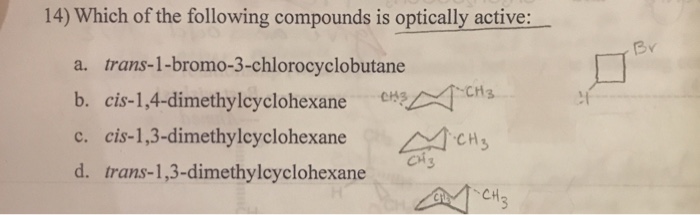

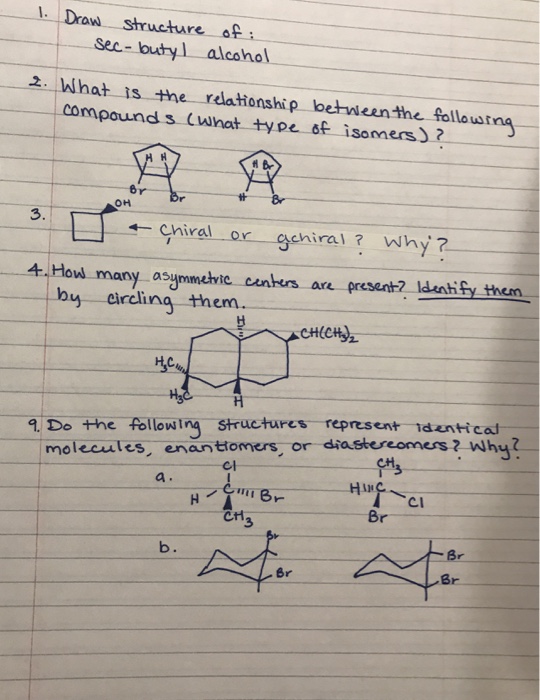
14) Which of the following compounds is optically active: a. trans-1-bromo-3-chlorocyclobutane b. cis-1,4-dimethylcyclohexane c. cis-1,3-dimethylcyclohexane d. trans-1,3-dimethylcyclohexane CHS MC CH3 CHE CH3 CH3 Br 6) Which of the following compounds (choose only one) is never chiral? (4 points) 2,3-dibromobutane; 1,3-dibromobutane; 1,2-dichlorobutane; 1,4-dibromobutane; and 1-bromo-2-chlorobutane. 1. Draw structure of: Sec-butyl alcohol 2. What is the relationship between the following compounds (what type of isomers)? 3. HH Br OH Chiral or gchiral? Why? 4. How many asymmetric centers are present? Identify them by circling them. CH(CH) a. Br H A HC HC 9. Do the following structures represent identical molecules, enantiomers, or diastereomers? Why? CI CH3 I C Br A CH3 b. Br H- Br HINC Br CI Br Br
Step by Step Solution
3.37 Rating (166 Votes )
There are 3 Steps involved in it
14 D option is correct Explanation Only compound D does not have a p... View full answer

Get step-by-step solutions from verified subject matter experts