







Question: (20%) Problem 1: A bicycle wheel has a radius r = 0.21 In and rotates at a constant frequency of f = 86 rev/min. Randomized
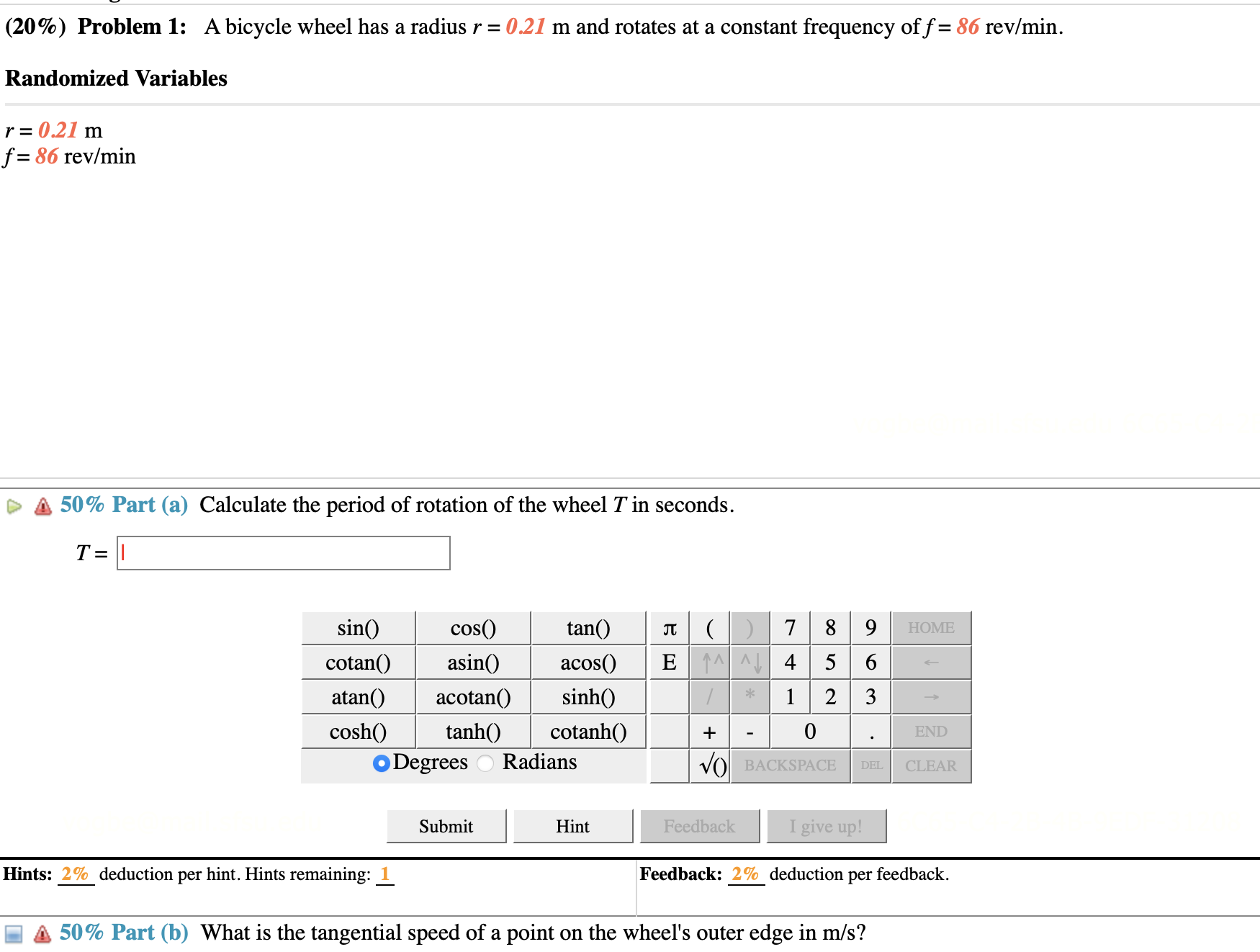
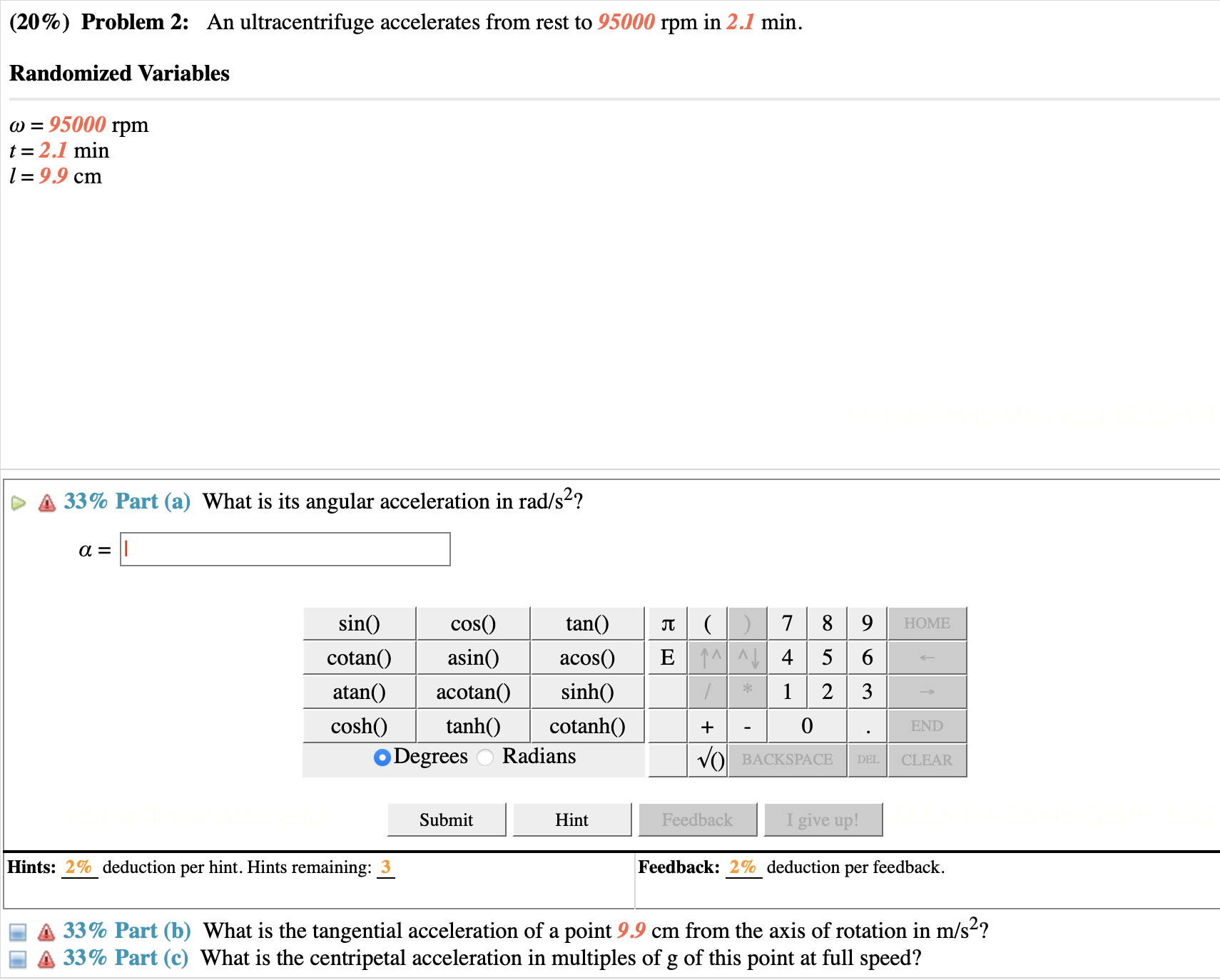
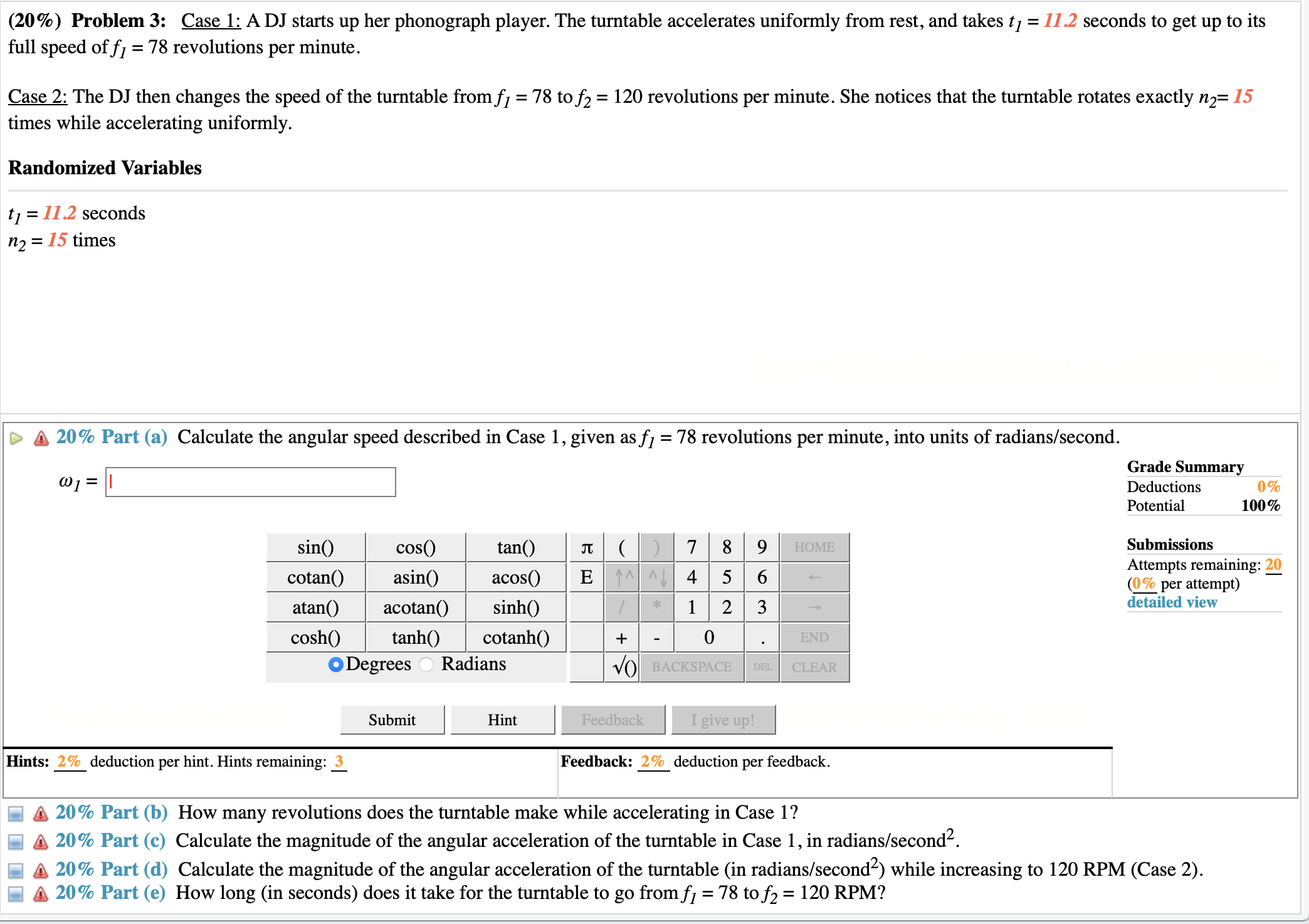
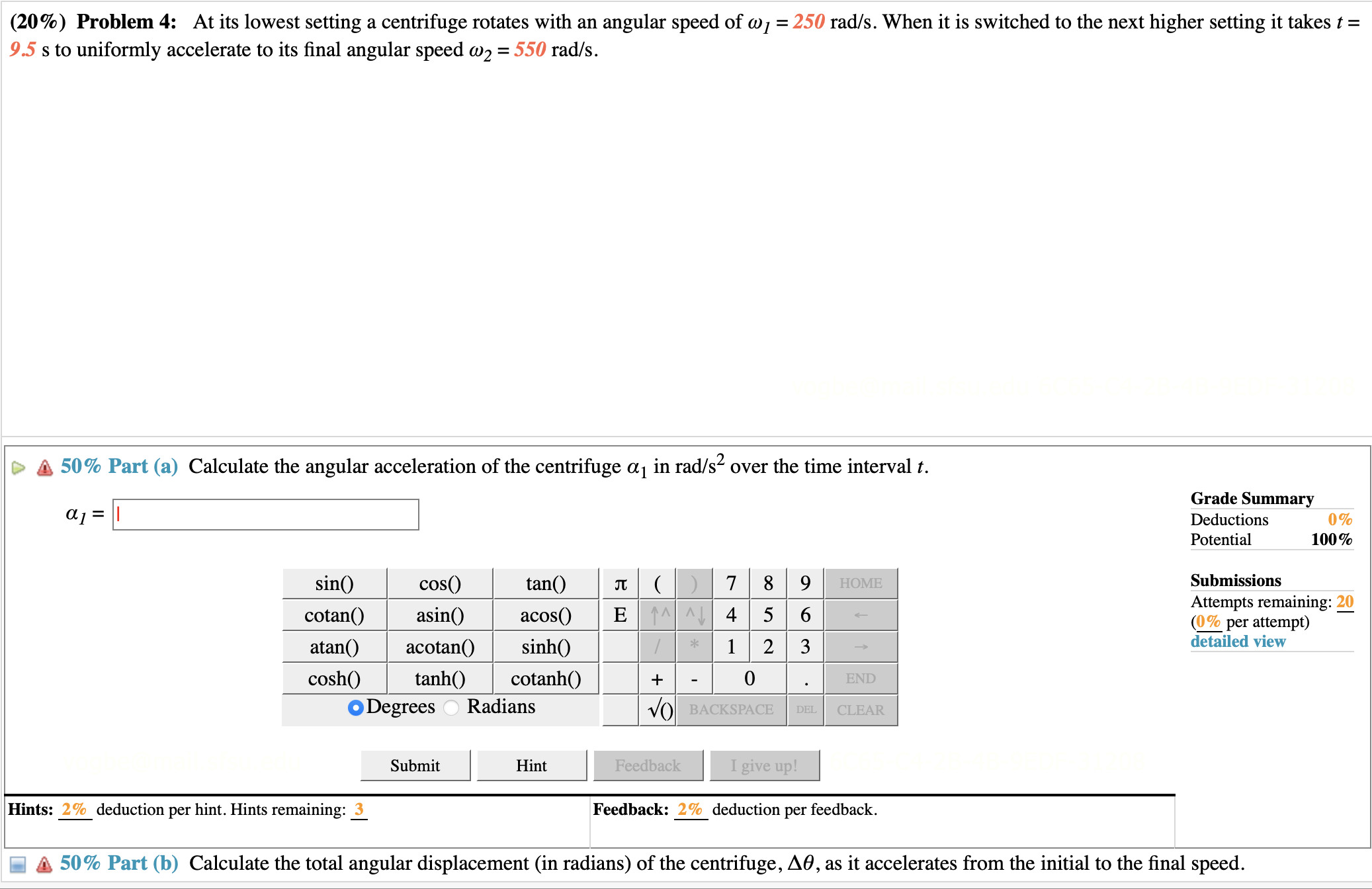
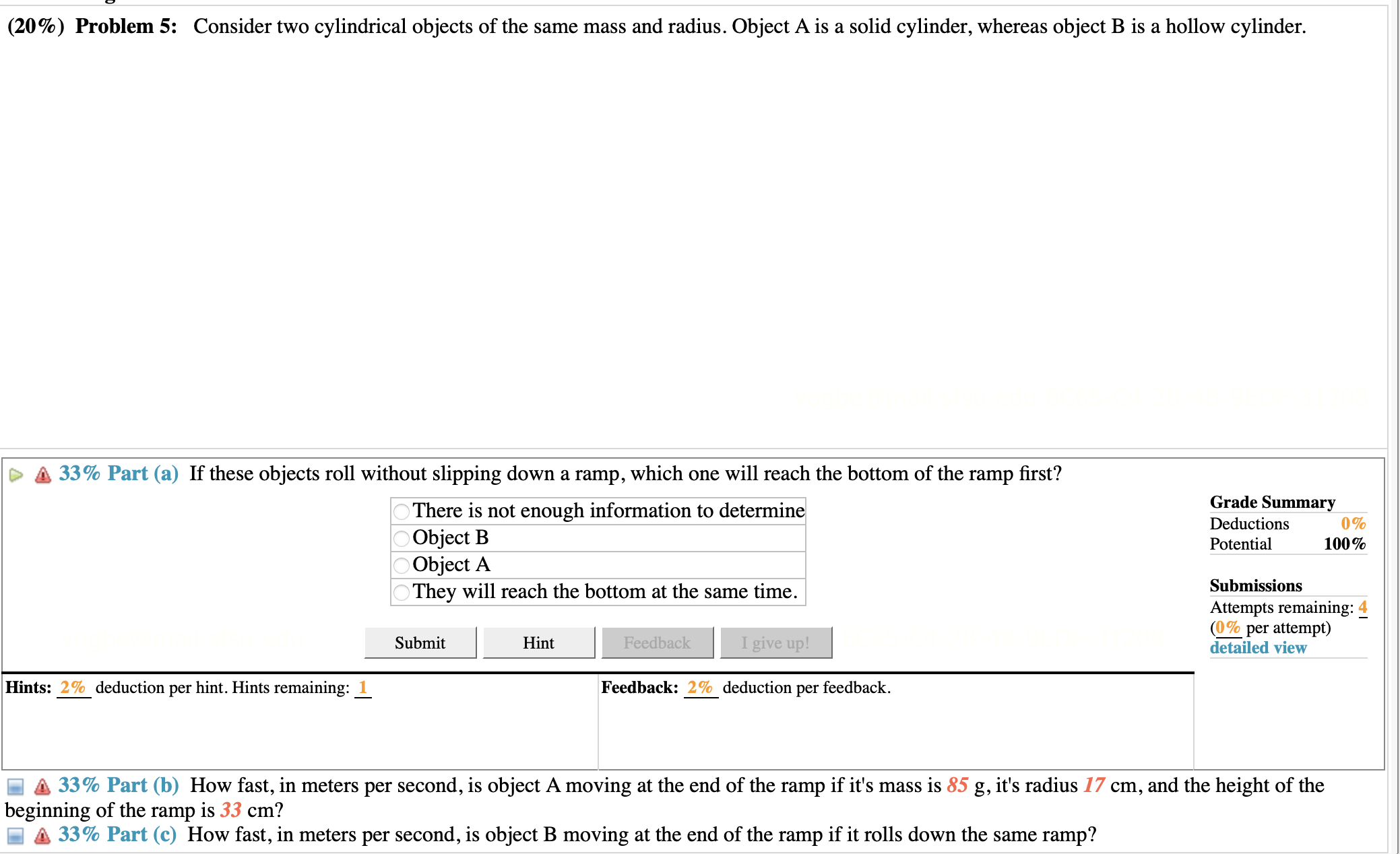
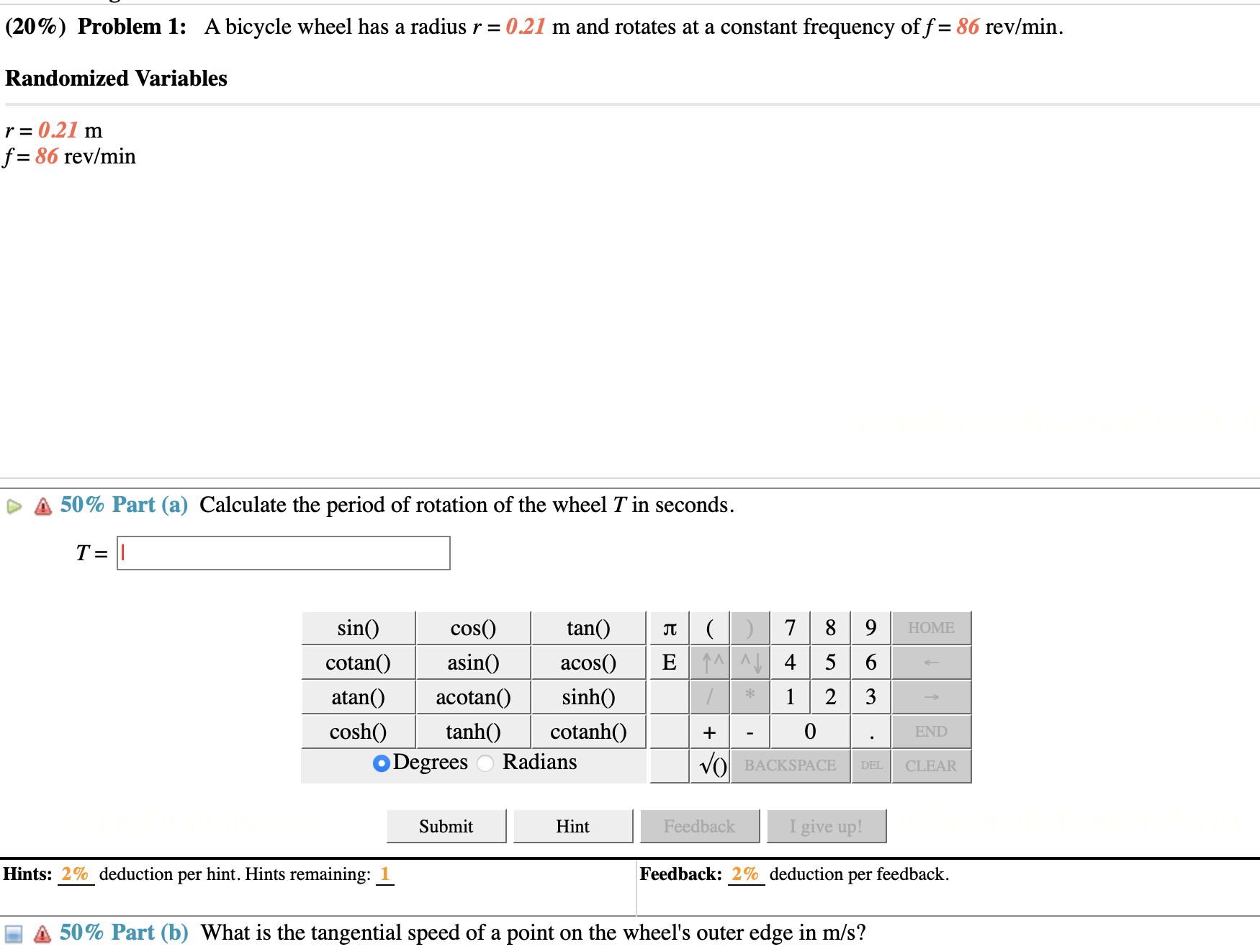
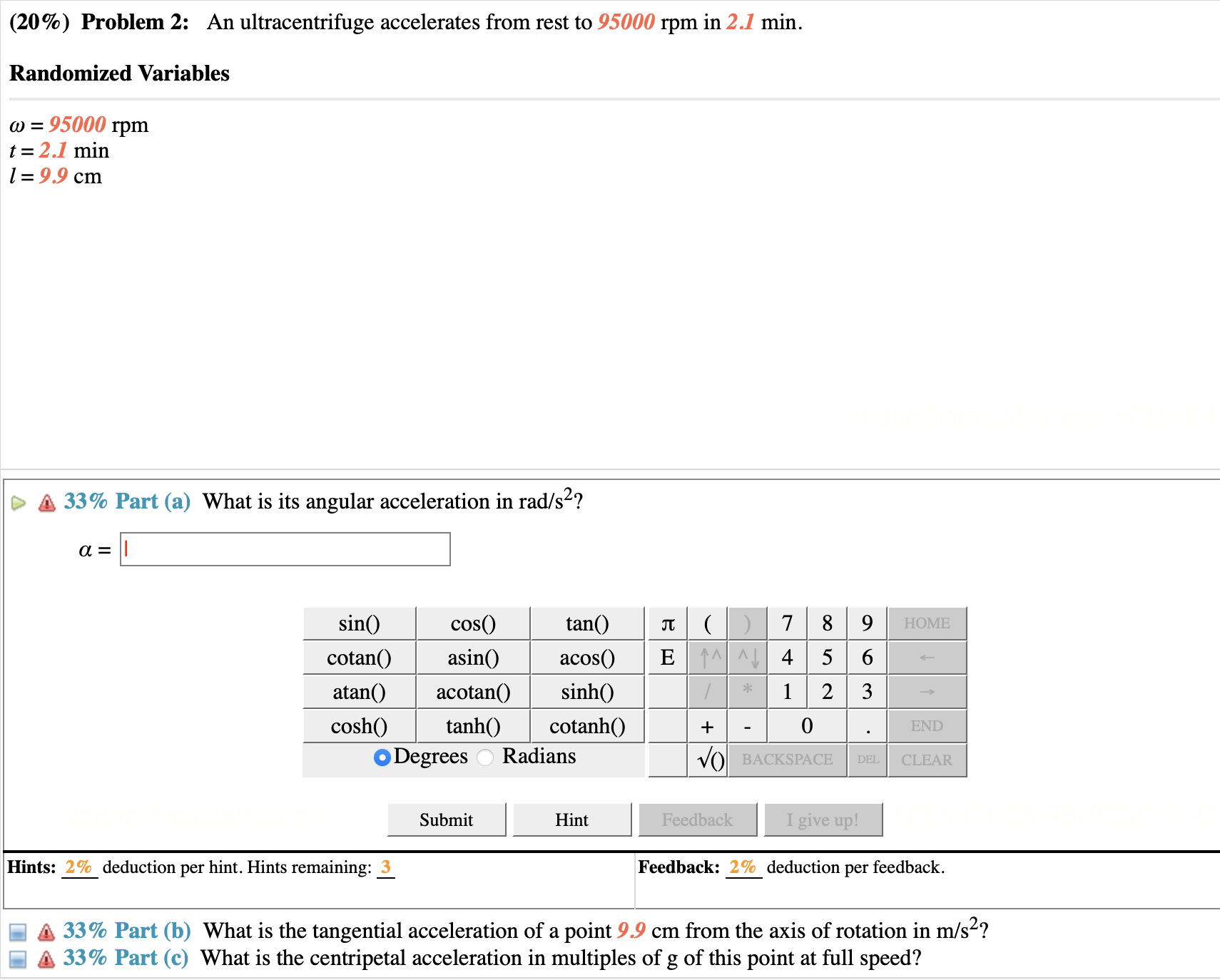
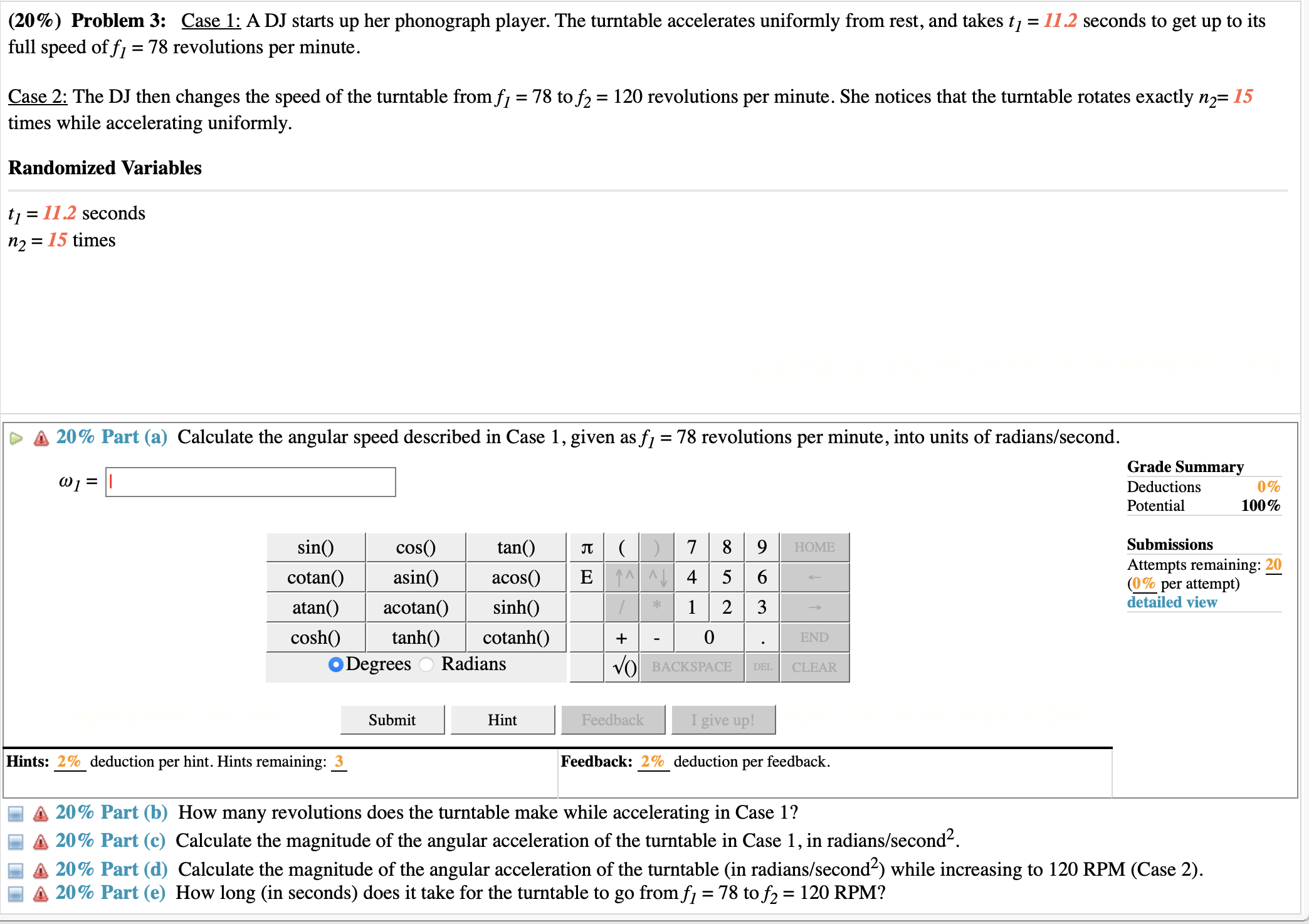
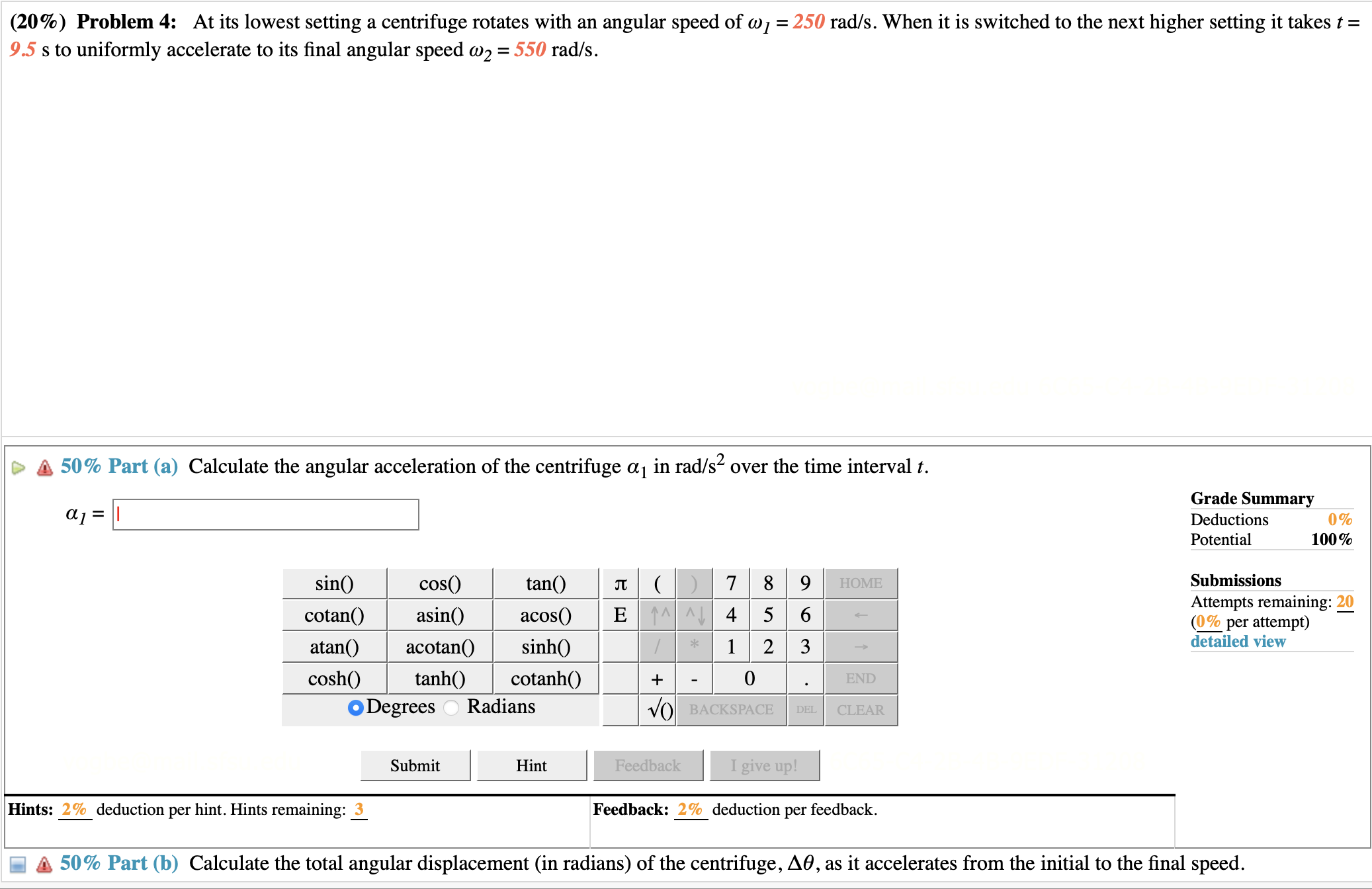
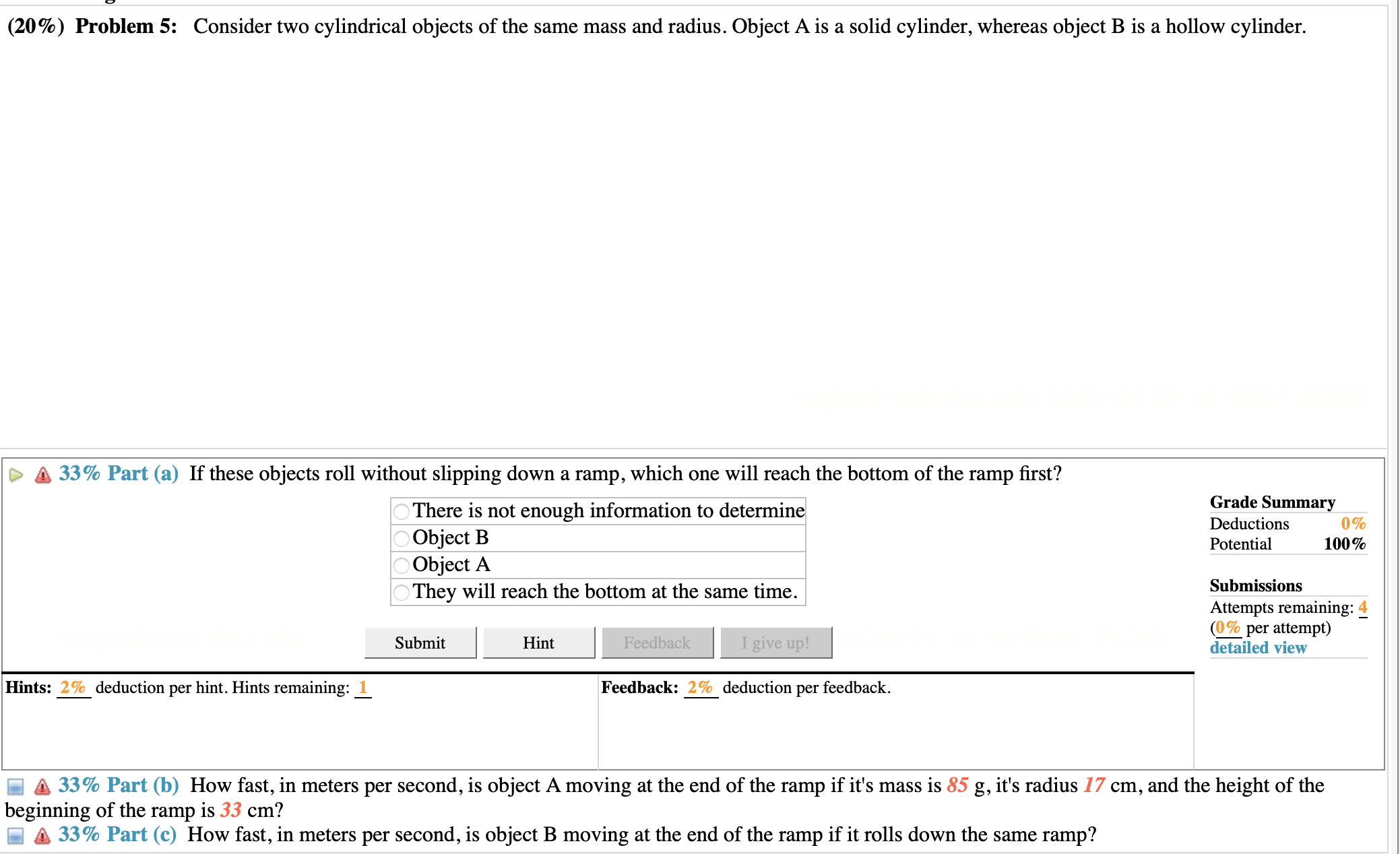
(20%) Problem 1: A bicycle wheel has a radius r = 0.21 In and rotates at a constant frequency of f = 86 rev/min. Randomized Variables r = 0.21 m f: 86 rev/min D A 50% Part (3) Calculate the period of rotation of the wheel T in seconds. '1": II I Hints: 2% deduction per hint. Hints remaining: i Feedback: 2% deduction per feedback. i A 50% Part (b) What is the tangential speed of a point on the wheel's outer edge in m/s'? (20%) Problem 2: An ultracentrifuge accelerates from rest to 95000 rpm in 2.1 min. Randomized Variables a) = 95000 rpm t=2.1 min 1:93 cm 5: 5 33% Part (a) What is its angular acceleration in rad/52? Hints: 2% deduction per hint. Hints remaining: 1 Feedback: 2% deduction per feedback, i A 33% Part (b) What is the tangential acceleration of a point 9.9 cm from the axis of rotation in III/$2? i A 33% Part (c) What is the centripetal acceleration in multiples of g of this point at full speed? (20%) Problem 3: Case 1: A DJ starts up her phonograph player. The turntable accelerates uniformly from rest, and takes 11 = 11.2 seconds to get up to its full speed of f 1 = 78 revolutions per minute. Case 2: The DJ then changes the speed of the turntable from f1 = 78 to f; = 120 revolutions per minute. She notices that the turntable rotates exactly 112: 15 times While accelerating uniformly. Randomized Variables :1 = 11.2 seconds n2 = 15 times D a 20% Part (3) Calculate the angular speed described in Case 1, given as f, = 78 revolutions per minute, into units of radians/second. Grade Summary )1 = E Deductions 0% Potential 100% sin() cos() tan() It ( ) 7 8 9 HOME Submissions , Attempts remaining: E cotan() asm() acos() E 1' A A l 4 5 6 '- (% per attempt) atan() acotanO sinhO / * 1 2 3 - \"mailed View cosh() tanh() cotanh() + - 0 . END 0 Degrees Radians J0 BACKSPACE DEL CLEAR Submit Hint Feedback I give up! Hints: 2 % deduction per hint. Hints remaining: 1 Feedback: 2% deduction per feedback. E A 20% Part (b) How many revolutions does the turntable make while accelerating in Case 1? E 3 20% Part (c) Calculate the magnitude of the angular acceleration of the turntable in Case 1, in radians/second? E 3 20% Part (d) Calculate the magnitude of the angular acceleration of the turntable (in radians/secondz) While increasing to 120 RPM (Case 2). E 3 20% Part (6) How long (in seconds) does it take for the turntable to go from f1 = 78 to f2 = 120 RPM? (20%) Problem 4: At its lowest setting a centrifuge rotates with an angular speed of w/ = 250 rad/s. When it is switched to the next higher setting it takes t = 9.5 s to uniformly accelerate to its final angular speed w2 = 550 rad/s. A 50% Part (a) Calculate the angular acceleration of the centrifuge a, in rad/s over the time interval t. Grade Summary a1 = Deductions 0% Potential 100% sin() cos() tan() 7 8 HOME Submissions Attempts remaining: 20 cotan() asin() acos() A A 5 6 (0% per attempt) atan() acotan() sinh() 2 3 detailed view cosh() tanh() cotanh() + O END Degrees O Radians VO BACKSPACE DEL CLEAR Submit Hint Feedback I give up! Hints: 2% deduction per hint. Hints remaining: 3 Feedback: 2% deduction per feedback. 4 50% Part (b) Calculate the total angular displacement (in radians) of the centrifuge, AO, as it accelerates from the initial to the final speed.(20%) Problem 5: Consider two cylindrical objects of the same mass and radius. Object A is a solid cylinder, whereas object B is a hollow cylinder. A 33% Part (a) If these objects roll without slipping down a ramp, which one will reach the bottom of the ramp first? There is not enough information to determine Grade Summary Deductions 0% Object B Potential 100% Object A They will reach the bottom at the same time. Submissions Attempts remaining: 4 0% per attempt) Submit Hint Feedback I give up! detailed view Hints: 2% deduction per hint. Hints remaining: 1 Feedback: 2% deduction per feedback. 4 33% Part (b) How fast, in meters per second, is object A moving at the end of the ramp if it's mass is 85 g, it's radius 17 cm, and the height of the beginning of the ramp is 33 cm? 4 33% Part (c) How fast, in meters per second, is object B moving at the end of the ramp if it rolls down the same ramp
Step by Step Solution
There are 3 Steps involved in it

Get step-by-step solutions from verified subject matter experts
 Study Help