







Question: 6) When removing the root of a heap, we replace its data with that of the left/right)-most node from the bottom level. This preserves the
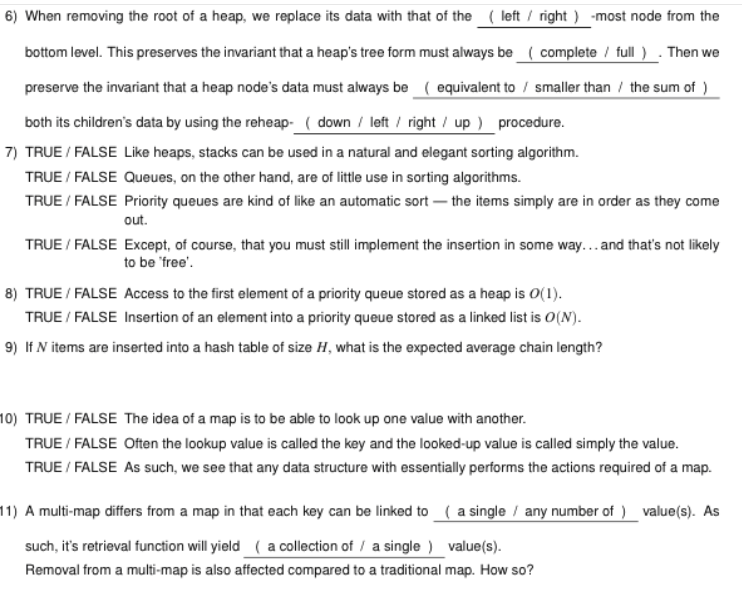
6) When removing the root of a heap, we replace its data with that of the left/right)-most node from the bottom level. This preserves the invariant that a heap's tree form must always be complete/full) . Then we preserve the invariant that a heap node's data must always be equivalent to smaller than /the sum of) both its children's data by using the reheap- down left / right / up) procedure. 7) TRUE/ FALSE Like heaps, stacks can be used in a natural and elegant sorting algorithm. TRUE/FALSE Queues, on the other hand, are of little use in sorting algorithms. TRUE /FALSE Priority queues are kind of like an automatic sort-the items simply are in order as they come out. TRUE/FALSE Except, of course, that you must still implement the insertion in some way... and that's not likely to be free 8) TRUE/FALSE Access to the first element of a priority queue stored as a heap is o( TRUE /FALSE Insertion of an element into a priority queue stored as a linked list is O(N. 9) If N items are inserted into a hash table of size H, what is the expected average chain length? 10) TRUE/ FALSE The idea of a map is to be able to look up one value with another. TRUE /FALSE Often the lookup value is called the key and the looked-up value is called simply the value. TRUE/FALSE As such, we see that any data structure with essentially performs the actions required of a map. 11) A multi-map differs from a map in that each key can be linked to (a single any number of value(s). As such, it's retrieval function will yield(a collection of a single) value(s). Removal from a multi-map is also affected compared to a traditional map. How so
Step by Step Solution
There are 3 Steps involved in it

Get step-by-step solutions from verified subject matter experts
 Study Help