







Question: 7,8,9,10 & 11 1. 2. 10. Set up the diode laser and the slit set as shown in Figure 4. Then set up the white
7,8,9,10 & 11
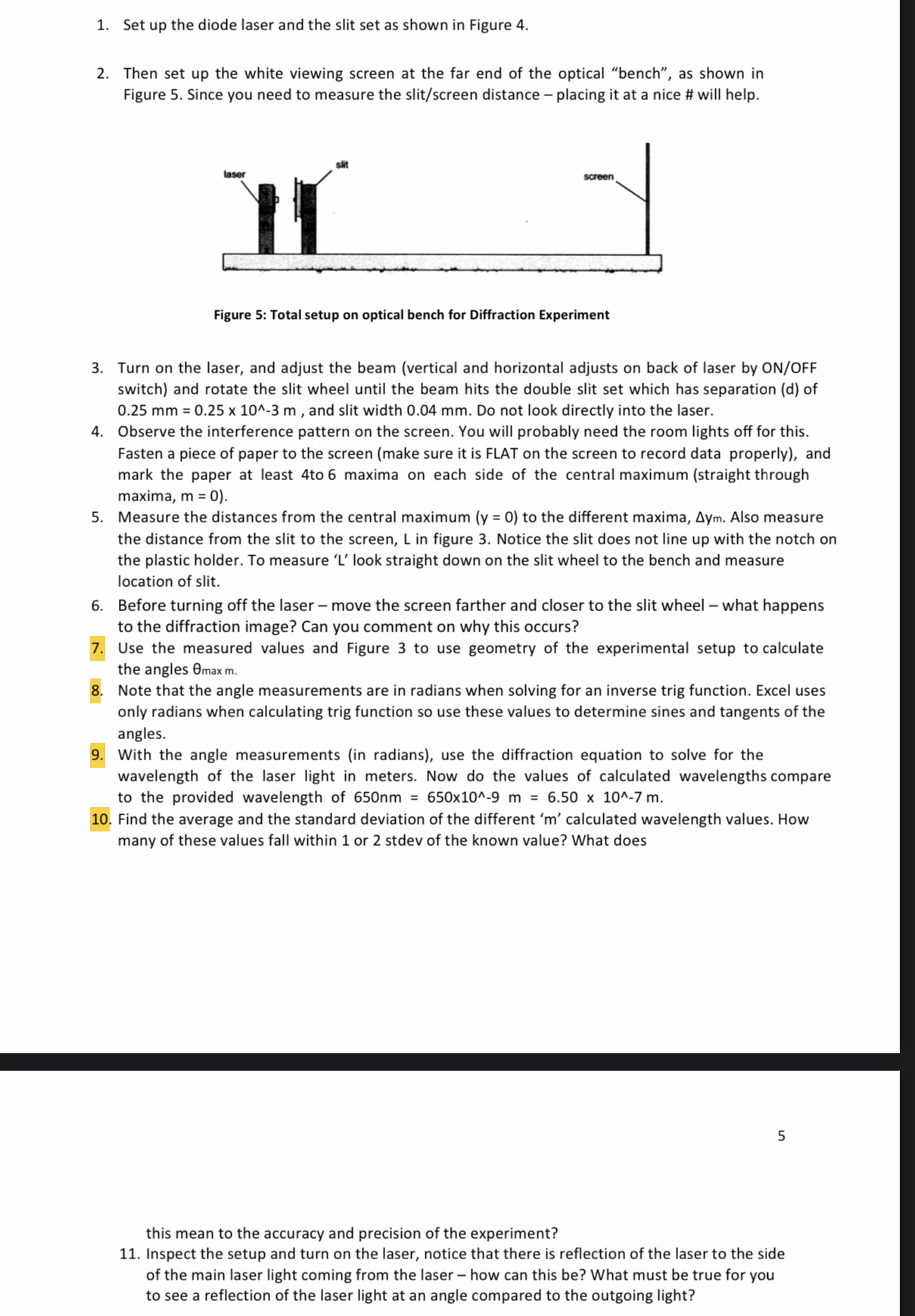
1. 2. 10. Set up the diode laser and the slit set as shown in Figure 4. Then set up the white viewing screen at the far end of the optical "bench", as shown in Figure 5. Since you need to measure the slit/screen distance placing it at a nice it will help. Figure 5: Total setup on optical bench for Diffraction Experiment Turn on the laser, and adjust the beam (vertical and horizontal adjusts on back of laser by ON/OFF switch) and rotate the slit wheel until the beam hits the double slit set which has separation (d) of 0.25 mm = 0.25 x 10"-3 m , and slit width 0.04 mm. Do not look directly into the laser. Observe the interference pattern on the screen. You will probably need the room lights off for this. Fasten a piece of paper to the screen {make sure it is FLAT on the screen to record data properly}, and mark the paper at least Alto 6 maxima on each side of the central maximum (straight through maxima, m = 0). Measure the distances from the central maximum (y = 0) to the different maxima, Aym. Also measure the distance from the slit to the screen, L in figure 3. Notice the slit does not line up with the notch on the plastic holder. To measure 'L' look straight down on the slit wheel to the bench and measure location of slit. Before turning off the laser move the screen farther and closer to the slit wheel what happens to the diffraction image? Can you comment on why this occurs? Use the measured values and Figure 3 to use geometry of the experimental setup to calculate the angles 6am m. Note that the angle measurements are in radians when solving for an inverse trig function. Excel uses only radians when calculating trig function so use these values to determine sines and tangents of the angles. With the angle measurements (in radians}, use the diffraction equation to solve for the wavelength of the laser light in meters. Now do the values of calculated wavelengths compare to the provided wavelength of 650nm : 650x10A-9 m = 6.50 x 10⁵-7 m. Find the average and the standard deviation of the different 'm' calculated wavelength values. How many of these values fall within 1 or 2 stdev of the known value? What does this mean to the accuracy and precision of the experiment? 11. Inspect the setup and turn on the laser, notice that there is reflection of the laser to the side of the main laser light coming from the laser- how can this be? What must be true for you to see a reflection of the laser light at an angle compared to the outgoing light
Step by Step Solution
There are 3 Steps involved in it

Get step-by-step solutions from verified subject matter experts
 Study Help