



Question: A physicist has invented a way to compress entire atoms into crystalline structures that are the size of atomic nuclei in order to make them
A physicist has invented a way to compress entire atoms into crystalline structures that are the size of atomic nuclei in order to make them super strong.
a) [10 points] What wavelength region must you use to probe the structure of this crystalline structure that is the size of the atomic nucleus of an atom (hint: use the figure below)?
b) [5 points] You use a light ray that you borrow from your friend Bruce Banner to study the structure using the concept of Bragg Diffraction. What is the relevant equation for mapping the structure of this atomic nucleus crystal?
c) [10 points] You shoot the above light ray at the super strong atomic nucleus and observe light refracting off of the surface at an angle of 30 degrees to form a second order bright spot. The wavelength you use is 1.50 x 10⁻¹³ meters. Use this information to determine the distance between the crystalline structure layers of this new atomic nucleus.
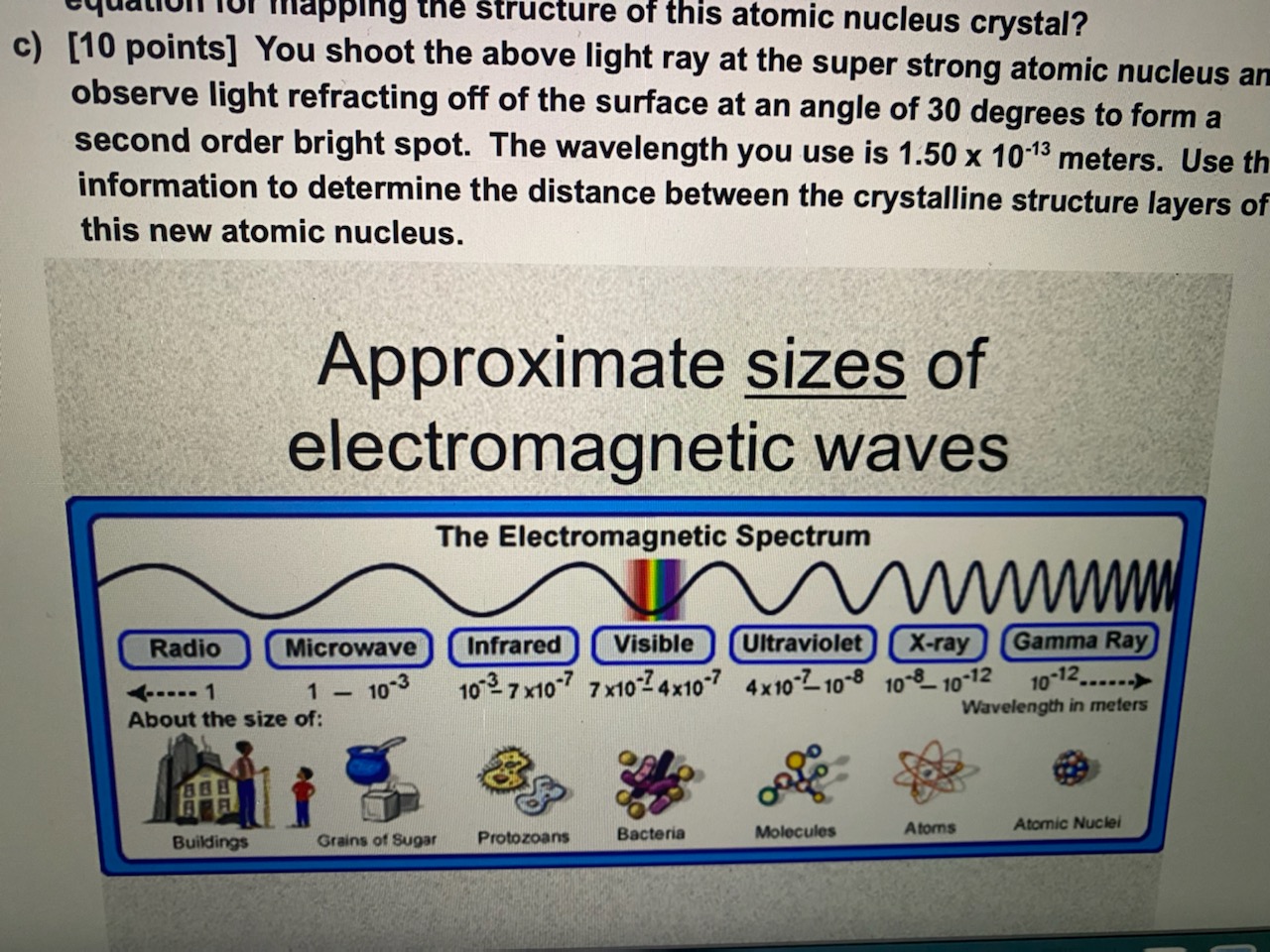
i fof mapping the structure of this atomic nucleus crystal? c) [10 points] You shoot the above light ray at the super strong atomic nucleus an observe light refracting off of the surface at an angle of 30 degrees to form a second order bright spot. The wavelength you use is 1.50 x 10⁻¹³ meters. Use th information to determine the distance between the crystalline structure layers of this new atomic nucleus. Approximate sizes of electromagnetic waves The Electromagnetic Spectrum Radio Microwave Infrared Visible Ultraviolet X-ray Gamma Ray About the size of: Wavelength in meters Buildings Protozoans Bacteria Molecules Atoms Atomic Nuclei Grains of Sugar
Step by Step Solution
There are 3 Steps involved in it

Get step-by-step solutions from verified subject matter experts