







Question: answer the following questions. 1. Analyze The Pub's competitive environment and macroenvironment. 2. Answer the following questions. a. What are the two most significant driving
answer the following questions.
1. Analyze The Pub's competitive environment and macroenvironment.
2. Answer the following questions.
a. What are the two most significant driving forces of change in The Pub case? Justify your answer.
b. To address the driving forces of change, what actions should The Pub take that are not mentioned in the case? Justify your answer.
3. How did the bargaining power between the bars and the suppliers mentioned in "The Pub" case change during the case? 4. How did the bargaining power between the bars and the buyers mentioned in "The Pub" case change during the case?
5. How have changes in the political environment affected the US coal industry? 6. How have changes in the economic environment affected the US coal industry?
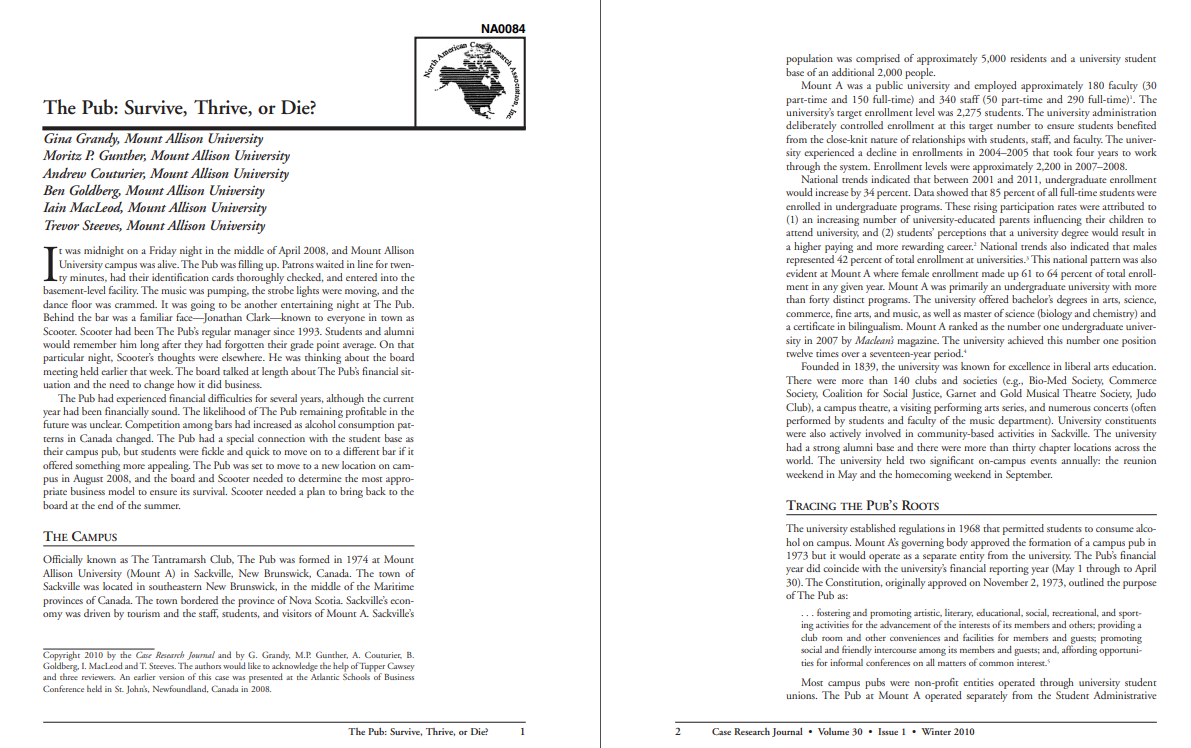
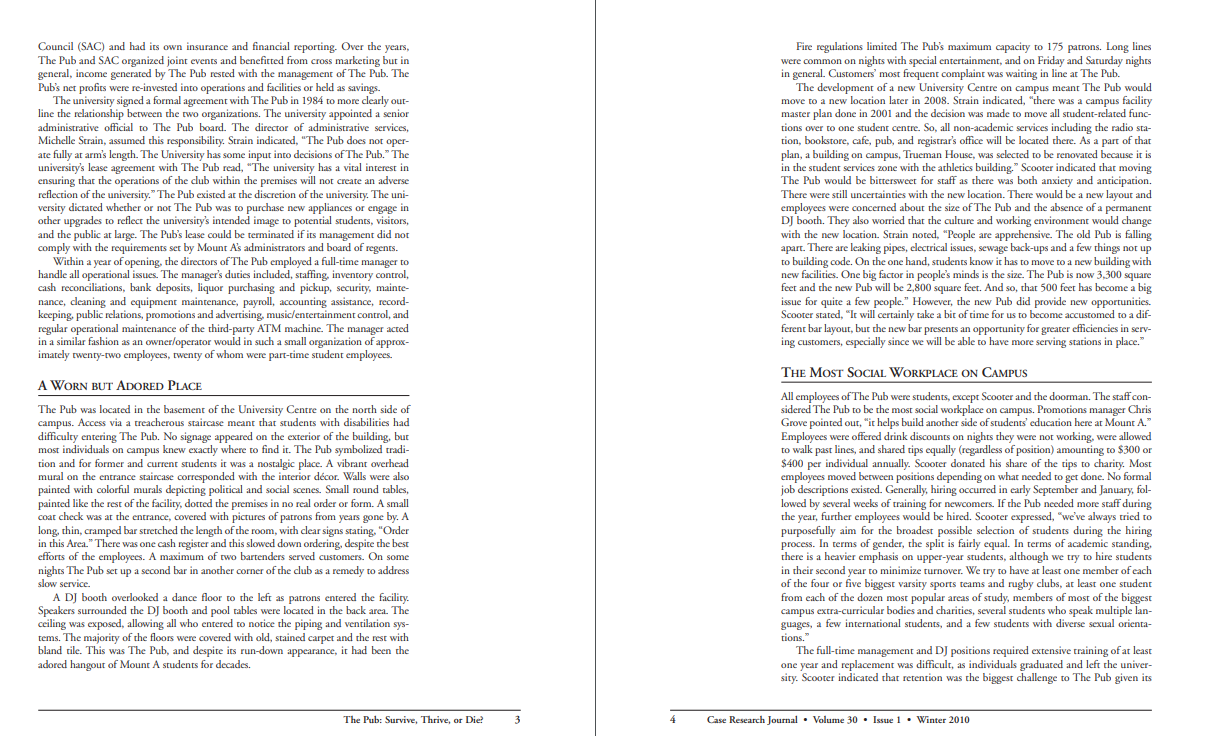
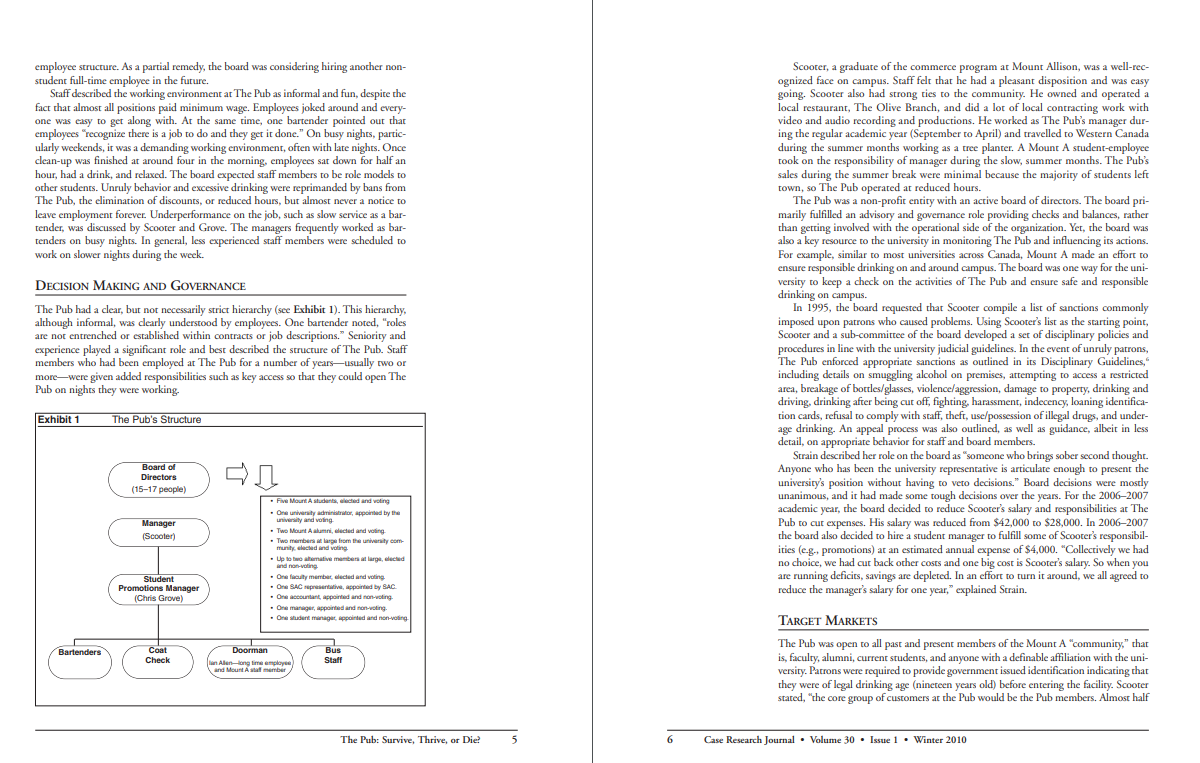
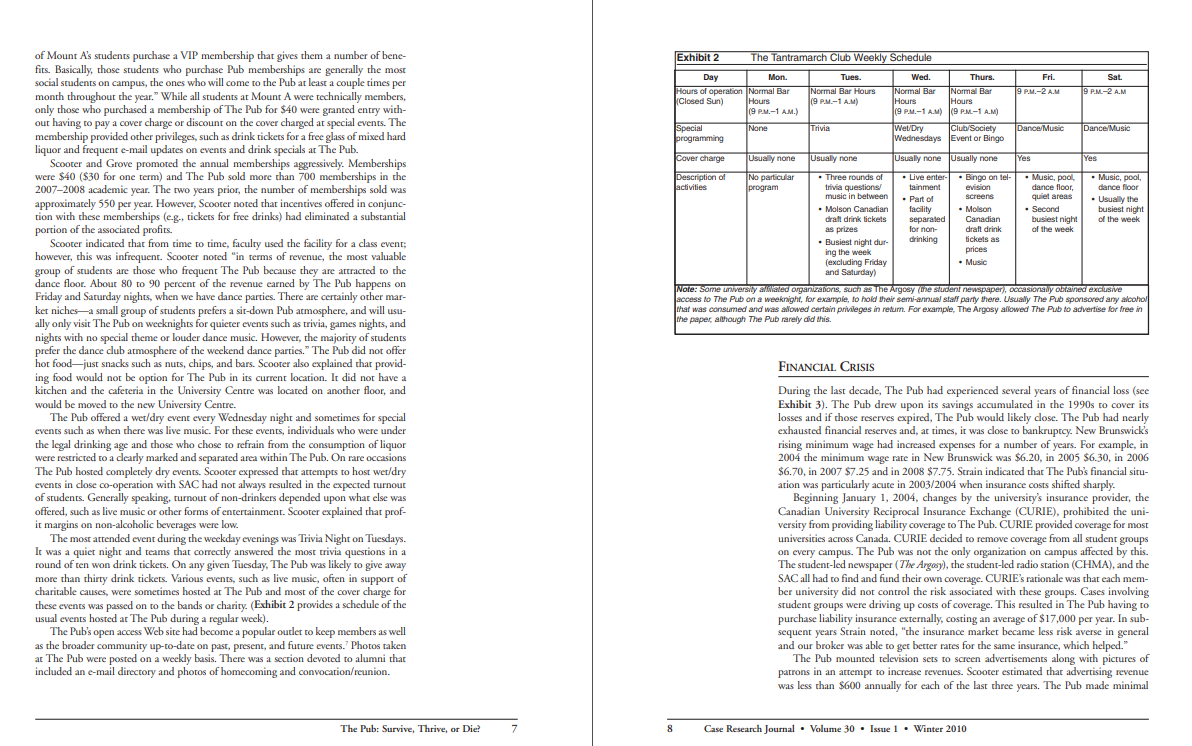
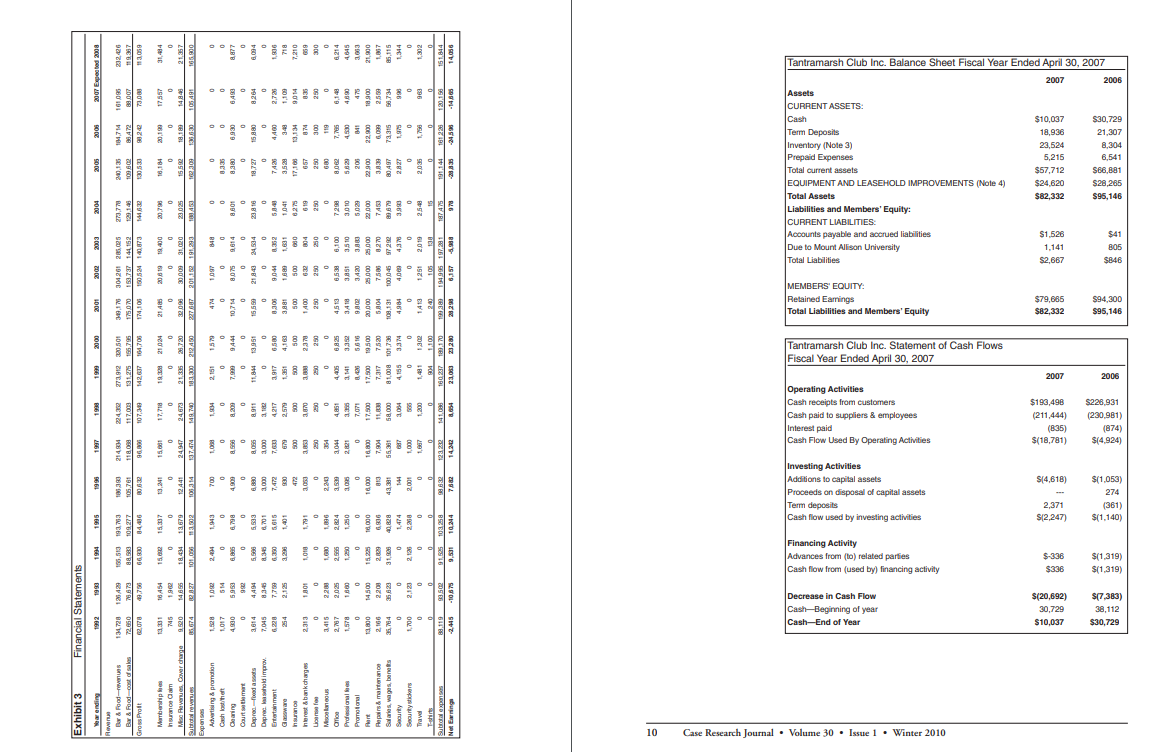
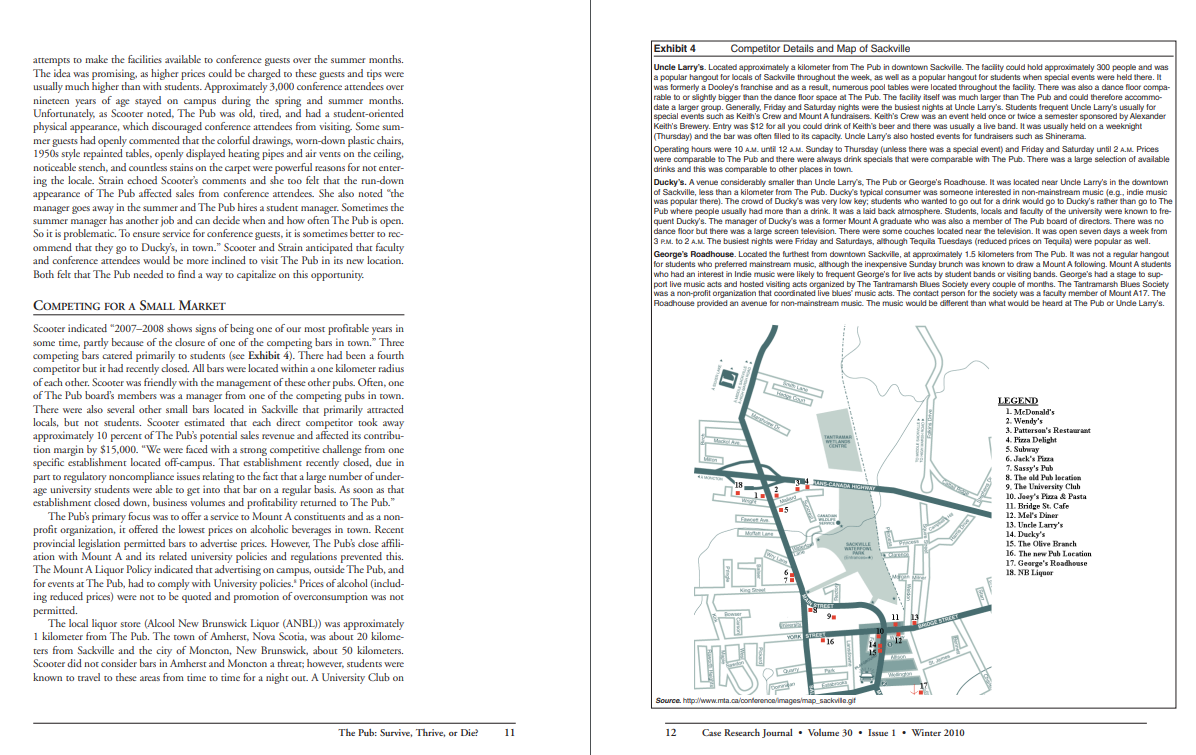
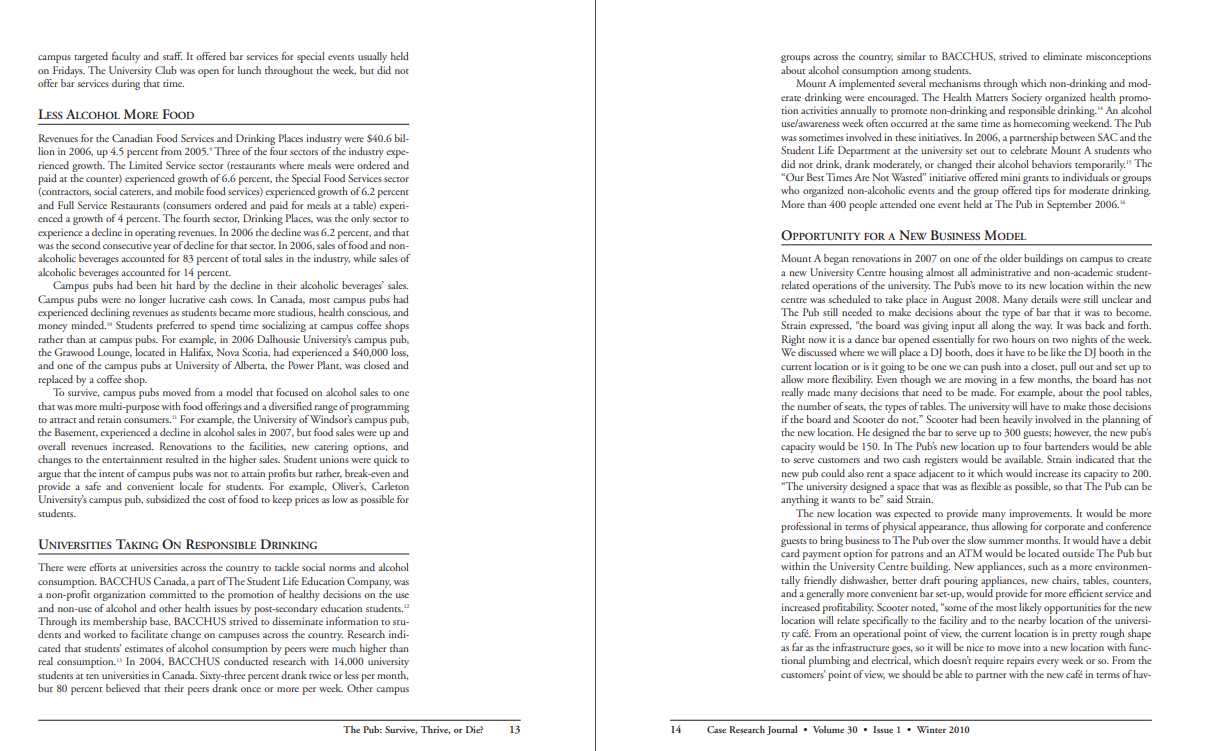
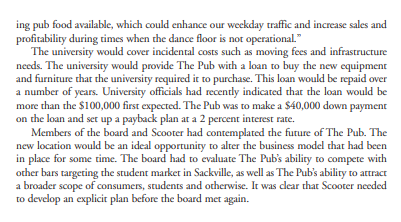
NA0084 North A population was comprised of approximately 5,000 residents and a university student base of an additional 2,000 people. Mount A was a public university and employed approximately 180 faculty (30 The Pub: Survive, Thrive, or Die? part-time and 150 full-time) and 340 staff (50 part-time and 290 full-time)'. The university's target enrollment level was 2,275 students. The university administration deliberately controlled enrollment at this target number to ensure students benefited Gina Grandy, Mount Allison University from the close-knit nature of relationships with students, staff, and faculty. The univer- Moritz P. Gunther, Mount Allison University sity experienced a decline in enrollments in 2004-2005 that took four years to work Andrew Couturier, Mount Allison University through the system. Enrollment levels were approximately 2,200 in 2007-2008. National trends indicated that between 2001 and 201 1, undergraduate enrollment Ben Goldberg, Mount Allison University would increase by 34 percent. Data showed that 85 percent of all full-time students were lain MacLeod, Mount Allison University enrolled in undergraduate programs. These rising participation rates were attributed to Trevor Steeves, Mount Allison University (1) an increasing number of university-educated parents influencing their children to attend university, and (2) students' perceptions that a university degree would result in t was midnight on a Friday night in the middle of April 2008, and Mount Allison a higher paying and more rewarding career.' National trends also indicated that males University campus was alive. The Pub was filling up. Patrons waited in line for twen represented 42 percent of total enrollment at universities.' This national pattern was also ty minutes, had their identification cards thoroughly checked, and entered into the evident at Mount A where female enrollment made up 61 to 64 percent of total enroll- basement-level facility. The music was pumping. the strobe lights were moving, and the ment in any given year. Mount A was primarily an undergraduate university with more dance floor was crammed. It was going to be another entertaining night at The Pub. than forty distinct programs. The university offered bachelor's degrees in arts, science, Behind the bar was a familiar face-Jonathan Clark-known to everyone in town as commerce, fine arts, and music, as well as master of science (biology and chemistry) and Scooter. Scooter had been The Pub's regular manager since 1993. Students and alumni a certificate in bilingualism. Mount A ranked as the number one undergraduate univer- would remember him long after they had forgotten their grade point average. On that sity in 2007 by Maclean's magazine. The university achieved this number one position particular night, Scooter's thoughts were elsewhere. He was thinking about the board twelve times over a seventeen-year period." meeting held earlier that week. The board talked at length about The Pub's financial sit- Founded in 1839, the university was known for excellence in liberal arts education. uation and the need to change how it did business. There were more than 140 clubs and societies (e-g., Bio-Med Society, Commerce The Pub had experienced financial difficulties for several years, although the current Society, Coalition for Social Justice, Garner and Gold Musical Theatre Society, Judo year had been financially sound. The likelihood of The Pub remaining profitable in the Club), a campus theatre, a visiting performing arts series, and numerous concerts (often future was unclear. Competition among bars had increased as alcohol consumption pat- performed by students and faculty of the music department). University constituents terns in Canada changed. The Pub had a special connection with the student base as were also actively involved in community-based activities in Sackville. The university their campus pub, but students were fickle and quick to move on to a different bar if it had a strong alumni base and there were more than thirty chapter locations across the offered something more appealing. The Pub was set to move to a new location on cam- world. The university held two significant on-campus events annually: the reunion pus in August 2008, and the board and Scooter needed to determine the most appro- weekend in May and the homecoming weekend in September. priare business model to ensure its survival. Scooter needed a plan to bring back to the board at the end of the summer. TRACING THE PUB'S ROOTS THE CAMPUS The university established regulations in 1968 that permitted students to consume alco- hol on campus. Mount A's governing body approved the formation of a campus pub in Officially known as The Tantramarsh Club, The Pub was formed in 1974 at Mount 1973 but it would operate as a separate entity from the university. The Pub's financial Allison University (Mount A) in Sackville, New Brunswick, Canada. The town of year did coincide with the university's financial reporting year (May 1 through to April Sackville was located in southeastern New Brunswick, in the middle of the Maritime 30). The Constitution, originally approved on November 2, 1973, outlined the purpose provinces of Canada. The town bordered the province of Nova Scotia. Sackville's econ- of The Pub as: omy was driven by tourism and the staff, students, and visitors of Mount A. Sackville's . . . fostering and promoting artistic, literary, educational, social, recreational, and sport- ing activities for the advancement of the interests of its members and others; providing a club room and other conveniences and facilities for members and guests, promoting Copyright 2010 by the Case Research Journal and by G. Grandy, M.P. Gunther, A. Couturier, B. social and friendly intercourse among its members and guests; and, affording opportuni- Goldberg, I. Macleod and T. Steeves. The authors would like to acknowledge the help of Tupper Cawsey ties for informal conferences on all matters of common interest.' and three reviewers. An earlier version of this case was presented at the Atlantic Schools of Business Conference held in St. John's, Newfoundland, Canada in 2008. Most campus pubs were non-profit entities operated through university student unions. The Pub at Mount A operated separately from the Student Administrative The Pub: Survive, Thrive, or Die? 2 Case Research Journal . Volume 30 . Issue 1 . Winter 2010Council (SAC) and had its own insurance and financial reporting. Over the years, Fire regulations limited The Pub's maximum capacity to 175 patrons. Long lines The Pub and SAC organized joint events and benefitted from cross marketing but in were common on nights with special entertainment, and on Friday and Saturday nights general, income generated by The Pub rested with the management of The Pub. The in general. Customers' most frequent complaint was waiting in line at The Pub Pub's net profits were re-invested into operations and facilities or held as savings. The development of a new University Centre on campus meant The Pub would The university signed a formal agreement with The Pub in 1984 to more clearly out- move to a new location later in 2008. Strain indicated, "there was a campus facility line the relationship between the two organizations. The university appointed a senior master plan done in 2001 and the decision was made to move all student-related func- administrative official to The Pub board. The director of administrative services, tions over to one student centre. So, all non-academic services including the radio sta- Michelle Strain, assumed this responsibility. Strain indicated, "The Pub does not oper- tion, bookstore, cafe, pub, and registrar's office will be located there. As a part of that are fully at arm's length. The University has some input into decisions of The Pub." The plan, a building on campus, Trueman House, was selected to be renovated because it is university's lease agreement with The Pub read, "The university has a vital interest in in the student services zone with the athletics building." Scooter indicated that moving ensuring that the operations of the club within the premises will not create an adverse The Pub would be bittersweet for staff as there was both anxiety and anticipation. reflection of the university." The Pub existed at the discretion of the university. The uni- There were still uncertainties with the new location. There would be a new layout and versity dictated whether or not The Pub was to purchase new appliances or engage in employees were concerned about the size of The Pub and the absence of a permanent other upgrades to reflect the university's intended image to potential students, visitors, DJ booth. They also worried that the culture and working environment would change and the public at large. The Pub's lease could be terminated if its management did not with the new location. Strain noted, "People are apprehensive. The old Pub is falling comply with the requirements set by Mount A's administrators and board of regents. apart. There are leaking pipes, electrical issues, sewage back-ups and a few things not up Within a year of opening. the directors of The Pub employed a full-time manager to to building code. On the one hand, students know it has to move to a new building with handle all operational issues. The manager's duties included, staffing, inventory control, new facilities. One big factor in people's minds is the size. The Pub is now 3,300 square cash reconciliations, bank deposits, liquor purchasing and pickup, security, mainte- feet and the new Pub will be 2,800 square feet. And so, that 500 feet has become a big nance, cleaning and equipment maintenance, payroll, accounting assistance, record- issue for quite a few people." However, the new Pub did provide new opportunities. keeping, public relations, promotions and advertising, music/entertainment control, and Scooter stated, "It will certainly take a bit of time for us to become accustomed to a dif- regular operational maintenance of the third-party ATM machine. The manager acted ferent bar layout, but the new bar presents an opportunity for greater efficiencies in serv- in a similar fashion as an owner/operator would in such a small organization of approx- ing customers, especially since we will be able to have more serving stations in place." imarely twenty-two employees, twenty of whom were part-time student employees. THE MOST SOCIAL WORKPLACE ON CAMPUS A WORN BUT ADORED PLACE All employees of The Pub were students, except Scooter and the doorman. The staff con- The Pub was located in the basement of the University Centre on the north side of sidered The Pub to be the most social workplace on campus. Promotions manager Chris campus. Access via a treacherous staircase meant that students with disabilities had Grove pointed out, "it helps build another side of students' education here at Mount A." difficulty entering The Pub. No signage appeared on the exterior of the building, but Employees were offered drink discounts on nights they were not working, were allowed most individuals on campus knew exactly where to find it. The Pub symbolized tradi- to walk past lines, and shared tips equally (regardless of position) amounting to $300 or tion and for former and current students it was a nostalgic place. A vibrant overhead $400 per individual annually. Scooter donated his share of the tips to charity. Most mural on the entrance staircase corresponded with the interior decor. Walls were also employees moved between positions depending on what needed to get done. No formal painted with colorful murals depicting political and social scenes. Small round cables, job descriptions existed. Generally, hiring occurred in early September and January, fol- painted like the rest of the facility, dotted the premises in no real order or form. A small lowed by several weeks of training for newcomers. If the Pub needed more staff during coat check was at the entrance, covered with pictures of patrons from years gone by. A the year, further employees would be hired. Scooter expressed, "we've always tried to long, thin, cramped bar stretched the length of the room, with clear signs stating, "Order purposefully aim for the broadest possible selection of students during the hiring in this Area." There was one cash register and this slowed down ordering, despite the best process. In terms of gender, the split is fairly equal. In terms of academic standing, efforts of the employees. A maximum of two bartenders served customers. On some there is a heavier emphasis on upper-year students, although we try to hire students nights The Pub set up a second bar in another corner of the club as a remedy to address in their second year to minimize turnover. We try to have at least one member of each slow service. of the four or five biggest varsity sports teams and rugby clubs, at least one student A DJ booth overlooked a dance floor to the left as patrons entered the facility. from each of the dozen most popular areas of study, members of most of the biggest Speakers surrounded the DJ booth and pool tables were located in the back area. The campus extra-curricular bodies and charities, several students who speak multiple lan- ceiling was exposed, allowing all who entered to notice the piping and ventilation sys- guages, a few international students, and a few students with diverse sexual orienta tems. The majority of the floors were covered with old, stained carpet and the rest with tions." bland tile. This was The Pub, and despite its run-down appearance, it had been the The full-time management and DJ positions required extensive training of at least adored hangout of Mount A students for decades. one year and replacement was difficult, as individuals graduated and left the univer- sity. Scooter indicated that retention was the biggest challenge to The Pub given its The Pub: Survive, Thrive, or Die? 3 4 Case Research Journal . Volume 30 . Issue 1 . Winter 2010employee structure. As a partial remedy, the board was considering hiring another non- Scooter, a graduate of the commerce program at Mount Allison, was a well-rec- student full-time employee in the future. ognized face on campus. Staff felt that he had a pleasant disposition and was easy Staff described the working environment at The Pub as informal and fun, despite the going. Scooter also had strong ties to the community. He owned and operated a fact that almost all positions paid minimum wage. Employees joked around and every- local restaurant, The Olive Branch, and did a lot of local contracting work with one was easy to get along with. At the same time, one bartender pointed out that video and audio recording and productions. He worked as The Pub's manager dur- employees "recognize there is a job to do and they get it done." On busy nights, partic- ing the regular academic year (September to April) and travelled to Western Canada ularly weekends, it was a demanding working environment, often with late nights. Once during the summer months working as a tree planter. A Mount A student-employee clean-up was finished at around four in the morning, employees sat down for half an took on the responsibility of manager during the slow, summer months. The Pub's hour, had a drink, and relaxed. The board expected staff members to be role models to sales during the summer break were minimal because the majority of students left other students. Unruly behavior and excessive drinking were reprimanded by bans from town, so The Pub operated at reduced hours. The Pub, the elimination of discounts, or reduced hours, but almost never a notice to The Pub was a non-profit entity with an active board of directors. The board pri- leave employment forever. Underperformance on the job, such as slow service as a bar- marily fulfilled an advisory and governance role providing checks and balances, rather tender, was discussed by Scooter and Grove. The managers frequently worked as bar- than getting involved with the operational side of the organization. Yet, the board was renders on busy nights. In general, less experienced staff members were scheduled to also a key resource to the university in monitoring The Pub and influencing its actions. work on slower nights during the week. For example, similar to most universities across Canada, Mount A made an effort to ensure responsible drinking on and around campus. The board was one way for the uni- DECISION MAKING AND GOVERNANCE versity to keep a check on the activities of The Pub and ensure safe and responsible drinking on campus. The Pub had a clear, but not necessarily strict hierarchy (see Exhibit 1). This hierarchy, In 1995, the board requested that Scooter compile a list of sanctions commonly although informal, was clearly understood by employees. One bartender noted, "roles imposed upon patrons who caused problems. Using Scooter's list as the starting point, are not entrenched or established within contracts or job descriptions." Seniority and Scooter and a sub-committee of the board developed a set of disciplinary policies and experience played a significant role and best described the structure of The Pub. Staff procedures in line with the university judicial guidelines. In the event of unruly patrons, members who had been employed at The Pub for a number of years-usually two or The Pub enforced appropriate sanctions as outlined in its Disciplinary Guidelines," more-were given added responsibilities such as key access so that they could open The including details on smuggling alcohol on premises, attempting to access a restricted Pub on nights they were working. area, breakage of bottles/glasses, violence/aggression, damage to property, drinking and driving, drinking after being cut off, fighting, harassment, indecency, loaning identifica- Exhibit 1 The Pub's Structure tion cards, refusal to comply with staff, theft, use/possession of illegal drugs, and under- age drinking. An appeal process was also outlined, as well as guidance, albeit in less detail, on appropriate behavior for staff and board members. Strain described her role on the board as "someone who brings sober second thought. Board of Directors Anyone who has been the university representative is articulate enough to present the 15-17 people) university's position without having to veto decisions." Board decisions were mostly . Five Mount A students, slachild and weling unanimous, and it had made some tough decisions over the years. For the 2006-2007 One university admin tutor, appointed by the academic year, the board decided to reduce Scooter's salary and responsibilities at The Manager university and voing . Two Mount A alumni, elected and voting Pub to cut expenses. His salary was reduced from $42,000 to $28,000. In 2006-2007 (Scooter) . Two mumbers at large from the university com- the board also decided to hire a student manager to fulfill some of Scooter's responsibil munity slacked and voting iries (eg., promotions) at an estimated annual expense of $4,000. "Collectively we had Le to two shimafive members at large, clocked find non-voting no choice, we had cut back other costs and one big cost is Scooter's salary. So when you Student . One faculty member, elected and voting are running deficits, savings are depleted. In an effort to turn it around, we all agreed to Promotions Manager . One BAC mp appointed by BAC. (Chris Grove) . One accountant, app infind and fon-woling. reduce the manager's salary for one year," explained Strain. . Ona manager, ap and and run-woling. . On student minagat appointed and non-voting. TARGET MARKETS Coal The Pub was open to all past and present members of the Mount A "community," that Bartenders Doorman Check n Alan-long time amplapin Staff is, faculty, alumni, current students, and anyone with a definable affiliation with the uni- and Mount A shall member versity. Patrons were required to provide government issued identification indicating that they were of legal drinking age (nineteen years old) before entering the facility. Scooter stared, "the core group of customers at the Pub would be the Pub members. Almost half The Pub: Survive, Thrive, or Die! 6 Case Research Journal . Volume 30 . Issue 1 . Winter 2010of Mount A's students purchase a VIP membership that gives them a number of bene- Exhibit 2 The Tantramarch Club Weekly Schedule firs. Basically, those students who purchase Pub memberships are generally the most social students on campus, the ones who will come to the Pub at least a couple times per Day Mon Tues Wed Thurs. Fri. Sat. month throughout the year." While all students at Mount A were technically members, Hours of operation Normal Bar Normal Bar Hours Normal Bar Normal Bar 9 P.M.-2 A.M 9 P.M.-2 A.M [Closed Sun) Hours 9 P.M.-1 A.M) Hours Hours only those who purchased a membership of The Pub for $40 were granted entry with- 9 P.M.-1 A.M.) (9 P.M.-1 A.M) (9 P.M.-1 A.M) out having to pay a cover charge or discount on the cover charged at special events. The Special None Trivia WellDry Club/Society Dance/Music Dance Music membership provided other privileges, such as drink tickets for a free glass of mixed hard programming Wednesdays Event or Bingo liquor and frequent c-mail updates on events and drink specials at The Pub. Scooter and Grove promoted the annual memberships aggressively. Memberships Cover charge Usually none sally none Usually none Usually none Yes were $40 ($30 for one term) and The Pub sold more than 700 memberships in the Description of No particular Three rounds of Live enter- * Bingo on let- . Music, pool, . Music, pool, 2007-2008 academic year. The two years prior, the number of memberships sold was activities program trivia questions tainment evision dance floor, dance floor music in between approximately 550 per year. However, Scooter noted that incentives offered in conjunc Part of screens quiet areas Usually the Molson Canadian Molson Second busiest night tion with these memberships (e-g., tickets for free drinks) had eliminated a substantial cility draft drink tickets separated Canadian busiest night of the week portion of the associated profits. as prizes for non- draft drink of the week Scooter indicated that from time to time, faculty used the facility for a class event; . Busiest night dur- drinking tickets as ing the week prices however, this was infrequent. Scooter noted "in terms of revenue, the most valuable (excluding Friday Music group of students are those who frequent The Pub because they are attracted to the and Saturday) dance floor. About 80 to 90 percent of the revenue earned by The Pub happens on Note: Some university alldialed organizations, such as The Argosy (me student newspaper), occasionally obtained exclusive Friday and Saturday nights, when we have dance parties. There are certainly other mar- access to The Pub on a weeknight, for example, to hold their semi-annual stall party there. Usually The Pub sponsored any alcohol ker niches-a small group of students prefers a sit-down Pub armosphere, and will usu- that was consumed and was allowed certain privileges in return. For example. The Argosy allowed The Pub to advertise for free in ally only visit The Pub on weeknights for quieter events such as trivia, games nights, and the paper, although The Pub rarely did this. nights with no special theme or louder dance music. However, the majority of students prefer the dance club atmosphere of the weekend dance parties." The Pub did not offer hot food-just snacks such as nuts, chips, and bars. Scooter also explained that provid- FINANCIAL CRISIS ing food would not be option for The Pub in its current location. It did not have a kitchen and the cafeteria in the University Centre was located on another floor, and During the last decade, The Pub had experienced several years of financial loss (see would be moved to the new University Centre. Exhibit 3). The Pub drew upon its savings accumulated in the 1990s to cover its The Pub offered a wet/dry event every Wednesday night and sometimes for special losses and if those reserves expired, The Pub would likely dose. The Pub had nearly events such as when there was live music. For these events, individuals who were under exhausted financial reserves and, at times, it was close to bankruptcy. New Brunswick's the legal drinking age and those who chose to refrain from the consumption of liquor rising minimum wage had increased expenses for a number of years. For example, in were restricted to a clearly marked and separated area within The Pub. On rare occasions 2004 the minimum wage rate in New Brunswick was $6.20, in 2005 $6.30, in 2006 The Pub hosted completely dry events. Scooter expressed that attempts to host wet/dry $6.70, in 2007 $7.25 and in 2008 $7.75. Strain indicated that The Pub's financial situ- events in close co-operation with SAC had not always resulted in the expected turnout ation was particularly acure in 2003/2004 when insurance costs shifted sharply. of students. Generally speaking, turnout of non-drinkers depended upon what else was Beginning January 1, 2004, changes by the university's insurance provider, the offered, such as live music or other forms of entertainment. Scooter explained that prof- Canadian University Reciprocal Insurance Exchange (CURIE), prohibited the uni- it margins on non-alcoholic beverages were low. versity from providing liability coverage to The Pub. CURIE provided coverage for most The most attended event during the weekday evenings was Trivia Night on Tuesdays. universities across Canada. CURIE decided to remove coverage from all student groups It was a quiet night and teams that correctly answered the most trivia questions in a on every campus. The Pub was not the only organization on campus affected by this. round of ten won drink tickets. On any given Tuesday, The Pub was likely to give away The student-led newspaper (The Argosy), the student-led radio station (CHMA), and the more than thirty drink tickets. Various events, such as live music, often in support of SAC all had to find and fund their own coverage. CURIE's rationale was that each mem- charitable causes, were sometimes hosted at The Pub and most of the cover charge for ber university did not control the risk associated with these groups. Cases involving these events was passed on to the bands or charity. (Exhibit 2 provides a schedule of the student groups were driving up costs of coverage. This resulted in The Pub having to usual events hosted at The Pub during a regular week). purchase liability insurance externally, costing an average of $17,000 per year. In sub- The Pub's open access Web site had become a popular ouder to keep members as well sequent years Strain noted, "the insurance market became less risk averse in general as the broader community up-co-date on past, present, and future events.' Photos taken and our broker was able to get better rates for the same insurance, which helped." at The Pub were posted on a weekly basis. There was a section devoted to alumni that The Pub mounted television sets to screen advertisements along with pictures of included an e-mail directory and photos of homecoming and convocation/ reunion. patrons in an attempt to increase revenues. Scooter estimated that advertising revenue was less than $600 annually for each of the last three years. The Pub made minimal The Pub: Survive, Thrive, or Die? 7 8 Case Research Journal . Volume 30 . Issue 1 . Winter 2010Exhibit 3 Financial Statements who ar ending 1992 19 93 1994 1995 19:9% 1997 192 1999 20 00 20 01 20 02 2003 20 04 20 05 20 08 20 07 Exo bed 2008 Bar & Food-revenues 134.728 126,429 156,513 193.703 214874 2432 Bar & Food-cost of sakes 72.860 73812 320,501 76 8 73 349.176 304 261 285 025 88 583 109.277 106,781 11 8.089 273,7 79 240.135 184,714 117.083 161,095 232420 Gross Profit 131.276 156,796 176 070 153,737 141.162 20.1 4 62 078 109 802 49,750 88 472 80.632 88,0 07 107 5349 142637 164.703 174,105 150.524 140.873 144532 130.5:37 98 .242 18454 15217 19,341 15,081 17,718 Insurance Claim 19:108 21024 745 21485 20819 19,400 18,18 20,194 17 557 31,414 Mac Flewaruns. Cower charge 9.520 14 8 85 18434 13.879 12 441 24907 24.873 21.335 28 720 32 098 20.002 31.020 23.025 16 602 18,180 14 8 48 174M MAM Expan S 183300 21240 2787 2014182 19123 145 12309 14030 106481 Advertising & promotion 1,528 1,943 Cash last/theft 2 151 1,579 1,017 1,097 514 474 848 Clearing 4.930 5,953 8,798 4.909 8,209 8,3 35 7,909 Court sathemant 9444 10,714 8,075 9.814 8.80 8.380 8.930 992 8,877 0 Deprec- food a boots 3,814 4,494 5,533 6,830 8,095 Diproc. Inaschald improv 8,911 11,844 13,951 7,045 8.3-45 21 843 24,534 23,818 8 701 18,7:27 16,8 80 8.264 6,094 Entertainment 6.228 7.759 6.350 5.615 7,472 254 2.126 4.217 3.917 6.580 3,208 8.305 1,401 9044 930 8.352 5.849 679 7 426 4AGO 2.720 1,836 2.579 hanna 1,351 4,183 1,689 1,831 1,041 472 3.528 500 1,109 718 500 500 Interest & bankcharges 500 BIEZ 500 500 680 1801 1,018 1,791 3,053 6.275 17,108 13,134 9014 7,210 Licaring for 3,870 2.378 1 403 6:32 250 6 19 874 250 8:35 Misca kan squ 250 250 250 250 3415 2 280 250 1,896 303 250 2.243 354 300 2.767 2,025 2 824 3.530 680 119 1,578 1 860 4.851 4,405 6,825 4,513 1,250 8,538 1,250 6,100 7 298 2821 7,705 6,148 6214 Promotional 3 141 3,352 34 18 3,851 3.510 3,0 10 5,829 4530 4,890 4845 7 071 5.610 13,800 9802 14,500 3420 3.883 16.030 5,029 206 841 18,800 475 3.063 Repairs & maintenance 17.500 17,500 19500 20,000 25,000 2. 166 25.000 2.208 22 003 2.829 22 900 813 18.903 21,900 7.904 11,838 Salaries, wages, bandits 7,317 7520 5804 35,764 7.50G 8.270 745 3.839 6 039 1,867 40.828 2.569 58,1000 Security 8 1,008 01,738 08,131 100 045 97 292 89,879 1,474 80 497 73,315 58,734 85,115 4 155 Security stickers 3374 4984 4,009 1.700 4378 3.953 2.123 2. 19 2.827 1,975 2.208 998 1,030 1,344 Travel 1481 1302 1.413 1251 2.019 2.035 1.798 1,302 103 15 Subtotal expans 38.119 91.875 103 258 123232 141.08 Not Earring 180 237 180.170 1:90 380 194 906 197.281 -2445 -10.875 747S 9.531 191,144 181 228 10.244 120.1 58 1432 16 1.844 2:3.083 20.280 324 298 6,157 30.8:35 -24,596 -14.6 65 14,056 10 Cash Assets Interest paid Case Research Journal . Volume 30 . Issue 1 . Winter 2010 Term deposits Total Assets Total Liabilities Term Deposits Cash-End of Year Financing Activity Investing Activities Retained Earnings Inventory (Nole 3) Prepaid Expenses Total current assets Operating Activities MEMBERS' EQUITY: Decrease in Cash Flow CURRENT ASSETS: Cash-Beginning of year Additions to capital assets CURRENT LIABILITIES: Cash receipts from customers Due to Mount Allison University Advances from (to) related parties Cash paid to suppliers & employees Liabilities and Members' Equity: Cash flow used by investing activities Proceeds on disposal of capital assets Cash Flow Used By Operating Activities Total Liabilities and Members' Equity Cash flow from (used by) financing activity Fiscal Year Ended April 30, 2007 Accounts payable and accrued liabilities Tantramarsh Club Inc. Statement of Cash Flows EQUIPMENT AND LEASEHOLD IMPROVEMENTS (Note 4) Tantramarsh Club Inc. Balance Sheet Fiscal Year Ended April 30, 2007 $(20,692) $(18,781) $183,498 $10,037 30,729 $(2,247) (211,444) $79,686 2,371 $[4,618) $82,332 $336 $-3:36 $24,620 $82,332 $67,712 2007 1,141 $1.526 $10,037 5,216 23,524 $2,667 18,936 (835 2007 $17.383 $(1.319 $226,931 $30,729 (230,981) $(1,319) 38,112 $(1.053) $(1,140) $94,300 $(4.924) $95, 146 $30,72 (361) 2006 $95,146 274 $28,265 $86,881 (874) 6,541 8,30 1.307 200 $41 805Exhibit 4 Competitor Details and Map of Sackville attempts to make the facilities available to conference guests over the summer months. Uncle Larry's. Located approximately a kilometer from The Pub in downtown Sackville. The facility could hold approximately 300 people and was The idea was promising, as higher prices could be charged to these guests and tips were apopular hangout for locals of Sackville throughout the week, as well as a popular hangout for students when special events were held there. It usually much higher than with students. Approximately 3,000 conference attendees over was formerly a Dooley's franchise and as a result, numerous pool tables were located throughout the facility. There was also a dance floor compa- nineteen years of age stayed on campus during the spring and summer months. rable to or slightly bigger than the dance floor space at The Pub. The facility itself was much larger than The Pub and could therefore accommo- Unfortunately, as Scooter noted, The Pub was old, tired, and had a student-oriented date a larger group. Generally, Friday and Saturday nights were the busiest nights at Uncle Larry's. Students frequent Uncle Larry's usually for special events such as Keith's Crew and Mount A fundraisers. Keith's Crew was was an event held once or twice a semester sponsored by Alexander physical appearance, which discouraged conference attendees from visiting. Some sum- Keith's Brewery. Entry was $12 for all you could drink of Keith's beer and there was usually a live band. It was usually held on a weeknight mer guests had openly commented that the colorful drawings, worn-down plastic chairs, (Thursday) and the bar was often filled to its capacity. Uncle Larry's also hosted events for fundraisers such as Shinerama. 1950s style repainted cables, openly displayed heating pipes and air vents on the ceiling, Operating hours were 10 A.M. until 12 A.M. Sunday to Thursday (unless there was a special event) and Friday and Saturday until 2 A.M. Prices were comparable to The Pub and there were always drink specials that were comparable with The Pub. There was a large selection of available noticeable stench, and countless stains on the carpet were powerful reasons for not enter- drinks and this was comp rable to other p as in town. ing the locale. Strain echoed Scooter's comments and she too felt that the run-down Ducky's. A venue considerably smaller than Uncle Larry's, The Pub or George's Roadhouse. It was located near Uncle Larry's in the downtown appearance of The Pub affected sales from conference attendees. She also noted "the of Sackville, less than a kilometer from The Pub. Ducky's typic sted in n ainstream music (e.g., indie music manager goes away in the summer and The Pub hires a student manager. Sometimes the was popular there). The crowd of Ducky's was very low key; students who wanted to go out for a drink would go to Ducky's rather than go to The Pub where people usually had more than a drink cals and faculty of the were known to fre- summer manager has another job and can decide when and how often The Pub is open. quent Ducky's. The manager of Ducky's was a former Mount A graduate who was also a member of The Pub board of directors. There was no So it is problematic. To ensure service for conference guests, it is sometimes better to rec- dance floor but there was a large screen tel television. It was open seven days a week from ommend that they go to Ducky's, in town." Scooter and Strain anticipated that faculty 3 PM. to 2 A.M. The busiest nights were Friday and Saturdays, al ced prices on Tequila) were popular as well and conference attendees would be more inclined to visit The Pub in its new location. George's Roadhouse. Located the furthest from downtown Sackville, at approximately 1.5 kilometers from The Pub. It was not a regular hangout or students who preferred mainstream music, although the inexpensive Sunday brunch was known to draw a Mount A following. Mount A students Both felt that The Pub needed to find a way to capitalize on this opportunity. who had an interest in Indie music were likely to live acts siting bands. George's had a stage to sup- port live music acts and hosted visiting acts organized by The Tantramarsh Blues Society every couple of months. The Tantramarsh Blues Society was a non-profit organization that coordinated live blues' music acts. The contact person for the society was a faculty member of Mount A17. The COMPETING FOR A SMALL MARKET Roadhouse provided an avenue for non-mainstream music. The music would be different than what would be heard at The Pub or Uncle Larry's. Scooter indicated "2007-2008 shows signs of being one of our most profitable years in some time, partly because of the closure of one of the competing bars in town." Three competing bars catered primarily to students (see Exhibit 4). There had been a fourth competitor but it had recently closed. All bars were located within a one kilometer radius of each other. Scooter was friendly with the management of these other pubs. Often, one of The Pub board's members was a manager from one of the competing pubs in town. LEGEND There were also several other small bars located in Sackville that primarily attracted 1. McDonald's locals, but not students. Scooter estimated that each direct competitor took away 2. Wendy's approximately 10 percent of The Pub's potential sales revenue and affected its contribu- 3. Patterson's Restaurant TRMIRAMAR 4. Pizza Delight tion margin by $15,000. "We were faced with a strong competitive challenge from one 5. Subway specific establishment located off-campus. That establishment recently closed, due in 6. Jack's Pizza T. Sassy's Pub part to regulatory noncompliance issues relating to the fact that a large number of under- 8. The old Pub location age university students were able to get into that bar on a regular basis. As soon as that 3 4 JAM-CANAM HIGH 9. The University Club establishment closed down, business volumes and profitability returned to The Pub." 10. Joey's Pizza & Pasta 11. Bridge St. Cafe The Pub's primary focus was to offer a service to Mount A constituents and as a non- 12. Mel's Diner profit organization, it offered the lowest prices on alcoholic beverages in town. Recent 13. Uncle Larry's 14. Ducky's provincial legislation permitted bars to advertise prices. However, The Pub's close affilia 15. The Olive Branch ation with Mount A and its related university policies and regulations prevented this. 16. The new Pub Location The Mount A Liquor Policy indicated that advertising on campus, outside The Pub, and 17. George's Roadhouse 18. NB Liquor for events at The Pub, had to comply with University policies." Prices of alcohol (includ ing reduced prices) were not to be quoted and promotion of overconsumption was not permitted. The local liquor store (Alcool New Brunswick Liquor (ANBL)) was approximately 11 I kilometer from The Pub. The town of Amherst, Nova Scotia, was about 20 kilome- YOUR ters from Sackville and the city of Moncton, New Brunswick, about 50 kilometers. Scooter did not consider bars in Amherst and Moncton a threat; however, students were known to travel to these areas from time to time for a night out. A University Club on Source. http:/www.mta.ca/conference/imag nap_sackville.git The Pub: Survive, Thrive, or Die? 11 12 Case Research Journal . Volume 30 . Issue 1 . Winter 2010campus targeted faculty and staff. It offered bar services for special events usually held groups across the country, similar to BACCHUS, strived to eliminate misconceptions on Fridays. The University Club was open for lunch throughout the week, but did not about alcohol consumption among students. offer bar services during that time. Mount A implemented several mechanisms through which non-drinking and mod- crate drinking were encouraged. The Health Matters Society organized health promo- LESS ALCOHOL MORE FOOD tion activities annually to promote non-drinking and responsible drinking." An alcohol use/awareness week often occurred at the same time as homecoming weekend. The Pub Revenues for the Canadian Food Services and Drinking Places industry were $40.6 bil- was sometimes involved in these initiatives. In 2006, a partnership between SAC and the lion in 2006, up 4.5 percent from 2005.' Three of the four sectors of the industry exper Student Life Department at the university set out to celebrate Mount A students who rienced growth. The Limited Service sector (restaurants where meals were ordered and did not drink, drank moderately, or changed their alcohol behaviors temporarily." The paid at the counter) experienced growth of 6.6 percent, the Special Food Services sector "Our Best Times Are Not Wasted" initiative offered mini grants to individuals or groups (contractors, social caterers, and mobile food services) experienced growth of 6.2 percent who organized non-alcoholic events and the group offered tips for moderate drinking. and Full Service Restaurants (consumers ordered and paid for meals at a table) experi- More than 400 people attended one event held at The Pub in September 2006." enced a growth of 4 percent. The fourth sector, Drinking Places, was the only sector to experience a decline in operating revenues. In 2006 the decline was 6.2 percent, and that OPPORTUNITY FOR A NEW BUSINESS MODEL was the second consecutive year of decline for that sector. In 2006, sales of food and non- alcoholic beverages accounted for 83 percent of total sales in the industry, while sales of Mount A began renovations in 2007 on one of the older buildings on campus to create alcoholic beverages accounted for 14 percent. a new University Centre housing almost all administrative and non-academic student- Campus pubs had been hit hard by the decline in their alcoholic beverages' sales. related operations of the university. The Pub's move to its new location within the new Campus pubs were no longer lucrative cash cows. In Canada, most campus pubs had centre was scheduled to take place in August 2008. Many details were still unclear and experienced declining revenues as students became more studious, health conscious, and The Pub still needed to make decisions about the type of bar that it was to become. money minded." Students preferred to spend time socializing at campus coffee shops Strain expressed, "the board was giving input all along the way. It was back and forth. rather than at campus pubs. For example, in 2006 Dalhousie University's campus pub, Right now it is a dance bar opened essentially for two hours on two nights of the week. the Grawood Lounge, located in Halifax, Nova Scotia, had experienced a $40,000 loss, We discussed where we will place a DJ booth, does it have to be like the DJ booth in the and one of the campus pubs at University of Alberta, the Power Plant, was closed and current location or is it going to be one we can push into a closet, pull out and set up to replaced by a coffee shop- allow more flexibility. Even though we are moving in a few months, the board has not To survive, campus pubs moved from a model that focused on alcohol sales to one really made many decisions that need to be made. For example, about the pool tables, that was more multi-purpose with food offerings and a diversified range of programming the number of seats, the types of tables. The university will have to make those decisions to attract and retain consumers." For example, the University of Windsor's campus pub, if the board and Scooter do not." Scooter had been heavily involved in the planning of the Basement, experienced a decline in alcohol sales in 2007, but food sales were up and the new location. He designed the bar to serve up to 300 guests; however, the new pub's overall revenues increased. Renovations to the facilities, new catering options, and capacity would be 150. In The Pub's new location up to four bartenders would be able changes to the entertainment resulted in the higher sales. Student unions were quick to to serve customers and two cash registers would be available. Strain indicated that the argue that the intent of campus pubs was not to attain profits but rather, break-even and new pub could also rent a space adjacent to it which would increase its capacity to 200. provide a safe and convenient locale for students. For example, Oliver's, Carleton "The university designed a space that was as flexible as possible, so that The Pub can be University's campus pub, subsidized the cost of food to keep prices as low as possible for anything it wants to be" said Strain. students. The new location was expected to provide many improvements. It would be more professional in terms of physical appearance, thus allowing for corporate and conference UNIVERSITIES TAKING ON RESPONSIBLE DRINKING guests to bring business to The Pub over the slow summer months. It would have a debit card payment option for patrons and an ATM would be located outside The Pub bur There were efforts at universities across the country to tackle social norms and alcohol within the University Centre building. New appliances, such as a more environment consumption. BACCHUS Canada, a part of The Student Life Education Company, was rally friendly dishwasher, better draft pouring appliances, new chairs, tables, counters, a non-profit organization committed to the promotion of healthy decisions on the use and a generally more convenient bar set-up, would provide for more efficient service and and non-use of alcohol and other health issues by post-secondary education students." increased profitability. Scooter noted, "some of the most likely opportunities for the new Through its membership base, BACCHUS strived to disseminate information to stu- location will relate specifically to the facility and to the nearby location of the universi- dents and worked to facilitate change on campuses across the country. Research indi- try cafe. From an operational point of view, the current location is in pretty rough shape cared that students' estimates of alcohol consumption by peers were much higher than as far as the infrastructure goes, so it will be nice to move into a new location with func- real consumption." In 2004, BACCHUS conducted research with 14,000 university tional plumbing and electrical, which doesn't require repairs every week or so. From the students at ten universities in Canada. Sixty-three percent drank twice or less per month, customers' point of view, we should be able to partner with the new cafe in terms of hav- but 80 percent believed that their peers drank once or more per week. Other campus The Pub: Survive, Thrive, or Die? 13 14 Case Research Journal . Volume 30 . Issue 1 . Winter 2010ing pub food available, which could enhance our weekday traffic and increase sales and profitability during times when the dance floor is not operational" The university would cover incidental costs such as moving fees and infrastructure needs. The university would provide The Pub with a loan to buy the new equipment and furniture that the university required it to purchase. This loan would be repaid over a number of years. University officials had recently indicated that the loan would be more than the $100,000 first expected. The Pub was to make a $40,000 down payment on the loan and set up a payback plan at a 2 percent interest male. Members of the board and Scooter had contemplated the future of The Pub. The new location would be an ideal opportunity to alter the business model that had been in place for some time. The board had to evaluate The Pub's ability to compete with other bars targeting the student market in Sackville, as well as The Pub's ability to attract a broader scope of consumers, students and otherwise. It was clear that Scooter needed to develop an explicit plan before the board met again
Step by Step Solution
There are 3 Steps involved in it

Get step-by-step solutions from verified subject matter experts
 Study Help