







Question: Answer the questions. in the following attachments. Question 1. (10 marks) Consider the function z = f(x, y) = x/y. Showing all steps, use the
Answer the questions. in the following attachments.
Question 1. (10 marks) Consider the function z = f(x, y) = x/y. Showing all steps, use the Newton Quotient approach to find ?z/?y.
Question 2. (5 marks) Let w = xx yx zx . Find the (partial) elasticity of w with respect to x.
Question 3. (5 marks) Let y = 1/x1 + ? x2 with x1 = t3 and x2 = 3t1/3 . (a) Use the chain rule to find dy/dt. (b) Confirm your result by substituting for t and differentiating directly with respect to t.
Question 4. (10 marks) Consider the production function y = f(x1, x2, x3) = A(a1x1-b + a2x2-b + a3x3-b )-1/r .
(a) Find the marginal product functions for x1, x2 and x3. Denote these as MPi , i = 1, 2, 3.
(b) What is the marginal rate of substitution of x2 for x1?
(c) Derive the elasticity of substitution between x2 and x1.
(d) Why is f(x1, x2, x3) called a Constant Elasticity of Substitution (CES) product function?
Question 5. y = f(x1, x2) = x13 ex1x2
a) Find the gradient vector of f(x1, x2). Call this g(x1, x2)
(b) Find the Hessian matrix of f(x1, x2). Call this H(x1, x2)
(c) What does Young's Theorem say about the form of H(x1, x2)?
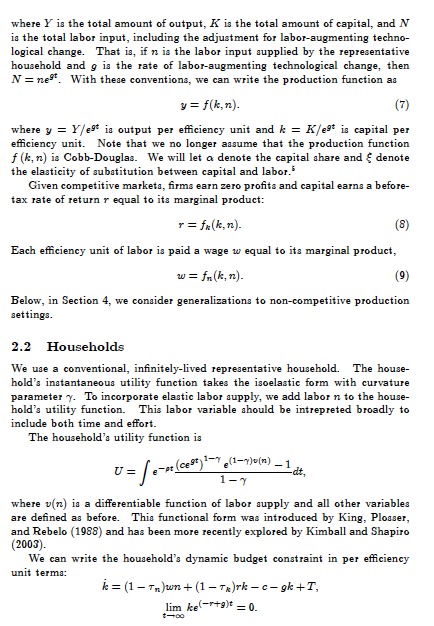
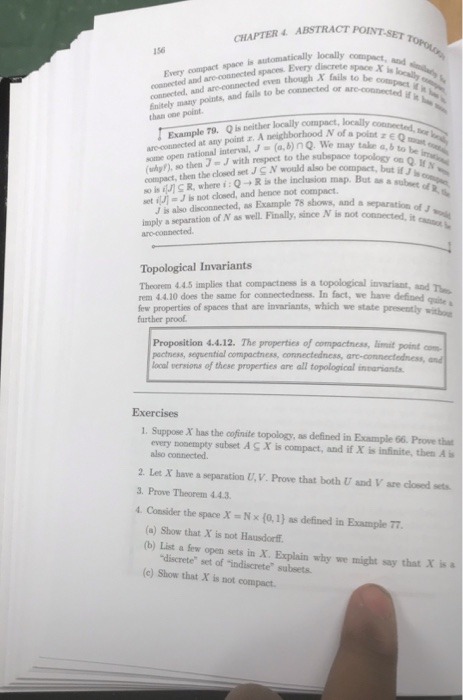
where Y is the total amount of output, A is the total amount of capital, and N is the total labor input, including the adjustment for labor-augmenting techno- logical change. That is, if n is the labor input supplied by the representative household and g is the rate of labor-augmenting technological change, then N= ne". With these conventions, we can write the production function as y = f(k, n). (7) where y = 1/e" is output per efficiency unit and k = Kest is capital per efficiency unit. Note that we no longer assume that the production function f (k, n) is Cobb-Douglas. We will let a denote the capital share and { denote the elasticity of substitution between capital and labor. Given competitive markets, firms earn zero profits and capital earns a before- tax rate of return r equal to its marginal product: r = f*( k,n). (8) Each efficiency unit of labor is paid a wage w equal to its marginal product, w = fn( k, n). (9) Below, in Section 4, we consider generalizations to non-competitive production settings. 2.2 Households We use a conventional, infinitely-lived representative household. The house- hold's instantaneous utility function takes the isoelastic form with curvature parameter y. To incorporate elastic labor supply, we add labor n to the house- hold's utility function. This labor variable should be intrepreted broadly to include both time and effort. The household's utility function is U= e-m (ce)1-7 (1-)(m) - 1 1-7 where v(n) is a differentiable function of labor supply and all other variables are defined as before. This functional form was introduced by King, Ploaser, and Rebelo (1988) and has been more recently explored by Kimball and Shapiro (2003). We can write the household's dynamic budget constraint in per efficiency unit terms: k= (1 - T)wn+ (1 -Tx)rk - c- gk+I, lim kertalt = 0.CHAPTER 4. ABSTRACT POINT-SET TOPOLOS 156 Every compact space is automatically locally compact, sad wanected and are connected spaces. Every discrete space . is locally connected, and are connected even though & fails to be compact Snitely many points, and fails to be connected or are-connected HE than one point. Example 79. Q) is neither locally compact, locally connected, Bor by We collected at any point r. A neighborhood ! of a point - 6 10 manager 50the open rational interval, J = [objnQ. We may take a,& to be ing (whyF), so then ] = J with respect to the subspace topology on Q. IN compact, then the closed set J C N would also be compact, but if J 's comes wiff CR. where i : Q -+ R is the inclusion map. But as a subset of R. set iJ) = J Is not closed, and hence not compact. J is also disconnected, as Example 78 slows, and a separation of J imply a separation of IV as well. Finally, since AV is not connected, it cang aro-connected. Topological Invariants Theorem 4.4.5 implies that compactness is a topological invariant, and Then rem 4.4.10 does the same for connectedness. In fact, we have defined quite few properties of spaces that are invariants, which we state presently withon further proof Proposition 4.4.12. The properties of compactness, limit point com- pactress, sequential compactness, connectedness, are-connectedness, and local versions of these properties are all topological invariants. Exercises 1. Suppose A has the cofinite topology, as defined in Example 66. Prove that every nonempty subset A C X is compact, and if X is infinite, then A is also connected. 2. Let X have a separation U. V. Prove that both U and V are closed sets. 3. Prove Theorem 4.4.3. 4. Consider the space X = N x (0, 1) as defined in Example 17. (a) Show that X is not Hausdorff. (b) List a few open sets in X. Explain why we might say that X is a "discrete" set of "indiscrete" subsets. (c) Show that X is not compact
Step by Step Solution
There are 3 Steps involved in it

Get step-by-step solutions from verified subject matter experts
 Study Help