







Question: business process reengineering (BPR) is to design techniques to allow simulate and A town planning BPMJ new legislation; check different sets of processes that could
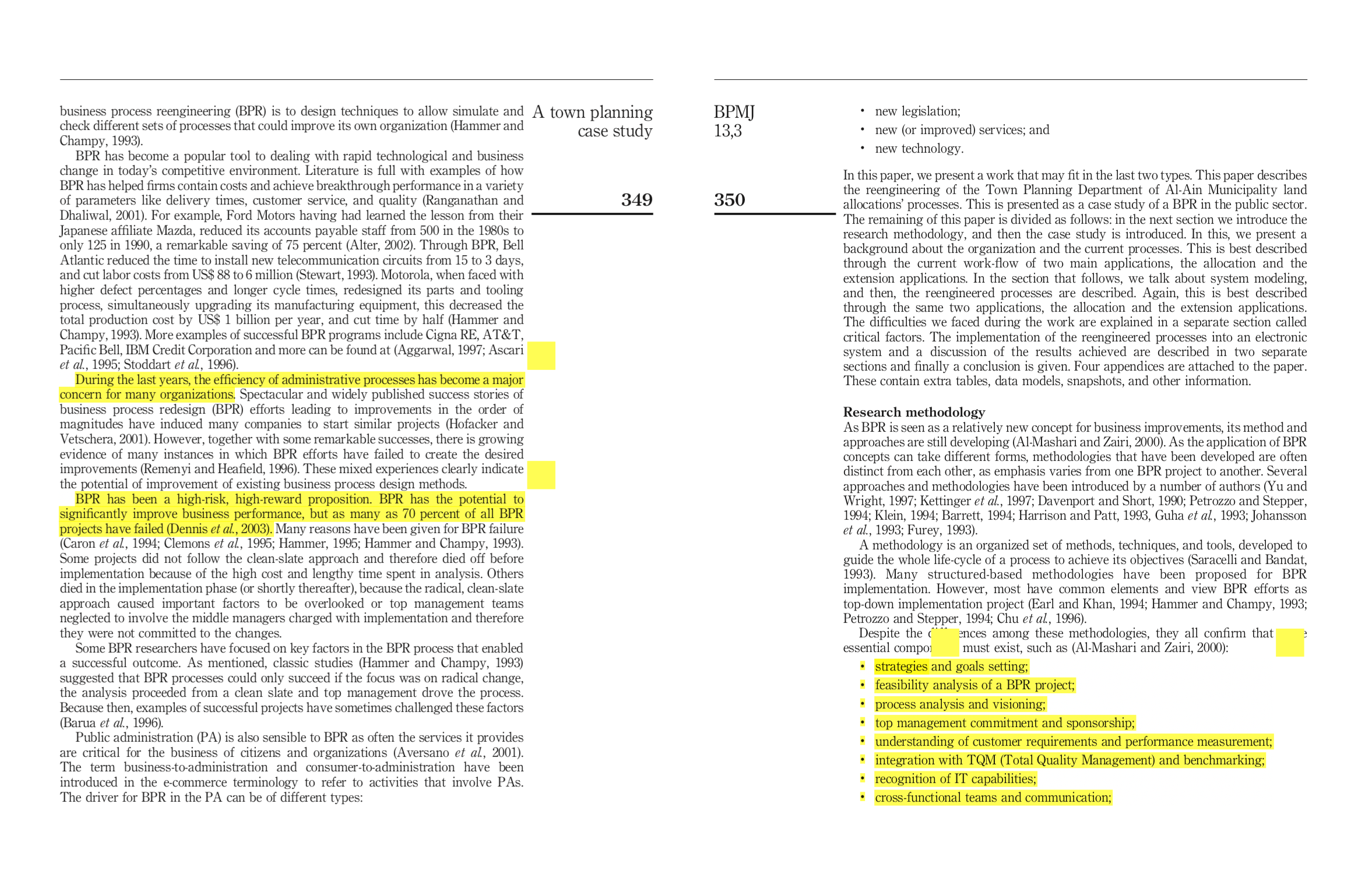
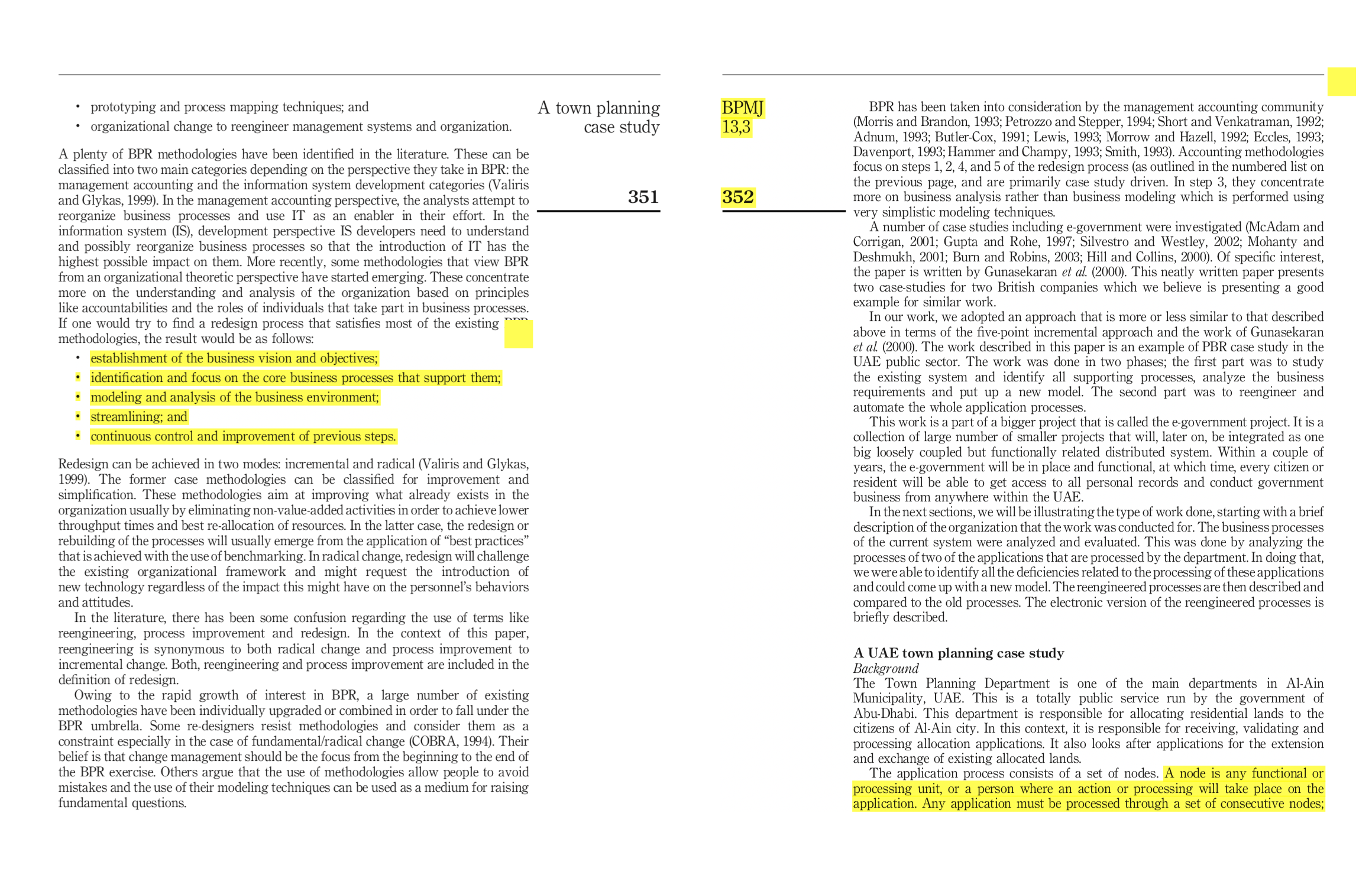
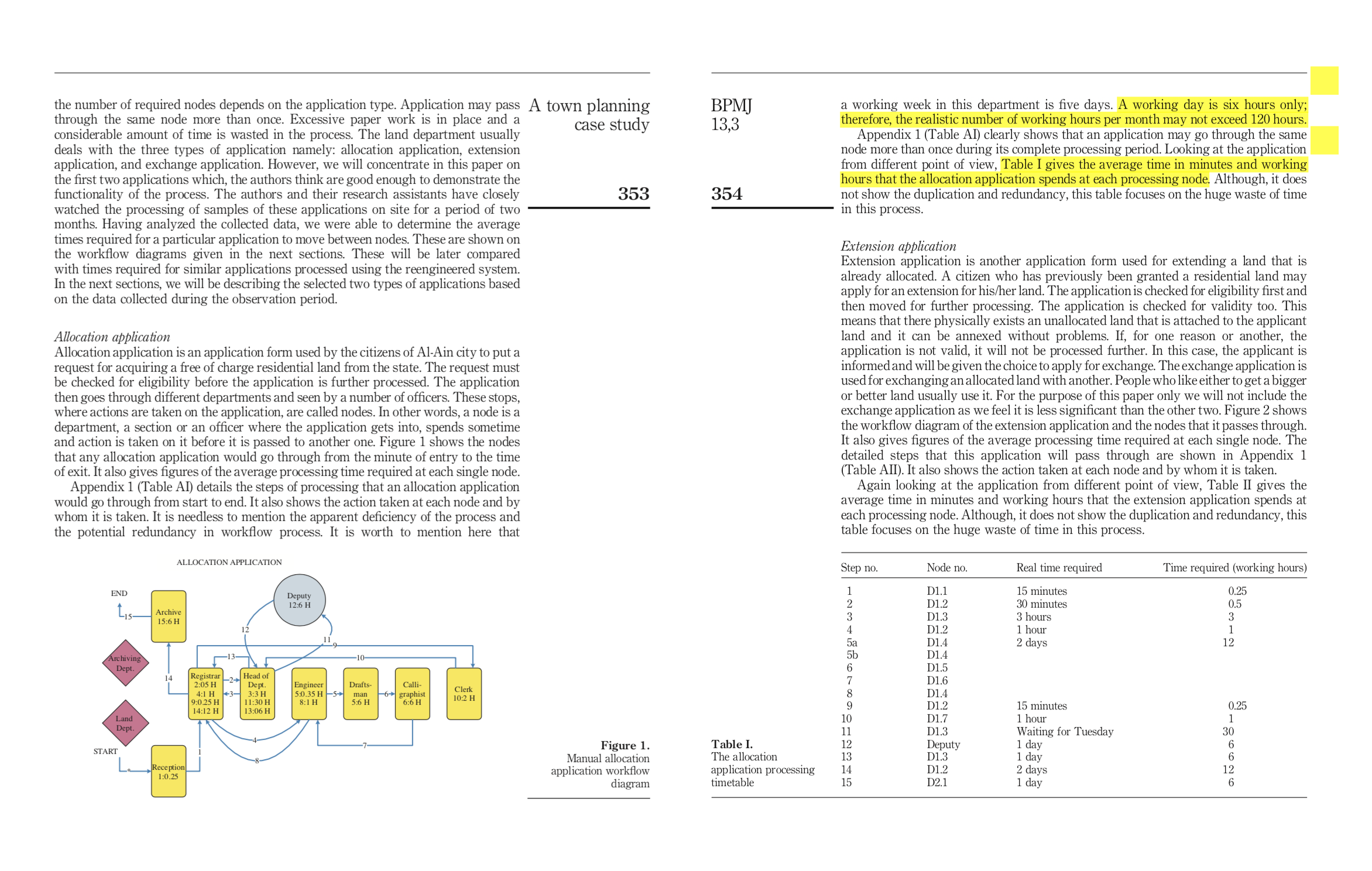
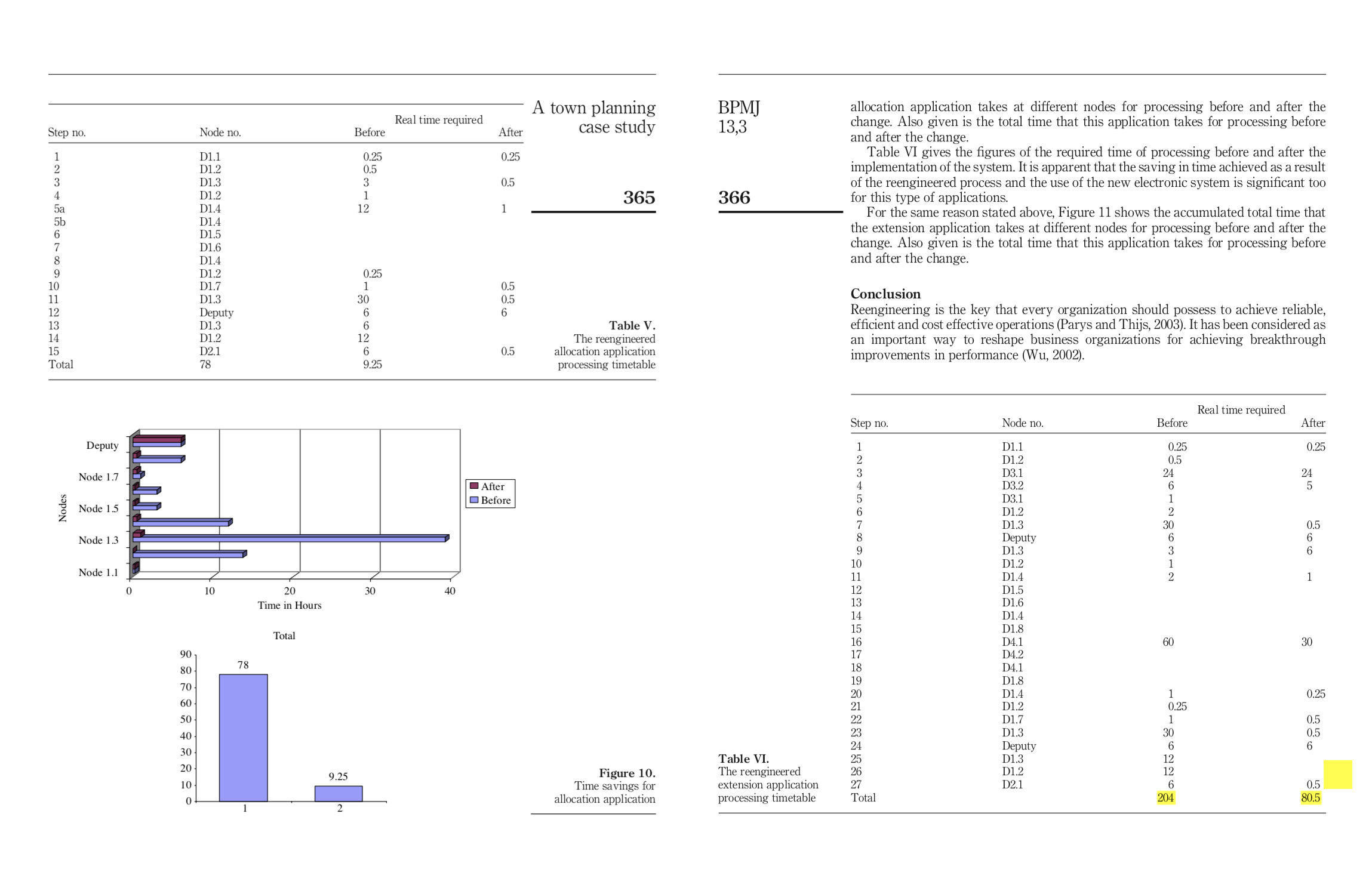
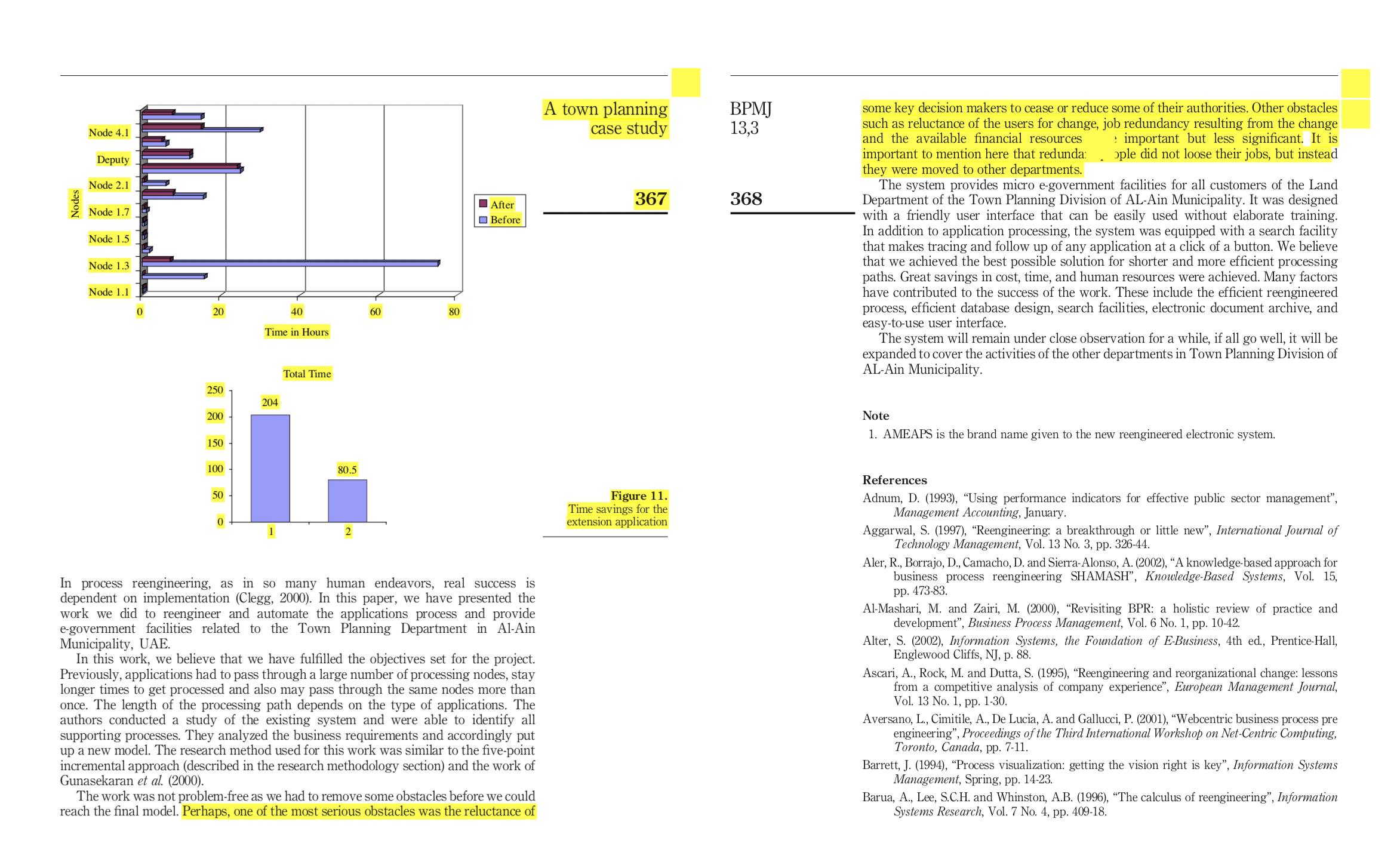
business process reengineering (BPR) is to design techniques to allow simulate and A town planning BPMJ new legislation; check different sets of processes that could improve its own organization (Hammer and Champy, 1993). case study 13,3 new (or improved) services; and BPR has become a popular tool to dealing with rapid technological and business new technology. change in today's competitive environment. Literature is full with examples of how BPR has helped firms contain costs and achieve breakthrough performance in a variety In this paper, we present a work that may fit in the last two types. This paper describes of parameters like delivery times, customer service, and quality (Ranganathan and 349 350 the reengineering of the Town Planning Department of Al-Ain Municipality land Dhaliwal, 2001). For example, Ford Motors having had learned the lesson from their allocations' processes. This is presented as a case study of a BPR in the public sector. Japanese affiliate Mazda, reduced its accounts payable staff from 500 in the 1980s to The remaining of this paper is divided as follows: in the next section we introduce the only 125 in 1990, a remarkable saving of 75 percent (Alter, 2002). Through BPR, Bell research methodology, and then the case study is introduced. In this, we present a Atlantic reduced the time to install new telecommunication circuits from 15 to 3 days, background about the organization and the current processes. This is best described and cut labor costs from US$ 88 to 6 million (Stewart, 1993). Motorola, when faced with through the current work-flow of two main applications, the allocation and the higher defect percentages and longer cycle times, redesigned its parts and tooling extension applications. In the section that follows, we talk about system modeling, process, simultaneously upgrading its manufacturing equipment, this decreased the and then, the reengineered processes are described. Again, this is best described total production cost by US$ 1 billion per year, and cut time by half (Hammer and through the same two applications, the allocation and the extension applications. Champy, 1993). More examples of successful BPR programs include Cigna RE, AT&T, The difficulties we faced during the work are explained in a separate section called Pacific Bell, IBM Credit Corporation and more can be found at (Aggarwal, 1997; Ascari critical factors. The implementation of the reengineered processes into an electronic et al., 1995; Stoddart et al., 1996 system and a discussion of the results achieved are described in two separate During the last years, the efficiency of administrative processes has become a major sections and finally a conclusion is given. Four appendices are attached to the paper. concern for many organizations. Spectacular and widely published success stories of These contain extra tables, data models, snapshots, and other information. business process redesign (BPR) efforts leading to improvements in the order of magnitudes have induced many companies to start similar projects (Hofacker and Research methodology Vetschera, 2001). However, together with some remarkable successes, there is growing As BPR is seen as a relatively new concept for business improvements, its method and evidence of many instances in which BPR efforts have failed to create the desired approaches are still developing (Al-Mashari and Zairi, 2000). As the application of BPR improvements (Remenyi and Heafield, 1996). These mixed experiences clearly indicate concepts can take different forms, methodologies that have been developed are often the potential of improvement of existing business process design methods. distinct from each other, as emphasis varies from one BPR project to another. Several BPR has been a high-risk, high-reward proposition. BPR has the potential to approaches and methodologies have been introduced by a number of authors (Yu and significantly improve business performance, but as many as 70 percent of all BPR Wright, 1997; Kettinger et al., 1997; Davenport and Short, 1990; Petrozzo and Stepper, projects have failed (Dennis et al., 2003). Many reasons have been given for BPR failure 1994; Klein, 1994; Barrett, 1994; Harrison and Patt, 1993, Guha et al, 1993; Johansson (Caron et al., 1994; Clemons et al, 1995; Hammer, 1995; Hammer and Champy, 1993). et al., 1993; Furey, 1993). Some projects did not follow the clean-slate approach and therefore died off before A methodology is an organized set of methods, techniques, and tools, developed to implementation because of the high cost and lengthy time spent in analysis. Others guide the whole life-cycle of a process to achieve its objectives (Saracelli and Bandat, died in the implementation phase (or shortly thereafter), because the radical, clean-slate 1993). Many structured-based methodologies have been proposed for BPR approach caused important factors to be overlooked or top management teams implementation. However, most have common elements and view BPR efforts as top-down implementation project (Earl and Khan, 1994; Hammer and Champy, 1993; neglected to involve the middle managers charged with implementation and therefore they were not committed to the changes. Petrozzo and Stepper, 1994; Chu et al., 1996). Some BPR researchers have focused on key factors in the BPR process that enabled essential compo Despite the cences among these methodologies, they all confirm that must exist, such as (Al-Mashari and Zairi, 2000): a successful outcome. As mentioned, classic studies (Hammer and Champy, 1993) suggested that BPR processes could only succeed if the focus was on radical change, strategies and goals setting; he analysis proceeded from a clean slate and top management drove the process feasibility analysis of a BPR project; Because then, examples of successful projects have sometimes challenged these factors . process analysis and visioning; (Barua et al., 1996). Public administration (PA) is also sensible to BPR as often the services it provides top management commitment and sponsorship; are critical for the business of citizens and organizations (Aversano et al, 2001). understanding of customer requirements and performance measurement; The term business-to-administration and consumer-to-administration have been integration with TOM (Total Quality Management) and benchmarking; introduced in the e-commerce terminology to refer to activities that involve PAs. recognition of IT capabilities; The driver for BPR in the PA can be of different types: cross-functional teams and communication;' prototyping and process mapping techniques; and ' organimtional change to reeng'ineer management systems and organization. A plenty of BPR methodologies have been identied in the literature. These can be classied into two main categories depending on the perspective they take in BPR: the management accounting and the information system development categories (Valiris and Glykas, 1999). In the management accounting perspective, the analysts attempt to reorganize busine$ pmes and use IT as an enabler in their effort. In the information system (IS), development perspective IS developers need to understand and possibly reorganize business processes so that the introduction of IT has the highest possible impact on them. More recently, some methodologies that View BPR from an organizational theoretic perspective have started emerging. These concentrate more on the understanding and analysis of the organimtion based on principles like aocountabilities and the roles of individuals that take part in busintss processes If one would try to nd a redesign process that satises most of the existing \"N' methodologies, the result would be as follows ' establishment of the business vision and objectives; ' identication and focus on the core brsiness processes that support them; ' modeling and analysis of the businas environment; ' streamlining; and ' continuous control and improvement of previous steps Redesign can be achieved in two modes incremental and radical (Valiris and Glykas, 1999). The former case methodologies an be classied for improvement and simplication. These methodologies aim at improving what already arists in the organization usually by eliminating non-value-added activities in order to achieve lower throughput times and best re-allomtion of resources, In the latter case, the redesign or rebuilding of the processes will usually emerge from the application of \"best practices" that is achieved with the use of benchmarking. In radiral change, redesign will challenge the existing organizational framework and might request the introduction of new technology regardless of the impact this might have on the personnel's behaviors and attitudes In the literature, there has been some confusion regarding the use of terms like reengineering, process improvement and redesign In the context of this paper, reerrgineering is synonymous to both radial change and proctss improvement to incremental change Both, reeng'ineering and proce$ improvement are included in the denition of redesign. Owing to the rapid growth of interest in BPR, a large number of existing methodologies have been individually upgraded or combined in order to fall under the BPR umbrella. Some re-designers resist methodologies and consider them as a constraint especially in the case of fundamental/radial change (COBRA, 1994). Their belief is that change management should be the focus from the beginning to the end of the BPR exercise Others argue that the use of methodologies allow people to avoid mistakes and the use of their modeling techniques (an be used as a medium for raising fundamental questions A town planning arse study 351 BPMJ 13,3 352 BPR has been taken into consideration by the management accounting community (Morris and Brandon 1993; Petrozzo and Stepper, 1994; Short and Venkatraman, 1992; Adnum, 1993; Butler-Cox, 1991; Lewis, 1993; Morrow and Hazel], 1992; Eccles, 1993; Davenport, 1993; Hammer and Champy, 1993; Smith, 1993), Accounting methodologies focus on steps I, 2, 4, and 5 of the redesign process (as outlined in the numbered list on the previous page, and are primarily case study driven. In step 3, they concentrate more on business analysis rather than business modeling which is performed using very simplistic modeling techniques. A number of case studies including e-government were investigated (McAdam and Corrigan, 2001; Gupta and Rohe, 1997; Silvestro and Westley, 2002; Mohanty and Deshmukh, 2001; Bum and Robins, 2003; Hill and Collins, 2000), Of specic interest, the paper is written by Gunasekaran et al (2000), This neatly written paper presents two case-studies {or two British companies which we believe is presenting a good example for similar work. In our work, we adopted an approach that is more or less similar to that described above in terms of the ve-point incremental approach and the work of Gunasekaran et All (2000). The work described in this paper is an example of PBR case study in the UAE public sector. The work was done in two phases; the rst part was to study the existing system and identify all supporting processes, analyze the business requirements and put up a new model. The second part ms to reengineer and automate the Whole application processes. This work is a part of a bigger project that is called the e-government project. It is a collection of large number of smaller projects that will, later on, be integrated as one big loosely coupled but functionally related distributed system. Within a couple of years, the e-govemment will be in place and functional, at which time, every citizen or resident will be able to get access to all personal records and conduct government business from anywhere within the UAE. In the next sections, we will be illustrating thetype of work done, starting with a brief description of the organization that the work was conducted for, The business processes of the current system were analyzed and evaluated. This was done by analyzing the processes of two of the applications that are processed by the department. In doing that, we were able to identify all the deciencies related to the processing of these applications and could come up witha new model. The reengineered processes are then described and compared to the old processes The electronic vasion of the reengineered processes is briey described. A UAE town planning case study Background The Town Planning Department is one of the main departments in Al-Ain Municipality, UAE. This is a tomlly public service run by the government of Abu-Dhabi. This department is responsible for allocating residential lands to the citizens of Al-Ain city. In this context, it is responsible for receiving, validating and processing alloartion applications It also looks after applications for the extension and exchange of existing allocated lands. The application process consists of a set of nodes. A node is any functional or processing unit, or a person where an action or processing will take place on the application. Any application must be processed through a set of consecutive nodes; the number of required nodes depends on the application type. Application may pass A town planning through the same node more than once. Excessive paper work is in place and a considerable amount of time is wasted in the process The land department usually deals with the three types of application namely: allocation applitztion, extension applimtion, and exchange applimtion. However, we will concentrate in this paper on the rst two applimtions which, the authors think are good enwgh to demonstrate the functionality of the proces The authors and their research assistants have closely watched the processing of samples of these applications on site for a period of two months. Having analyzed the collected data, we were able to determine the average times required for a particular application to move between nodes These are shown on the workow diagrams given in the next sections. These will be later compared with times required for similar applications processed using the reengineered system. In the next sections, we will be describing the selected two types of applications based on the data collected during the observation period. Allocation application Allocation application is an application form used by the citizens of Al-Ain city to put a request for acquiring a free of charge residential land from the smte. The request must be checked for eligibility before the application is further proceed. The application then goes through different departments and seen by a number of ofcers These stops, where actions are taken on the application, are called nodes. In other words, a node is a department, a section or an ofcer Where the application gets into, spends sometime and action is taken on it before it is passed to another one Figure 1 shows the nodes that any allocation application would go through from the minute of entry to the time of exit. It also gives gures of the average processing time required at each single node. Appendix 1 (Table AI) details the steps of processing that an allomtion application would go through trom start to end. It also shows the action taken at each node and by whom it is taken. It is needless to mention the apparent deciency of the process and the potential redundancy in workow process It is worth to mention here that ALLOCATION APPLICA'IION case study 353 Figure 1. Manual allocah'on application workow diagram BPMJ 13,3 354 Table I. The allocation application processing timetable a working week in this department is five days. A working day is six hours only; therefore, the realistic number of working hours per month may not exceed 120 hours. Appendix 1 (Table AD clearly shows that an application may go through the same node more than once during its complete processing period. Looking at the application from different point of view, Table I gives the average time in minutes and working hours that the allocation applimtion spends at each processing node. Although, it does not show the duplication and redundancy, this table focuses on the huge waste of time in this process. Extenrion application Extension application is another application form used for extending a land that is alrmdy allocated. A citizen who has previously been granted a residential land may apply for an extension for his/her land. The application is checked for eligi 'lity first and then moved for further processing. The application is checked for validity too. This means that there physically exists an unallocated land that is attached to the applicant land and it can be annexed without problems If, for one reason or another, the application is not valid, it will not be processed further. In this case, the applicant is informed and will be given the choice to apply for exchange. The exchange application is used for exchanging an allocated land with another. People who like either to get a bigger or better land usually use it. For the purpose of this paper only we will not include the exchange applirztion as we feel it is less signiamt than the other two. Figure 2 shows the workow diagram of the extension application and the nodes that it passes through. It also gives gures of the average processing time required at each single node. The detailed steps that this application will pass through are shown in Appendix 1 (Fable All). It also shows the action taken at each node and by whom it is taken. Again looking at the application from different point of View, Table [I gives the average time in minutes and working hours that the extension application spends at each processing node. Although, it does not show the duplication and redundancy, this table focuses on the huge waste of time in this process. Step no. Node no. Real time required Time required (working hours) 1 D11 15 minutes 0.25 2 01.2 30 minutes 0.5 3 01.3 3 hours 3 4 01.2 1 hour 1 5a D1.4 2 days 12 5b D1.4 6 D15 7 D1.6 8 D1.4 9 D12 15 minutes 0.25 10 D17 1 hour 1 11 D13 Waiting for Tuesday 30 12 Deputy 1 day 6 13 D13 1 day 6 14 D12 2 days 12 15 D21 1 day 6 Real time required A town planning BPMI allocation application takes at different nodes for processing before and after the Step no. Node no. Before After case study 13,3 change. Also given is the total time that this application takes for processing before and after the change. D1.1 0.25 0.25 Table VI gives the figures of the required time of processing before and after the D1.2 0.5 implementation of the system. It is apparent that the saving in time achieved as a result D1.3 3 0.5 D1.2 1 of the reengineered process and the use of the new electronic system is significant too D1.4 12 1 365 366 for this type of applications. D1.4 For the same reason stated above, Figure 11 shows the accumulated total time that D1.5 the extension application takes at different nodes for processing before and after the D1.6 change. Also given is the total time that this application takes for processing before D1.4 D1.2 and after the change. 0.25 D1.7 D1.3 0.5 30 0.5 Conclusion Deputy 6 6 Reengineering is the key that every organization should possess to achieve reliable, D1.3 6 Table V. D1.2 12 efficient and cost effective operations (Parys and Thijs, 2003). It has been considered as D2.1 6 The reengineered 0.5 an important way to reshape business organizations for achieving breakthrough Total allocation application 78 9.25 processing timetable improvements in performance (Wu, 2002). Step no. Real time required Node no. Before After Deputy D1.1 0.25 0.25 D1.2 0.5 Node 1.7 D31 24 After D3.2 6 24 5 Nodes Node 1.5 Before D3.1 D1.2 D1.3 30 Node 1.3 Deputy 6 0.5 D1.3 Node 1.1 D1.2 D1.4 NHWO 10 20 30 D1.5 Time in Hours D1.6 D1.4 Total D1.8 30 90 78 17 D4.1 60 18 D4.2 19 D4.1 D1.8 20 21 D1.4 0.25 0.25 22 D1.2 23 D1.7 D1.3 1 0.5 30 0.5 25 Deputy Table VI. 24 6 D1.3 12 9.25 Figure 10. The reengineered 26 D1.2 12 Time savings for extension application 27 D2.1 6 0.5 2 allocation application processing timetable Total 204 80.5A town planning BPMJ some key decision makers to cease or reduce some of their authorities. Other obstacles Node 4.1 case study 13,3 such as reluctance of the users for change, job redundancy resulting from the change and the available financial resources : important but less significant. It is Deputy important to mention here that redunda: pple did not loose their jobs, but instead they were moved to other departments. Nodes Node 2.1 Node 1.7 After 367 368 The system provides micro e-government facilities for all customers of the Land Department of the Town Planning Division of AL-Ain Municipality. It was designed Before with a friendly user interface that can be easily used without elaborate training. Node 1.5 In addition to application processing, the system was equipped with a search facility that makes tracing and follow up of any application at a click of a button. We believe Node 1.3 that we achieved the best possible solution for shorter and more efficient processing Node 1.1 paths. Great savings in cost, time, and human resources were achieved. Many factors have contributed to the success of the work. These include the efficient reengineered 20 40 60 80 process, efficient database design, search facilities, electronic document archive, and Time in Hours easy-to-use user interface. The system will remain under close observation for a while, if all go well, it will be expanded to cover the activities of the other departments in Town Planning Division of Total Time AL-Ain Municipality. 250 7 204 200 Note 150 1. AMEAPS is the brand name given to the new reengineered electronic system. 100 80.5 References 50 Figure 11. Time savings for the Adnum, D. (1993), "Using performance indicators for effective public sector management", 2 extension application Management Accounting, January. Aggarwal, S. (1997), "Reengineering: a breakthrough or little new", International Journal of Technology Management, Vol. 13 No. 3, pp. 326-44. Aler, R., Borrajo, D., Camacho, D. and Sierra-Alonso, A. (2002), "A knowledge-based approach for In process reengineering, as in so many human endeavors, real success is business process reengineering SHAMASH", Knowledge-Based Systems, Vol. 15, dependent on implementation (Clegg, 2000). In this paper, we have presented the pp. 473-83. work we did to reengineer and automate the applications process and provide Al-Mashari, M. and Zairi, M. (2000), "Revisiting BPR: a holistic review of practice and e-government facilities related to the Town Planning Department in Al-Ain development", Business Process Management, Vol. 6 No. 1, pp. 10-42. Municipality, UAE. Alter, S. (2002), Information Systems, the Foundation of E-Business, 4th ed., Prentice-Hall, In this work, we believe that we have fulfilled the objectives set for the project. Englewood Cliffs, NJ, p. 88. Previously, applications had to pass through a large number of processing nodes, stay Ascari, A., Rock, M. and Dutta, S. (1995), "Reengineering and reorganizational change: lessons longer times to get processed and also may pass through the same nodes more than from a competitive analysis of company experience", European Management Journal, once. The length of the processing path depends on the type of applications. The Vol. 13 No. 1, pp. 1-30. authors conducted a study of the existing system and were able to identify all Aversano, L., Cimitile, A., De Lucia, A. and Gallucci, P. (2001), "Webcentric business process pre supporting processes. They analyzed the business requirements and accordingly put engineering", Proceedings of the Third International Workshop on Net-Centric Computing, up a new model. The research method used for this work was similar to the five-point Toronto, Canada, pp. 7-11. incremental approach (described in the research methodology section) and the work of Barrett, J. (1994), "Process visualization: getting the vision right is key", Information Systems junasekaran et al. (2000). Management, Spring, pp. 14-23. The work was not problem-free as we had to remove some obstacles before we could Barua, A., Lee, S.C.H. and Whinston, A.B. (1996), "The calculus of reengineering", Information reach the final model. Perhaps, one of the most serious obstacles was the reluctance of Systems Research, Vol. 7 No. 4, pp. 409-18
Step by Step Solution
There are 3 Steps involved in it

Get step-by-step solutions from verified subject matter experts
 Study Help