Question: Canyou read the article under below and answer the following question like tell us what article you read and your reaction to the article. Your
Canyou read the article under below and answer the following question like tell us what article you read and your reaction to the article. Your 'audience' is your peers, so can you explain reaction to be of the most value to them. It can include things like:
What was new or surprised you?
What you agree or disagree?
What in your own experience corresponds to what you read?
What was the main 'takeaway'?
Should your peers read it or not? Why or why not?
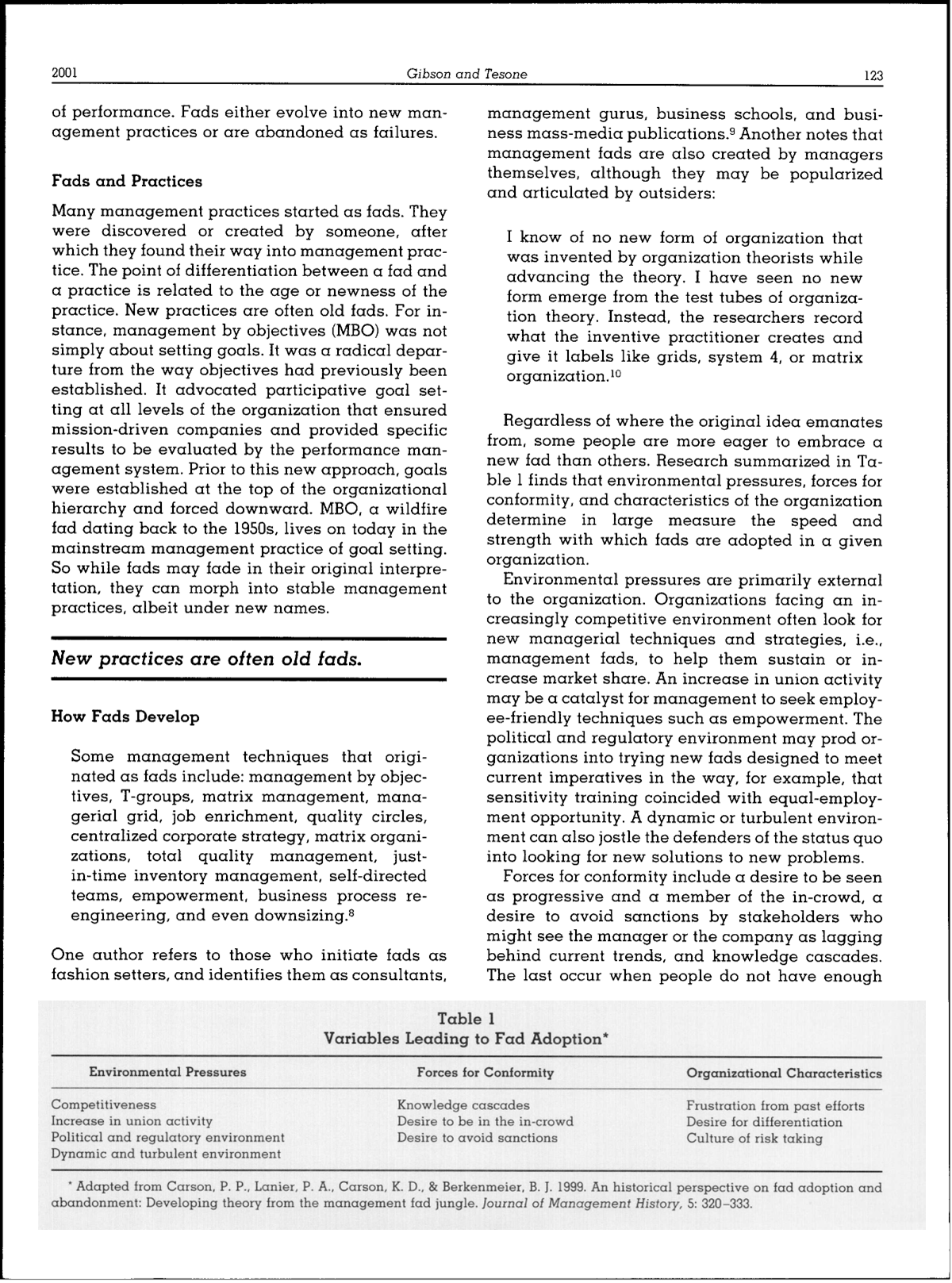
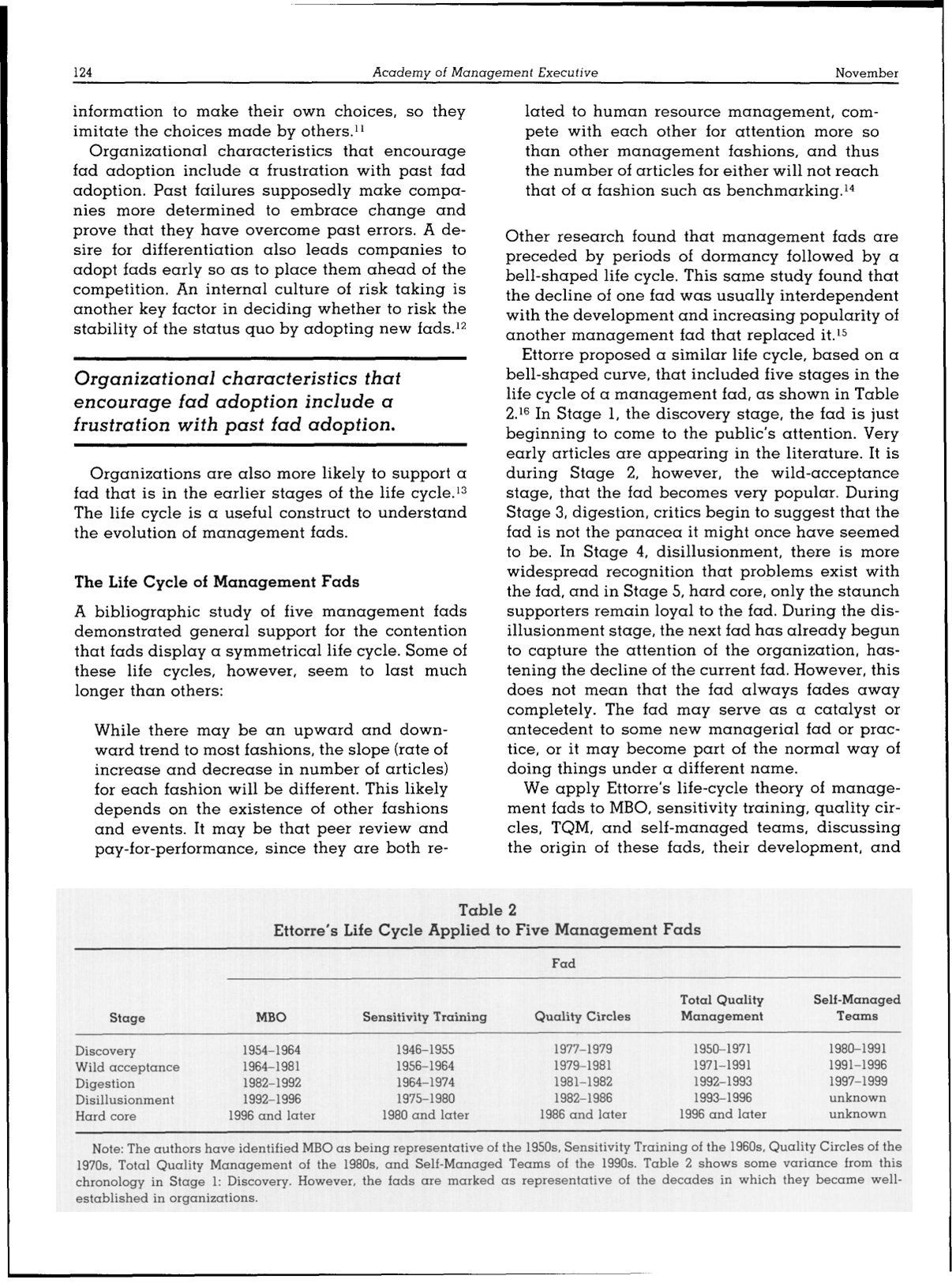
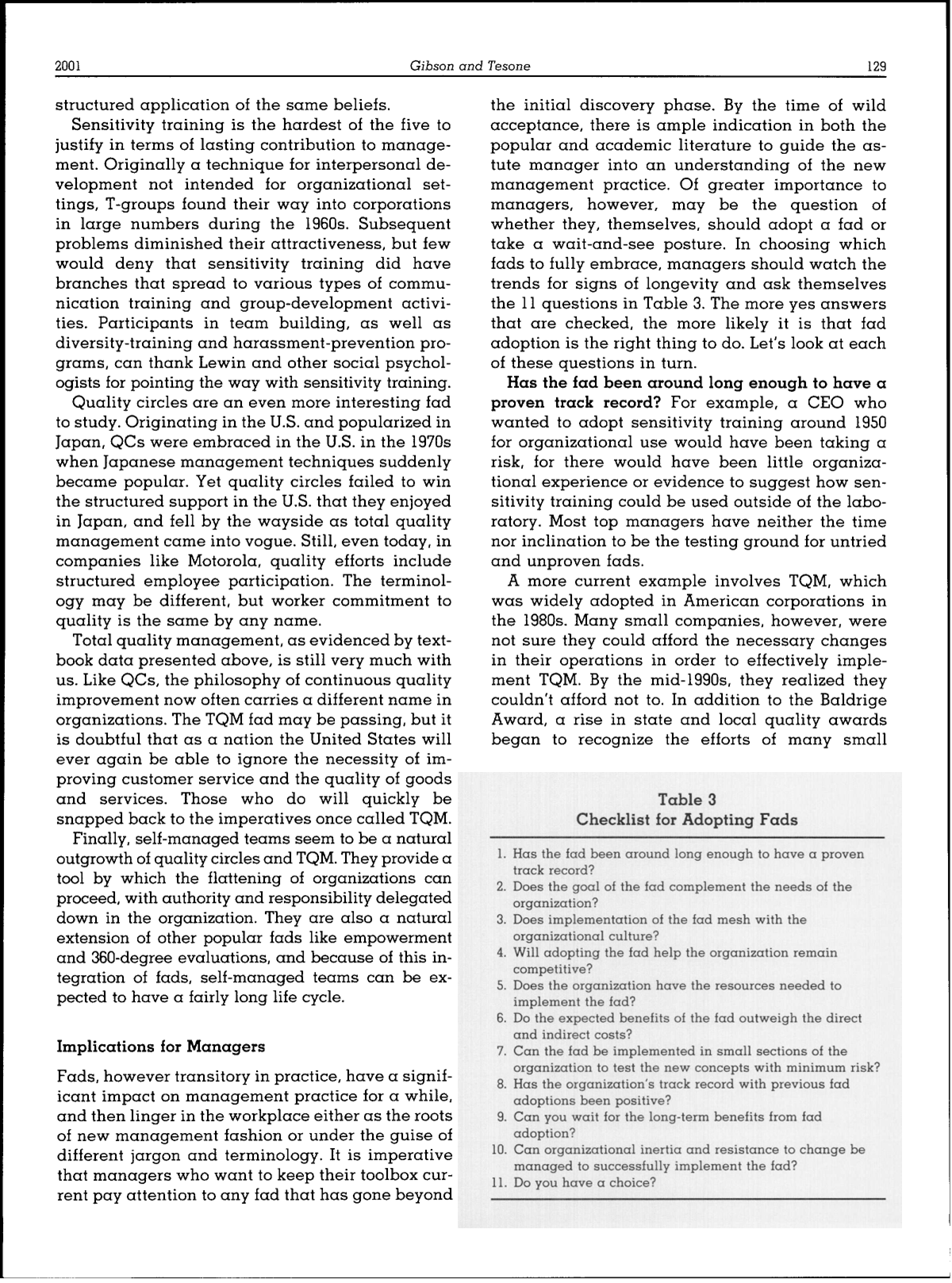
' Academy of Management EXOCque. 20m. Vol, [5, No, 4 .................................... a..-I......oo..-.u.4....ias.....n....o-.u.u...a....u...u............u...........-..-..............................r....4--'..o...... Management fads: Emergence. evolution. and implications for managers lane Whitney Gibson and Dana V. Tesone Executive Overview Management fads often get a lot of attention. Should managers be concerned about the latest management fad. or is it just a waste of time?I Considerable interest has been shown in the literature about management fads and fashions. Journal and newspaper articles abound.2 and professional books have been written on the subject? Unlilre many literature-based. academic concepts. these fads and fashions are well known by practicing managers. This article focuses on five management fads of the late 20'\" century. each one representative of a management trend of a specific decade: MBO (1955's). sensitivity training (19503). quality circles (19705). total quality management (19805). and self-managed or self-directed teams (19905}. In each case. this article explores the origin of the fad through its evolution into mainstream management practice. Further. each tad is examined to determine relevance to current management practice. The article offers practical guidelines for managers regarding which fads to embrace and when. ........................................ a...o..n...ooo.oo...-a.'on...os.g.-.4oc..oos.-n..ioo...a...uI..u....-.......u...-....................................o.o..o-Qooa Faddish iargon is everywhere. As one author noted: You can, if you wish, atten your pyramid, become a horizontal organization, and elimi nate hierarchy from your company. You can empower your people, open your environ- ment. and transform your culture. . . . You can improve continuously. shift your paradigms, and become a learning organization. You can devote yourself and your company to total quality management.4 In the last half of the 20th century. management fads came and went. which suggests there is a life cycle to management fashion. One central. pre- vailing question 01 this article is: where have these fads gone? Have they disappeared or have they evolved into management practices? If the latter is true, do newer fads build upon the content of older fads? What Constitutes a Management Fad? Management fads and management fashions are terms that are often used interchangeably. A fad 122 is generally thought of as a craze, a temporary cultural blip in society, like the Hula Hoop craze of the 19503 or the miniskirts of the 19705. Management fads are a more serious phenomee non, although they are often as temporary and compelling. One author defines management fads as rela- tively transitory collective beliefs, disseminated by management fashion setters.5 A more recent defini~ tion describes fads as "managerial interventions which appear to be innovative. rational. and func- tional and are aimed at encouraging better organi- zational performance."6 Learning outcomes associ- ated with effectiveness of the fad may result in the retention or rejection of the fad itself. In either case, the fad loses its specific identity as an intervention strategy at some point, which results in the decline of its individual notoriety. However. the content of the fad becomes part of the overall management expe- riential base, which means new fads should be at equal or higher levels than preceding processes.l This overall management experiential base can be called a management practice. We consider management fade to be widely ac cepted, innovative interventions into the organiza- tion's practices designed to improve some aspect 2001 Gibson and Tesone 123 of performance. Fads either evolve into new man- agement practices or are abandoned as failures. Pads and Practices Many management practices started as fads. They were discovered or created by someone, after which they found their way into management prac- tice. The point of differentiation between a fad and a practice is related to the age or nominees of the practice. New practices are often old fads. For ins stance. management by objectives (MBO) was not simply about setting goals. It was a radical depar ture from the way objectives had previously been established. It advocated participative goal set ting at all levels of the organization that ensured mission-driven companies and provided specific results to be evaluated by the performance man- agement system. Prior to this new approach, goals were established at the top of the organizational hierarchy and forced downward. MBO. a wildfire fad dating back to the 19505, lives on today in the mainstream management practice of goal setting. So While fads may fade in their original interpre- tation. they can morph into stable management practices. albeit under new names. New practices are often old fads. How Fads Develop Some management techniques that origi- nated as fads include: management by objec tives. T-groups. matrix management, mana- gerial grid. job enrichment, quality circles, centralized corporate strategy. matrix organi zations. total quality management, just intime inventory management, self-directed teams, empowerment, business process re- engineering. and even downsizing.8 One author refers to those who initiate fads as fashion setters. and identifies them as consultants. management gurus. business schools. and busi- ness mass-media publications.9 Another notes that management fads are also created by managers themselves. although they may be popularized and articulated by outsiders: I know of no new form of organization that was invented by organization theorists while advancing the theory. I have seen no new form emerge from the test tubes of organiza- tion theory. Instead. the researchers record what the inventive practitioner creates and give it labels like grids, system 4, or matrix organization.l0 Regardless of where the original idea emanates from. some people are more eager to embrace a new tad than others. Research summarized in Ta- ble 1 finds that environmental pressures. forces for conformity. and characteristics of the organization determine in large measure the speed and strength with which fads are adopted in a given organization. Environmental pressures are primarily external to the organization. Organizations facing an in- creasingly competitive environment often look for new managerial techniques and strategies, i.e.. management fade. to help them sustain or in- crease market share. An increase in union activity may be a catalyst for management to seek employ- ee-friendly techniques such as empowerment. The political and regulatory environment may prod or- ganizations into trying new fads designed to meet current imperatives in the way, for example. that sensitivity training coincided with equal-employ- ment opportunity. A dynamic or turbulent environ- ment can also jostle the defenders of the status quo into looking for new solutions to new problems. Forces for conformity include a desire to be seen as progressive and a member of the in-crowd, a desire to avoid sanctions by stakeholders who might see the manager or the company as lagging behind current trends, and knowledge cascades. The last occur when people do not have enough Table 1 Variables Leading to Fad Adoption' Environmental Pressures Competitiveness Increase in union activity Political and regulatory env1romnent Dynamic and turbulent environment Forces for Contormity Knowledge cascades Desire to be in the iii-crowd Desire to avoid sanctions Organizational Characteristics Frustration from past efforts Desrre for {litterentiation Culture at risk taking ' Adapted from Carson. P. P.. Lcrliier, P. A . Carson. K. D. 3: Berkenmeier. B. l. 1999 (in historical perspective on fad ariopnon and abandonment: Developing theory from the management fad jungle. Journal of Management History, 5: 320 333. 124 Academy of Management Executive November information to make their own choices. so they imitate the choices made by others.\" Organizational characteristics that encourage fad adoption include a lrustration with past tad adoption. Past failures supposedly make compa- nies more determined to embrace change and prove that they have overcome past errors. A de- sire for differentiation also leads companies to adopt tads early so as to place them ahead of the competition. An internal culture of risk taking is another key factor in deciding whether to risk the stability of the status quo by adopting new lads.l2 Organizational characteristics that encomage fad adoption include a frustration with past fad adoption. Organizations are also more likely to support a fad that is in the earlier stages of the life cycle.13 The life cycle is a useiul construct to understand the evolution of management tads. The Life Cycle of Management Fads A bibliographic study of five management fads demonstrated general support for the contention that fads display a symmetrical life cycle. Some 01 these life cycles. however, seem to last much longer than others: While there may be an upward and down- ward trend to most fashions, the slope (rate of increase and decrease in number at articles) for each fashion will be different. This likely depends on the existence of other fashions and events. It may be that peer review and pay-for-performance. since they are both re- lated to human resource management. com- pete with each other for attention more so than other management fashions, and thus the number of articles for either will not reach that of a fashion such as benchmarking.\" Other research found that management fads are preceded by periods of dormancy followed by a bell-shaped lite cycle. This same study found that the decline of one tad was usually interdependent with the development and increasing popularity of another management fad that replaced it.15 Ettorre proposed a similar liie cycle, based on a bellshaped curve. that included five stages in the life cycle of a management lad, as shown in Table 2.\"5 In Stage 1. the discovery stage. the fad is just beginning to come to the public's attention. Very early articles are appearing in the literature. it is during Stage 2. however. the wild-acceptance stage. that the fad becomes very popular. During Stage 3, digestion. critics begin to suggest that the fad is not the panacea it might once have seemed to be. In Stage 4. disillusionment, there is more widespread recognition that problems exist with the lad. and in Stage 5. hard core. only the staunch supporters remain loyal to the fad. During the dis- illusionment stage. the next fad has already begun to capture the attention of the organization. has- tening the decline of the current tad. However. this does not mean that the lad always fades away completely. The lad may serve as a catalyst or antecedent to some new managerial tad or prac- tice. or it may become part of the normal way of doing things under a dilferent name. We apply Ettorre's life-cycle theory oi manage- ment lads to MBO. sensitivity training. quality cir- cles. TQM. and self-managed teams. discussing the origin of these fads. their development. and Table 2 Ettorre's Life Cycle Applied to Five Management Fads Fad Total Quality Sell-Managed Stage MBO Sensitivity Training Quality Circles Management Teams Discovery 19541954 lEl-'iEiQSS 197?-19'?9 1950 1971 19813771991 Wild acceptance 1954198! 19551954 IEWQ 1931 19711991 1991-1395 Digestion 1982 1992 1984 1974 1931-1982 19924993 HST1999 Disillusionment 1392- 1996 151751980 198? 1985 1993 1995 unknown Hard core 1998 and later 1980 and later 1985 and latet 1986 and later unknown Note: The authors have identified M30 as being representative at the 1850s,Sensr1ivity Traming oi the 19505, Quality Circles ol the 1970s. Total Quality Management of the 1980s, and Self-Managed Teams of the 1990s. Table 2 shows some variance from this chronology in Stage 1: Discovery. However. the fads are marked as representative of the decades in which altcy become well eslabhshed in organizations. \f126 Academy of Management Executive no assigned topic. The goal is for participants to develop self-insight and awareness. to in- crease sensitivity to one's effect on others. and to bring to the surface data on one's blind spots and hidden areas. . . . Participants can then take back to their work new ways of behaving and working with others.\" As the practice of laboratory training slowly came out of the laboratory and into organizations. T-groups attained considerable popularity all through the 19605. Several problems emerged. First, it was not unusual for poorly trained facili tators to lead these sessions. Since topics of a personal nature often came up during Tgroup training, an inexperienced trainer was often inept at putting the group back together again. Second. while the original Tegroups were totally voluntary in nature and the participants were strangers one to another, the very personal nature of the training took on a whole new meaning when interdepen- dent people, as opposed to strangers. were going through this training. Third. there was little or no prool, other than purely anecdotal. that there was suiticient carry-over of training results back to the job to justify the time and expense. As these short- comings became apparent, T-groups began to lose inuence in the workplace. See Table 2 for the approximate years of each stage of the sensitivity training cycle. Since topics of a personal nature often came up during T-group training. an inexperienced trainer was often inept at putting the group back together again. The influence 01 sensitivity training, however. was felt in subsequent personaldevelopment movements, such as encounter groups, and other management lads, such as team building. While T-groups proved to be an ineffective technique. the concept oi sensitivity training surged in popularity as workplace-diversity and harassment-preven- tion programs became popular during the 1990s. The impact of T-groups as a tad may be summed up in the following way: Things have certainly changed trom the 19505 when laboratory learning or T-groups took on something of a fad nature. The extremes of the fad were widely reported and widely crit- icized. It was another one of those touchy- feely seminars. No agenda. no leader. No top- ic. The ]et's all be honest and open bull November sessions ot the sixties taded away. but some oi the laboratory teaming goals stayed with us: learn to admit mistakes. feelings. ques- tions. tolerate and even applaud openness. And some of the group techniques of the early days have persisted in somewhat modernized torrn.25 Quality Circles In the 19705, while Sensitivity training laded, qual- ity circles (QCs) became very popular. Like many quality initiatives, QCs came to the United States via lapan. After World War II, Japanese industry seemed determined to rid itself of the negative stigma associated with "Made in Japan," and em- barked on an all-out, national effort to improve quality and build market share. QCs were a part of that strategy. Simply put. quality circles con- sisted of volunteer groups of workers who met on company time and considered ways in which the quality of products andfor processes could be improved. It is thought that the iirst QC was reg- istered with the Japanese Union of Scientists and Engineers (IUSE) in 1952. By the early 1990s. over a million QCs had been registered in Japan.26 It was not until the early 1970s. however. that the rst use of quality circles in the U. S. was docu- mented at Lockheed Missile and Space Compa- ny.\" These circles quickly grew as American firms scrambled to adopt what might have been the sim- plest part of W. Edwards Deming's overall quality program. Hughes Aircratt reported saving $45,000 in 1978 as a result of a QC initiative.28 Deming advocated the use of quality circles as part of a lar more comprehensive program. but often QC pro- grams were seen as a quick way to increase worker participation.\" When carefully planned and inaugurated, however, QCs ottered both mea surable cost savings and human-relations benefits in the form at improved attitudes and behavior among employees.all QC programs became popular in the United States in a very short time. By 1980. Donald L. Dewar of the International Association of Quality Circles estimated that 2,000 to 3.000 quality circles were running in over 100 U.S. companies.31 In 1982. 6,300 US. sites were reported as having active QCs.32 By the middle of the 1980s, QCs were used in over 90 percent of the Fortune 500 companies. including IBM. THW. Honeywell. Digital Equip- ment, and Xerox.33 However, a survey in 1988 showed that more than 80 percent of the Fortune 500 companies that had tried QCs had already abandoned them.\" One measure of a lad's popularity is the number \f\fTable 3 Checklist for Adopting Fads 1. Has the fad been around long enough to have a proven track record? 2. Does the goal of the fad complement the needs of the organization? 3. Does implementation of the fad mesh with the organizational culture? 4. Will adopting the fad help the organization remain competitive? 5. Does the organization have the resources needed to implement the fad? 6. Do the expected benefits of the fad outweigh the direct and indirect costs? 7. Can the fad be implemented in small sections of the organization to test the new concepts with minimum risk? 8. Has the organization's track record with previous fad adoptions been positive? 9. Can you wait for the long-term benefits from fad adoption? 10. Can organizational inertia and resistance to change be managed to successfully implement the fad? 11. Do you have a choice?130 Academy of Management Executive November organizations. Florida's Sterling Award included. tor example. Armstrong World Industries, Inc.. and the Pinellas County School System. while the New York Excelsior Awards recognized Trident Tool Co. and AIL Systems. Inc.\" Does the goal of the fad complement the needs of the organization? What problem is management trying to solve? [f customer service and quality oi products is a true concern ot the organization, then it could hardly afford to ignore TQM in the 19803. However, it the company was already scoring very high in these areas. it was probably better not to spend the time and money to overlay the new TQM approach on top of what was already working. One company. Sun Microsystems' microelectron- ics division. was not handling customer problems effectively. To deal with customers waiting up to six months to get a problem solved. Sun set up a lS-member interdepartmental team to improve its analysis of microchip failure. As a result. Sun's customers in 1999 could get a preliminary analysis in six days instead of six months. Notably. the Sun team program went on to establish 300 teams. in- volving over 4.000 employees, but steered away from calling the teams either quality circles or sell-managed teams.55 Does implementation at the tad mesh with the organizational culture? This question has to do with organizational fit. Does the new fad mesh with the organizational culture as it exists? Cul ture change requires a long lead time and often causes much anxiety. If, however. the fad seems to blend well with the core values 01 the organization, it will be much easier to integrate with the expec- tation of positive results. Introducing self-managed teams. for example. into a bureaucratic, managed-from-the-top organi- zation will require considerable culture shift. The same tad would be much more easily implemented in a culture like Southwest Airlines where employ ees are already given a great deal of responsibility and authority. Likewise. when one reads the qual- ity-commitment statement of Boise Cascade. it is clear the organization is philosophically in tune with its TQM program. The statement entitled "Our Total Quality Commitment" states: To continuously make improvements that will enable us to anticipate, Understand. and fulfill both internal and ex- ternal customer expectations So that the company becomes the preferred supplier of each oi our customers.\" Will adopting the fad help the organization re- main competitive? Organizations continue to look for competitive advantage, and it TQM will gener ate greater customer satisfaction and thus an edge over the competition. it will be hard to resist giving it a try. This question requires the manager to know exactly what the lad is supposed to accom- plish. How can benchmarking make Kodak more competitive? What can empowerment do to im- prove Delta Airlines' customer service? Managers need to have their eyes on specific outcomes be- fore running to embrace the latest fad. Managers need to have their eyes on specific outcomes before running to embrace the latest fad. Does the organization have the resources needed to implement the lad? Does the organiza- tion have the time. money. and energy required to implement the fad successfully? There are many examples of tailed MBO programs whose philoso- phy was never communicated etiectively to man- agers and employees at all levels. Merely deciding to try a new technique does not necessarily mean that employees will follow through. If they find that the lad is being given lip service and not truly being institutionalized. they may quickly revert to the old way of doing things. Institutionalizing lads often equates to putting financial resources behind them. When the Reagan Administration created the Federal Qual- ity Institute. there was no executive order mandat ing TQM initiatives. It was left to the Defense De- partment {DOD} to provide a solid role model with its success stories. DOD saw TQM as a valuable management philosophy and incorporated its sta- tistical tools and techniques widely. More impor- tantly. DOD committed the resources to provide training. self-assessment protocols. and manage- ment directives.\" Do the expected benets of the lad outweigh the direct and indirect costs? This question asks the manager to do a cost/benefit analysis regarding the lad. measuring both direct and indirect costs. Indirect costs often escape notice. What type of corporate anxiety will reengineering produce? How will employees' tears be overcome and at what cost? How much will the fad disrupt the rou~ tine oi the organization. and is that disruption a positive or a negative thing? The direct costs of training. for example. are easier to weigh. but all costs must be clearly thought out before making the decision to proceed. Likewise. what benefits 2001 Gibson and Tesone 131 are likely to accrue to the organization? Do the benefits justify the costs? Can the fad be implemented in small sections of the organization to test the new concepts with min- imum risk? Is it possible. for example. to introduce salt-managed teams into a single department or facility to perfect the process and measure the results? Assuming positive results. it will be easier to sell the rest of the organization on the benefits of the new fad if there are success stories to be told. If the fad doesn't work out. the costs have been kept to a minimum. Has the organization's track record with previ- ous fad adoptions been positive? Research shows that companies that have failed in their implementation of earlier fads are more likely to run out and embrace the next fad, hoping for better results.58 Managers are advised to look back in their organization's history and examine how previous fads have fared. Have they been implemented successfully? If not, what caused the failure and how can these problems be avoided in the future? Managers at Philip Morris think they have an answer. They believe QCs failed at their company primarily because of in- sufficient management interest and the lack of concrete goals. In the early 1990s. they believed they would tare better with TQM because the focus on customer needs and continuous im- pmvement more closely matched the corporate philosophy of Philip Morris.59 Can you wait for the long-term benets from fad adoption? The literature indicates that the life cycles of fads are getting shorter. This may be because of mounting external pressures on man- agers to be successful and competitive in an increasingly complex global environment. Achiev- ing lasting benefits from something as fundamen- tally different as selfmanaged teams takes time and patience. CAE Electronics Ltd. found persever- ance paid off when it implemented QCs in the late 19705 and early 19805. The first attempts failed for the standard reasous: lack of management com mitment. poor planning, and little training. By early 1990. however. CAB was ready to try again and hired a full-time QC facilitator. Since that time. 44 major projects have been recommended to management by the QC teams. and all but one have been accepted and implemented.60 The literature indicates that the life cycles of fads are getting shorter. Can organizational inertia and resistance to change be managed to successfully implement the tad? Change always produces stress on employees and the organization's processes. Can this stress be managed in such a way that the fad is accepted comfortably in a reasonable amount of time? One success story is that told by Rich Teerlink. When Teerlink decided that a massive change program needed to be instituted to save the faltering Har- ley-Davidson organization. he teamed with consul- tant Lee Ozley to introduce participative manage- ment and self-managed teams. Despite initial resistance. he eventually reported success: Employee satisfaction and "empowerment" at HarleyDavidson are at record levels, which may also explain why customer satisfaction with the Harley-Davidson Sportster has im- proved by 2CK3%. The fact that a 1824 month waiting period has been reduced to 2 weeks or less clearly has delighted all stakeholders.51 Do you have a choice? Managers often find that they are under political pressure from upper man agement to institute the newest fad in their organ- izations. Likewise. they may feel pressure to appear progressive and up-to-date in their managerial style and tools. In this case. managers may teel compelled to try their best to operationalize the tad. Consider, for example. the 1999 survey by Otfice Team that showed that 79 percent of top executives surveyed thought self-managed teams would increase produc- tivity for US. companies. Likewise. 84 percent be- lieved employees have adopted a better team-play attitude over the last five years. Managers reading these statistics would be hard pressed to explain why their companies were not making use of the newest techniques.$2 Considering these 11 questions can help manag- ers decide whether to support adoption of a partice ular tad and give them reasons to justify the deci sion. After all, the goal of fad adoption is to provide an innovative technique to improve organizational performance. Likewise. the adopter will want to embrace a fad that has a good chance of evolving into a standard management practice over time. Otherwise. the effort and cost of the fad adoption are unlikely to justify the shortterm results. The Benefits of Fads Understanding management fads and translating them into practice within the organization is a mark of the manager who stays current in both theory and practice. This ability serves two pur poses for the manager. First, it demonstrates that the person is up-to-date on current management techniques designed to increase organizational ef- \f
Step by Step Solution
There are 3 Steps involved in it
1 Expert Approved Answer
Step: 1 Unlock
Question Has Been Solved by an Expert!
Get step-by-step solutions from verified subject matter experts
Step: 2 Unlock
Step: 3 Unlock
Students Have Also Explored These Related Finance Questions!

















 Study Help