







Question: Case Analysis - Red Bull Read the Red Bull case study below and answer the following questions: Describe the different sources of external secondary data
Case Analysis - Red Bull
Read the Red Bull case study below and answer the following questions:
- Describe the different sources of external secondary data available to Red Bull. Using examples, discuss how these sources might be used. (In-text citation included in word-count) 300-400 words per question - Multiple Referencing Sources are required (APA 7th Edition Format)
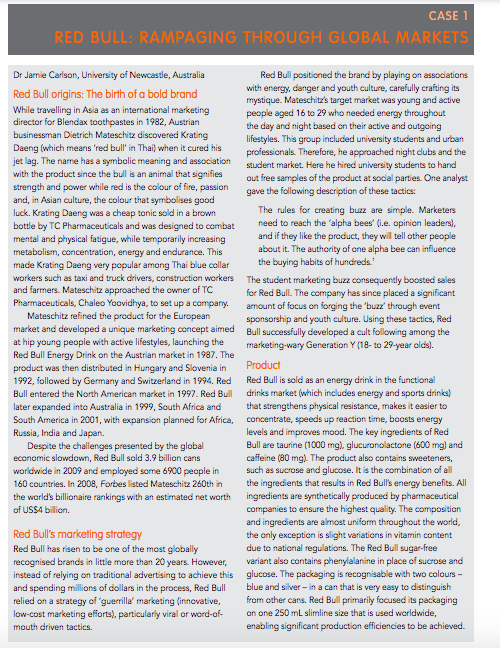
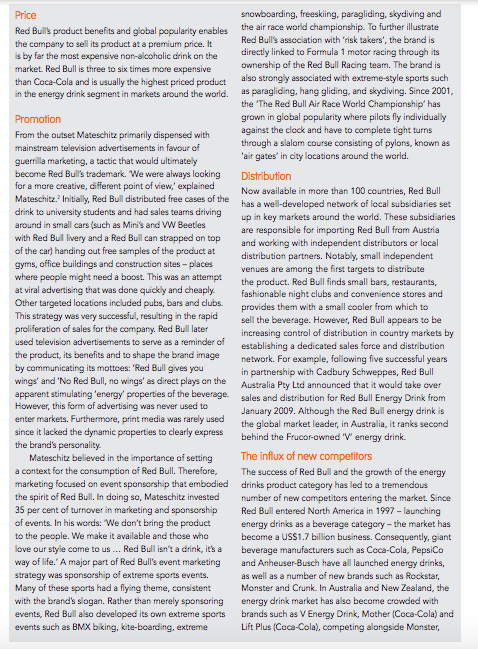
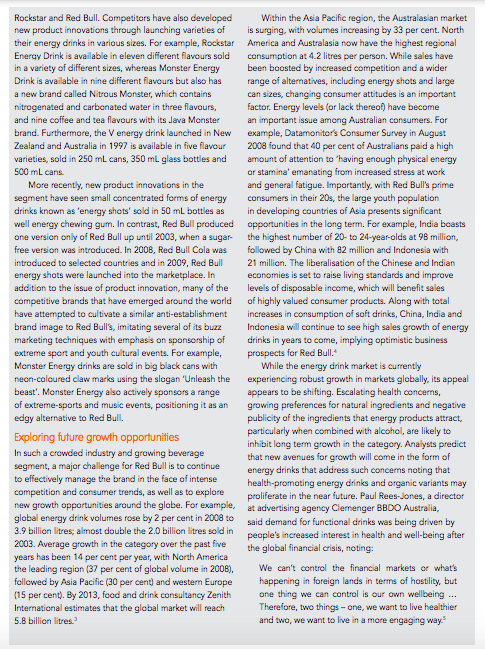
CASE 1 RED BULL: RAMPAGING THROUGH GLOBAL MARKETS Dr Jamie Carlson, University of Newcastle, Australia Red Bull positioned the brand by playing on associations Red Bull origins: The birth of a bold brand with energy, danger and youth culture, carefully crafting its mystique. Mateschitz's target market was young and active While travelling in Asia as an international marketing people aged 16 to 29 who needed energy throughout director for Blendax toothpastes in 1982, Austrian the day and night based on their active and outgoing businessman Dietrich Mateschitz discovered Krating lifestyles. This group included university students and urban Daeng (which means 'red bull' in Thai) when it cured his professionals. Therefore, he approached night clubs and the jet lag. The name has a symbolic meaning and association student market. Here he hired university students to hand with the product since the bull is an animal that signifies out free samples of the product at social parties. One analyst strength and power while red is the colour of fire, passion gave the following description of these tactics: and, in Asian culture, the colour that symbolises good luck. Krating Daeng was a cheap tonic sold in a brown The rules for creating buzz are simple. Marketers bottle by TC Pharmaceuticals and was designed to combat need to reach the 'alpha bees (i.e. opinion leaders) mental and physical fatigue, while temporarily increasing and if they like the product, they will tell other people metabolism, concentration, energy and endurance. This about it. The authority of one alpha bee can influence made Krating Daeng very popular among Thai blue collar the buying habits of hundreds workers such as taxi and truck drivers, construction workers The student marketing buzz consequently boosted sales and farmers. Mateschitz approached the owner of TC for Red Bull. The company has since placed a significant Pharmaceuticals, Chaleo Yoovidhya, to set up a company. amount of focus on forging the 'buzz through event Mateschitz refined the product for the European Sponsorship and youth culture. Using these tactics, Red market and developed a unique marketing concept aimed Bull successfully developed a cult following among the at hip young people with active lifestyles, launching the marketing-wary Generation Y (18-to 29-year olds). Red Bull Energy Drink on the Austrian market in 1987. The product was then distributed in Hungary and Slovenia in Product 1992, followed by Germany and Switzerland in 1994. Red Red Bull is sold as an energy drink in the functional Bull entered the North American market in 1997. Red Bull drinks market (which includes energy and sports drinks) later expanded into Australia in 1999, South Africa and that strengthens physical resistance, makes it easier to South America in 2001, with expansion planned for Africa, concentrate, speeds up reaction time, boosts energy Russia, India and Japan. levels and improves mood. The key ingredients of Red Despite the challenges presented by the global Bull are taurine (1000 mg), glucuronolactone (600 mg) and economic slowdown, Red Bull sold 3.9 billion cans caffeine (80 mg). The product also contains sweeteners, worldwide in 2009 and employed some 6900 people in such as sucrose and glucose. It is the combination of all 160 countries. In 2008, Forbes listed Mateschitz 260th in the ingredients that results in Red Bulls energy benefits. All the world's billionaire rankings with an estimated net worth ingredients are synthetically produced by pharmaceutical of US$4 bilion. companies to ensure the highest quality. The composition and ingredients are almost uniform throughout the world, Red Bull's marketing strategy the only exception is slight variations in vitamin content Red Bull has risen to be one of the most globally due to national regulations. The Red Bull sugar-free recognised brands in little more than 20 years. However, variant also contains phenylalanine in place of sucrose and instead of relying on traditional advertising to achieve this glucose. The packaging is recognisable with two colours - and spending millions of dollars in the process, Red Bull blue and Silver - in a can that is very easy to distinguish relied on a strategy of guerrilla' marketing (innovative, from other cans. Red Bull primarily focused its packaging low-cost marketing efforts), particularly viral or word-of- on one 250 mL slimline size that is used worldwide, mouth driven tactics. enabling significant production efficiencies to be achieved. Price snowboarding, freeskiing, paragliding, skydiving and Red Bulls product benefits and global popularity enables the air race world championship. To further illustrate the company to sell its product at a premium price. It Red Bull's association with 'risk takers', the brand is is by far the most expensive non-alcoholic drink on the directly linked to Formula 1 motor racing through its market. Red Bull is three to six times more expensive ownership of the Red Bull Racing team. The brand is than Coca-Cola and is usually the highest priced product also strongly associated with extreme-style sports such in the energy drink segment in markets around the world. as paragliding, hang gliding, and skydiving. Since 2001, the "The Red Bull Air Race World Championship has Promotion grown in global popularity where pilots fly individually From the outset Mateschitz primarily dispensed with against the clock and have to complete tight turns mainstream television advertisements in favour of through a slalom course consisting of pylons, known as guerrilla marketing, a tactic that would ultimately 'air gates' in city locations around the world. become Red Bull's trademark. We were always looking Distribution for a more creative, different point of view,' explained Now available in more than 100 countries, Red Bull Mateschitz. Initially, Red Bull distributed free cases of the has a well-developed network of local subsidiaries set drink to university students and had sales teams driving up in key markets around the world. These subsidiaries around in small cars (such as Mini's and VW Beetles with Red Bull livery and a Red Bull can strapped on top are responsible for importing Red Bull from Austria and working with independent distributors or local of the car) handing out free samples of the product at distribution partners. Notably, small independent gyms, office buildings and construction sites - places venues are among the first targets to distribute where people might need a boost. This was an attempt the product. Red Bull finds small bars, restaurants, at viral advertising that was done quickly and cheaply. fashionable night clubs and convenience stores and Other targeted locations included pubs, bars and clubs. provides them with a small cooler from which to This strategy was very successful, resulting in the rapid sell the beverage. However, Red Bull appears to be proliferation of sales for the company. Red Bull later increasing control of distribution in country markets by used television advertisements to serve as a reminder of establishing a dedicated sales force and distribution the product, its benefits and to shape the brand image network. For example, following five successful years by communicating its mottoes: 'Red Bull gives you in partnership with Cadbury Schweppes, Red Bull wings' and 'No Red Bull, no wings' as direct plays on the apparent stimulating energy properties of the beverage sales and distribution for Red Bull Energy Drink from Australia Pty Ltd announced that it would take over However, this form of advertising was never used to January 2009. Although the Red Bull energy drink is enter markets. Furthermore, print media was rarely used since it lacked the dynamic properties to clearly express the global market leader, in Australia, it ranks second behind the Frucor-owned 'V' energy drink. the brand's personality Mateschitz believed in the importance of setting The influx of new competitors a context for the consumption of Red Bull. Therefore, The success of Red Bull and the growth of the energy marketing focused on event sponsorship that embodied drinks product category has led to a tremendous the spirit of Red Bull. In doing so, Mateschitz invested number of new competitors entering the market. Since 35 per cent of turnover in marketing and sponsorship Red Bull entered North America in 1997 - launching of events. In his words: We don't bring the product energy drinks as a beverage category- the market has to the people. We make it available and those who become a US$1.7 billion business. Consequently, giant love our style come to us ... Red Bull isn't a drink, it's a beverage manufacturers such as Coca-Cola, PepsiCo way of life.' A major part of Red Bull's event marketing and Anheuser-Busch have all launched energy drinks, strategy was sponsorship of extreme sports events. as well as a number of new brands such as Rockstar, Many of these sports had a flying theme, consistent Monster and Crunk. In Australia and New Zealand, the with the brand's slogan. Rather than merely sponsoring energy drink market has also become crowded with events, Red Bull also developed its own extreme sports brands such as V Energy Drink, Mother (Coca-Cola) and events such as BMX biking, kite-boarding, extreme Lift Plus (Coca-Cola), competing alongside Monster, Rockstar and Red Bull Competitors have also developed Within the Asia Pacific region, the Australasian market new product innovations through launching varieties of is surging, with volumes increasing by 33 per cent. North their energy drinks in various sizes. For example, Rockstar America and Australasia now have the highest regional Energy Drink is available in eleven different flavours sold consumption at 4.2 litres per person. While sales have in a variety of different sizes, whereas Monster Energy been boosted by increased competition and a wider Drink is available in nine different flavours but also has range of alternatives, including energy shots and large a new brand called Nitrous Monster, which contains can sizes, changing consumer attitudes is an important nitrogenated and carbonated water in three flavours, factor. Energy levels (or lack thereof) have become and nine coffee and tea flavours with its Java Monster an important issue among Australian consumers. For brand. Furthermore, the energy drink launched in New example, Datamonitors Consumer Survey in August Zealand and Australia in 1997 is available in five flavour 2008 found that 40 per cent of Australians paid a high varieties, sold in 250 mL cans, 350 mL glass bottles and amount of attention to 'having enough physical energy 500 mL cans or stamina' emanating from increased stress at work More recently, new product innovations in the and general fatigue. Importantly, with Red Bull's prime segment have seen small concentrated forms of energy consumers in their 20s, the large youth population drinks known as 'energy shots' sold in 50 ml bottles as in developing countries of Asia presents significant well energy chewing gum. In contrast, Red Bull produced opportunities in the long term. For example, India boasts one version only of Red Bull up until 2003, when a sugar- the highest number of 20-to 24-year-olds at 98 million, free version was introduced. In 2008, Red Bull Cola was followed by China with 82 million and Indonesia with introduced to selected countries and in 2009, Red Bull 21 million. The liberalisation of the Chinese and Indian energy shots were launched into the marketplace. In economies is set to raise living standards and improve addition to the issue of product innovation, many of the levels of disposable income, which will benefit sales competitive brands that have emerged around the world of highly valued consumer products. Along with total have attempted to cultivate a similar anti-establishment increases in consumption of soft drinks, China, India and brand image to Red Bull's, imitating several of its buzz Indonesia will continue to see high sales growth of energy marketing techniques with emphasis on sponsorship of drinks in years to come, implying optimistic business extreme sport and youth cultural events. For example, prospects for Red Bull. Monster Energy drinks are sold in big black cans with While the energy drink market is currently neon-coloured claw marks using the slogan 'Unleash the experiencing robust growth in markets globally, its appeal beast'. Monster Energy also actively sponsors a range appears to be shifting. Escalating health concerns, of extreme-sports and music events, positioning it as an growing preferences for natural ingredients and negative edgy alternative to Red Bull publicity of the ingredients that energy products attract, Exploring future growth opportunities particularly when combined with alcohol, are likely to inhibit long term growth in the category. Analysts predict In such a crowded industry and growing beverage that new avenues for growth will come in the form of segment, a major challenge for Red Bull is to continue energy drinks that address such concems noting that to effectively manage the brand in the face of intense health-promoting energy drinks and organic variants may competition and consumer trends, as well as to explore new growth opportunities around the globe. For example, at advertising agency Clemenger BBDO Australia, proliferate in the near future. Paul Rees-Jones, a director global energy drink volumes rose by 2 per cent in 2008 to said demand for functional drinks was being driven by 3.9 billion litres, almost double the 2.0 billion litres sold in people's increased interest in health and well-being after 2003. Average growth in the category over the past five the global financial crisis, noting: years has been 14 per cent per year, with North America the leading region (37 per cent of global volume in 2008). We can't control the financial markets or what's followed by Asia Pacific (30 per cent) and western Europe happening in foreign lands in terms of hostility, but (15 per cent). By 2013, food and drink consultancy Zenith one thing we can control is our own wellbeing ... International estimates that the global market will reach Therefore, two things - one, we want to live healthier 5.8 billion litres and two, we want to live in a more engaging way
Step by Step Solution
There are 3 Steps involved in it
1 Expert Approved Answer
Step: 1 Unlock

Question Has Been Solved by an Expert!
Get step-by-step solutions from verified subject matter experts
Step: 2 Unlock
Step: 3 Unlock
 Study Help