Question: Chrome File Edit View History Bookmarks Profiles Window Help Q 8. Tue Mar 15 9:34 PM ... G celtx - Go X celex Celtx -
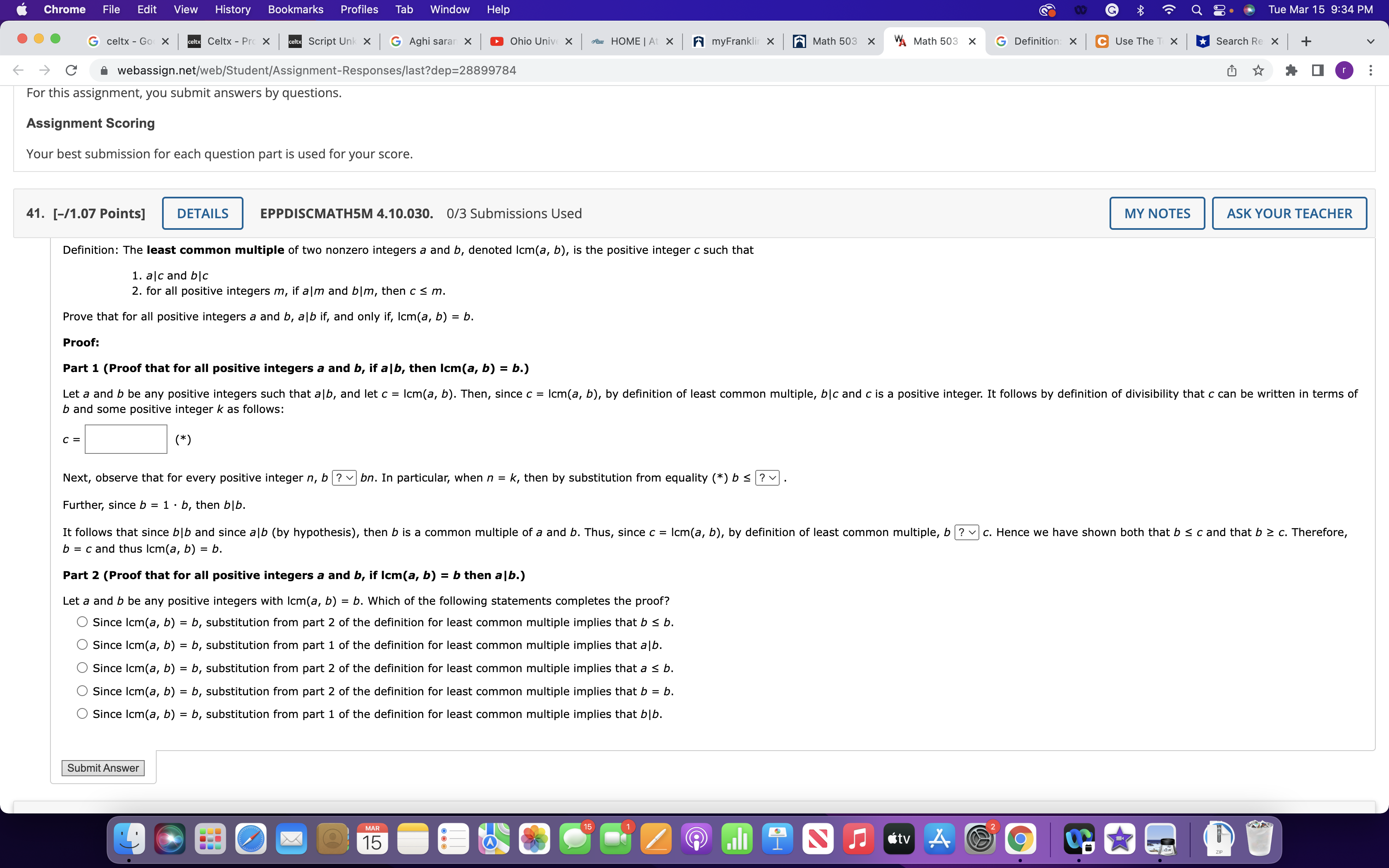
Chrome File Edit View History Bookmarks Profiles Window Help Q 8. Tue Mar 15 9:34 PM ... G celtx - Go X celex Celtx - Prc X celex Script Unk x G Aghi sarar x Ohio Univ x HOME | At x | F myFranklin x |F) Math 503 x X Math 503 x G Definition: x C Use The T X Search Re x | + C webassign.net/web/Student/Assignment-Responses/last?dep=28899784 For this assignment, you submit answers by questions. Assignment Scoring Your best submission for each question part is used for your score. 41. [-/1.07 Points] DETAILS EPPDISCMATHSM 4.10.030. 0/3 Submissions Used MY NOTES ASK YOUR TEACHER Definition: The least common multiple of two nonzero integers a and b, denoted Icm(a, b), is the positive integer c such that 1. alc and b|c 2. for all positive integers m, if alm and bim, then c s m. Prove that for all positive integers a and b, alb if, and only if, Icm(a, b) = b. Proof: Part 1 (Proof that for all positive integers a and b, if alb, then Icm(a, b) = b.) Let a and b be any positive integers such that alb, and let c = Icm(a, b). Then, since c = Icm(a, b), by definition of least common multiple, bic and c is a positive integer. It follows by definition of divisibility that c can be written in terms of b and some positive integer k as follows: ( * ) Next, observe that for every positive integer n, b |? | bn. In particular, when n = k, then by substitution from equality (*) b s |? v. Further, since b = 1 . b, then blb. It follows that since blb and since alb (by hypothesis), then b is a common multiple of a and b. Thus, since c = Icm(a, b), by definition of least common multiple, b ? v c. Hence we have shown both that b s c and that b 2 c. Therefore, b = c and thus Icm(a, b) = b. Part 2 (Proof that for all positive integers a and b, if Icm(a, b) = b then alb.) Let a and b be any positive integers with Icm(a, b) = b. Which of the following statements completes the proof? O Since Icm(a, b) = b, substitution from part 2 of the definition for least common multiple implies that b s b. O Since Icm(a, b) = b, substitution from part 1 of the definition for least common multiple implies that alb. O Since Icm(a, b) = b, substitution from part 2 of the definition for least common multiple implies that a s b. O Since Icm(a, b) = b, substitution from part 2 of the definition for least common multiple implies that b = b. O Since Icm(a, b) = b, substitution from part 1 of the definition for least common multiple implies that blb. Submit Answer MAR 15
Step by Step Solution
There are 3 Steps involved in it
1 Expert Approved Answer
Step: 1 Unlock
Question Has Been Solved by an Expert!
Get step-by-step solutions from verified subject matter experts
Step: 2 Unlock
Step: 3 Unlock
Students Have Also Explored These Related Mathematics Questions!









 Study Help