







Question: Consider three subnets shown in Figure 2. Assume that they use the addresses assigned by Figure 3. (a) (3 points) E wants to send
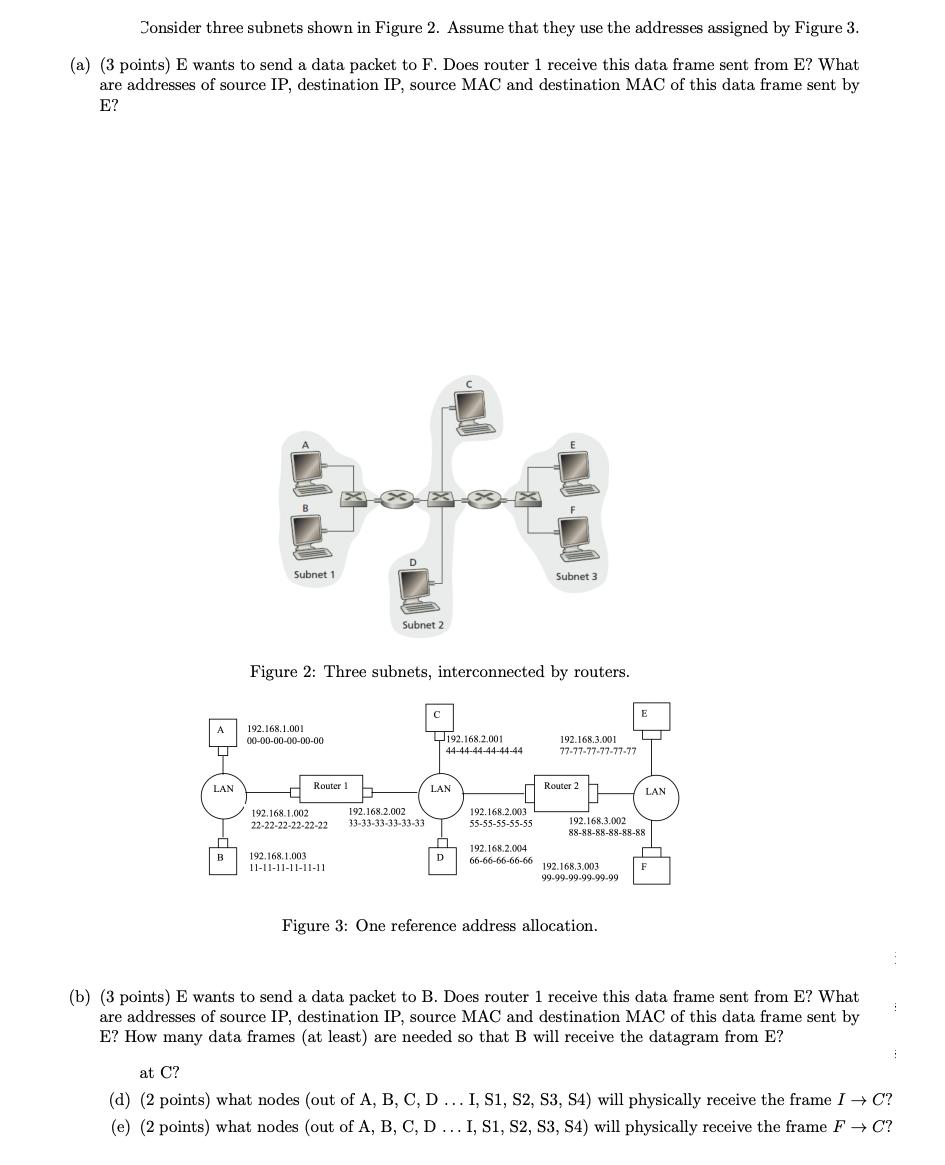
Consider three subnets shown in Figure 2. Assume that they use the addresses assigned by Figure 3. (a) (3 points) E wants to send a data packet to F. Does router 1 receive this data frame sent from E? What are addresses of source IP, destination IP, source MAC and destination MAC of this data frame sent by E? A T LAN B Subnet 1 192.168.1.001 00-00-00-00-00-00 Router 1 D Figure 2: Three subnets, interconnected by routers. Subnet 2 192.168.1.003 11-11-11-11-11-11 192.168.1.002 192.168.2.002 22-22-22-22-22-22 33-33-33-33-33-33 192.168.2.001 44-44-44-44-44-44 LAN D Subnet 3 192.168.2.003 55-55-55-55-55 192.168.3.001 77-77-77-77-77-77 Router 2 192.168.2.004 66-66-66-66-66 192.168.3.003 192.168.3.002 88-88-88-88-88-88 99-99-99-99-99-99 E Figure 3: One reference address allocation. LAN F F (b) (3 points) E wants to send a data packet to B. Does router 1 receive this data frame sent from E? What are addresses of source IP, destination IP, source MAC and destination MAC of this data frame sent by E? How many data frames (at least) are needed so that B will receive the datagram from E? I at C? (d) (2 points) what nodes (out of A, B, C, D... I, S1, S2, S3, S4) will physically receive the frame I C? (e) (2 points) what nodes (out of A, B, C, D ... I, S1, S2, S3, S4) will physically receive the frame F C?
Step by Step Solution
There are 3 Steps involved in it
Part a of your question For the data packet sent from E to F router 1 will receive the data frame The addresses for this data frame are as follows Sou... View full answer

Get step-by-step solutions from verified subject matter experts
 Study Help