







Question: Excel Activity: Interest Rate Determination and Yield Curves The data has been collected in the Microsoft Excel file below. Download the spreadsheet and perform the
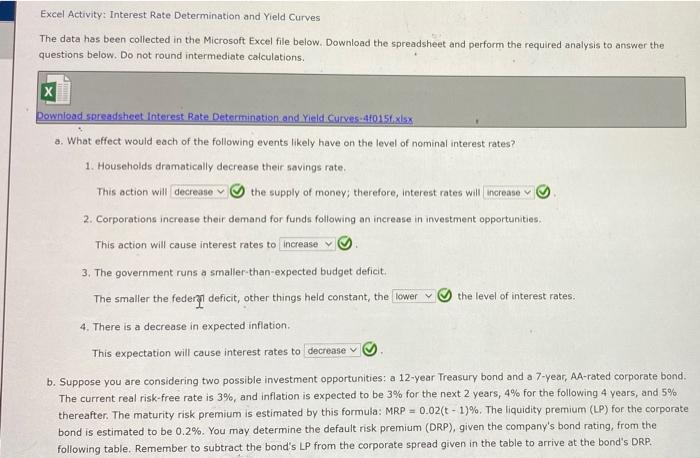
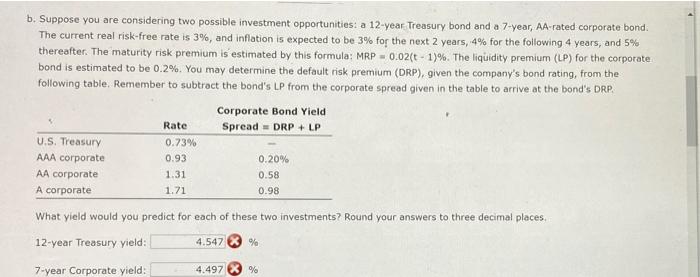
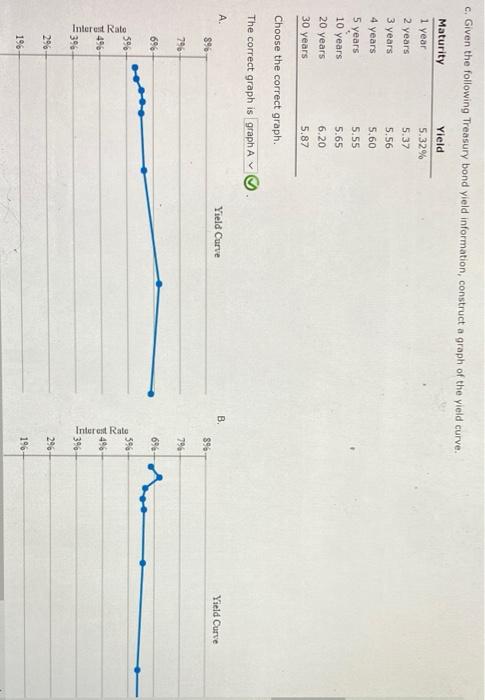
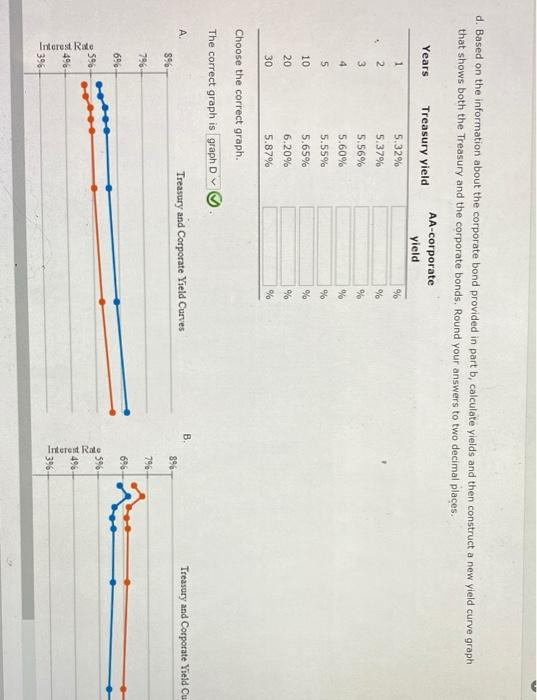
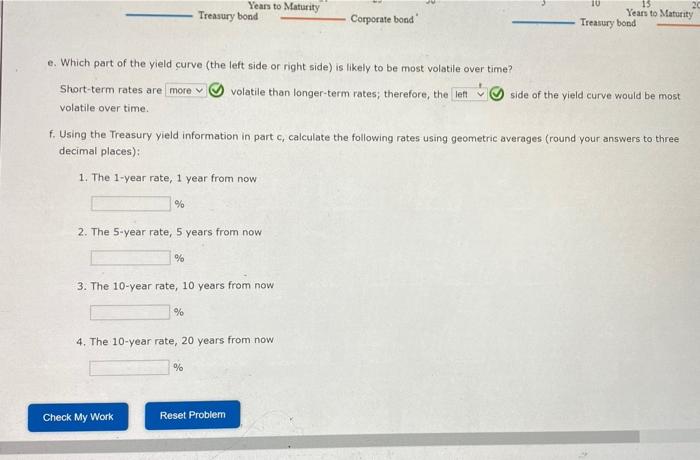
Excel Activity: Interest Rate Determination and Yield Curves The data has been collected in the Microsoft Excel file below. Download the spreadsheet and perform the required analysis to answer the questions below. Do not round intermediate calculations, Download spreadsheet Interest Rate Determination and Yield Curves-480151xx a. What effect would each of the following events likely have on the level of nominal interest rates? 1. Households dramatically decrease their savings rate This action will decrease the supply of money; therefore, interest rates will increase 2. Corporations increase their demand for funds following an increase in investment opportunities This action will cause interest rates to increase the level of interest rates. 3. The government runs a smaller than expected budget deficit. The smaller the federal deficit, other things held constant, the lower 4. There is a decrease in expected inflation This expectation will cause interest rates to decrease b. Suppose you are considering two possible investment opportunities: a 12-year Treasury bond and a 7-year, AA-rated corporate bond. The current real risk-free rate is 3%, and inflation is expected to be 3% for the next 2 years, 4% for the following 4 years, and 5% thereafter. The maturity risk premium is estimated by this formula: MRP = 0.02(t-1)%. The liquidity premium (LP) for the corporate bond is estimated to be 0.2%. You may determine the default risk premium (DRP), given the company's bond rating, from the following table. Remember to subtract the bond's LP from the corporate spread given in the table to arrive at the bond's DRP. b. Suppose you are considering two possible investment opportunities: a 12-year Treasury bond and a 7-year, AA-rated corporate bond. The current real risk-free rate is 3%, and inflation is expected to be 3% for the next 2 years, 4% for the following 4 years, and 5% thereafter. The maturity risk premium is estimated by this formula: MRP = 0.02(t-1)%. The liquidity premium (LP) for the corporate bond is estimated to be 0.2%. You may determine the default risk premium (DRP), given the company's bond rating, from the following table. Remember to subtract the bond's LP from the corporate spread given in the table to arrive at the bond's DRP. Corporate Bond Yield Rate Spread = DRP+ LP U.S. Treasury 0.73% AAA corporate 0.93 0.20% AA corporate 1.31 0.58 A corporate 1.71 0.98 What yield would you predict for each of these two investments? Round your answers to three decimal places 12-year Treasury yield: 4.547 % 7-year Corporate yield: 4.497 X % c. Given the following Treasury bond yield information, construct a graph of the yield curve. Maturity Yield 1 year 2 years 3 years 4 years 5 years 10 years 20 years 30 years 5.32% 5.37 5.56 5.60 5.55 5.65 6.20 5.87 Choose the correct graph. The correct graph is graph A A. Yield Curve B Yield Curve 896 $9 796 796 6% 69+ 59 5% Interest Rate 49 Interest Rate T49 39- 3% 296 296 196 1% d. Based on the information about the corporate bond provided in part b, calculate yields and then construct a new yield curve graph that shows both the Treasury and the corporate bonds. Round your answers to two decimal places. AA-corporate Years Treasury yield yield 1 5.32% % 2 5.37% % 3 5.56% 4 5.60% % 5 5.55% % 10 5.65% % 20 6.20% % 9% 30 5.87% % Choose the correct graph. The correct graph is graph DV A B Treasury and Corporate Vield Curves Treasury and Corporate Yield Cu 896 896 796 796 696 59- 5% Interest Rate Interest Rate 496 496 3 396 396 Years to Maturity Treasury bond Corporate bond 10 15 Years to Maturity Treasury bond e. Which part of the yield curve (the left side or right side) is likely to be most volatile over time? Short-term rates are more volatile than longer-term rates, therefore, the left side of the yield curve would be most volatile over time. F. Using the Treasury yield information in part, calculate the following rates using geometric averages (round your answers to three decimal places): C 1. The 1-year rate, 1 year from now % 2. The 5-year rate, 5 years from now % 3. The 10-year rate, 10 years from now % 4. The 10-year rate, 20 years from now % Check My Work Reset Problem Excel Activity: Interest Rate Determination and Yield Curves The data has been collected in the Microsoft Excel file below. Download the spreadsheet and perform the required analysis to answer the questions below. Do not round intermediate calculations, Download spreadsheet Interest Rate Determination and Yield Curves-480151xx a. What effect would each of the following events likely have on the level of nominal interest rates? 1. Households dramatically decrease their savings rate This action will decrease the supply of money; therefore, interest rates will increase 2. Corporations increase their demand for funds following an increase in investment opportunities This action will cause interest rates to increase the level of interest rates. 3. The government runs a smaller than expected budget deficit. The smaller the federal deficit, other things held constant, the lower 4. There is a decrease in expected inflation This expectation will cause interest rates to decrease b. Suppose you are considering two possible investment opportunities: a 12-year Treasury bond and a 7-year, AA-rated corporate bond. The current real risk-free rate is 3%, and inflation is expected to be 3% for the next 2 years, 4% for the following 4 years, and 5% thereafter. The maturity risk premium is estimated by this formula: MRP = 0.02(t-1)%. The liquidity premium (LP) for the corporate bond is estimated to be 0.2%. You may determine the default risk premium (DRP), given the company's bond rating, from the following table. Remember to subtract the bond's LP from the corporate spread given in the table to arrive at the bond's DRP. b. Suppose you are considering two possible investment opportunities: a 12-year Treasury bond and a 7-year, AA-rated corporate bond. The current real risk-free rate is 3%, and inflation is expected to be 3% for the next 2 years, 4% for the following 4 years, and 5% thereafter. The maturity risk premium is estimated by this formula: MRP = 0.02(t-1)%. The liquidity premium (LP) for the corporate bond is estimated to be 0.2%. You may determine the default risk premium (DRP), given the company's bond rating, from the following table. Remember to subtract the bond's LP from the corporate spread given in the table to arrive at the bond's DRP. Corporate Bond Yield Rate Spread = DRP+ LP U.S. Treasury 0.73% AAA corporate 0.93 0.20% AA corporate 1.31 0.58 A corporate 1.71 0.98 What yield would you predict for each of these two investments? Round your answers to three decimal places 12-year Treasury yield: 4.547 % 7-year Corporate yield: 4.497 X % c. Given the following Treasury bond yield information, construct a graph of the yield curve. Maturity Yield 1 year 2 years 3 years 4 years 5 years 10 years 20 years 30 years 5.32% 5.37 5.56 5.60 5.55 5.65 6.20 5.87 Choose the correct graph. The correct graph is graph A A. Yield Curve B Yield Curve 896 $9 796 796 6% 69+ 59 5% Interest Rate 49 Interest Rate T49 39- 3% 296 296 196 1% d. Based on the information about the corporate bond provided in part b, calculate yields and then construct a new yield curve graph that shows both the Treasury and the corporate bonds. Round your answers to two decimal places. AA-corporate Years Treasury yield yield 1 5.32% % 2 5.37% % 3 5.56% 4 5.60% % 5 5.55% % 10 5.65% % 20 6.20% % 9% 30 5.87% % Choose the correct graph. The correct graph is graph DV A B Treasury and Corporate Vield Curves Treasury and Corporate Yield Cu 896 896 796 796 696 59- 5% Interest Rate Interest Rate 496 496 3 396 396 Years to Maturity Treasury bond Corporate bond 10 15 Years to Maturity Treasury bond e. Which part of the yield curve (the left side or right side) is likely to be most volatile over time? Short-term rates are more volatile than longer-term rates, therefore, the left side of the yield curve would be most volatile over time. F. Using the Treasury yield information in part, calculate the following rates using geometric averages (round your answers to three decimal places): C 1. The 1-year rate, 1 year from now % 2. The 5-year rate, 5 years from now % 3. The 10-year rate, 10 years from now % 4. The 10-year rate, 20 years from now % Check My Work Reset
Step by Step Solution
There are 3 Steps involved in it

Get step-by-step solutions from verified subject matter experts
 Study Help