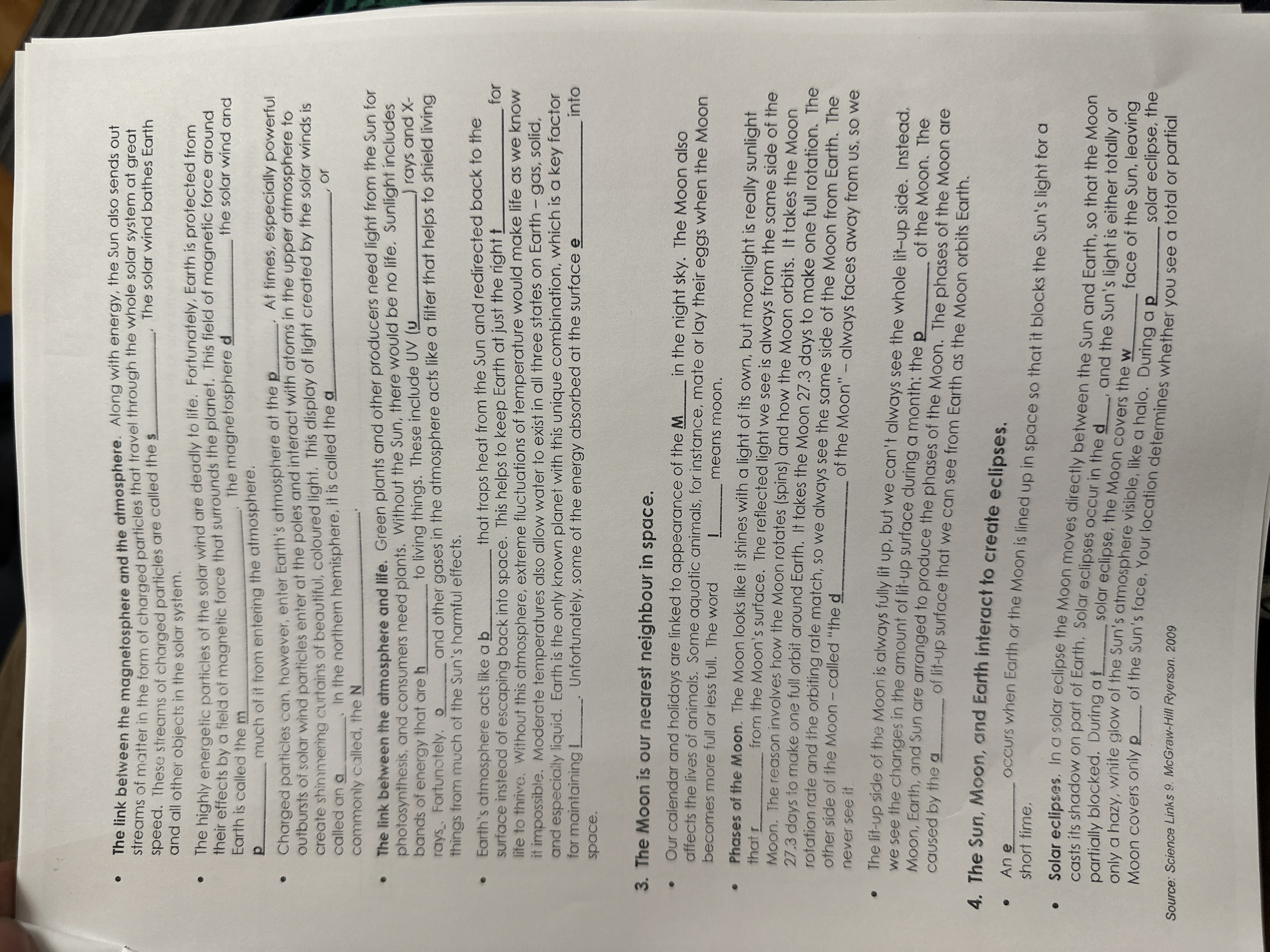
Question: Fill up the blanks The link between the magnetosphere and the atmosphere. Along with energy, the Sun also sends out streams of matter in the
Fill up the blanks
The link between the magnetosphere and the atmosphere. Along with energy, the Sun also sends out streams of matter in the form of charged particles that travel through the whole solar system at great speed. These streams of charged particles are called the s The solar wind bathes Earth and all other objects in the solar system. The highly energetic particles of the solar wind are deadly to life. Fortunately, Earth is protected from their effects by a field of magnetic force that surrounds the planet. This field of magnetic force around The magnetosphere d the solar wind and Earth is called the m p much of it from entering the atmosphere. Charged particles can, however, enter Earth's atmosphere at the p _ At times, especially powerful outbursts of solar wind particles enter at the poles and interact with atoms in the upper atmosphere to create shimmering curtains of beautiful, coloured light. This display of light created by the solar winds is or called an a . In the northern hemisphere, it is called the a commonly called, the N The link between the atmosphere and life. Green plants and other producers need light from the Sun for photosynthesis, and consumers need plants. Without the Sun, there would be no life. Sunlight includes _ to living things. These include UV (u _) rays and X- bands of energy that are h rays_. Fortunately, o and other gases in the atmosphere acts like a filter that helps to shield living things from much of the Sun's harmful effects. Earth's atmosphere acts like a b that traps heat from the Sun and redirected back to the surface instead of escaping back into space. This helps to keep Earth at just the right t for life to thrive. Without this atmosphere, extreme fluctuations of temperature would make life as we know it impossible. Moderate temperatures also allow water to exist in all three states on Earth - gas, solid, and especially liquid. Earth is the only known planet with this unique combination, which is a key factor for maintaining L_. Unfortunately, some of the energy absorbed at the surface e into space. 3. The Moon is our nearest neighbour in space. Our calendar and holidays are linked to appearance of the M_in the night sky. The Moon also affects the lives of animals. Some aquatic animals, for instance, mate or lay their eggs when the Moon becomes more full or less full. The word . means moon. Phases of the Moon. The Moon looks like it shines with a light of its own, but moonlight is really sunlight that I . from the Moon's surface. The reflected light we see is always from the same side of the Moon. The reason involves how the Moon rotates (spins) and how the Moon orbits. It takes the Moon 27.3 days to make one full orbit around Earth. It takes the Moon 27.3 days to make one full rotation. The rotation rate and the orbiting rate match, so we always see the same side of the Moon from Earth. The other side of the Moon - called "the d. never see it. of the Moon" - always faces away from us, so we The lit-up side of the Moon is always fully lit up, but we can't always see the whole lit-up side. Instead, we see the changes in the amount of lit-up surface during a month: the p caused by the a Moon, Earth, and Sun are arranged to produce the phases of the Moon. The phases of the Moon are of the Moon. The of lit-up surface that we can see from Earth as the Moon orbits Earth. 4. The Sun, Moon, and Earth interact to create eclipses. An e short time, occurs when Earth or the Moon is lined up in space so that it blocks the Sun's light for a Solar eclipses, In a solar eclipse the Moon moves directly between the Sun and Earth, so that the Moon casts its shadow on part of Earth, Solar eclipses occur in the d , and the Sun's light is either totally or partially blocked. During a 1 _ solar eclipse, the Moon covers the w only a hazy, white glow of the Sun's atmosphere visible, like a halo. During a p face of the Sun, leaving Moon covers only _ of the sun's face, Your location determines whether you see a total or partial _ solar eclipse, the Source: Science Links 9. McGraw-Hill Ryerson. 2009